
Gionatan Scali on ‘Best Self,’ Leaving Johnny Fishborn Behind, and Writing to an Imaginary Analyst
Meet Gionatan Scali, a London-based individual who shed his previous creative identity and title exactly one decade ago.
He’s best known for his parnassian lyrics, which are nestled inside unexpected chords and accented by delicious moments of dissonance. His latest release, ‘Best Self,’ captures the essence of these last 10 years, and will be Scali’s title track and lead single to his third studio album.
Dark and soulful. Inside this tasty soundscape, there are a plethora of bright guitar hits, little bends, and micro-riffs, all constantly supported by the unshakeable bass drum. Scali leaves an artful amount of space between each word and note, allowing us to not just feel, but rather, taste and imbibe the meaning. We wonder: Is this a work of poetry? Somewhere between the distortion and Bukowski, we witness the heartwood of a soul. Like a phoenix, something intangible bursts into flames, and just before the last ash hits the earth, it is reborn.
‘Best Self’ captures the essence of a decade in a bottle. Next, the music transmutes into a nostalgic, legato guitar section that rises in intensity—a veritable free-climb to the peak statement: “My best self found me dead.”
Ever since 2018, Scali has been writing letters to a fictional psychologist as a 10-year-long project that ‘Best Self’ is a slice of. “I couldn’t afford an analyst,” Gionatan Scali explained. “I needed an intimate relationship with my subconscious. No human could give me that kind of attention, so I wrote to an imaginary one.”
The organic feeling of the swinging 6/8 time feels almost psychedelic as the track flows to completion. We don’t quite get a resolution to the tonic, but rather, a curt drum hit sees the sound out on the dominant. This sonic statement is extremely fitting, given that the project is still 2 years away from completion. Listeners come away from the final chord of ‘Best Self’ with a question: Where will Scali lead us next?
“My best self found me dead.”
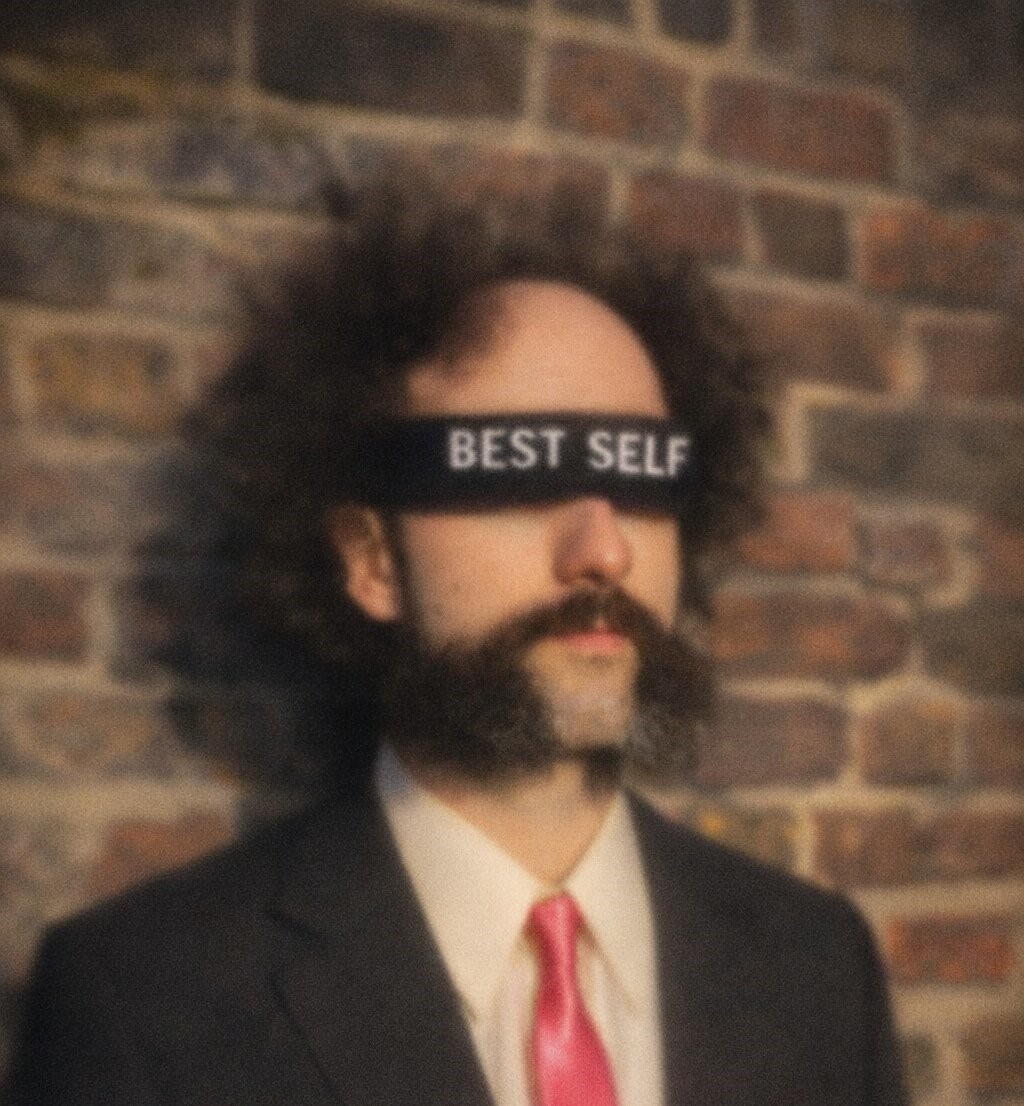
In the art for this single, why did you choose to wear the blindfold? What does it represent?
I think the blindfold came to me more intuitively than intentionally at first, but over time it started to make a lot more sense symbolically. It represents that idea of the unconscious—how so much of what drives us operates beneath the surface, out of sight, yet still shaping who we are and how we present ourselves.
With ‘Best Self,’ there’s this tension between what we show the world and what we keep hidden. The “best self” isn’t always honest—it can be curated, performative, even misleading. The blindfold became a way to express that contradiction: seeing without really seeing, presenting clarity while something important remains obscured.
There’s also a broader layer to it. The imagery subtly points to the hypocrisy within political and public systems.
How do you write your lyrics? Your process results in such a poetic feeling.
Honestly, I don’t really have a fixed process—it changes every time. Most of the time it starts with a mood or a sound I can’t quite explain, something I hear or feel in my head. From there, I try to find a word or a phrase that captures that feeling, like a small anchor I can build everything else around.
After that, it’s pretty raw. I write, I mess things up, I throw a lot away. I’ll sketch ideas, go for walks, come back and hear things differently. It’s a bit chaotic—I kind of let myself get lost in it. There’s a lot of trial and error, a lot of overthinking and then undoing that overthinking.
I guess I just keep pushing it, sometimes to the point of driving myself a little insane, until something finally clicks and feels honest. That’s when I know it’s done.
Many moons ago, you were performing under the name Johnny Fishborn in Italy. How did the stage name come to be, and how is Italy’s Fishborn both similar and different to Gionatan Scali of London?
Yeah, that’s right—Johnny Fishborn came out of something quite playful. It started almost as a joke, tied to my birthday on April 1st—April Fool’s Day. In Italian we say “pesce d’aprile” (April fish), so the whole name “Fishborn” was a literal and ironic twist on being “born on the day of the fish.” Adding “Johnny” just gave it that slightly exaggerated, almost character-like feel.
In a way, Johnny Fishborn belonged to a specific time and place. I think he “ended” when I left Italy in 2015. Moving to London felt like a turning point, and going back to my real name, Gionatan Scali, felt more honest. Ironically, my actual name ended up sounding more distinctive and fitting in that context than an anglicised stage name would have.
Both identities gave me a lot—great experiences, but also some frustration. I got a bit tired of always having to explain the name, what it meant, where it came from. But at the same time, I’m proud of both chapters. It really feels like a kind of transformation—like something had to end for something else to begin. In a way, I didn’t just drop the name, I outgrew it. It’s like Johnny Fishborn had to “die” for me to be reborn into something more real.
Who is it that you miss in one of the first verses in ‘Best Self’? Is it the old you?
Maybe. Or maybe it’s a woman. Or even something less literal—like my feminine side, or a more romantic, sensitive version of myself.
I don’t think it’s meant to be pinned down to one clear identity. It’s more like a feeling of absence, something that was once there and isn’t anymore, or something I’m still trying to understand. That ambiguity is important to me, because it leaves space for different interpretations—even for myself.
So yeah, it could be the “old me,” but it could just as easily be a part of me that I’ve lost, or maybe even a part I’m still searching for.
What kind of a person is the imaginary analyst in your project? We’d love to know their name and what their personality is like.
His name is Giorgio Hazel. I imagine him as a kind of Jungian analyst—someone deeply immersed in dream interpretation and the unconscious. In my mind, he lives in a quiet mansion somewhere in the Swiss Alps, a bit removed from everything, almost outside of time.
I’ve been writing emails to him since January 2018, and the idea is to continue until January 2028. It’s like an ongoing dialogue, but also a way of documenting my inner world over a long stretch of time. I never actually open or revisit those emails as I go.
The plan is that, once I reach the end of that ten-year period, I’ll finally go back and read everything. I want to sift through all that correspondence and try to understand what I was going through, almost as if I’m seeing myself through the eyes of Giorgio Hazel. It’s a way of creating distance from myself—of turning my own life into something I can analyze, question, and maybe finally make sense of.
When your project concludes in 2028, what future works do you think will be completed, and how do you think it will feel to look at the full concept/cycle?
It’s hard to say exactly, because the whole project is still evolving as I go through it. But I imagine that by 2028, one of the natural outcomes will be a book—something that brings together a selection of the “letters to Giorgio Hazel.”
At the same time, I don’t want to define it too strictly yet. Part of the process is allowing it to unfold without forcing a final shape too early. What I do know is that looking back at the full cycle will probably feel quite intense—like confronting a version of myself that I’ve been documenting for a decade.
I think it will be a mix of clarity and confusion, maybe even a bit overwhelming. But hopefully, it will also bring some sense of meaning—like all those fragments, thoughts, and moments finally connecting into something I can understand more deeply.
Gionatan Scali Facebook / Instagram / X / Bandcamp / YouTube / SoundCloud