

Dennis Herring Interview | From Leonard Cohen to Modest Mouse, and Back to Mississippi
From Saltillo to Los Angeles and back to Oxford, two-time Grammy-winning producer Dennis Herring talks Leonard Cohen, Barry Hannah, Modest Mouse, Johnny Marr, and the instinct to trust what feels slightly wrong.
‘You put out all you can every chance you get, and then you sit around and hope somebody sends you a check for it someday.’
Dennis Herring has spent much of his life noticing the thing other people are about to throw away.
That feels like a good way into ‘Never Any Good’, a conversation with a producer and musician whose career has passed through records by Camper Van Beethoven, Throwing Muses, Counting Crows, Jars of Clay, Buddy Guy, Elvis Costello, Modest Mouse, The Hives and many others.
But this is not really a résumé piece. Herring is much more interesting when he starts talking about the rooms he has been in, the people he has worked with, and the strange turns that brought him from Saltillo, Mississippi to Los Angeles and eventually back South to Oxford.
There is very little mist around the past here. Herring tells these stories with humour, bluntness and a healthy distrust of playing things safe.
Sometimes the wrong thing is the thing.
A note about this conversation
This conversation was conducted by writer and VOX PRESS Executive Director Louis Bourgeois and first recorded on video for VOX PRESS. Bourgeois later prepared the interview as a written transcript and submitted it to It’s Psychedelic Baby Magazine. This is the first publication of that edited written version.
“Of course what saved me was music.”
Did you always want to leave Mississippi?
Dennis Herring: Man, I wanted to get out of Saltillo probably from the time I was six.
Not too many escape for as long as you have.
Yeah, I suppose. But of course what saved me was music. I was always playing music from the very beginning. And the more I got into it, the more I realized there was a whole other world out there, and I wasn’t a part of it.
And to their credit, to my parents’ credit, they were relatively sophisticated for a town of 700 people in rural Mississippi. They were really cool, and they would take us to faraway places, and my dad would talk about faraway things. My dad made me read ‘Mein Kampf’ in the sixth grade because he wanted me to see that there was educational information in that, and he wanted me to see that you shouldn’t be biased against it simply because people see it as the enemy or the other.
But to me, the thing to do was to go. I had an opportunity to go to college here in the state, but I bailed on that. My first career was being a studio musician in Los Angeles, and I did great at that, and it worked. But that was really a go-for-broke situation. I only noticed that in hindsight. To me, these were all obvious steps. I felt: I have to do this.
You weren’t scared of failing so far from home?
The notion of failing at it didn’t seem that scary. I don’t think I was considering failing that much. Actually, I don’t think I thought about it at all. But even if I did, it didn’t scare me that much either.
Of course you recorded with all kinds of people in Los Angeles, but could you talk about that funny incident in the studio with Leonard Cohen?
Well, I had this odd sound pedal, and it’s got this super-extreme ‘doesn’t fit a Leonard Cohen song’ sound. And we run the song down a couple of times and we’ve got this thing going, and Dean Parks, the grown-up guitar player sitting next to me, looks over at me and says, ‘DON’T DO THAT!’
He’s saying, don’t do that, to me. And I’m like, no, this is awesome. He’s wrong.
And the engineer comes on the talkback and goes around to each dude. ‘Jim, you sound great. Curt, you sound great on the snare.’ And to the bass player, Lee Sklar, ‘You sound great.’ Then he gets to me: ‘Dennis, your sound is a little bit thin.’
And I say, ‘Yeah, that’s what I’m going for.’
And he says, ‘OKAY!’ Like he’s saying, okay, you just guaranteed yourself not to be on the record when it’s finished. But I’m sticking with it.
Leonard comes out to sing with us, and we do a couple of takes. Then we go in to listen to the playback, and they play it back, and I can’t hear myself. The engineer goes, ‘This sounds pretty good,’ and about my part, ‘That sounds horrible, so turn that way down.’ He’s not listening to me.
And Leonard’s there, and he’s with his girlfriend at the time, Rebecca De Mornay, and I knew her, so that was cool. He listens through to the end. Everybody goes, ‘Yeah, that sounds great.’
And Leonard goes, ‘Where’s that weird little squeaky part?’
They all say, ‘What?’
He says, ‘Where’s that little squeaky part? It sounds like a squirrel or something.’
And he goes, ‘Turn that up.’
They turn it up so you can really hear it. Leonard comes over to me and kisses me, and he says, ‘Thank you for making this song special.’
And you could just see the other musicians going, Dennis…
Now that’s a story! But why on earth did you move back to Mississippi?
When I first decided to leave Los Angeles, I knew I wanted to move to a higher-quality living environment, and I knew I wanted to move to the South, but I didn’t know where.
To me, the highest-quality environments I knew were cities or towns that were university towns. Because then you get sophistication, but you also get a smaller environment where people know each other. There’s walking. There are all these things that make life better.
So I decided to visit different places. I already knew Austin pretty well. I went and stayed in Athens for a couple of nights. I went and stayed in Chapel Hill. You know, those kinds of places in the South, kind of hip enclaves where you could meet hip folks. Those kinds of oasis spots.
Then I came and hung out in Oxford for a couple of nights, and my dad came over from Saltillo and met me for breakfast. We went to this place on the Square, Smitty’s. I forget the owner’s name, but she was checking us out as we were checking out, and she was just being real sweet.
She says, ‘Honey, are you a student here?’
And I said, ‘Oh no, ma’am. Education and I parted ways many years ago and have never crossed paths again.’
She laughed.
And my dad said, ‘You know, he’s considering moving here.’
She said, ‘Well, if you’re considering moving here, there’s something you should know about Oxford.’
And I said, ‘What’s that?’
She said, ‘In Oxford, we tolerate our eccentrics, but we don’t suffer fools.’
And I’m like, I think I may have found the right place!
To me, that was the fucking poster as you drive into town, with Faulkner in front driving the snowplow!
I think I remember hearing somewhere that part of the reason you moved here was Barry Hannah?
Yeah, that was what put Oxford on my list of places to hang out and check out.
‘The Oxford American’ was going good, and my little brother, who still lives in Saltillo, kept mailing me copies when they would come out. I was kind of blown away by it.
There was one issue in particular that had a big article with photos by Susan Lee, you know, Tim Lee’s wife. There was this stock-car track, a dirt track, and all these amazing pictures she had taken of it. She was so good. That was just resonating for me.
And then there was a Mississippi guy who lived in California, who I hung around with a lot when I was a musician, named Glen Ballard. He’d been really successful as a songwriter and musician. Really successful. And he’s a really nice guy too.
When I started talking to Glen about how I was thinking about moving to the South, he was like, ‘Man, you’ve got to check out Oxford. That dude Barry Hannah is from there.’
And I go, ‘Who’s Barry Hannah?’
He’s like, ‘Aw, man, he’s like the best short-story writer in the world. I think he’s my favorite writer there is.’
He loaned me a couple of Barry’s books. So I read those, and I had ‘The Oxford American’. All that together really resonated.
What was it like working with Modest Mouse in Oxford?
The singer in the band, Isaac Brock, I really love working with him, and he’s really intense. He’s on his own and within himself. It’s not about me or anybody else.
I remember the first record we worked on together. We were sitting around doing vocals, and Isaac didn’t really have lyrics. The first night, it was difficult to figure out what was happening, but I thought I was on the verge of capturing some really good shit because he was just this very caustic, freaking-out person who was trying to get somewhere.
At one point I was playing something back to him…
What was he freaking out about?
Just that he didn’t have lyrics. So he would go up to the microphone and just yell, or do gibberish, or whatever, just do super-intense stuff.
At first I didn’t know what to do with that. I’d go, ‘Yeah, Isaac, that’s good. Let’s do that again.’
And he’d go, ‘I’m shit! I’m a fucking asshole!’
He was just freaking out, you know.
Then I started to realize, oh, he wants me to interact with him about the lyrics. I figured that out and found a way to make it work. I would listen to him rant and then make a note of things that seemed to be working.
He’d come in and I’d go, ‘I gotta hear this one bit. This bit you did was really great.’
And he’d go, ‘Really? Are you sure? Fuck! Fuck! Fuck!’
I’d play it back for him and he’d go, ‘That is pretty fucking good! Let me go back out there.’
And he would build on that.
At one point we were building on the song and I was playing something back for him. I was facing the console, and I started to smell something weird, and I realized he’d set my hair on fire. So my hair’s kind of burning right here.
I get that put out and I said, ‘Hey, man, do you think I’m a pussy and that’s gonna bug me? You gotta go back out there and sing. You’re just putting off the real shit right now. That’s what you’re doing, and I know it. Don’t even think I’m afraid of you. You’ve gotta go back out there and sing.’
And it was great.
We worked together many times after that.
Did you get on well with Johnny Marr?
Well, no, not really (laughs).
I’d wondered how The Smiths broke up. I mean, of course Morrissey is a diva, and that can break up a band, but members of a band like that having to deal with a diva lead singer is pretty standard for a band like that.
But in the Modest Mouse situation, Johnny Marr was his own big-ass diva, so then I could see how he and Morrissey couldn’t stay together.
And then with Modest Mouse for the ‘We Were Dead Before the Ship Even Sank’ album, Johnny had joined a long-running band with a defined identity, a band that had just become pretty hot, and he came into it like they were his backing band or something (laughs).
For me, I didn’t mind so much him being a pain in the ass, but he was musically a pain in the ass too, and that’s my department.
I had to work with both him and Isaac Brock at times to get their guitar playing to work well together, and Johnny did not dig that. In my view, that was intrinsically uncool in the spirit of the music.
He cussed me out here and there… eh, that’s par for the course.
I’m ultimately proud of the musical results we got from that record.
And anything else you want to say to the audience?
You know, choosing music as the way you make your living… you’ve gotta be self-loathing on some level to do that.
You put out all you can every chance you get, and then you sit around and hope somebody sends you a check for it someday. It’s just the silliest structure.
And yet, you should do it anyway if, in your heart, that’s what you really want to do.
Louis Bourgeois
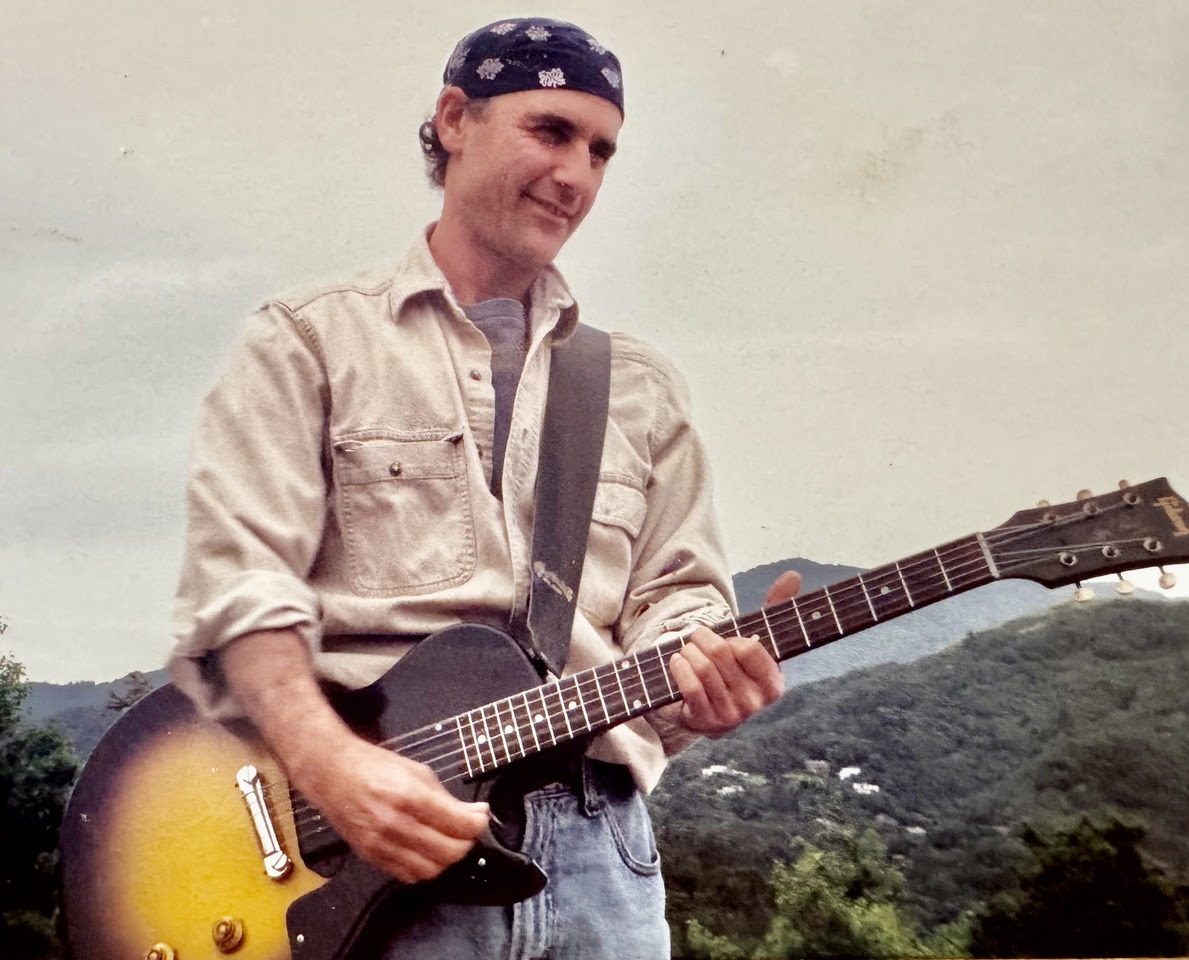
Dennis Herring, Oxford, Mississippi. Photo by Mike Stanton. Copyright VOX PRESS 2026.