
Anthony Korf on Marius Constant, ‘The Twilight Zone’ and the Barrel Organ Concerto
Composer and Riverside Symphony co-founder Anthony Korf discusses his encounters with Marius Constant, the unusual Concerto for Barrel Organ and Orchestra, and why he believes Constant’s music deserves a wider audience beyond his famous theme for The Twilight Zone.
Anthony Korf once called Marius Constant “the most famous obscure composer who ever lived.” Most people would recognise his music from ‘The Twilight Zone’, even if the name means nothing to them. The familiar guitar theme was actually put together from two short pieces Constant had written for CBS. He composed a great deal more than that, but most of his music has never reached anything like the same audience.
Born in Bucharest in 1925, Constant settled in Paris after the war, studying with Olivier Messiaen, Nadia Boulanger and Arthur Honegger. He went on to work with Roland Petit’s Ballets de Paris and founded the contemporary music ensemble Ars Nova in 1963. His catalogue includes ballet scores, orchestral works and concertos, among them a particularly unusual piece written in 1988 for barrel organ and orchestra, inspired by the playing of French musician Pierre Charial.
Composer Anthony Korf and conductor George Rothman first came across Constant’s music during a research trip to Paris in 1997. The two had founded Riverside Symphony in New York in 1981, and have since performed and recorded several of Constant’s works. Korf also knew the composer personally, and their conversations gave him some insight into the way Constant approached his music.
On November 15, Riverside Symphony will give the U.S. premiere of the Concerto for Barrel Organ and Orchestra at Riverside Church in New York, with Jonathan Mathis playing the barrel organ and Rothman conducting. I spoke with Korf about his first encounter with Constant’s music, the peculiar appeal of the barrel organ, and why he believes the composer still hasn’t received the attention he deserves.
“This is part of the power of the piece—to evoke a memory you yourself don’t even have!”
When did Marius Constant become more than simply another composer whose music interested you? Was there a particular piece, or even a particular moment in a piece, that did it?
George Rothman (Riverside Symphony’s Music Director and Conductor) and I discovered Constant’s music on a 1997 research visit to Paris. The challenge was to find composers not named Pierre Boulez or Henri Dutilleux, the latter of whose music we had performed a number of times. We attended many concerts and spent many more hours in a central music library with stacks of scores and recordings. There was a preponderant representation of new French music created in the artistically questionable laboratory of Pierre Boulez’ electronic gadget factory, IRCAM and then there were the composers in the “Musique Spectral” movement, whom we found (and still find) equally uninteresting. In any event, George and I were sitting on opposite sides of the table practically hidden from one another by those intervening piles of scores, when I came around to Constant’s Turner. Good music is instantly recognizable, especially in the context of faceless, synthetic chaos, so I immediately gave a thumbs up to my partner-in-crime and the rest was history. We’ve performed Turner several times on our concert series, as well as a number of his other works, which we’ve recorded.
IRCAM (Institut de Recherche et Coordination Acoustique/Musique) is a Paris-based institute devoted to research into music and sound, founded under the direction of Pierre Boulez.
You once called Constant “the most famous obscure composer who ever lived.” Why do you think somebody with that much imagination remained obscure?
Music requiring close attention nowadays is unlikely to gain traction in the near-term. Much of the new music praised today is all about “effect.” It’s more about sensation—or sensationalism—than emotion, or, God forbid, narrative coherence. A piece featuring pounding rhythms with aggressively ugly notes is more likely to win audiences than a tightly-knit musical argument containing beautiful ones, to be honest. Then there are the shapeless works that rely exclusively on repetition, or music so impossibly retrograde that it’s impossible to know what century it was written in. In contrast to all this, Constant has all the goods in my view: his voice is distinctive from a melodic and harmonic standpoint, but you have to learn his musical “language” and listen long and closely enough that you understand where he’s going and why. I believe…or hope…in the long run, his music will find the wider audience it deserves.
Constant resisted the serial orthodoxy around him without retreating into conservatism. Do you think that independence cost him something at the time?
It very well could have. Composers who didn’t buy into mid-to-late 20th century orthodoxies were widely overlooked, and especially so in Paris. Prokofiev provides an even earlier example of French “au courant” fetishism, since the musical intelligentsia of his time deemed his music insufficiently “forward-looking.” As for serial technique, I doubt that Boulez’ acolytes necessarily compose using such methods, but any composer creating technological marvels at IRCAM became an instant ally to the most powerful man in French music for decades. Obviously, Constant was completely independent of these fads, especially as a composer of ballet scores (i.e. music with a practical purpose). Dutilleux was of course also independent, but perhaps owing to the advocacy of Rostropovich, Stern and others, he achieved something of the success he deserved.
What did you and George Rothman hear in Constant that made you want to keep returning to his music rather than simply perform or record him once and move on?
The simple answer is quality. There is a fierce beauty, authenticity and expressive urgency to Constant’s work, which of course translates to interest. These are extremely rare qualities for music of any era, but particularly contemporary music, where there is surely a greater supply today than at any time in history. The opportunity to champion a composer whose limited celebrity is completely at odds with music’s quality is a privilege indeed. I’m not the first composer who’s said he likes to compose music he’d like to hear and the same is true on the curatorial end. We perform music we want to listen to in the belief that others will too.
The Barrel Organ Concerto began with Constant becoming fascinated by Pierre Charial and the possibilities of the instrument. When you look at the finished score, where does the curiosity end and the composing begin?
If only I knew! I never felt his explanations of his own work began to capture the essence of the music. He was intrigued by his own methods but I’m exclusively obsessed by the results.
It is easy to write for an unusual instrument and end up with a novelty piece. Where does Constant avoid that trap?
You are correct. This is one of the supreme achievements of this particular work. I think it derives from musical content: the primacy of pitch and harmony with Constant, as is the case with any great composer. I would think the barrel organ is most widely associated with childhood (carnivals and the like), thus he took a modest, vernacular instrument with a strong nostalgic component and turned it into something of a heroic beast, made possible by his incredible harmonic and gestural vocabulary. There’s also an element of piquant “strangeness,” not uncommon in many Constant works, that hearkens back to the Twilight Zone music. Then there’s the middle section, “Beethoven aussi” which, according to where you read about the piece online, is a transcription of a work Beethoven wrote for the same instrument. But don’t quote me on this, we’re still trying to get to the bottom of it! In any event, the Beethovenian language of the middle movement is unmistakably nostalgic in character. A very bold move!
A barrel organ comes with an entire world attached to it: the street, fairs, popular music, mechanical repetition. How much of that history do you hear in the concerto?
My childhood was deprived of the barrel organ experience, but that said, there are moments, particularly in the middle movement, where you feel you are experiencing the instrument’s history, even without knowing exactly why or what that history is. This is part of the power of the piece—to evoke a memory you yourself don’t even have!
The player can alter the musical flow simply through the movement of the crank. Does that introduce an element of unpredictability that an orchestra has to learn to live with?
From my understanding, the barrel organist has some flexibility in timing that makes everything work. We shall see at the rehearsal.
Why do you think Constant brings Beethoven into the second movement, “Beethoven aussi…,” through a mechanical instrument of all things?
Aside from the feeling of nostalgia the piece evokes, the linguistic change and overall character put the listener in a sort of coma. In short, you completely erase the opening movement from your consciousness because the piece is obviously telling you to do just that. As one might expect, the return to and further development of the opening material is very powerful. At the onset of movement three, it’s almost as if Constant is muttering to himself: “Now…where WAS I?”
Constant described himself as an instinctive rather than an intellectual composer and spoke about inventing forms according to what a piece needed. Does the Barrel Organ Concerto bear that out for you?
Most certainly he was an instinctive composer, and every note bears that out. The element of spontaneity is naturally controlled by flawless musical logic, or cohesion; that’s what brilliance does. On the other hand, as mentioned above, Constant embraced a sort of gamesmanship in the creative process that was much more important to him than the listener (as is invariably the case). The best example I can think of is the violin concerto 103 regards dans l’Eau. If I understood Constant correctly in our chats, there are literally 103 movements in the 25 or so minute concerto, each of which was inspired by some aspect of water, sometimes from poetry. However, the total effect is a seamless, through-composed work.
Nearly everyone has heard Constant through The Twilight Zone, even if they have never heard his name. Has that thirty seconds of fame ultimately helped his music, or made it harder for people to hear the composer who existed beyond it?
I think the two are almost unrelated, living separate lives, as it were. The fact of the former achievement (he wrote the Twilight Zone theme in an afternoon) has no bearing, apparently, on his life’s work.
As a composer yourself, what in Constant feels closest to your own instincts, and what remains completely foreign to you?
Yes, certain contemporary composers have reaffirmed and fortified long-held inner instincts, and Constant is absolutely one of them. Mainly, in all his music, there’s the primacy of human expression, which is only possible through pitch and rhythm, with color and gesture taking on the necessary secondary role. Constant’s work is unique and unmistakable…but through traditional means, strange as it may sound for a composer who wrote a concerto for barrel organ! There’s no gimmickry to this work; something in the instrument inspired a constellation of emotions and associations for Marius.
What remains foreign, as you put it, has more to do with HOW he composed, the extra-musical aspect of those inspirations and challenges he took upon himself.
“In modern times, it’s also true that composers are way too hung up on ‘originality,’ and in seeking novelty, actually wind up sounding the same.”
Riverside has spent forty-five years looking for music other orchestras overlook. How do you tell the difference between a neglected masterpiece and a piece that history had good reason to forget?
That’s an excellent question I ask myself almost every day. Take Haydn for example and his 104 symphonies: what makes the overwhelming majority of those wonderful works absolutely first-rate is their “aliveness,” not only from Haydn’s spirit and wit, but by the internal logic that holds them together.
It’s a matter of the necessary-ness of the music. There is not a single wasted moment!
For pieces history has good reason to forget, they lack inspiration, relying either on technique (in the case of older music) or gimmickry (in the case of contemporary work). In modern times, it’s also true that composers are way too hung up on “originality,” and in seeking novelty, actually wind up sounding the same. I wish they were more hung up on “necessary-ness,” as I believe Constant and Haydn were, even if they might not have called it that.
If the November performance goes exactly as you hope, what would you like to happen to this piece afterward?
I don’t know about this piece per se, but certainly we would hope that both the audience and performers are transformed in some way, as happens with all great art. I suspect it will take a while for Constant to “catch fire” with the general public and with major symphony orchestras, but any performance that moves listeners to appreciate his brilliance and find other works to listen to has to add up. REAL composers create music for people to listen to and let celebrity find its own course. I suspect the reverse to be true for the pretenders.
Klemen Breznikar
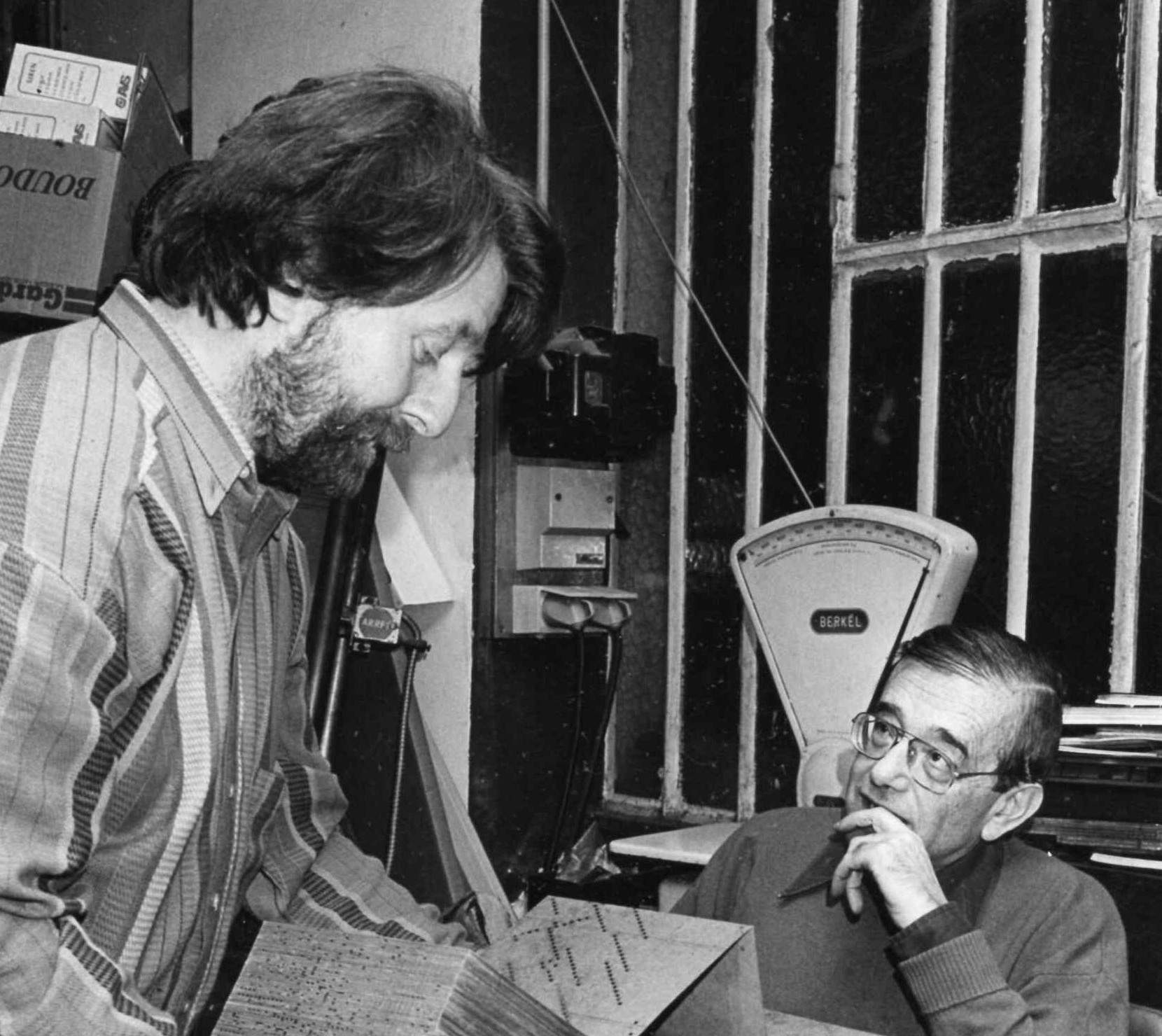
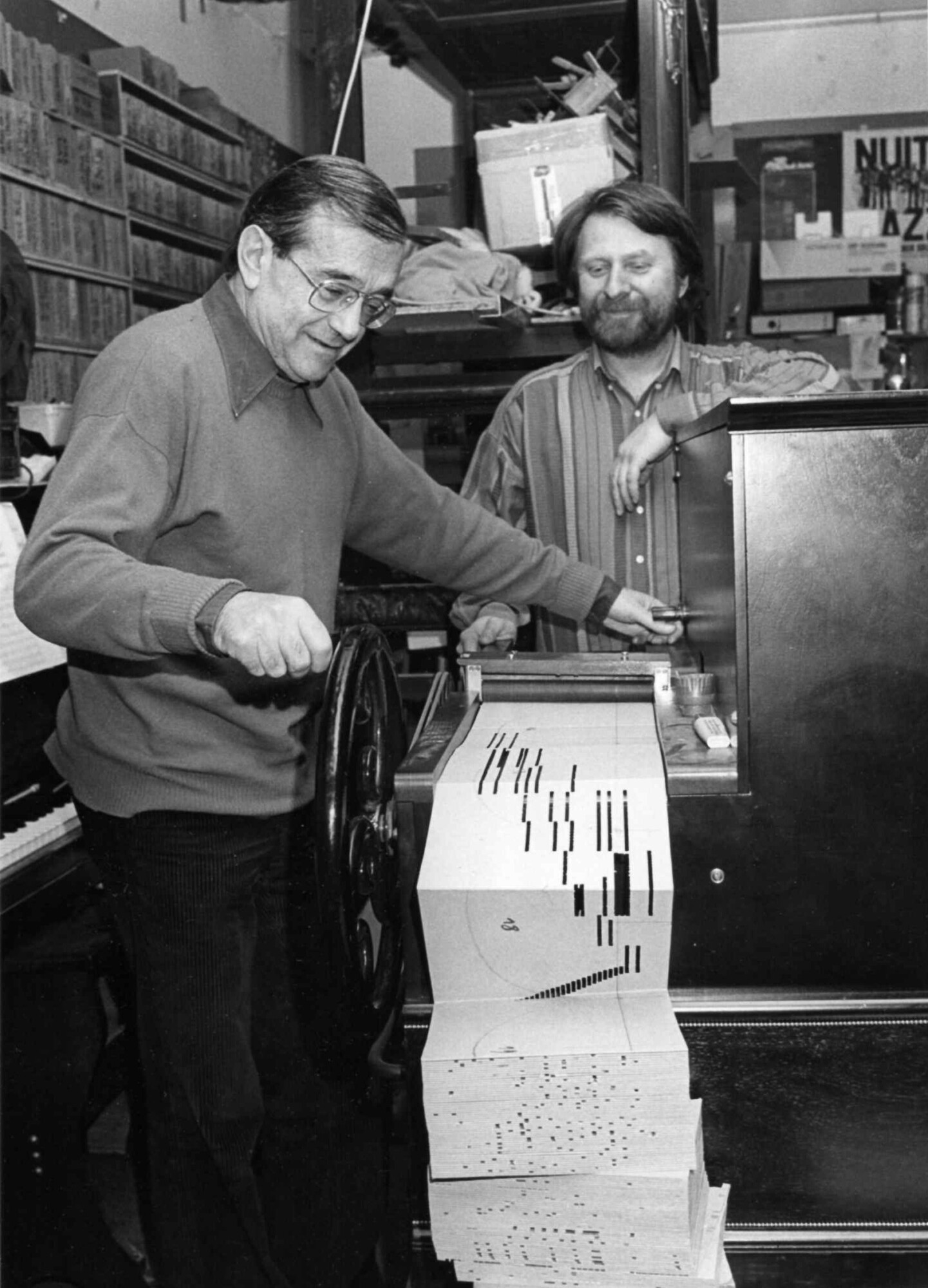
Headline credit: Marius Constant and barrel organist Pierre Charial examine a perforated music book used to operate the mechanical instrument. Photograph: Courtesy of Riverside Symphony
Riverside Symphony: Battle of the Organs
Sunday, November 15, 2026, at 3:00 PM
The Riverside Church, 490 Riverside Drive, New York City
George Rothman, conductor
Jonathan Mathis, barrel organ
Nathaniel Gumbs, pipe organ
Programme:
Ludwig van Beethoven: Prometheus Overture
Johann Sebastian Bach: Toccata and Fugue in D minor
Francis Poulenc: Concerto for Organ, Timpani and Strings
Marius Constant: Concerto for Barrel Organ and Orchestra (U.S. premiere)
Tickets for Battle of the Organs
Riverside Symphony Official Website / Facebook / Instagram
Anthony Korf Official Website