

“We Just Pressed Record”: Marvelous Kid Revisit Their Lost 1974 Recordings on ‘Immanuel’s Manual’
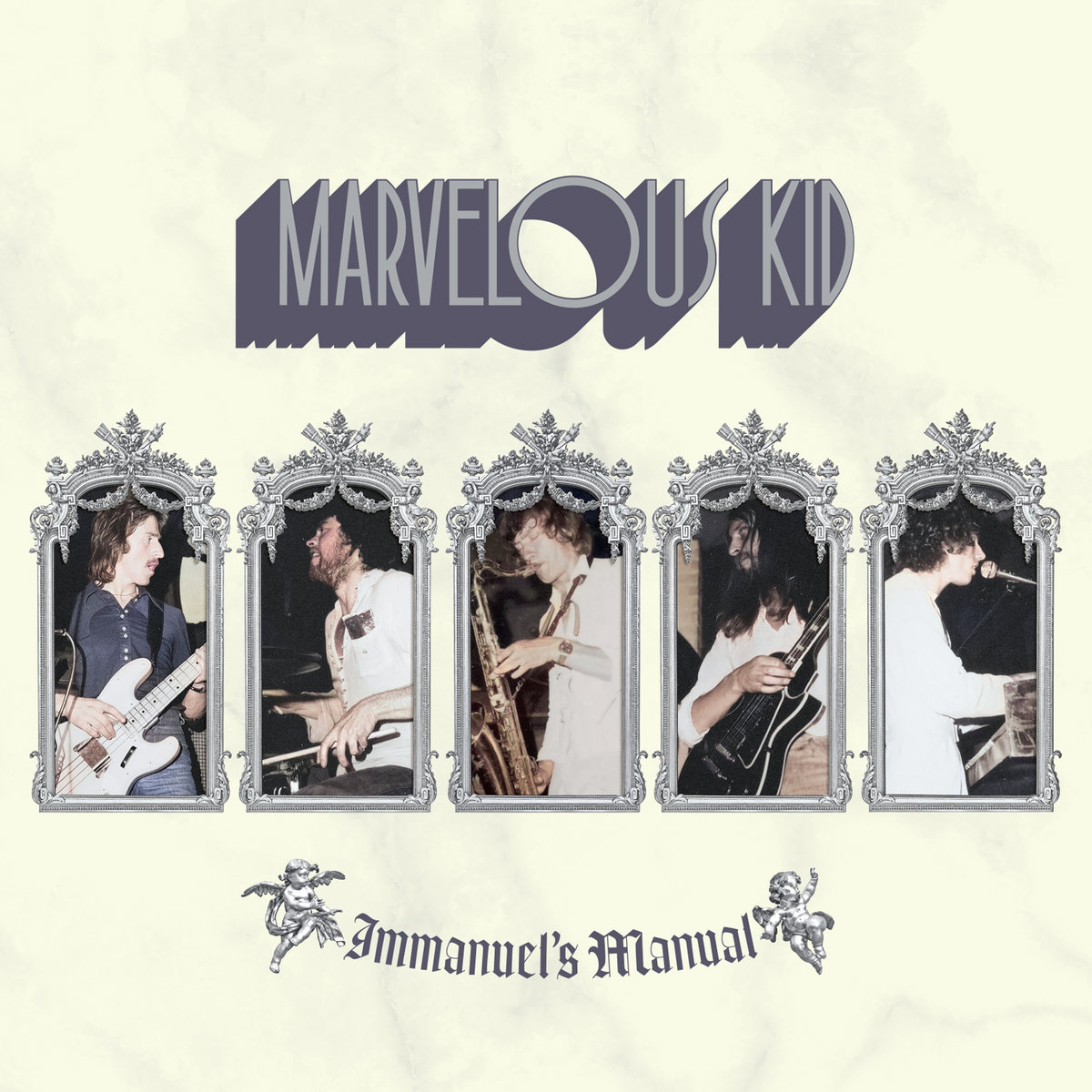
Marvelous Kid return with ‘Immanuel’s Manual’, a collection of previously unreleased 1974 recordings, out on 30 October through Seelie Court / Good Time Records.
In 1974, Marvelous Kid were recording in the living room of their house in Walton-on-Thames. Their friend Richard Hubbard sat next door in the dining room with a Revox tape recorder, connected to the band by a tangle of cables. Thick curtains provided some soundproofing, but there was little they could do about the limited equipment. With pieces running to sixteen minutes and tape in short supply, mistakes generally had to be played through. There was no fixing them afterwards.
The band had come a long way since forming in Cornwall in 1970. They had played the 1971 Glastonbury Fayre, toured extensively and spent years trying to secure a record deal. When I first interviewed them in 2023, we talked about those early days and the Dublin sessions that eventually appeared on Seelie Court’s ‘After The Race’. ‘Immanuel’s Manual’ picks up the story a year later, with Pete Davey, formerly of Ben, now on saxophone and flute. The band were playing regularly around London, and their music was becoming more adventurous.
The album contains four home recordings, including the sixteen-minute title piece, while the CD adds ‘Ants’, recorded at BBC Maida Vale. I’ve also been coordinating the project for Seelie Court and helping prepare the sleeve material. At the band’s request, Michael Björn contributed ‘A Story of Colliding Worlds’, an original science-fiction story. For this interview, I wanted to return to the musicians and talk about the recordings themselves. Tony, Steve, Paul and Frank remember the sessions, explain some of the unusual ideas behind the compositions, and look back on a time when they still hoped a record deal was around the corner.
“We had no idea about professional studio practice, we just pressed record on the machine.”
Can you take us back to Beech Close in 1974? How did you fit everyone and all the equipment into the room, and where was Richard Hubbard set up with the recorder?
Tony Coxon: Memories are rather hazy with all of us about this. The house was detached in a cul-de-sac and although we had originally rehearsed in a pub in Staines, we ended up using the living room at Beech Close for rehearsal and later on for recording. To soundproof the room as best as we could, we put up thick curtains, maybe blankets as well. We kept all our equipment set up in the living room as this was obviously safer than leaving it in the van parked in the street outside. New ideas could then be quickly tried out as compositions developed.
When recording, Richard remembers a “snake” of cables from this room to the dining room, which is where he sat with the Revox tape recorder. We had to shut the doors as best we could to isolate sound. He now wonders whether we used the Laney PA amp as a mixer (unlikely?) or whether Pete Davey brought along a mixer. He has no memory of whether condenser mics were used but does recall that we had an iconic Shure 55 (SH) mic which we used to either mic the bass drum or the drum kit itself. Overall it was very “Heath Robinson”. According to Richard, we suffered by having to use very long leads with high impedance mics which resulted in damping down higher frequencies.
Paul Moon: The room was fairly cramped with all the gear and instruments, they were more bulky back in those days, so not a lot of space. My memory was me in the middle facing the fireplace, Frank on my right, Steve and Tony to my left, and Pete opposite Frank and I. Lots of cables and microphones. It’s a great sound, considering how Heath Robinson it all was. However, like most things we did, we had fun, well we laughed a lot. And figured one day we would be rich. HA!
Were ‘Clench’, ‘Immanuel’s Manual’, ‘Don’t Speak With Your Mouth Full’ and ‘Oedipus Wrecks’ all recorded around the same time?
Steve Betts: The songs were all recorded at the same time. Setting up the room to record was a bit of an operation and it took some planning so once we had worked out how to do it we set it all up and had it there for a few days I think while we recorded everything. We wrote songs and added them to the set as we went along so the recording was basically our live set at that point.
Some of these pieces run for ten, twelve, even sixteen minutes. How many takes could you normally manage? What happened if somebody made a mistake fifteen minutes into a piece?
Paul: Takes? Well one mostly! Providing we get the beginning right, we were away, but on the odd occasions I reckon we may have stopped if someone wasn’t happy but only a few bars into the piece. There are mistakes there of course but we would always correct ourselves as we went, like controlling a skid on a racetrack, it’s the skill involved in playing music live I guess.
Steve: The idea of recording was to do just that – make a record of the songs. We had no idea about professional studio practice, we just pressed record on the machine. We might record two takes of the song but we didn’t have endless amounts of tape and with the songs being 12 to 15 minutes we had limited space. Also there was the question of concentration. Even though we were well rehearsed, mistakes could still happen. It was a simple straight-to-two-track setup and there was no option to “drop in” on a recording with one of the instruments. As Paul says, if it went catastrophically wrong we’d stop but if it was just a small error we’d carry on and then choose the best of the two takes we had.
Paul, last time we spoke you mentioned how cymbals could overwhelm some of your earlier home recordings. By 1974, had you worked out how to deal with that, or were you still playing much as you would at a gig and hoping for the best?
Paul: By the time we got to this stage I reckon we’d have figured out a way to deal with recording the cymbals, in fact on hearing these recordings 50 years later I’m pleasantly surprised and impressed with the cymbal sound. Playing was a way of life for us at the time, it was pretty much what we lived for. We would rehearse a lot for gigs so we really knew the pieces well. So the recordings were like live events, no overdubs and put the vocals on next month, it was all in and here we go.

What had changed in the band between the Dublin sessions and these recordings a year later? Did it feel like Marvelous Kid had become a different group by then?
Tony: Yes, I believe it did. Traveling to Dublin to record in 1973 after rehearsing the new material with Frank and Ivor had been exciting. After that we returned to Cornwall playing occasional gigs whilst setting in process the move to London, we started gigging in London soon after the move and continued creating new material.
However, after parting company with Ivor we replaced him with Pete Davey who played not only tenor sax and flute but also soprano sax. This made a remarkable difference to our sound and attitude. Pete was younger than Ivor and had a very different musical background. Although we only found out in recent years he had previously been in a prog rock band called Ben, who released a self-titled album in 1971 on the Vertigo label, including a track called ‘Gibbon’.
My own memory (is it to be trusted?) was that he had mentioned working with New Yorker Annette Peacock and that he was either just about to join Patto or had in fact started rehearsing with them but that Mike Patto had disbanded his band so that he could join Spooky Tooth.
Pete’s soloing could be brilliantly anarchic and exciting at the same time and changed our sound. The newer material as recorded on these new releases was in many ways different to the Dublin recordings. Thanks to gigging regularly in London pubs and colleges etc., we also became a very tight unit. Marvelous Kid as a band had so much confidence and even aggression with live performance – maybe the live recording from September 1975 shows that best of all.
What did Pete Davey bring into the band that hadn’t been there before? Did his arrival change the way you wrote or arranged the music?
Tony: I’ve really answered this in the last question. As for the second part of the question, for me it didn’t because I had already started writing (and possibly finished) ‘Immanuel’s Manual’ before Pete joined although I can’t remember Ivor playing it.
Paul: Yes, I’d say Tony covered this quite well. Pete Davey was a force of nature, uncompromising and not easy to make too many comments about his playing. It was a great experience working with Pete, he certainly veered us more toward that so-called “Canterbury sound” which incidentally we were never particularly aware of. I wish we knew of his whereabouts, we lost contact.
Steve: Pete Davey joining kind of made it like a real contemporary band. Ivor was a terrific sax player but he was of an earlier generation and steeped in ’50s and ’60s jazz. Pete was more from the crossover vibe that was happening at the time – Soft Machine, Colosseum etc. He had effects on his sax and he also played soprano sax which Ivor hadn’t done. That kind of brought him more into line with the Dick Heckstall-Smith and Elton Dean vibe.

“Pete Davey was a force of nature, uncompromising.”
Tony, you mentioned in our earlier interview that ‘Immanuel’s Manual’ drew on Velikovsky’s ‘Worlds in Collision’, Leonard Cohen’s ‘Beautiful Losers’ and an older piece called ‘Concerning Clowns’. How did all those ideas end up in one sixteen-minute composition?
Tony: Velikovsky’s book was the initial inspiration for the lyrics and the music. The book’s impact set me off on writing little sketches which imagined a similar cataclysmic celestial event happening in current times – the ‘Don’t Look Up’ of 1974 (ha ha) – and believing that many people would not believe any warnings of impending disaster, “they would only call you liar”. This is the first vocal section, Fameseekers etc.
From then on we’re joining up sections with musical sticky tape! And allowing soloing from Pete, Steve and myself. I can’t remember where the Perverted Princess section comes from but I knew the composition couldn’t end there. After a lot of thought and, of the opinion that ‘Concerning Clowns’ (one of my first pieces written and played in Cornwall) held some musical interest and perhaps could be salvaged, we took a whole instrumental section which starts without any preamble at the end of the Princess section.
By this time I had two “verses” for a new vocal section with some more reflective bossa chords – this ends with a reference to Leonard Cohen’s ‘Beautiful Losers’ – the Telephone Dance and hence the line about looking through your yellow pages – well it made sense to me at the time!
More musical sticky tape to add on another guitar chord section with flute on top and then gradually the keyboards lead into a repeat of the initial guitar theme and a decisive ending.
So, to answer the question, I’d say it just took some imagination!
An astute observer may discover that there is a fourth section in the lyrics but not in the recorded track. I think I probably intended to write an additional final section. Possibly I shelved the idea when I realised how long the piece had already become!
Incidentally ‘Worlds in Collision’ seems to be as controversial now as it was when it was first published.
When you first brought ‘Immanuel’s Manual’ to the band, how much was already written and how much developed as you rehearsed it together?
Tony: I think the basic structure for each section was there, at least in my head, and playing through with the band led eventually to a cohesive whole. Everyone had room to find their own parts and no doubt this changed the more we played and worked on the piece.
Steve, you once described ‘Clench’ as a mangled version of the final movement of Mozart’s ‘Prague Symphony’. What made you think of turning it into a Marvelous Kid piece, and how much of Mozart survived in the end?
Steve: Yeah, I just loved the ‘Prague Symphony’, I thought it sounded pretty rock and roll and had a kind of groove to it. I later found out that my record player was running slightly slow so it was sounding a lot heavier than it actually was. Still, I thought I’d have a bash at a version of my own using the same structure. I kind of thought it was a bit stilted at first but when MK got hold of it, it really started to kick.
The drums have the kind of driving pulse that’s on Yes’s ‘Astral Traveller’, a pattern I’ve always loved, and Paul really got behind all the dynamics and stops and starts. Frank’s bass matches Paul’s dynamics and you can hear the sound of the strings changing as his fingers strike with varying intensity. Really subtle interpretation. Tony had sustain on the guitar like Robert Fripp which made it sound like a bowed instrument and Pete’s soprano sax took it away from just being regular rock instruments.
It’s like we were covering the ground of an orchestra and by not all playing at once we were giving a sense of the different colours and the amount of dynamic power we had available in the band.
In some ways it’s very recognisable, it follows the structure in the last movement of the ‘Prague’ very closely, right down to the double punch at the end, but in another way it’s not recognisable at all because our instruments and playing had such a different energy.
Paul: All I’d say about ‘Clench’ is, it was a real joy to play, could really get one’s teeth into it and to coin a phrase, “get a tune out of it”. Pieces like that don’t come along very often, so when it does, make the most of it. It did feel a little symphonic.
‘Oedipus Wrecks’ is quite an unusual piece, almost like a little play with the son and father speaking to one another. Where did the idea come from, and how did you make it work musically?
Steve: I had a girlfriend who told me about the Oedipus story. It’s a great tragic story in the ancient Greek setting but I thought it could be kind of funny if it was in suburbia with the son trying to take his mother away from cooking and shopping.
My father used to write comic verse and he wrote a poem about a sailor who comes home from working on a trawler, which he called ‘Ulysses Jim’. I guess making fun of Greek myths runs in my family.
Putting the characters and their story inside the music was a way to create an emotional map. I had the verses start with a propulsive beat and moving chords so it feels like it’s going to continue on but then the music stops suddenly and the voice comes in with a wild statement like “Every time I see you I just want to try and free you wipe your eyes and shove an apple in your hand”, then two big chords, like “yep, that’s what I said!” I wanted the song to throw down the gauntlet.
The music only reflects the feelings of the father and the son though, the mother doesn’t actually speak. It’s all male gaze ha ha! The first and third sections are the son making all these wild statements and the quiet middle section is the father. I once met someone who was in a relationship and hated their partner but couldn’t leave, so they just stayed there pretending to be happy. I had the father express that in the middle section by being very angry over relatively soft music, especially “Ooh I hate you” instead of “Ooh I love you”.
Tony plays this beautiful flowing solo that really draws you into the soft mood, it’s great and then the contradictory lyrics come back in for the end of the section.
Overall, the song follows a pattern I like to use, which is loud, soft, loud, louder, explode, with a lot of fast playing, dropping into half time, riff-like melodies repeated and crashing chords. I thought it was the best song I’d written in MK. It was a shame it also turned out to be the last.
‘Don’t Speak With Your Mouth Full’ seems more personal than some of the other material. Were you writing about things going on in your own life at the time?
Steve: I thought it was going to be a satirical song when I came up with the title but in the end it turned into more of a lament. I was kind of expressing that I wasn’t always happy. The band was great and we all got on really well but there were times in my head when I just wasn’t sure who I was meant to be.
The song was a departure from my usual tightly wound writing and I thought the music was more expressive. I did try to say something about a relationship I was in at the time without feeling self-conscious and there are a couple of lines in there that I’m still pretty happy about.
The big theme in the middle section was very heartfelt and after a keyboard break Tony let fly with a really passionate solo, which was just what I wanted.
The “mummy” calls at the start were supposed to be like a horror film although no one but me may have thought so. Saying “mummy” like that used to freak me out a little if I’m honest, especially when we played a gig one time and my mother was actually there.
Hmm… ‘Oedipus Wrecks’ much?
Frank, you told me in our earlier interview that you had quite a lot of freedom to develop your own bass parts. How did you approach these longer compositions, and were there places where the arrangement had to be followed exactly?
Frank Artés: At the time we were developing these pieces I remember thinking they were a lot more demanding than some of the earlier songs. They were exciting compositions to play and each quite different, from the classically influenced ‘Clench’ to the jazz-fusion of ‘Ants’. Up until that time I had not listened to much of either genre, so it was melodic/harmonic instinct for sure. There was a lot of freedom for me to feel and interpret each song every time we rehearsed them until I had a musical pattern form. Even today I still think in patterns when playing with my current band.
There were specific bass riffs in two of the songs, ‘Immanuel’s Manual’ for which Tony had written an accented 6/4 riff in the opening sequences and likewise, in Pete’s very jazzed ‘Ants’ composition, he wanted a specific bass line introduced. That tune had a threatening, marching feel in places, which I always felt to be very sci-fi. Giant ant-like creatures taking over the world, definitely.
Playing these pieces live opened up the soloing spots which could go anywhere within the framework of the songs and Pete could play some killer “out there” stuff. Paul and I were a pretty tight rhythm section and I don’t remember any of us completely “losing the plot” so to speak. And as long as we were listening to each other there were cues to bring us all back to earth.
The CD also includes Pete’s ‘Ants’, recorded during your BBC session at Maida Vale. What do you remember about that day? Did being in a proper studio make much difference to the way you played?
Paul: Not much recollection of the BBC session at all, but I certainly remember the intensity and concentration required to play ‘Ants’, and I think you can hear that within the recording. Storming!
Steve: I remember being in a large room with the control room at the top of some stairs. They had a Hammond in the studio, which they insisted I play rather than my own organ. I didn’t mind though; having the chance to use a Leslie speaker was a blast and it made a big difference to ‘The John and Valerie Music’, which we also recorded, because it made the organ solo sound like Gregg Rolie in Santana.
Frank says they made him DI the bass instead of putting it through his amp. Knowing what I know now I’d say the engineer wanted the session completed in the minimum time with the minimum fuss and they already had everything set up to record that way.
I don’t think we played differently because of being in a proper BBC studio, the session was very brief and as usual we recorded everything together in one take. I think we recorded ‘Ants’ because we hadn’t recorded it at the home studio.
I did sessions at Maida Vale in the 1980s and the atmosphere then seemed a lot more friendly. I think the problem for us was that no one knew who MK were so there wasn’t any kind of buzz around us and for the engineers, we were just some unknown band who showed up for a three-hour recording session one afternoon.
The songs sound great though. It’s just a shame we didn’t have more time and a producer to give us some guidance.

When you made these recordings, you had no idea people would still be listening to them more than fifty years later. When you hear ‘Immanuel’s Manual’ now, is there anything you wish you could change, or are you glad we’re hearing the band exactly as it was?
Tony: That’s true – we were primarily recording each song for ourselves albeit perhaps we also were going to try and entice some record label to listen, still hoping for the elusive record deal. Sure, it would have been great to have recorded them in a real studio with time to elaborate upon the sound etc. But I’m just happy to get these out and hope people will take them for what they are and enjoy. I’m sure we are all proud of the music we created all those years ago.
Steve: I wouldn’t want to change it now but back then it would have been good to have access to a real studio. Richard Hubbard did a great job with limited resources but I know that if he’d had professional equipment he would have had us sounding like King Crimson or Soft Machine.
Paul: It is what it is now and that’s what makes it great. If there is interest and a market then great. We were just doing something we were passionate about and really enjoyed it. It was a special time in our lives.
Frank: This is a snapshot, a creative window on our life fifty years ago, with the feeling of optimism we all had for the “big time”, right there. Change anything? No way.
Klemen Breznikar
Headline credit: Marvelous Kid at Glastonbury Fair (June 1971) (Credit: Seelie Court / Good Time Records)
Seelie Court Facebook / Instagram
Good Time Records Website / Facebook / Instagram