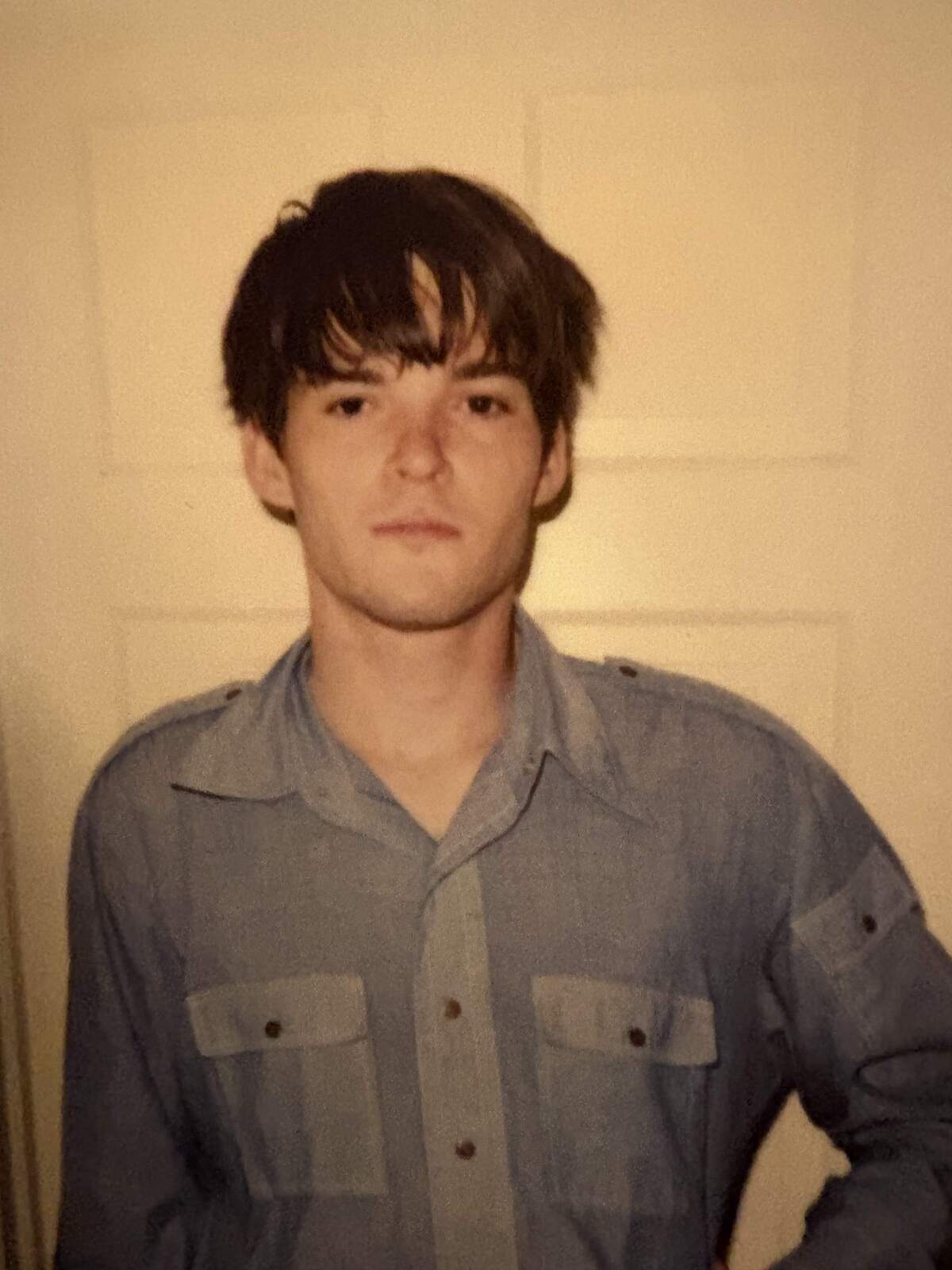

Russell Hoke: “Turning pain into songs makes a kind of joy out of pain”
The San Antonio songwriter and poet on his handmade records, years of street performances, and a lifetime of writing.
One of Russell Hoke’s short stories concerns a man who owns 22,722 records but hardly ever listens to them. His house is so full of LPs that he eventually sells his bed and takes to sleeping in a hammock. The story is called ‘He Has a Record’, and it appears in Hoke’s latest collection, ‘Fourteen Tales’. There is something rather amusing about finding it in a book by a man who spent years making records of his own, often in editions of just a hundred, with artwork he glued onto the sleeves himself. Unlike his fictional collector, Hoke cared enormously about what was in the grooves.
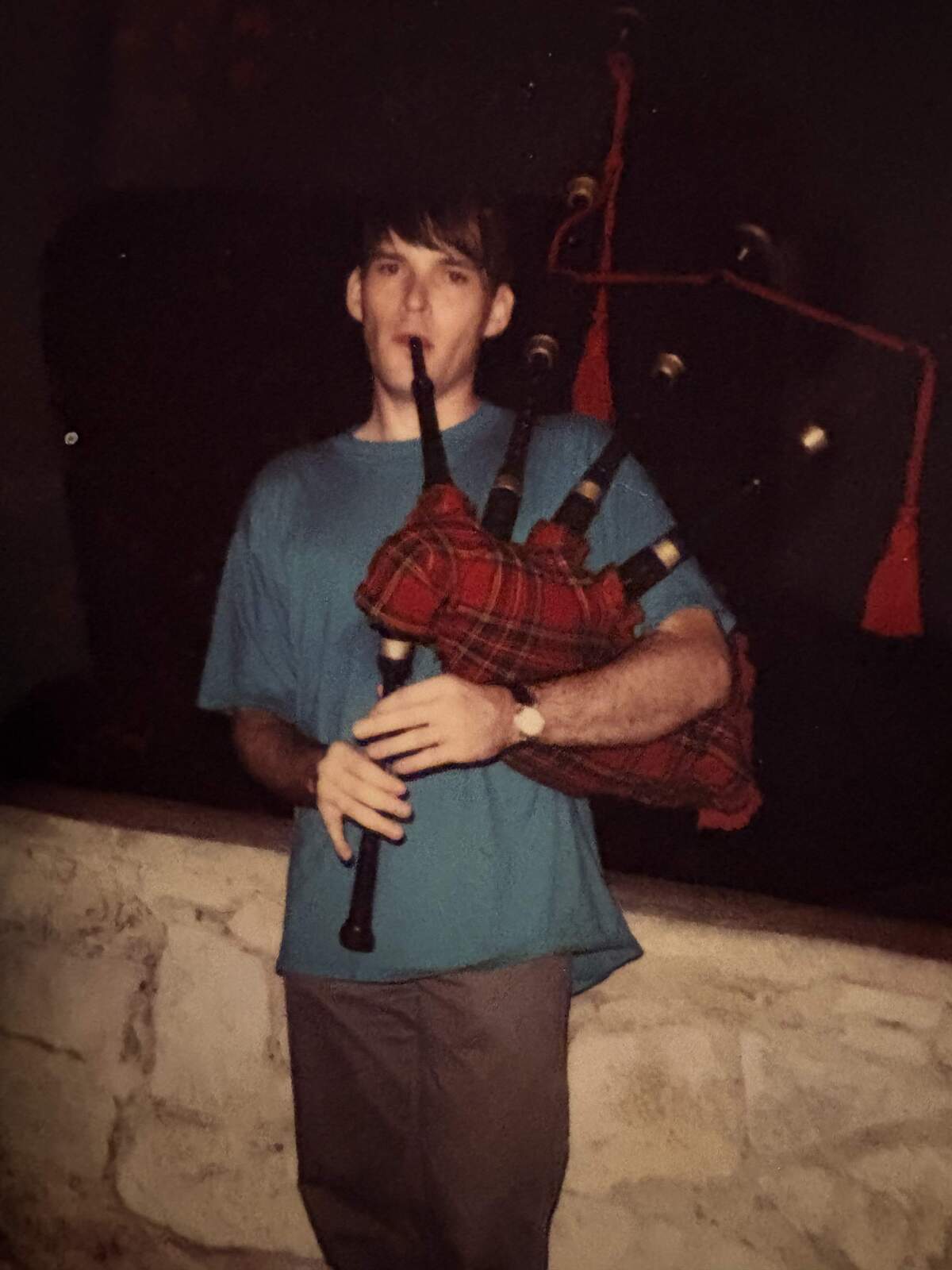
Born in Tampa, Florida, in 1965, Hoke grew up largely around San Antonio, Texas. He became fascinated with the banjo after hearing ‘Dueling Banjos’ and later took up guitar and harmonica, discovering in Bob Dylan a way of writing songs that opened up all sorts of possibilities. By the middle of the 1980s he was writing at a remarkable rate. Some songs were recorded on an ordinary boombox in his bedroom, others with his friend Mark Semmes, and a substantial number during sessions at Joe Treviño’s Blue Cat Studio in 1986. He was also a Highland bagpiper, spending nearly twenty-six years performing on the streets of San Antonio. In 2007, the ‘San Antonio Current’ named him the city’s Best Busker.
His earliest recordings were largely heard by friends. In 1988 he put together fifty copies of ‘Splashing Onto You, My Children’, containing the cassette ‘I’m a Cosmic Outlaw’ and a book of poems, ‘I Raise a Sword!’ The cardboard packaging looked enough like a pizza box for the description to stick, although Hoke is quite particular about explaining that it was not actually a pizza box. His first vinyl LP, ‘Cosmic Outlaw’, followed in 2000, with further privately pressed albums appearing on his Unheard-of Records label. There is anger in many of those early songs, but also tenderness, odd humour and a willingness to say things that most songwriters would probably leave alone. ‘Cosmic Outlaw’ is an extraordinary piece of social defiance, while ‘Someday Among Flowers’, written when he was still a teenager, shows an altogether gentler side. His songs can be awkward, funny, moving and bewildering, sometimes within the space of a few lines.
The records eventually travelled well beyond Texas. In 2011, David Perron discovered some of Hoke’s handmade LPs at Dusty Groove in Chicago, beginning an association that led to Round Bale Recordings releasing ‘A Voice from the Lonesome Playground’ in 2016 and ‘The Melancholy Traveler’ in 2021. The latter was made on an old mobile phone after Hoke had sold his instruments and more or less given up recording. More recently, ‘Wherefore Have I Wandered Here?’ brought together seventy-nine recordings from 1982 to 2022 in a six-LP box set, limited to fifty copies. Among the material still surviving are the original reels from his 1986 sessions, containing recordings that were sometimes shortened when prepared for vinyl years later.
I knew Hoke primarily through his music, but our correspondence introduced me to a considerably larger body of work. He sent me four of his newly revised books, including the enormous ‘The Complete Poems of Russell McCullers Hoke’, his collected ‘Lyrics’, ‘Fourteen Tales’ and ‘I Raise a Sword!’, a collection of more than a thousand aphorisms drawn from notebooks kept over forty-five years. His literary interests range from William Blake and T. S. Eliot to Nietzsche, and he is quite capable of arguing with the universe itself. The poems can be demanding, the aphorisms argumentative and frequently very funny, while the stories move between philosophical speculation and outright absurdity. What impressed me was how seriously he takes the work. He has spent decades revising individual poems and has discarded hundreds of pieces he no longer considered worth preserving.
Throughout our correspondence, Hoke continued to send old photographs, memories of recording sessions and further details about the people who had helped him. He wanted to make sure they received proper credit. He has also been remarkably generous with his time, particularly considering the length of this interview. There is a great deal here that goes well beyond the familiar descriptions of his music as “outsider folk”, a term he has little affection for. We talked about his childhood, the extraordinary years of songwriting, the friends who helped make his records, his interest in philosophy and poetry, and what happens when, after a lifetime of writing, the words finally stop coming.
“I feel that I am merely the caretaker of an interesting lyric or tune.”
You were born in Tampa in 1965, but San Antonio became home. What kind of child were you, and what do you remember about your family and those early moves?
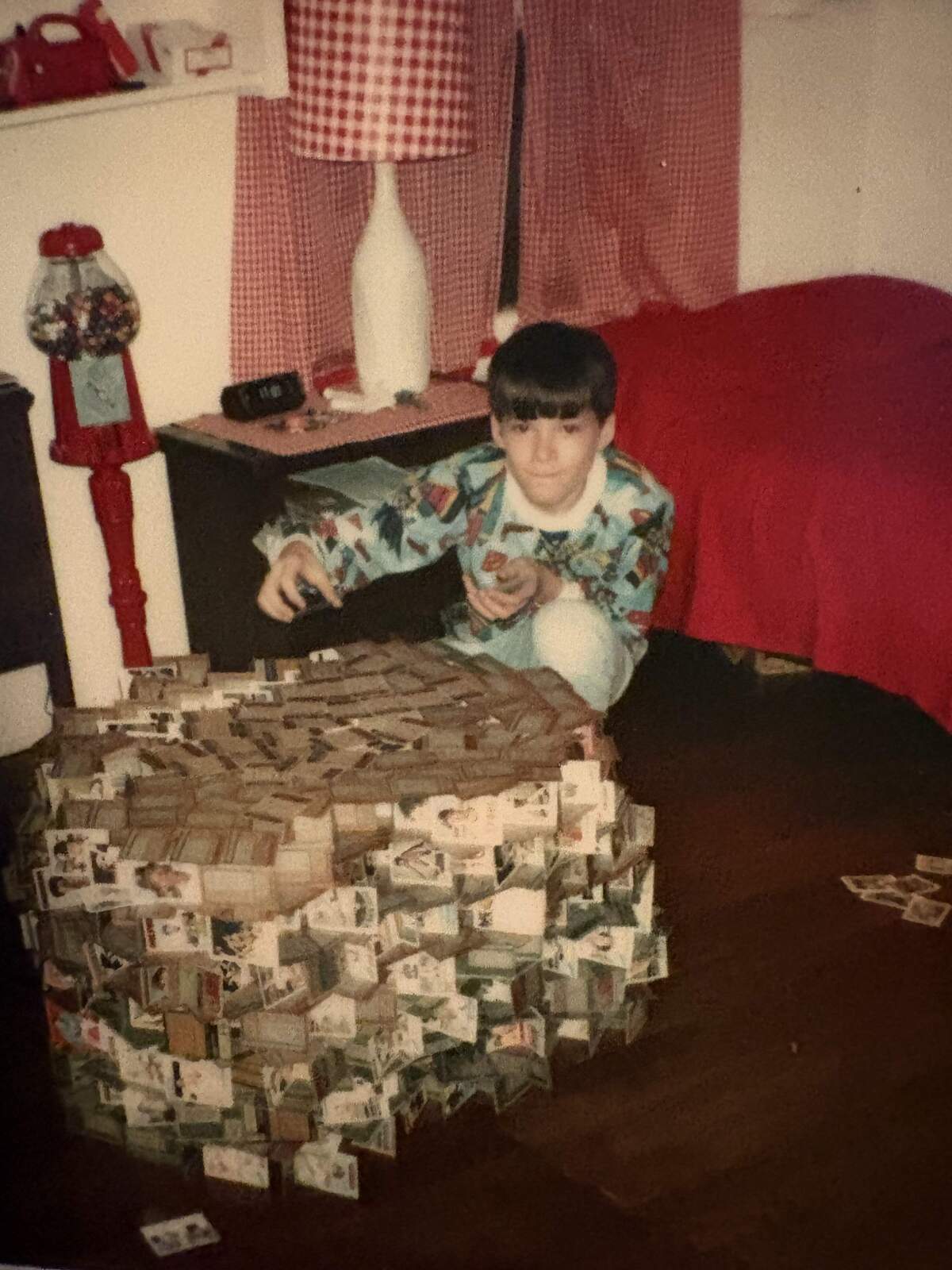
I was an only child, born with an entirely nerve-deaf right ear. The ear contributed to introspection to some extent, in that probably I was somewhat less distracted by noises and chatter. (Deafness gave me a lispy speech impediment that later was corrected by therapy.) I loved comic books, especially Richie Rich, Hot Stuff, Spooky, Casper, and Sad Sack. I tried to make my own comics, though I wasn’t a very good artist. I also loved baseball cards. I was the kind of kid who liked to spend most of his time alone. I made giant baseball card forts without implementing any adhesive. The forts were strong, and I could place 1/32 scale army men (and even their artillery) on the flat surfaces. I loved G.I. Joes, Johnny West dolls, and my army men (of which I had hundreds, maybe thousands), though in real life war was something I never would have extolled.
I liked to act out absurd roles before a mirror and make up characters and their voices. Spontaneously, I would devise skits and ridiculous interviews (like asking coroners how to dissect giant roach carcasses with footballs instead of scalpels). When I associated with other kids, we played in the streets and the yard, usually barefoot. We’d tackle each other and play tag. I loved Saturday mornings; I’d eat tons of sugary breakfast cereal and watch cartoons like the Bugs Bunny/Roadrunner Show.
My dad was in the United States Air Force. My earliest memories are of getting into mischief on the base in Lakenheath. Sometimes I ran away from home, causing my family to panic. I was an explorer. There was never any discord at home. I also liked to hang from two-storey windows and throw toys from the great height. My mom and dad were not really compatible, but I wasn’t aware of that until he returned from a mission in Thailand during the Vietnam War. While my dad was there, my mom moved back to my parents’ high school town, Havelock, North Carolina. In 1969, my dad was stationed at Randolph Air Force Base in Universal City, TX. My parents divorced. For a few years I was raised by my mother and maternal grandmother. I made weekend visits to my dad’s apartment. In 1976 my mom married my stepfather, who provided a beautiful home in which I could later pursue music with few worries.
I wasn’t a good student until my last year of high school. In elementary school, I was a daydreamer, and my teachers would lament that fact on my report cards. The only thing at which I excelled was spelling. I was always the last kid standing in our classroom spelling competitions.
What was the music like in your family home? I know the banjo was your first great enthusiasm. How did that begin, and how did guitar and harmonica enter the picture?
My parents played records often. Although my dad had performed in school choirs, he didn’t play any instruments. He loved Frank Sinatra, the Righteous Brothers, the Four Freshmen, and the Temptations. He would sometimes sing in a silly way, imitating Frankie Valli. My mom played classical piano when she was a teenager. She also played piano for her church, which she really didn’t like doing. She had a piano throughout my childhood, but she played it only for social gatherings.
In 1976, I was inspired to take up the banjo because I heard what I still consider to be the greatest banjo performance ever: ‘Dueling Banjos’, featured in the 1972 John Boorman movie, ‘Deliverance’. I remember running into the kitchen to tell my mom to come quickly and hear what I later discovered was Eric Weissberg’s electrifying sound.
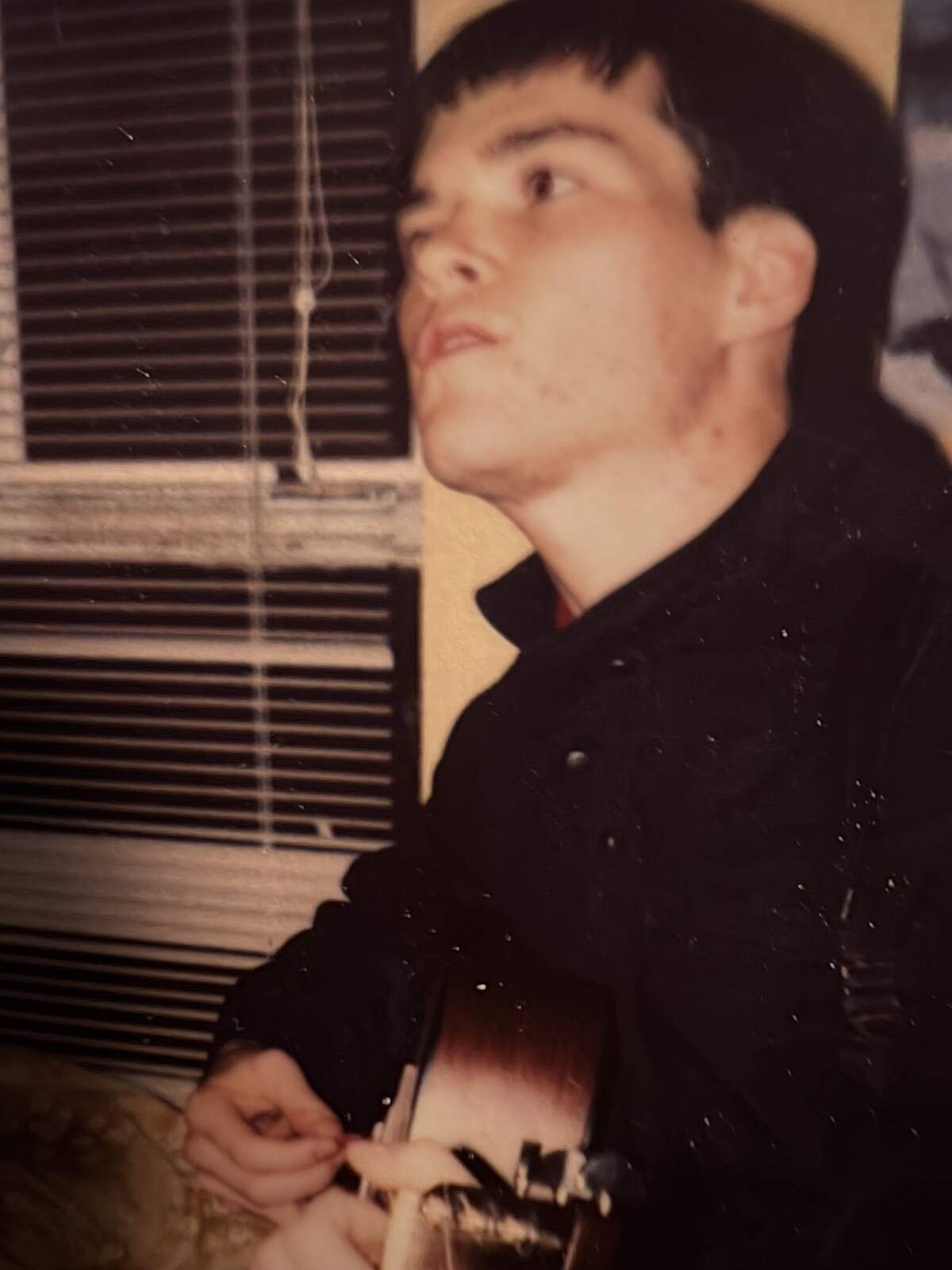
When my mom was on an archaeological dig, a fellow UTSA student and banjo player, Lang Scruggs, used to sing around the campfire at night. He played John Prine’s ‘Paradise’ so beautifully that she asked him about his musical background. She found that he had been in a bluegrass band that had released a vinyl LP on Mercury Records; she also learned that he taught banjo at Dellview Music Center in San Antonio. In early 1977, she asked me whether I wanted to take lessons with Lang, and I was thrilled. My mom bought me an Epiphone in 1984 without asking me whether I wanted it. It wasn’t until 1985 that I picked up the guitar. I first discovered Bob Dylan’s ‘The Times They Are A-Changin’’ LP in 1980, though I didn’t discover his other early records until 1985. I remember my amazement when I heard ‘The Times They Are A-Changin’’. I felt that it wasn’t only controversial; it was impossibly exciting and filled with the Zeitgeist of a dying nation. Dylan conveyed that with a strangely beautiful, nostalgic charm that left a listener uncomfortable yet grateful for poignant honesty. Until I heard Dylan, I wasn’t aware that what he did was possible. When I heard Bob’s harmonica, I felt that it was an essential weapon for my musical self-expression, so I quickly learned to play it.
I also discovered that I preferred to detune slightly one or two of the guitar’s strings. Maybe I’m nuts, but the guitar seemed to me to sound much better and to blend better with my harmonicas when it was just a tad out of tune.
What were the first songs you wrote that truly felt like your own? And what was happening around you when that great rush of songs came in 1987?
The first two songs of mine that I considered completely my own were ‘Don’t Stop Your Trying’ (1983) and ‘Someday Among Flowers’ (1984). I wrote the first one while I was a senior in high school. The latter I composed on my stepfather’s farm during a walk through a field. I had to hum the melody until I got home, wrote the lyric, and worked it out on the banjo. In 1987, I wrote a lot of angry songs because I was frustrated by what I thought were humanity’s ludicrous, destructive values. I was becoming more and more aware that most of modern life demonstrated a raving madness that was far more severe than my own. I didn’t have a place in society really. I had worked in a baseball card shop in which I was paid with cards, but really, until I was 27, I never was hired for a job, probably because I was extremely eccentric. So, I played the bagpipes in downtown San Antonio as a busker. Personal frustration and anger regarding the dimensional unawareness of human instincts was overwhelming my mind. And the more frustrated and angry I became, the more fuel I added to my songwriting engine.
What was everyday life like after you left Incarnate Word College? Were you mostly keeping to yourself and writing, or were you already playing in public?
I had withdrawn from the world. I really didn’t like college. Though I had a 3.89 GPA and liked many of my professors at Incarnate Word College, I didn’t feel at home there. It wasn’t the material I loathed; it was the alien social atmosphere and the partying mentality of most students. Students’ free time usually seemed like mindless debauchery.
In 1984, poems and songs came in tidal waves: while dreaming, as I woke in the mornings, and on walks and bike rides. I was spurred along at that time by reading T. S. Eliot, E. E. Cummings, and William Blake.
I didn’t play strings live or on stage until 1985. I started busking with bagpipes that year. I lived at my mother’s house and in a small back house, which functioned as a study for reading and songwriting. I remember the first time I played before a crowd. It was in a BBQ place, and I felt tingly love flow from my head and heart. I played ‘Why Is It So Hard When It’s So Easy?’ and instantly knew that I had found the right path for me. The tingly sensation convinced me. Music was IT for me. It was what I wanted to do to connect with others and my deepest Self. While poetry was my sacred and private activity, music fulfilled both private and public goals. I wanted somehow to reach people with poetry, but I knew that music made poetry more interesting and immediately accessible to others. Weirdly enough, the simpler the poetry, the more people seemed to react to its depth and core intent. Although some poetic ideas must be said in more complex verse, simple songs were what people obviously preferred and found most moving.
Can you tell us about the 1988 set ‘Splashing Onto You, My Children’, with its cassette and poetry book? People tend to describe the package as a pizza box. How did you make it, and who got those fifty copies?
I just wanted to share songs that made me think and feel intensely about important ideas. I was thinking things like, “If these songs and poems make me feel intense emotions, and make me think more deeply and carefully with each listening session, maybe other people will feel the same way when they hear or read them.” The title, ‘Splashing Onto You, My Children’, came from a line in one of my poems. I decided on that as the title for my 1988 box set, which contained a cassette called ‘I’m a Cosmic Outlaw’ and a perfect-bound book of poems, ‘I Raise a Sword!’, the title I have reused recently for my book of aphorisms. The box wasn’t really a pizza box. It was a little taller, a little narrower, and a little shorter. But the cardboard was white and, more than it resembled anything else, it resembled the kind used for packaging pizzas. There were 50 copies of the box set. Local friends and acquaintances received them. I mailed a few sets out of state. I didn’t think about the longevity of the work at the time. Are people still talking about that box set? If so, I’m pleasantly surprised. The songs on the tape, of course, were later reissued on the vinyl records. A few songs, such as ‘Moonbeams’, ‘The Truth of My Treason’, and ‘The Blind Aren’t in Night’, were later rerecorded; the early versions of those songs appeared only on that 1988 cassette tape.
You began putting out records in tiny editions, often with sleeves you assembled yourself. Why was having the songs on vinyl so important to you, and how did you arrive at the name Unheard-of Records?
In 1991, Joey Reynolds suggested that I should someday release my songs on vinyl. When I finally did so, it was not for profit, but to preserve the songs for posterity. I loved and believed in them. I always wanted to press a record and then see it revolve as my voice came from the speakers. Of course, there were ninety-nine other copies of each album–for friends and record stores. Although the 100-press runs were small, I knew that there would be enough surviving copies in the years to come to preserve the songs. I trusted that the records would find their way to the hands of the right collectors. I made up the name ‘Unheard-of’ because I knew that many of the songs were outrageous in subject matter. I also knew that most of them would remain, at least for a very long time, unheard of. Yes, I did all the writing for the first album’s jacket. For later albums, I completed many of the liner notes and record labels by hand. However, several covers featured photocopied or color-copied cover art, which I attached by hand with standard glue, rubber cement, or spray adhesive.
How did you make those early recordings, from the ones you taped alone at home to the sessions with Mark Semmes and at Blue Cat Studio? How did you know when you had a good take?
I used to carry a boombox around for home recordings. It was an off-brand; I don’t remember its name. It had two condenser mics, and the songs I recorded on it sounded to me nearly as good as studio recordings. I recorded ‘Cosmic Outlaw’ in Medina, TX by setting the boombox on my bed as I sat cross-legged on the floor. I wanted the voice and the harmonica to be closer to the mics than the guitar would be. No one else was present at such sessions; I might be sitting in my underwear or pajamas. Many of the songs that feature only me were recorded in this manner. In 1985, at the Incarnate Word College Electronic Music Lab, my lifelong friend and musical genius, Mark Semmes, recorded ‘Twisted Mountain’, ‘The Witch in Dark Eden’, ‘Angelic Choir’, ‘The Dead Preacher’s Folly’, ‘Someday Among Flowers’, and ‘I’ve Got a Desire to Go Sailing’ with my acoustic guitar and DX7 keyboard accompaniment. He used half-inch reel-to-reel tapes. In September of 1986, I went into Joe Treviño’s Blue Cat Studio in San Antonio and recorded about fifteen songs. Except for Misty Tagle’s vocal on ‘Why Is It So Hard?’, and Mark’s guitar and keyboard contribution on ‘Wendy’, all the songs featured me alone.
It would take me a day or two to write a song, and I would usually make about five attempts before getting a good take. Sometimes, when I needed an extra guitar, vocal, or harmonica track, I would use an extra tape recorder for a crude two-track recording.
I remember that ‘Translated Sanity’, originally titled ‘Cute, Used Match’, was recorded in one take in my bedroom as I sat on the floor. I’d worked on the song for about an hour before I pressed the record button on the boombox. I never played or sang the song again.
You made a lot of recordings on your own, but many people helped over the years, whether playing on the records, making sleeves or helping others hear the music. Who would you particularly like to acknowledge?
I met Mark Semmes in 1973. He and I weren’t really friends until we were almost done with high school. Mark is a great guitarist who studied at Dellview Music, the same music school I had attended. In the early to mid 1980s, he was well known as the guitarist for the Rejects (a legendary punk band that also included Mark and Denise Rubinstein), Platform of Youth, and Lung Overcoat. Mark Semmes is one of the most gifted musicians I have ever known. He also plays a mean pedal steel. He played backup on a dozen or so of my recordings. Gus Wanner, another local guitar legend, played on and recorded many tracks for the records I made from 2012 to 2022. Both Mark and Gus appear on the 2022 song, ‘You Again’. Heidi Buchhorn from San Antonio’s now-defunct band, the Pits, sang the beautiful backup vocal on ‘Driftwood’, a track that Gus and Shawn Terry recorded for me in 2013. Joey Reynolds played banjo on ‘If I Had Been the Universe’ in early 1991.
Ryan Wayment and Don Hurd greatly helped me. Don and Ryan designed several covers, and Ryan occasionally recorded and sang with me.
Lee Scrivner, a brilliant poet, novelist, musician, songwriter, and English professor, is a friend and a champion of my creative work. He has helped me immeasurably by posting my recordings on YouTube. He also interviewed me in 2023 and posted the interview on the same platform. Lee and I have known each other for 37 years and fiercely believe in each other’s work.
David Perron came across your handmade records at Dusty Groove in Chicago in 2011. What do you remember about first hearing from him?
Dawson Prater, a record dealer whom I met through friends, began distributing my records all over the country and, occasionally, even in Europe. I felt that if I kept distributing the records to the right shops, eventually an astute person like David would find them and hear their merit. When it happened, I was happier for the songs than for myself. I still don’t entirely take credit for songs that I feel are worth capturing. I feel that I am merely the caretaker of an interesting lyric or tune. Of course, there is a great deal of my personality in a song, but art is really a collaboration with so many universal factors; for me, art is more of a spiritual event than a personal triumph. I feel that David understands the sacredness of good songs. Nietzsche once said, “Art is the true metaphysical activity of man.”
Marie, Rebecca, Ellen, Wendy and Madi all appear in your songs. Were they people you knew, or did you sometimes turn real people into characters? Is there a story behind any of them you would like to share?
All the girls in the songs are real. Marie was a regular club hopper who seemed to be so sad that I wanted to rescue her. Rebecca was a poet who now works as a writer, editor, and English teacher in Pennsylvania. Ellen was a cute girl I knew in my neighborhood. She was about five years younger than I was; when she was ready to go off to college, I wanted her to keep her charming, innocent personality. Wendy was a brilliant girl descended from Gypsies and Native Americans. She claimed to be a traditional witch who was trained by a sorceress in Arizona. She went to MIT to become a geophysicist. She was the most mysterious girl I ever met. Madi was a psychic I knew. In ‘Scorpio Madi’, I turned her into a hillbilly sort of character, which the real Madi definitely was not. Jeremiah was an invented character, as was Dark Audrey. Miss Arkenzie was Rebecca.
What is the story behind ‘Twisted Mountain’? And did writing songs help you work through anger and sorrow?
‘Twisted Mountain’ is the song of a character named Sabra in my novella, ‘The Legend of Twisted Mountain’. In the story, she was a wise, young witch, modeled mostly after Wendy.
Yes, music was my favorite weapon against the horrors and sorrows of civilization. Turning pain into songs makes a kind of joy out of pain. It’s transformative magic. And humor always helps to whet music’s blade. I think the greatest comedians are those who are most aware of life’s sorrows and horror.
People have often called your music “outsider folk”, a term I’m not sure does justice to the writing behind it. What do you make of that description? Whose songs mattered most to you when you began?
The term “outsider” seems to me to make an artist appear as an inhabitant of a zoo. It seems to be a sensationalist way of describing a freak or anomaly with whom “sane,” “normal” people (whatever that means!) can amuse themselves; their use of that term seems to be a tactic for attempting to elevate themselves to the status of maturity that has made our world the flawless paradise we now see and experience everywhere today. (Ha ha ha). Using “outsider” is a way to marginalize or look down on someone while simultaneously justifying the insult with noblesse oblige praise.
When I first began writing songs, I felt closest to the songs of Joni Mitchell, Buffy Sainte-Marie, Melanie Safka, Tim Buckley, Bob Dylan, Lee Hazlewood, the Byrds, the Beatles, Cream, Leonard Cohen, Cat Stevens, Don Partridge, and the early Rolling Stones. In 1988, Jason Witherspoon, a local San Antonian and a future DJ of Harvard’s radio station, introduced me to Nick Drake, whose music seized me. A few years later, I found a copy of Pearls Before Swine’s first LP at a thrift store. That record was also a mind-blower. (I exchanged a few emails with Tom Rapp before he passed away. I found him to be a kindred soul.)
The Great Highland Bagpipe has been another large part of your life, and you studied the instrument seriously. What first appealed to you about it? You’ve written about how its structure trained your mind. What did you mean?
The Great Highland Bagpipe has a dignity about it that few other instruments share. The drones combined with the piercing chanter make a formidable foe for effeteness, low-vibe consciousness, and mediocrity in general. It is powerful, like a firestorm. I had begun piping in 1981, playing with a local band called the Alamo City Highlanders. I wanted to keep learning, and to explore the classical, “big” music of the Highland Pipe, known as piobaireachd, which means “piping” or “pipe playing” in Gaelic.
By “intricate structure” I meant one that requires precision, accuracy, and concentration. I didn’t experience that intricate structure with strings—at least not to the same degree; in my opinion, piping is much harder than playing banjo and guitar. It required for me much more focus, attention to detail, and many hours of intense practice and discipline. It trained me to be infinitely patient and to take years—sometimes decades—to perfect a line or a phrase of a song, a poem, or even an aphorism.
You spent almost twenty-six years busking with the pipes in San Antonio. What did playing for people on the street teach you? I’d also love to hear about your friendship with Don Partridge.
It taught me the importance of pleasing others as well as myself. These lines from Wilfred Owen’s sonnet, ‘Music’, sum up the answer to the question:
“I have been gay with trivial fifes that laugh;
And songs more sweet than possible things are sweet;
And gongs, and oboes. Yet I guessed not half
Life’s symphony till I had made hearts beat,
And touched Love’s body into trembling cries,
And blown my love’s lips into laughs and sighs.”
One evening, as I was busking, I met Nick, a real, live G.I. Joe. He was a prodigy who, as a teenager, had gone to Thailand as an aircraft technician. He himself was a pilot, and he also had sailed solo across the Atlantic Ocean to Spain, using mind control techniques to wake himself every five minutes to scan the horizon with a 360-degree sweep. He became the only student to whom I ever taught bagpipes.
In 1968, my mother went to see ‘Yellow Submarine’ at a London theater and encountered Don Partridge busking nearby. He was playing ‘Blue Eyes’, which was one of Don’s two minor-hit singles for Columbia records. She soon found the single of ‘Blue Eyes’, which she frequently played in our home for many years. In 2008, I contacted Don on Facebook and told him how much that record (and his self-penned flip-side song, ‘I’ve Got Something for You’) had meant to me throughout my life. By that time, I was a seasoned busker, too, having played Highland bagpipes for 23 years in downtown San Antonio. Don and I sent each other our printed poetry collections, and he invited me to come to Sussex. He also suggested that I bring my pipes and travel to Sweden with him and a few fellow buskers. Sadly, he passed away before I could make the trip. I marvel at how magically things worked out, though; it amazes me how much resulted from the simple fact that Don was playing ‘Blue Eyes’ as my mother was on her way to see a movie; that brief incident led me, decades later and via the Internet, to befriending Don, one of my musical heroes. That is truly miraculous—because Don himself was miraculous.
You’ve visited the Great Pyramid, the Acropolis and Borobudur, and you write about the “left-hand path.” What did those journeys mean to you? And what does that phrase mean in your own life?
I went to Egypt in 1981 with my mom and stepfather. (En route to Cairo, we briefly stopped in Greece.) I like to think of being in the King’s Chamber as a spiritually transformative event that afterward granted me some kind of mystical boost for essential cosmic awareness. Maybe that’s silly. Maybe it’s not. I feel the same about touching the stones of antiquity in Greece and Java. It seemed as if I had absorbed all the events that those stones had witnessed for centuries. I imagined that whatever they endured and absorbed could be relayed to my own thinking, feelings, and, therefore, personal art.
“The left-hand path” refers to the road less traveled that Joseph Campbell described in his lectures. It does not mean the life of an evil, selfish occultist; it means the difficult life of a person who chooses an unusual life path rather than a path of a preexistent cultural model or social inculcation. It embodies the meaning of introversion as Jung would have intended the word, in which a person’s path or meaning of reality is determined by an inner guide rather than by the guides of the establishment and blind adherence to a society’s traditions.
Having read your poetry alongside the lyrics, I’m struck by how different the two can be. Did you experience writing a song and writing a poem as different kinds of work?
The poems and songs, oddly enough, come from two different worlds and rarely resemble each other. Songs seem more immediate and require less nuance. I see this now, in retrospect; when I was writing prolifically, I never thought about the distinction. Of course, if a melody came before any words presented themselves, I just knew that I was finding a song rather than a poem. If the words came first, I could tell whether they required that “intricate structure” of high or deepest poetry, which is like spelunking in the soul. One thing that my poems and songs had in common, though, was that, during their composition, they both used to arrest me in a trancelike manner.
Your 2020 ‘Collected Works’ brought decades of writing together, and you’ve continued revising the books since. What has it felt like to go back through all that work? How did you decide what deserved to survive?
It is a rewarding feeling in that I know I gave ideas and feelings everything I had within me, and I knew that I protected them as well as I possibly could. When I had the energy to pursue thought that aimed for the aristos, I engaged it and would not allow it to sit idle. Whenever a thought nibbled on the fishing lines of what I perceived to be universal connections, I reeled it in and gave it a home in some sort of art or philosophical statement.
Regarding ‘Collected Works’ (which I have since updated in unpublished files): I left out reams of poems and aphorisms, some short stories, and a play. The omitted stories were in a very early handwritten collection called ‘Voluntary Chaos’. They were rather puerile and derivative, so I threw them away about twenty years ago. The play was called ‘All the Time Among the Flowers’. I tossed it, too. During the last forty-five years, I have thrown away about a thousand poems along with hundreds of aphoristic thoughts. Some of the old poems can be found in my embarrassingly dreadful hardback called ‘The Reawakening of an Atlantean Degenerate’, which was published in 1997 and reprinted in a “revised,” larger hardcover edition in 2000. I must warn anyone who acquires a copy of that book: The poems are raw, unfinished, and terrible works of juvenilia.
“In the early days, creativity dragged me around and made me its slave. It was imperative that I write and compose; I simply had no choice.”
You seemed ready to stop making records more than once, and eventually you even sold your instruments. Why did the songs stop coming? And what led you to borrow a guitar and banjo and make ‘The Melancholy Traveler’ on an old phone?
In the early days, creativity dragged me around and made me its slave. It was imperative that I write and compose; I simply had no choice. It’s almost as if the songs and poems grabbed me as if I were their pen, typewriter, or computer. I look back and can hardly remember how much work I did. The hours, days, weeks, months, and years now seem endless; most of my life must have been spent by sitting with words and sounds, and I now barely remember any of the process.
Eventually, the songs and poems began to trickle rather than rush. I felt that I had said what I wanted; or, rather, I felt that what wanted to be written through me, for whatever reason, had quit knocking at my mind’s door. I wasn’t someone who wanted to explore or look at new truths interminably; I liked what I already had investigated and produced. Emily Dickinson’s words precisely describe what had happened: My soul had selected its own society and shut the door. I was still the steward of a few songs that I never had recorded cleanly, so I thought some of them were good enough to warrant more dignified, recorded versions. I didn’t have any other recording devices/equipment at the time, so the old cell phone came in handy and actually went well beyond the call of duty. I can’t tell that ‘The Melancholy Traveler’ was recorded on a cell phone. Maybe my hearing is pitifully poor. In any case, other listeners seem to like that record.
You’ve recorded other people’s songs, including two by Sandy Denny. What does a song need to have before you want to sing it? What is it about Sandy’s writing that speaks to you?
A song must have sufficient emotion or beauty to instigate tears or goosebump-inducing ecstasy. A song must have an element about it that creates or unleashes awe or the sublime. Obviously, not all good songs inspire awe, but the great ones do, and I think that is because awe inspired them. And if a true connoisseur of art hears a great song, even if it’s obscure, he or she will recognize its superiority when it is compared with a merely “good” one.
The main thing I like about Sandy Denny is that she instinctively knew how to track down mystical essence in songs, whether hers, tradition’s, or contemporary songwriters’. She knew just how to craft a lyrical line or a guitar strum or phrase so that listeners’ hearts would cry or break. Think of the peerless wonder demonstrated by her words, “Who knows where the time goes?”
I don’t really feel close to the writers of songs; I feel close to their songs. I try to put myself in the role of the composer, however, so that the melodies and words briefly can become my own when I play and sing them.
On ‘Sneaking Into the Light’ you worked with a fuller band at Fourth Floor. Was it enjoyable hearing other musicians take your songs somewhere new? Did anything from those sessions remain unreleased?
Nothing else was captured at the Fourth Floor sessions. I dug the full-band sound, and it was fun observing what touches of musical color my friends wished to add to the melodies.
Speaking of unreleased material, there is a song written about my last love. Although it has a lyric, its tune is also suitable for the bagpipe. I’m actually learning it on the pipes at this time. There’s another really long song I never recorded called ‘Just Part of a Brain’ that is quite good. It’s in my ‘Lyrics’ book. I think it was written in the mid 90s, but I can’t remember exactly. I would like to record both of those songs. Maybe someday!
‘Wherefore Have I Wandered Here?’ gathers seventy-nine recordings from four decades into six LPs. How did you choose them? Was there a song you regretted leaving out?
I selected what I thought were the most interesting songs, at least to me, my friends, and the fans who had mentioned their favorites through the years. ‘A Wee Tattie’ would have been fun to include, but I don’t feel that the few songs that I omitted have been in any way disrespected; they are on other records, if one wishes to hunt them down and hear them.
Looking back, what do you think people have understood about your songs, and what have they got wrong? Do you still feel any pull to write or record, or is that chapter largely complete?
They understand that, initially, feelings wrote the songs. I never wrote a song for popularity. Every one was written for someone to revisit—either for sheer joy or for conducting a case study of a spiritually ill patient who needed help and guidance for finding a consoling truth.
The anger, sorrow, and love-longing in my voice were not only real to me; they were expressions to which (I hoped) anyone with a heart could relate. If listeners don’t recognize that in my songs, they are missing the ultimate reason for their composition. My stuff is definitely not dance music, but I certainly hope it can provide fun and food for contemplation and meaning.
Again, I would like to record ‘Just Part of a Brain’ and the song for my last love, the latter perhaps on the pipes. I don’t feel the need to access the old feelings or their expressive words again because the songs I’ve recorded successfully captured what I wished to preserve. I don’t write songs or poems any more. At the end of his life, Kurt Vonnegut quoted Nietzsche, stating that he had reached “the melancholia of everything completed.” Now I want only a good girlfriend, peace, sleep, close friends, the maintenance of my freedom, and the good fortune to find and reunite with my half-sister’s daughters, my nieces. I shall always savor a good cup of coffee and a bowl of sugary breakfast cereal. It would be consoling to see the classic cartoons of Bugs Bunny and Daffy Duck on TV again.
Klemen Breznikar
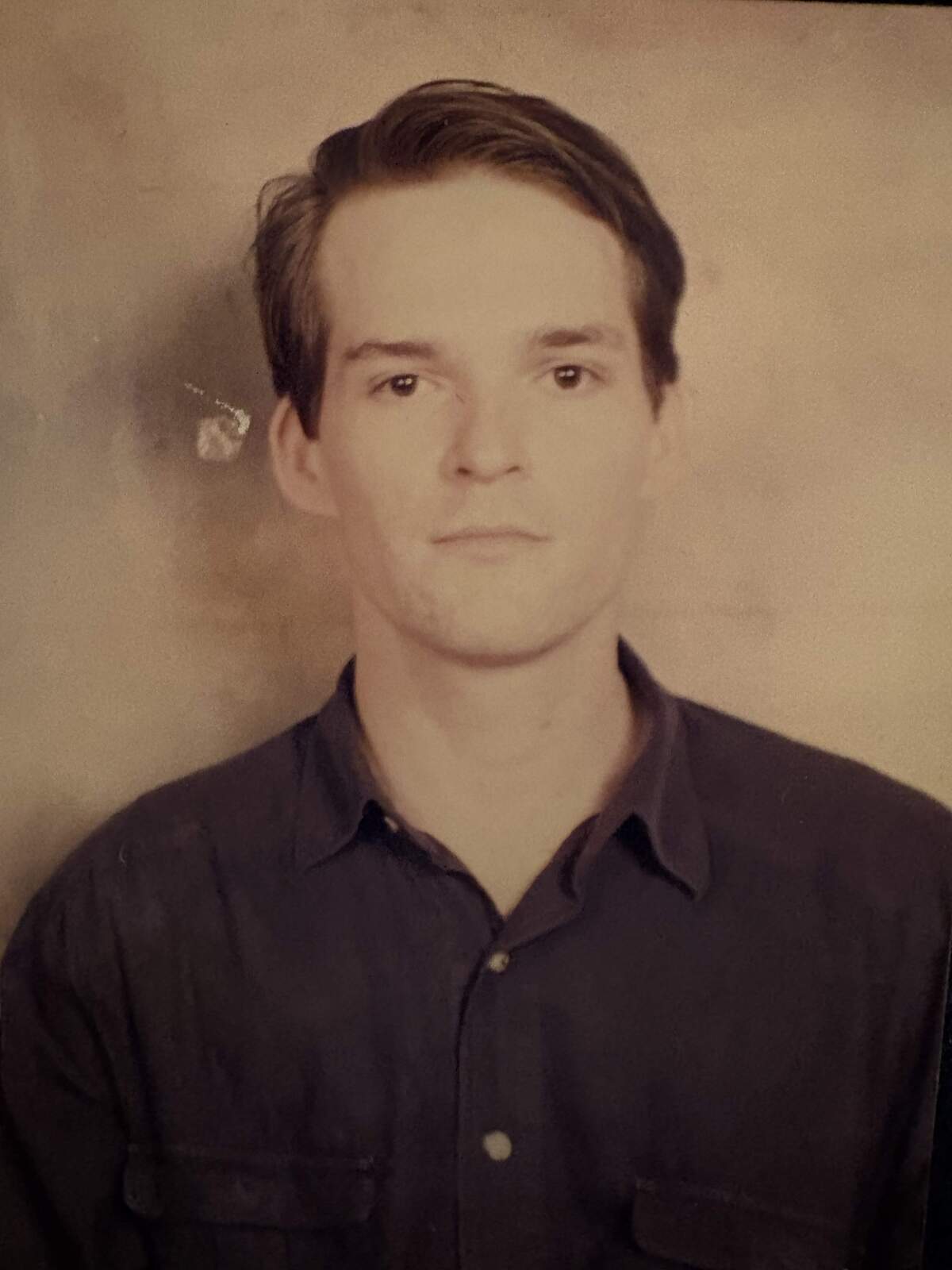
Headline credit: Russell Hoke in the mid-1980s, during his most prolific period of songwriting. Photograph: Courtesy of Russell Hoke.
Russell Hoke Official Website / YouTube /Bandcamp