
Luke Bainbridge | Inside the Palindromic World of ‘PETSTEP’
Luke Bainbridge spent five years making his second album, ‘PETSTEP’. During that time his ideas about composition were changing, as was his life outside music.
The death of his family dog, Olive, became part of the background to the record, alongside what he describes as a growing awareness of adult life and its pressures. Rather than writing directly about those experiences, Bainbridge found a structure that gave him somewhere to put them.
That structure came from a palindrome. The idea first appeared while he was writing ‘Spillage in the Village’, a rap that began after a homebrew accident during lockdown. What started as something private and humorous gradually became the basis for the album. “The moment the idea of a palindrome came into my head, that was the real way in,” he says.
Across ‘PETSTEP’, Bainbridge uses symmetry, repeated shapes and rhythmic systems without allowing them to determine everything. Messiaen is one reference point, but so are MF DOOM, heavy metal, dance music and the free improvisation Bainbridge was hearing around London. As he puts it, “Asymmetry is the thing that makes music live.”
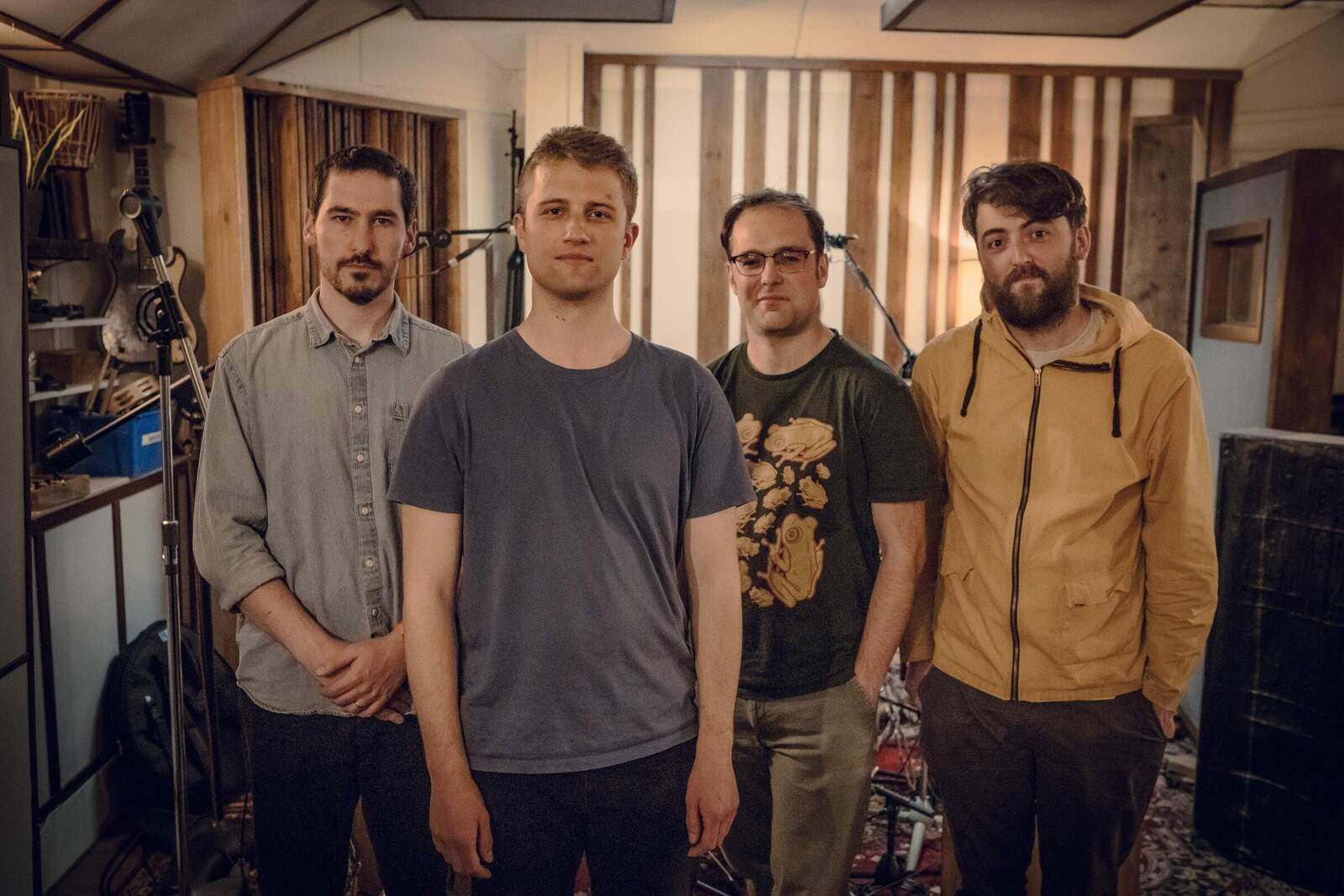
The band is central to how those ideas work in practice. Bainbridge plays drums alongside Kieran McLeod on trombone, Ralph Wyld on vibraphone and Huw V Williams on bass. With no piano or guitar, the roles remain relatively open, and written passages can move quickly into improvisation.
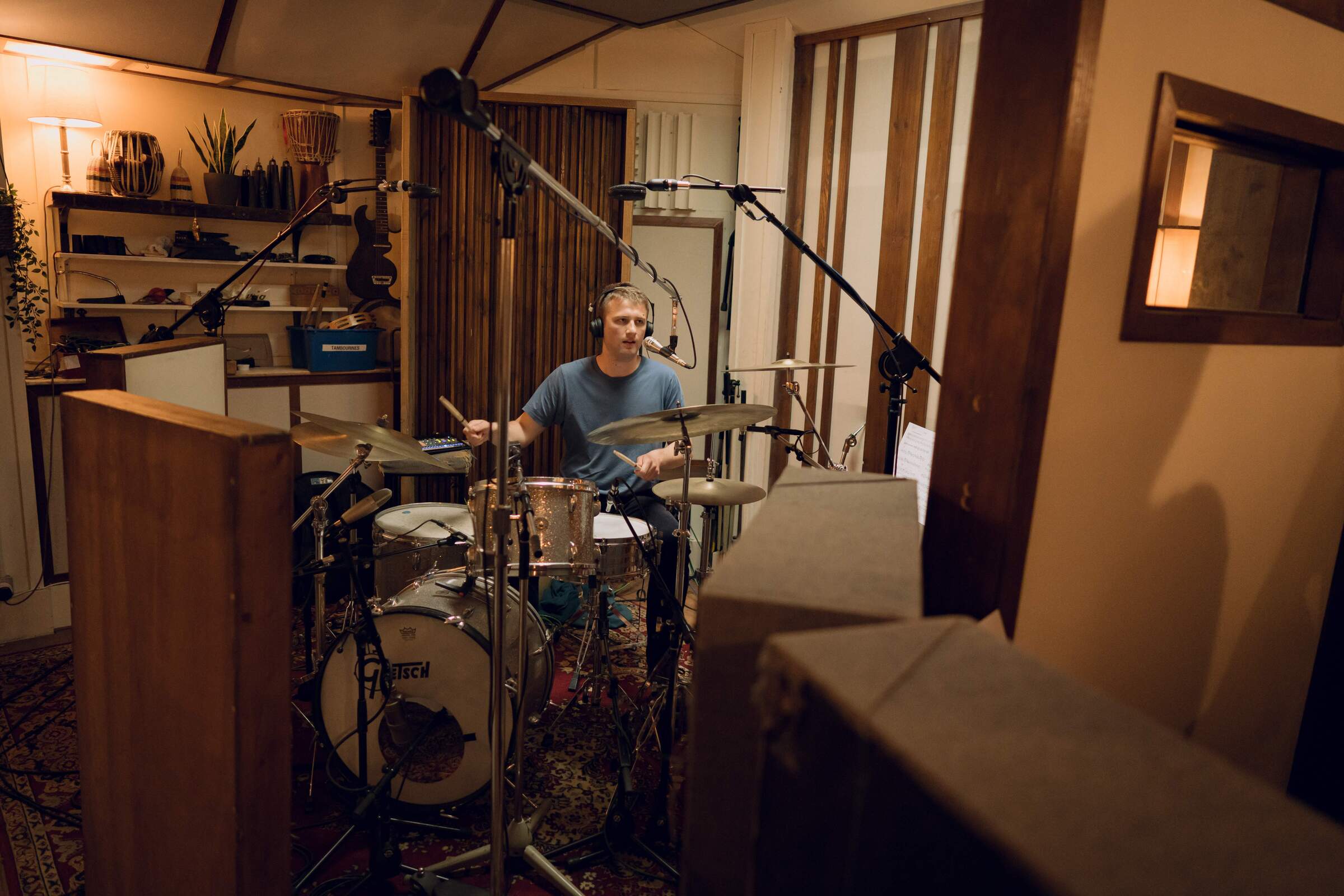
The album was recorded over two days at Lightship 95. Bainbridge remembers the sessions as intense, particularly given the amount and complexity of the material. The result is a record in which detailed composition and the less predictable character of a working band are continually meeting each other. In the interview below, Bainbridge discusses how ‘PETSTEP’ took shape and why it took him so long to finish.
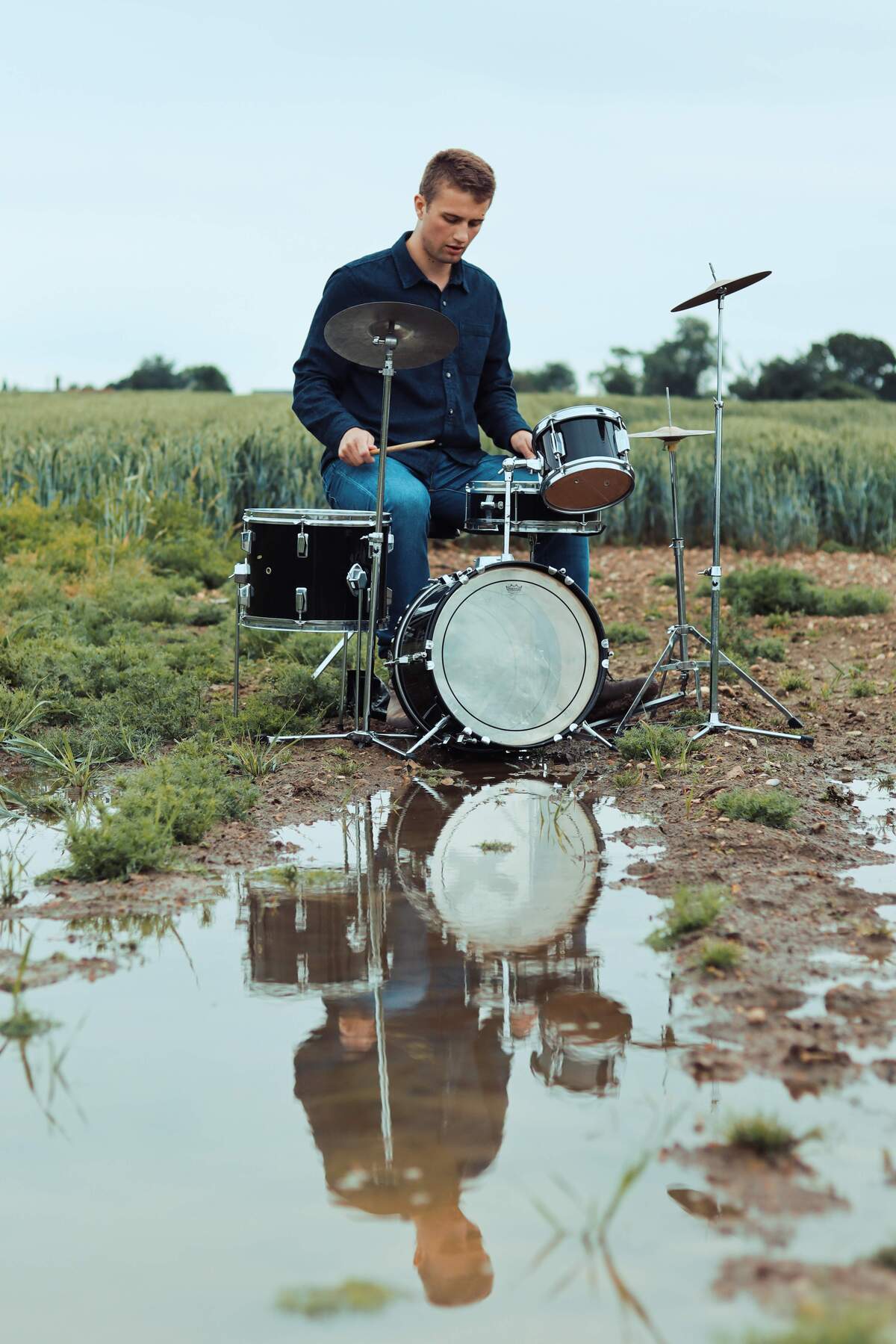
“Asymmetry is the thing that makes music live.”
You’ve called ‘PETSTEP’ the difficult second album. What made it difficult to make?
Luke Bainbridge: All three of those things, really. The whole album process took five years to complete, so it must have been difficult. The task of writing an album based on a palindrome was a challenge that took a while to develop, over years of sketches, drafts and rehearsals. It also took a while to express the change in my life and the difficult emotions I was feeling. Some musical ideas started quite light; for example, ‘Petstep’ used to be major-sounding – happy and bright. But I decided to make it darker-sounding to better reflect the emotion of the piece. It was also difficult to finish compositions when my tastes were changing at quite a rapid rate. I wanted to make sure that the music kept updating and striving towards the kind of musician I wanted to be, which was tricky to do as it was happening in real time.
‘Spillage in the Village’ began with a homebrew accident during lockdown. How did that eventually lead to the idea for the album?
It’s kind of unbelievable that a homebrew disaster during lockdown could spawn a rap, and that the lyrics of that rap ended up spawning a whole palindromic concept for an album! As I entered an unexpected flow state of writing verses for this rap track, I began to throw all my influences and tastes together into one massive pot of words. One of these ingredients was Christopher Nolan’s film “Tenet”, which is a film based on a palindrome that I recently went to see in the cinema, two days on the trot. The moment the idea of a palindrome came into my head, that was the real way in, and the lyrics ended up resembling a mission statement for the record.
‘Spillage in the Village’ brings together rap, Messiaen, MF DOOM and some quite complex rhythmic ideas. How did the piece develop?
It definitely felt like a one-off joke at first. I never thought that I would make an official release of it, and that I would be interviewed about it! I remember being excited about using words for the first time, and the fact that I viewed it as a private exercise felt liberating, to play with words and rhyme schemes with free abandon. I kept writing and laughing to myself as more bars were written, and it became a sort of personal scrapbook of ideas floating around in my head. Composition tutors have previously advised me to strip back and focus on one strong idea. But I watched an interview where Justin Hawkins from The Darkness said that if he has two ideas that aren’t fitting together, he writes a third to bring balance! It was fun to explore this maximalist approach to writing: grabbing as many disparate ideas as I can and combining them in a way that makes sense to me.
The album is also connected to the death of your family dog, Olive. How much did that experience shape the music you were writing at the time?
I wasn’t completely conscious of that balance at the time. Looking back, the death of my family dog coincided with a watershed moment where I felt the challenges of adult life. I wanted to express some of the more difficult emotions I was experiencing, but I can see now that some of those attempts were actually offset by humour.
A clear example is ‘Spillage in the Village’, where my reaction to my dad’s outburst of rage was to create a humorous rap, while still presenting it in a very rageful way. Similarly, looking back on ‘Hair of the Dog’, that track is really about anxiety, but I presented it as the feeling of a hangover, which makes it lighter.
I also kept my band in the dark about the meaning behind other compositions. Because of that, the material I wrote has a certain dark feeling to it, but the experience of rehearsing and playing it with the band was such a joy that it brings a new dimension to the music.
When did you decide to use the palindrome as the main structural idea behind ‘PETSTEP’?
There’s a great quote from Stravinsky in “Poetics of Music”: “Creativity is born in constraint and dies in freedom.” Having this palindromic concept provided a huge constraint for my creativity, but having a set of rules did help me in this period of change.
The first few compositions I wrote felt a lot more instinctive; tracks like ‘Spillage in the Village’ and ‘Hair of the Dog’ seemed to flow out without me thinking about it too much. But later on, when I was trying to pull together influences from heavy metal, dance music, polyrhythmic jazz, Turkish rhythms, it became difficult to reach a flow state. I didn’t yet have a musical language where I felt I could express the full emotional range I wanted.
So, the palindromic structure gave me a firm foundation. When I struggled to finish a piece, these rules gave me ways to generate material and transform what I’d already written.
Did you ever find that the palindromic structure became too restrictive?
I liked the idea of neat concepts like a palindrome and using Messiaen’s symmetrical scales as a palette for writing. But I also learned that asymmetry is the thing that makes music live, and all of the music that I love breaks rules in some way.
While having a concept provides structure and creative constraints, I stopped the concept from taking over by making sure that whenever a more exciting or chaotic idea came to me, I went with that instead.
The band has an unusual instrumentation of drums, trombone, vibraphone and bass. What attracted you to that combination?
It’s a space where we can all choose to jump in at different points. It allows me to write more than one part that has complex cross-rhythms or a contrapuntal nature, so I can fill that space with dense writing. Then, when we’re improvising, it gives the soloist the ability to really fill out that space however they want.
Very few of my compositions have chord symbols. To me, having a comping instrument like a piano or guitar creates a very smooth bed to solo over, but it’s not very fitting for the kind of angular music I tend to write. Stripping it back allows for a much more democratic band setup. You can change the roles in every piece – who is holding down an ostinato, who is providing that rhythmical foundation for everyone else to launch off. It was nice to allow different instruments to adopt different roles across the tracks, and within the tracks as well.
You wrote the music with Kieran McLeod, Ralph Wyld and Huw V Williams in mind. How did knowing their playing affect the way you composed the album?
All three of them are drawn to complex music with difficult rhythms, harmony, and melody that challenge the ear. That made me try to write stuff beyond my comfort zone. If something felt a little bit too nice, I tried to add a bit of grit to it.
They also have a fantastic way of playing difficult written music and improvising on complex structures. I have this image of a cat burglar in a heist film, dancing through a web of laser beams to get to the bank vault. I knew they had the ability to do that with their solos, playing with the various parts getting in their way. They all play with a freedom that I love.
Much of the music is carefully written, but there is also a lot of room for improvisation. How do you decide what should be fixed and what should be left open?
Just before we recorded the album, we had a gig at the Vortex in London. My flatmates were talking about the gig, and the girlfriend asked her boyfriend what the music was like. He said, “It’s quite math-rocky, with difficult rhythms,” giving an impression of something quite mathematical and precise. But after listening to the gig, she said it sounded a lot more punky than what she was prepared for.
That was great to hear, and was down to the way the musicians are playing the written material. They bring soul to something that, if played exactly as accurately as my Sibelius software, would become pretty repetitive and boring quite quickly. The way they push back against it helps the music breathe, sing, and have a funk to it.
Why did you choose ‘Hell’s Stairwell’ to open the album?
I knew the tracklist had to resemble a palindrome, so there were some rules I couldn’t break. But I remember Ralph suggesting putting ‘Hell’s Stairwell’ at the start of the gig we did, just before recording ‘PETSTEP’. The idea of starting with something where no one knows where the “one” is, or the time signature, or what the “genre” of the band is, was exciting to me. It felt like a good statement of how the band has changed since the last record.
The title track has been compared to Eric Dolphy’s ‘Out to Lunch’. Was Dolphy an influence on the piece, or did that connection only become apparent afterwards?
I wasn’t thinking about that record when I wrote that piece, but I have had people come up to me and quote that record after a gig before, saying it had a sort of left-leaning band approach. It’s probably a testament to the way we perform live.
At the time of writing, I was attending more free improvised gigs in London, and I wanted to find a way of getting more of that into my playing and writing for improvisers. I wasn’t quite sure how I was going to do it yet, but I’m glad that we managed to strike a balance between the written material and the improvised sections. It’s great that it comes across in a way where people are able to hear a seminal album like ‘Out to Lunch’ in my music.
How did ‘Hair of the Dog’ begin, and how did it change when you brought it to the band?
I originally wrote it as a piano etude on a landscape piece of manuscript with very small staves. I enjoyed the flow of writing bar by bar with a pencil and just seeing what would come next. I hardly ever write in a linear way, from bar 1 to bar 101, but this was a nice way of exploring that process. It started off as a piano piece, a bit like a classical rhapsody by Liszt or Debussy where it moves through different zones. When I took that to the band, I realized some of these sections could be opened up to give inspiration for improvisation.
I had also been to a gig at SJQ with Seb Rochford and Theon Cross. Seb played what felt like a very long piece that moved through different spaces, and I couldn’t tell which bits were improvised and which bits were written. It looked like he’d just been writing straight onto manuscript paper. What I was trying to get at was creating my own version of that—a through-composed journey that moves between different spaces. The way I did it was pretty much fully written, but in the future, I’d like to create that same journey starting from a more improvisational standpoint, giving up more of the creative control to the players while keeping that shape I loved so much.
Where did the title ‘It’ll Pass’ come from, and what does the piece mean to you?
I called it that after hearing my mum say that phrase in times of trouble or stress. I also heard someone talk about the phrase “this too shall pass.” It means if you’re going through a hard time, there will be an end to it and life will change for the better. But at the same time, the amazing people who are around you won’t be there forever.
It’s about cherishing the good things that you have. Good and bad things can be happening simultaneously in your life, and neither of them will last forever. So ‘It’ll Pass’ has a double meaning: it’s a reminder that this doesn’t happen forever. I think I did need to hear it, but as I look back on it, I find that I needed to hear it in a few different ways. It’s a very simple phrase, but it can be read in so many different ways.
How do you see ‘PETSTEP’ in relation to your first album?
The interaction between the four of us has a definite continuity between the two albums. It’s great to present an album with the same lineup, to hear that our relationship stays strong, and to have an identifiable sound between the two records.
I think this second album has a lot more self-cohesion. Because of the self-similarity of the tracks and the stronger shape to it, I was able to explore more ideas and emotional depth within the tracks without meandering off or losing its form. There are things that are more challenging to the ear in this one, yet it probably also has a broader appeal. We were fearless about taking in influences from popular culture and “lowbrow” music, alongside the experimental, and finding a space for them both to exist together. Everything is on a slightly bigger scale this time around—the production quality and the time taken to think about every single element. I really doubled down and wanted to surpass the scale of the first one. It’s like the first album, but bigger in ambition.
You recorded ‘PETSTEP’ at Lightship 95 over two days. What do you remember most about those sessions?
It was terrifying having to capture it in two days! Having recorded more since then, I’ve realised that recording a live album over two days is very ambitious. I was a bit blissfully ignorant of what I had agreed to do. We did the first album in one day in my parents’ shed, so I thought two days would give us plenty of time. I didn’t realize that writing more difficult, involved music meant two days was the absolute lower limit of what you could expect to capture it all in.
We originally planned to record things in chunks to be more efficient, but in the end, we just did full takes of each track. In order to get through this huge body of music, we basically had to enter a flow state. We stopped being aware of piecing together the album and just tried to capture the raw energy of us bouncing off each other. That couldn’t be expressed more clearly than in my choice of how to record the rap on ‘Spillage in the Village’. It was suggested I record the drums first, and then go into the vocal booth. But I decided I needed to do it simultaneously. I couldn’t get the energy of the drums without rapping at the same time, and if I had done the rap without playing the drums, I would have felt completely self-conscious. I needed the angst of doing it at the same time to come across. The focus and adrenaline of getting this all done in two days meant we went into a flow state where it just happened, and I’m very glad that it did.
“I’m basically starting the creative cycle again, asking myself what kind of musician I want to be now.”
You’re releasing the album through your own Crossing Styx Records. Why did you decide to start your own label?
It was a bit of a practical decision. I would have loved to work with a label, but I’d already chosen the artwork and put so much of my own stamp on this album that I doubted a label would want to pick up something where most of the creative decisions had already been made.
I set up my own label and named it Crossing Styx because ‘Crossing Styx’ was one of the first compositions I wrote that combined my jazz influences and contemporary classical in one piece, and it won the Dankworth Prize for Composition in 2018. It felt like a nice imprint for releasing my own music, and having all of my work under one umbrella catalog. The process of putting this out on my own and learning about the business makes me feel like I could do this in the future. Regardless of whether I continue to release music or not, the idea of Crossing Styx—the journey to the dead—feels apt. We are all heading to death, and I feel like I will be doing music to my death.
Now that ‘PETSTEP’ is finished, what would you like to explore next?
This album has spanned a big chapter of my life, and I’m really looking forward to having some space to think about new ideas once it’s out. I’m basically starting the creative cycle again, asking myself what kind of musician I want to be now, and how I can write music that looks forward.
I’d like to take everything I’ve learned and carry it forward in a way that feels sustainable. I don’t feel the need to completely reinvent the wheel this time, but I do want to find new ideas that I’m genuinely excited about. I haven’t been able to finish a piece of music in a while, but I have lots of ideas saved up, so releasing this record will finally give me the headspace to start exploring them.
I’m also really looking forward to playing more. A lifetime goal of mine is to play gigs in European cities like Paris, Brussels, Berlin, Amsterdam, Cologne and more. It feels like a gargantuan task that will require a lot of thought, but it’s something that fills me with a lot of excitement. If this album helps me reach that goal, that would be absolutely fantastic.
Klemen Breznikar
Headline photo: Ted Smith
Luke Bainbridge Website / Facebook / Instagram / YouTube