
Tamio Shiraishi on Fushitsusha, Tokyo’s Minor and Playing Saxophone in New York Subway Stations
Shiraishi recalls his early performances with Keiji Haino, the unusual way he acquired his first saxophone, and why he prefers playing in deserted subway stations.
Born in Japan in 1949 and raised in Gunma, Tamio Shiraishi studied mathematics before becoming involved in Tokyo’s underground music scene. He was already in his late twenties when he began performing. Before that, he had spent years listening to rock and free jazz and going to avant-garde theatre, butoh and other experimental performances. By the late 1970s, he was playing synthesizer at Minor, a small venue in Kichijoji where punk musicians, free improvisers and performance artists gathered. He helped organise events there and played alongside Keiji Haino in the original duo incarnation of Fushitsusha.
Shiraishi later took up the alto saxophone without any formal training. His playing is often extraordinarily high-pitched, at times barely recognisable as the sound of a saxophone. He also worked with theatre groups and butoh dancers, and began performing outdoors in Tokyo, where he became interested in how his instrument sounded in open squares and between buildings.
His job as a software engineer took him to New York in 1990. He returned to Tokyo in 1992 before settling again in New York in 1994. There he played with musicians including Sean Meehan, Mico and Alan Licht, and eventually began performing in subway stations, often late at night. He wasn’t interested in busking or attracting a crowd. In fact, he preferred having the platform to himself, listening to his saxophone echo down the empty tracks. He continued working as a software engineer until the mid-2010s, while recording and performing whenever he could.
In our interview, Shiraishi remembers the early days at Minor, his rehearsals with Haino, his first attempts at playing the saxophone, and the places he has chosen to perform over the years.
“I prefer playing at a deserted station.”
What were you listening to before you began performing yourself? And when did you first start wanting to make your own sounds rather than play conventional music?
It was a long time ago. I barely remember. At university (I was a very slow starter), I started listening to the Beatles, the Rolling Stones, hard rock, progressive rock… like many young people. Then, soon, I became a frequent audience member at Japanese avant-garde theatre, butoh, performance art, films… AND free jazz. Before I started performing myself (I was already in my late twenties), I was already familiar with some Japanese free jazz performances. When I started my daytime work as a software engineer (it’s a frustrating life, of course), I decided to start getting involved with sounds. But when we first encounter melody in music textbooks, we definitely realise that it’s totally different from what we’d like to do. So somehow, I passionately started making immature sounds (not music), with an ambiguous image, away from ordinary melody.
You worked as a software engineer for around forty years. Did having a regular job give you more freedom as a performer? Was it difficult to keep your working life and music separate?
Yes, I was always aware that my involvement with sounds and art was not for money. Financial issues exist for whoever, whenever, whatever you are. But freedom from financial concerns is a different issue from sounds, I guess. Separation of day and night? Until my mid-thirties, I felt it wasn’t very difficult to separate sound and art-related issues from daytime business work. But it became more difficult as I got older.
At Minor in Kichijoji, you organised Joyo-Kachi-Bunkai-Kojo and co-organised Aiyoku Jinmin Juji Gekijo. What was happening there at the time? How did you end up organising these events?
It was an age just at the beginning of punk rock in Japan. So some young people were looking for a scene. And somehow, some young people who were looking for “something more” gathered at Minor. Most of them were around twenty years old. But some, including Keiji Haino and me, were in our late twenties. And when the young people there started to do something, I happened to become the person coordinating those “extreme” works by the young people.
In the late 1970s, you played synthesizer with Keiji Haino at Minor in the early duo version of Fushitsusha. You’ve described playing together as more of a duel than a duet. What made those rehearsals so intense?
I said (or wrote?) this when explaining our rehearsals in a studio (actually, it was at Minor in the daytime). I guess it’s like a fight in boxing, wrestling or judo. When fighting, you concentrate on your opponent with extremely high tension.
I’d read that a friend gave you your first alto saxophone after borrowing money from you. Is that what happened? And what do you remember about trying to play it for the first time?
It’s not a gift but a pawn. When I spoke about this, I thought I said “pawn”, but because of my poor pronunciation, people always thought it was “porn”. So our conversations didn’t make sense. Anyway, when I first played sax, I didn’t know how to play it at all. So I happened to bite the reed, and it sounded very high-pitched and very loud. That was the beginning.
You were already going to avant-garde theatre and butoh performances before you became a musician yourself. Later, you worked with the theatre company Homo-Fictus and with butoh dancers. What interested you about those performances?
As I wrote above, I had been an audience member at avant-garde performances for a long time. So they were already familiar to me. I liked sounds as one of those performance arts.
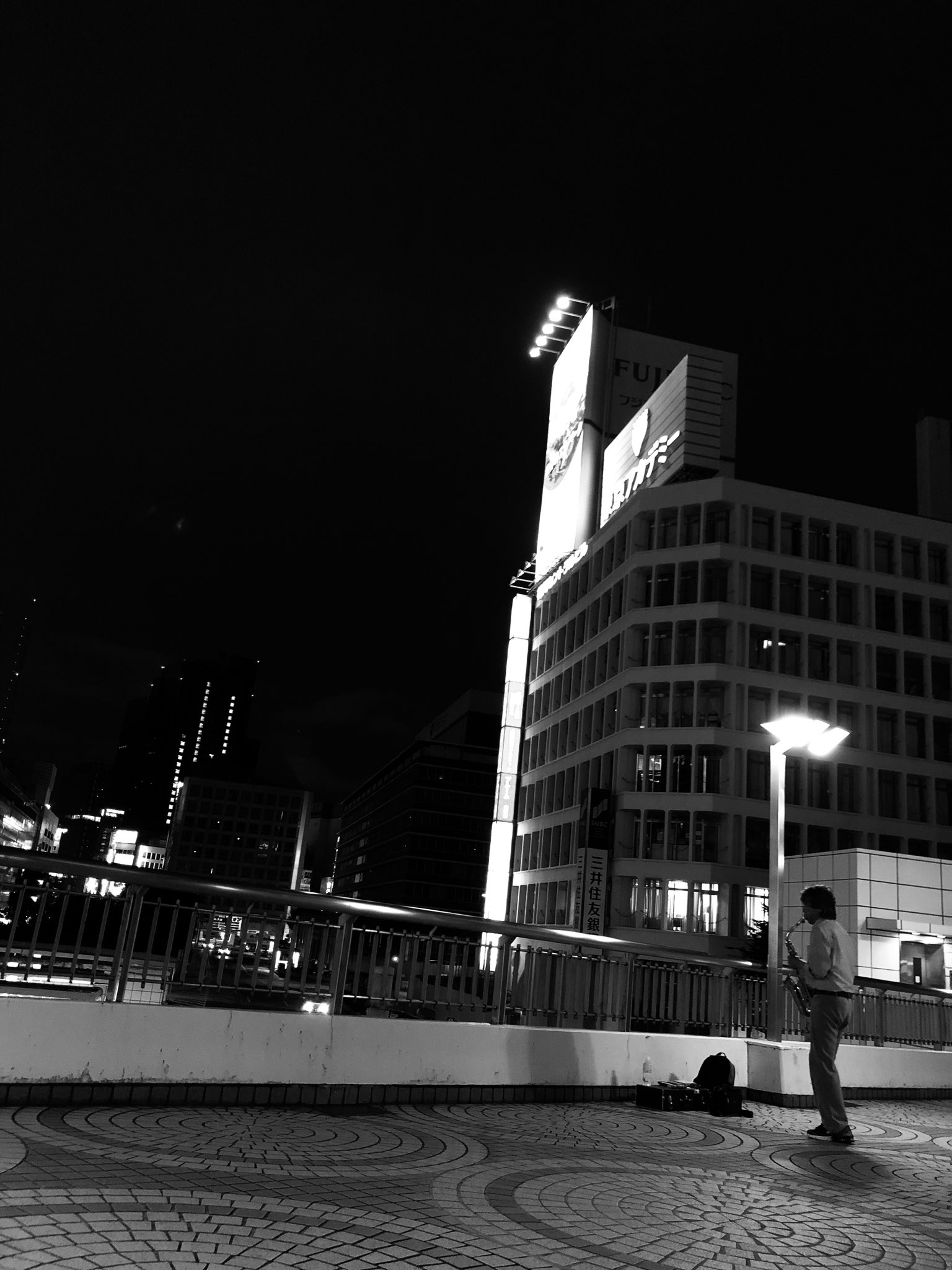
While you were living in Tokyo, you began playing outdoors at Shinjuku’s west exit square and later on a pedestrian bridge at night. What did you like about those places compared with clubs or concert halls?
I prefer playing in wide open spaces with “particular acoustics” rather than in enclosed concert venues.
You moved to New York in 1990, returned to Tokyo in 1992 and settled again in New York in 1994. During your first stay, you spent time at ABC No Rio. Was it difficult to get to know people and find your place in the music scene? How did you feel about musicians who came through on tour?
My English was, and still is, very poor (especially in conversation). My poor ability in English conversation makes everything different. In New York, although I live here, I’m totally a stranger. I’m at most just one of the performers. Regarding touring musicians: Before the internet, touring was the only way as a showcase. It was OK. Now, after the internet, they still follow the old style of “touring”. I feel communication between people on tour is too brief to create or investigate something deeply.
You’ve been playing in New York subway stations for many years, usually without asking for money. Do you pay much attention to the people passing by, or would you rather have the station to yourself?
I prefer playing at a deserted station. Maybe I like to listen to my own sounds fading away along the railway tracks of a wide, vacant station.
How do you choose a subway station? And what do you do when a train arrives while you’re playing?
Almost all the stations where I play are wide, with two express tracks in the middle, two local tracks on both sides, and few passengers. I always stop playing while a train is stopped at the platform.
In 2007, you took part in Arika’s ‘Shadowed Spaces’ project with Sean Meehan, Ikuro Takahashi and Denis Wood, performing in unusual places in Scotland and Newcastle. What do you remember about that experience? How did those places compare with the subway stations in New York?
I really loved that event in Scotland. It was a great job by the organiser, Arika, of Edinburgh, Scotland. They did a lot of work before and during the performances. Finding the places (many), planning the details, guiding audiences like a tour guide… a lot of work. All the places we performed were kind of “shadowed”. Like a big, vacant parking structure, deserted sidewalks along big streets surrounded by old, tall buildings, etc. Most had good echoes and reverberation. They were different from subway stations but had similar outdoor sound conditions. I also had an additional welcome from the seagulls. The seagulls in Scotland welcomed (or hated) my sounds, flying over our performances at most places.
Recordings such as ‘Live Performances: 1992–1994’, ‘Subway’, ‘Subway Stations in Queens’ and ‘Noisy Subway 2024’ capture your playing in particular places. How much of the experience do you think a recording can preserve?
I don’t know about ‘Subway Stations in Queens’ and ‘Noisy Subway 2024’. Did I publish these? Anyway, most (maybe all?) of the sounds on the first two were recorded with my small portable recorder. Then I/we made some minor edits, not major edits. In that sense, the sounds may not represent the whole circumstances.
You’ve worked with Sean Meehan and Mico, and ‘Moon’ collects ten duets with different musicians. How does playing with another person compare with playing alone? What do you look for when working with someone else?
As I wrote above, I have never studied “music”. So, in terms of “music”, I have very little ability to listen and collaborate with other performers. I guess I can collaborate with the “sounds” of other performers, instead of their “music”.
“I can perform only improvised sounds.”
On ‘Sora’, you often play the alto saxophone in its very highest register. Some of it was recorded at ISSUE Project Room and some at Thousand Caves in Queens. After all these years, do you usually know what sounds the instrument will make, or does it still surprise you?
All of my performances are improvised. I can perform only improvised sounds. I don’t mean I can control my sounds, but I guess I know how my instruments sound after long experience.
Your recordings for ‘Enka Mood Collection’ were made at Uramado in Shinjuku Golden Gai in 2005, with guitarist Malenkov accompanying you. You sang songs including ‘Yogiri no Blues’, ‘Abashiri Bangaichi’ and ‘Tokyo Nagaremono’. Had you been singing those songs for a long time? How did that particular performance come about?
While I was living in Japan, I often visited Golden Gai. There I sometimes sang songs with a nagashi guitarist named Malenkov. The songs mentioned above were ones I always sang with Malenkov at Golden Gai. When I was invited by Uramado to perform, I didn’t want to play sax in the very tiny room of Uramado. Instead, I suggested singing with Malenkov, as I always did in Golden Gai.
You’ve said before that “all music is noise” to you. Do you still feel that way? What does the word “noise” mean to you now?
I admit my sounds are noise. But also, I’d like to say most “so-called music” is noise. There is so much “music merely for show” in the streets, towns, on TV, on the internet… everywhere.
Klemen Breznikar
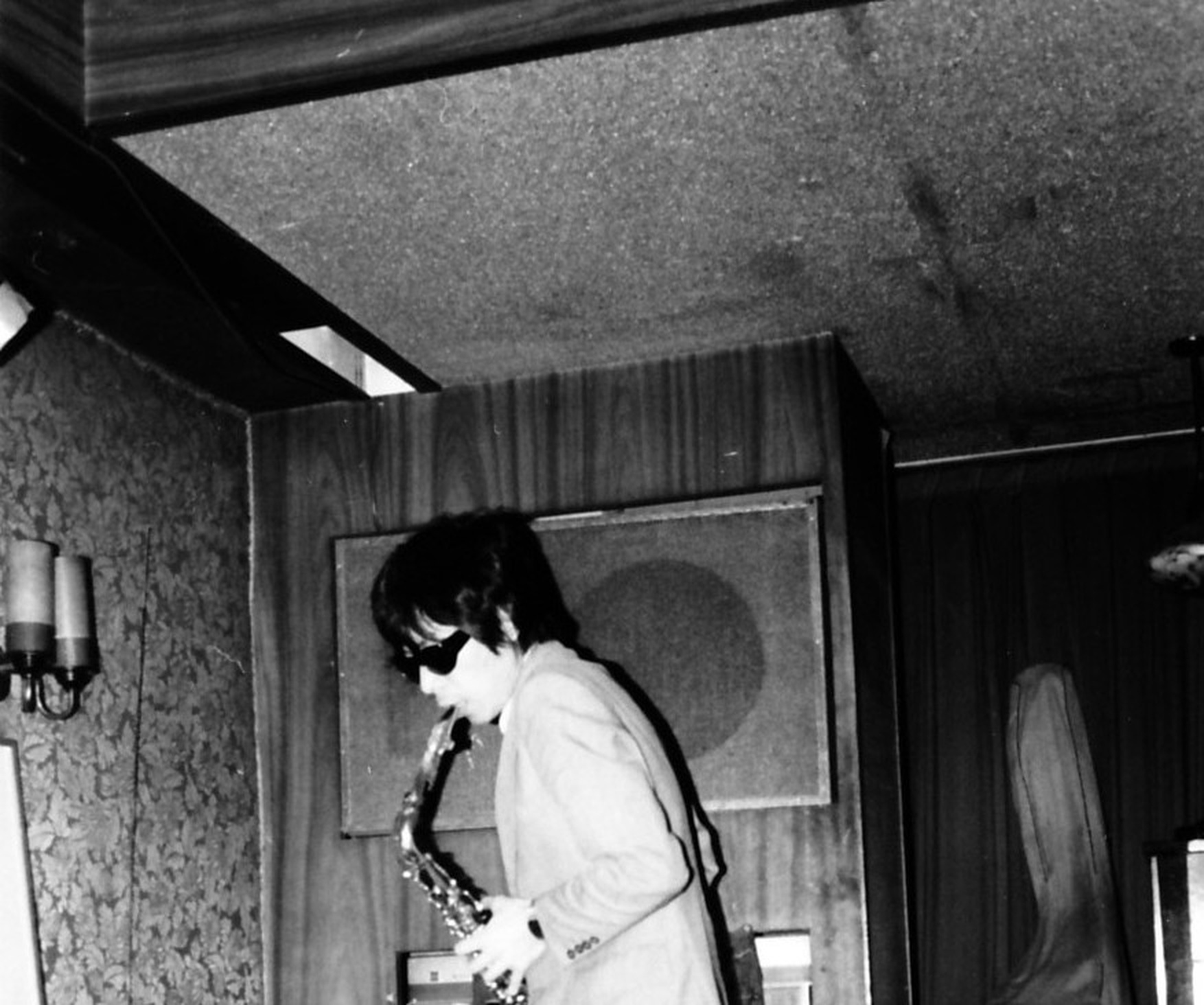
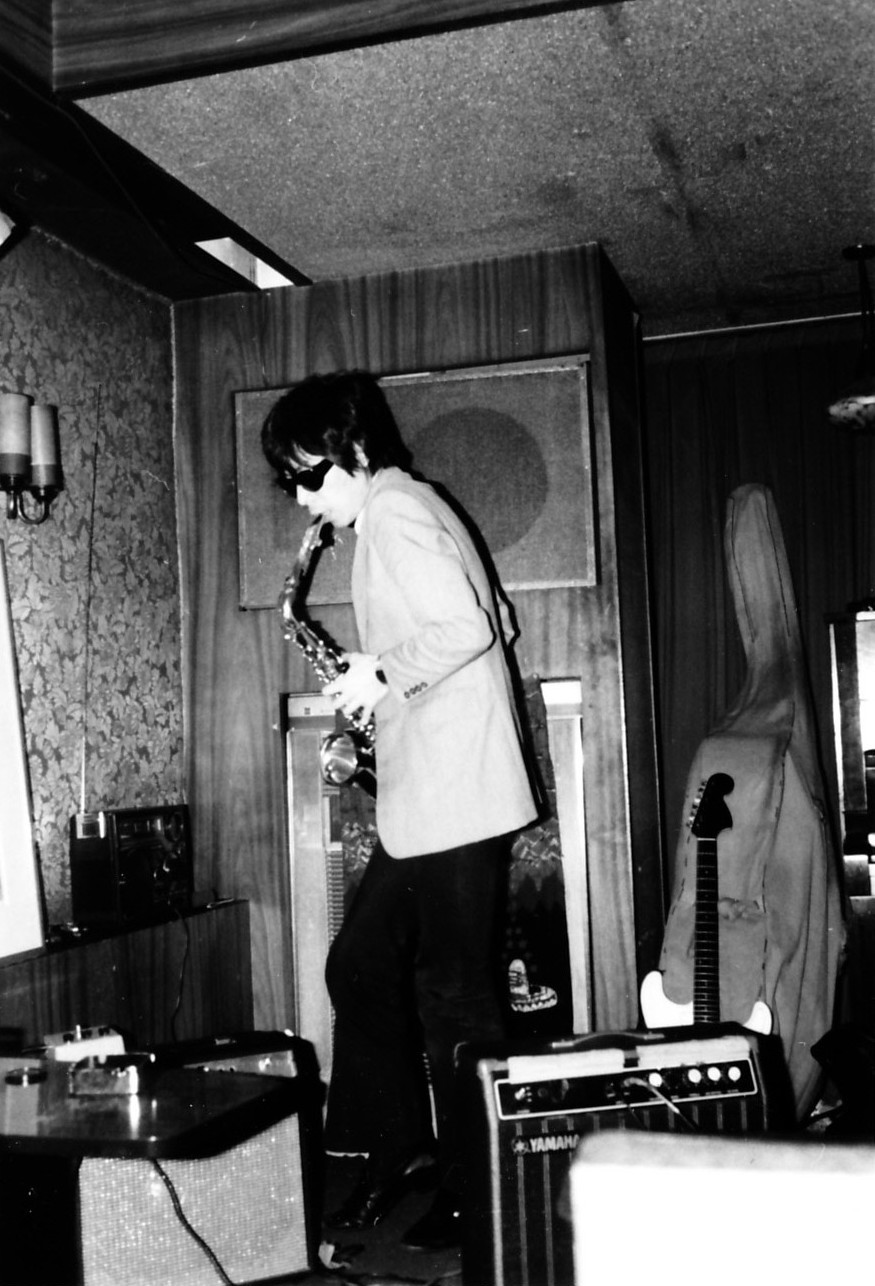
Headline credit: Tamio Shiraishi in Ogikubo, Tokyo, 1981. Photo courtesy of Tamio Shiraishi’s personal collection.