
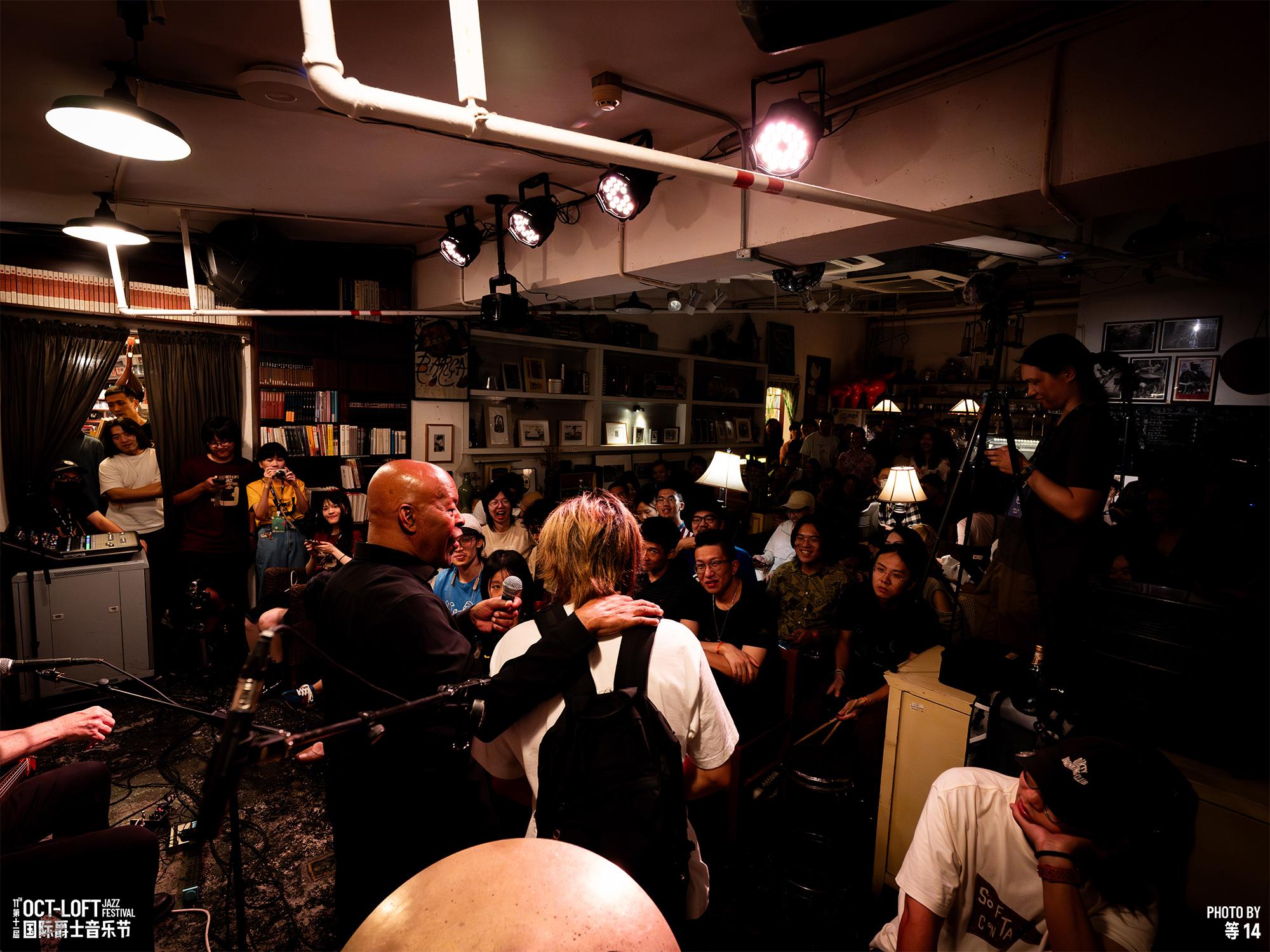

William Hooker Discusses New Album ‘Convergence: Live In China’
“Oh my god, music and sound is endless. It’s always all the things you just said. It never ends… it is just like LIFE.”
That is William Hooker in a few lines. For more than five decades, the drummer, composer, poet and improviser has followed that sense of possibility wherever it takes him. He came up through jazz, rhythm and blues and gospel, but none of those traditions ever became a boundary. They became part of the language. Over the years, Billy Bang, William Parker, David Murray, Elliott Sharp, Thurston Moore and many others have entered that language with him, while Hooker’s own work has grown into more than seventy recordings, alongside poetry, film and other multidisciplinary projects.
‘Convergence: Live In China’ finds him with guitarist and composer John King at the B10 Festival in Shenzhen. Two musicians, drums and guitar, a long way from New York. Yet for Hooker, what happened there seems to have gone well beyond the concert itself. “I felt a profound oneness,” he says. “It has never left.”
We talked about China, history, improvisation, tradition, trust and the strange freedom of not knowing exactly where the next note will lead.
“The music is the directive.”
In our first interview, you said, ‘All my albums have concepts behind them.’ What does ‘convergence’ mean to you on this record with John King?
William Hooker: Convergence is all of these rolled into one in a particular space and time, with people far, far away. Yet they are breathing and aware of my work and my existence on this earth. They are also aware of our oneness. This is separate from all that they try to foster on us regarding separation and color and language and genderism.
I felt a profound oneness. It has never left. This was necessary for my growth.
You wrote that the invitation to China came as a surprise. When you listen back, do you hear that whole journey, the distance, the place and the people, in the music?
This gave me a sense that what I had known all along was true. It confirmed the body of work I have accomplished and the many people I have worked with to spread my work throughout the world.
A vast world. A world where most of its inhabitants are not seen or thought of.
It was a unifying and heartfelt experience. A confirmation of sorts.
You have often pushed back against easy comparison. In our last interview, when I asked about older material and newer projects, you said people should not go there, they should listen. I understand that more now, because a record like Convergence is not really “about” where it fits in the catalogue. It’s more like evidence of a living event. Still, this album arrives after Symphonie of Flowers, Big Moon, Flesh and Bones, and Jubilation, all released through Org Music, and all very different in shape and personnel. Do you see these recent records as separate statements only, or do they also form a loose story about where your mind, body, and spirit have been in the last several years?
Wow… these questions are profound.
I have been feeling a togetherness, a convergence of spirit and blood. A recognition of the body of the cosmos that speaks to one. Not just a physical one, but one of like mind and purpose. This I have always tried to recognize in my music, poetry and multidisciplinary projects.
As I type this, I feel a joyfulness in the reminiscences of my arrival there and the instant camaraderie. I am hoping that this can happen in other parts of the globe as well.
The people and their spirit are so important to me, as is the cosmic message on UNITY.
How did you and John King find a shared language for this performance? Was trust the main structure behind it?
The music is the directive.
I can only describe the process of the improviser as one of trust in the spirit and the goodness of the future, which is the next note. I deal, often, in that realm.
I worked from a place of trust in the spirit and the capabilities of those I choose to work with, to explore with. I am not so sure of the vehicle because some help, some hinder and some are just coming along for the ride. I don’t think about that.
I have played a lot of music and those spirits I have worked with guide the journey. I have trust in that. I am also aware of the power behind such a creative force of unity and musical truth and history.
There is a lot to see. The eyes are not the only vehicle, and the ears can be deceiving as well.
You’ve worked with many guitarists over the years. Does the guitar take your drumming somewhere different from other instruments?
I like every instrument and I like every instrument to play MY music.
What you say about guitar can be said, in my music, about saxophone, piano, etc. Every instrument moves me to go in different directions. I have played with a million sax players.
“I grounded myself in traditional forms.”
You’ve said that jazz can talk about history because jazz itself is history. Did you feel yourself carrying that history with you when you played in China?
Of course I carry all of my background with me. All of us do.
Music reaches, as well, something that transcends all of this and reaches to a oneness. It is always a joy, a joy to experience, whether you are the musician or someone in the audience.
There is planning in your work, but also a lot of room for surprise. How do you balance preparation with letting the music happen?
I rely on my own experience, history and the many times I have presented my work. I try to make the conditions come up to my aspirations for a great performance in the time it is presented.
Years ago, you described the Loft jazz scene to me as ‘New. Scary. Incomplete. Searching. Present.’ Do those words still describe music for you today?
Oh my god, music and sound are endless. It is always all the things you just said. It never ends… it is just like LIFE.
The titles on ‘Convergence’ are very evocative, from ‘Red/Wavelengths’ to ‘Words – So Needless.’ How important is naming a piece for you?
Albert Ayler addressed it in an interview: ‘I just named it.’ Then it is done.
What would you like younger listeners discovering your work now to understand about where this music comes from?
In the beginning of my career I had a strong foundation in standard classic jazz, in rhythm and blues and in gospel.
Many years I played in a classic jazz group and many years I played in rhythm and blues, and gospel was a strong part of my upbringing.
I don’t just jump into avant garde jazz and try to find new forms of music. I grounded myself in traditional forms.
Klemen Breznikar
William Hooker Official Website / Facebook / Instagram
Org Music Official Website / Facebook / Instagram / Twitter / Bandcamp / YouTube

Thanks so much…Let’s do it again soon with a part 2 – if you will.