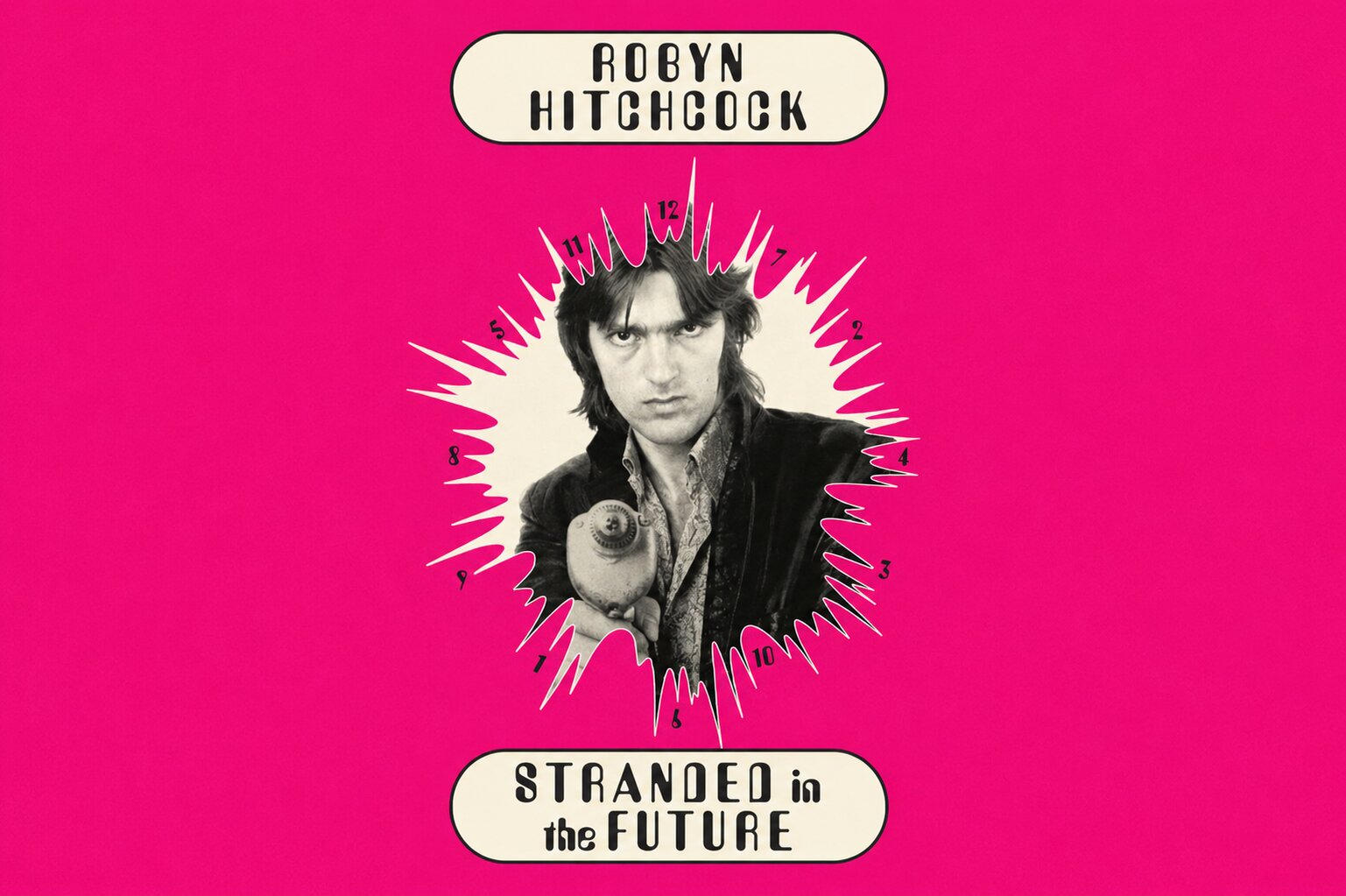

‘Stranded in the Future’ by Robyn Hitchcock | A Surreal Journey Through 1968–78
Following up on his 2024 autobiography that covered the singular year of 1967, Robyn Hitchcock (73 years young at present) has now offered personal recollections from the next decade of his life, 1968-78. But of course, him being who he is, this is no normal memoir. Rather, it’s a surreal trek through remembrances that are disjointed on the surface yet that always follow a certain mind-bending path.
In the early chapters, we read along as the then still teenaged Hitchcock engages in an often-uncomfortable relationship with a girl he favors. Interspersed are his thoughts on Syd Barrett, to whom Hitchcock as songwriter/performer has so often been compared. We also watch him come of age as a music listener, seeing Dylan and Hendrix at the Isle of Wight festival in 1969 and ‘70 respectively, following the career of The Incredible String Band, spouting Captain Beefheart lyrics to his uninterested girlfriend, etc.
The next chunk of the book – all of which could easily be ingested over one sitting of a couple hours – spends just a brief time covering Hitchcock’s world in the early ‘70s before plunging ahead to ‘76 and the early days of what became The Soft Boys. In between, he tells in his stream-of-consciousness manner of becoming more and more obsessed with Barrett (particularly his solo albums), brief times spent playing in a band while at art college then as a solo folk performer who admired Martin Carthy, and he touches briefly on his early days as a family man.
The third quarter of Stranded in the Future is an often-cartoonish account of the formative years for The Soft Boys. They annoy Robyn’s neighbors with loud rehearsals of their quirky mixture of spastic art rock and neo-psychedelia, release a debut single, get first attention from the press, and so on. Barrett (Hitchcock never actually names Syd but we know who he’s talking about), or the ghost of him, continues to be a presence, as does the author’s former girlfriend, who remained in his thoughts even when he was then married to another woman and raising two children with her. In this segment he also discusses his relationship with punk rock, which he seems to have appreciated in a way without being drawn to it stylistically in making his own music.
The final section of the book includes a lengthy, druggy vision Hitchcock had at the time while hanging out with eventual Soft Boy Kimberley Rew, this piece reading like a dream sequence from a movie as scripted by Lewis Carroll. Also in this part of the book Hitchcock tells of The Soft Boys opening for Elvis Costello and the Attractions on a few occasions, him meeting Nick Lowe who regarded the band’s songs more highly than did others at the time, and finally The Soft Boys becoming a fully realized act, with managers and publishing contracts and the like, for better or worse.
Throughout the read, what really comes across via Hitchcock’s psychedelic storytelling is the picture of a teenager and young man discovering life and his own place in the world. There’s scenes with his friends, his love interests, his record collection, his interactions with people at large, his coming into his own as a musical performer, etc. that all gradually reveal the mind and spirit of the artist we’ve come to know through his otherworldly yet melodic songs. And there’s a universal feel to the words, such that they’re likely to conjure memories for any reader as they reflect back on their own years of being a teenager and young adult.
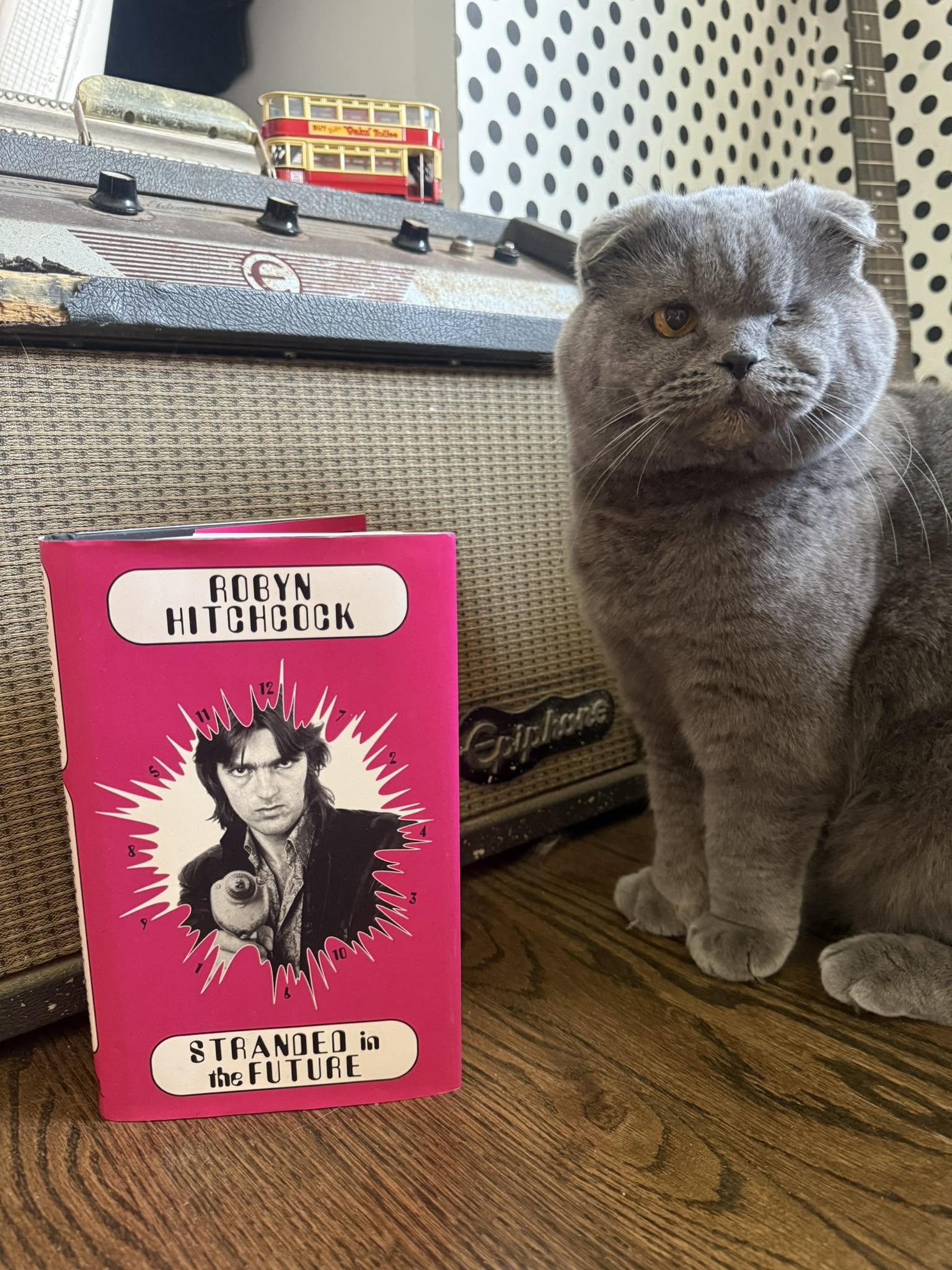
The whole read is a swirling tapestry of scattered thoughts that come to create a whole. It’s chronological yet it’s reminiscent of Dylan’s Chronicles, Volume One in following a path that flows with the writer’s subjective thought patterns rather than being a straight rendering of these times from his life. There’s nothing wrong with a conventional autobiography, if it’s well-written and the author’s life is interesting, but it’s refreshing to read one that’s penned in a less standard manner such as this. And who would’ve expected or wanted Robyn Hitchcock’s writings to be any more conventional than his music, anyway?
Brian Greene
Stranded in the Future by Robyn Hitchcock (Akashic Books 2026)