
The Flintstones of Calcutta: Park Street Beat-Pop and Psych on the ‘Happy By My Side / Be Mine’ 7-Inch, Reissued for RSD 2026
The Flintstones formed in Calcutta in the mid-1960s, at a point when Western pop and rock had begun to circulate more widely among the city’s Anglo-Indian community.
Members of the group, including Clayton Saunders and Rhett May, had been exposed early to artists such as Cliff Richard, The Shadows and The Beatles, learning songs from radio broadcasts and imported records that were often difficult to obtain.
The band itself came together for what was intended as a single performance, assembled from musicians already active in local groups. The response to that appearance led to further engagements, and the Flintstones soon became regular performers along Park Street, the centre of Calcutta’s nightlife. Venues such as Trincas provided a platform for bands from across India, and the Flintstones established themselves within this circuit through frequent live appearances.
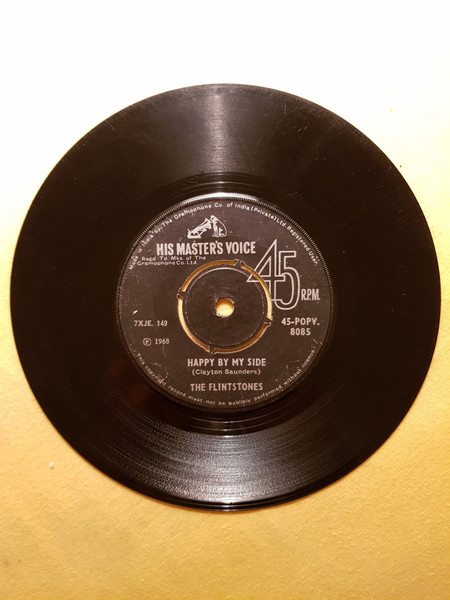
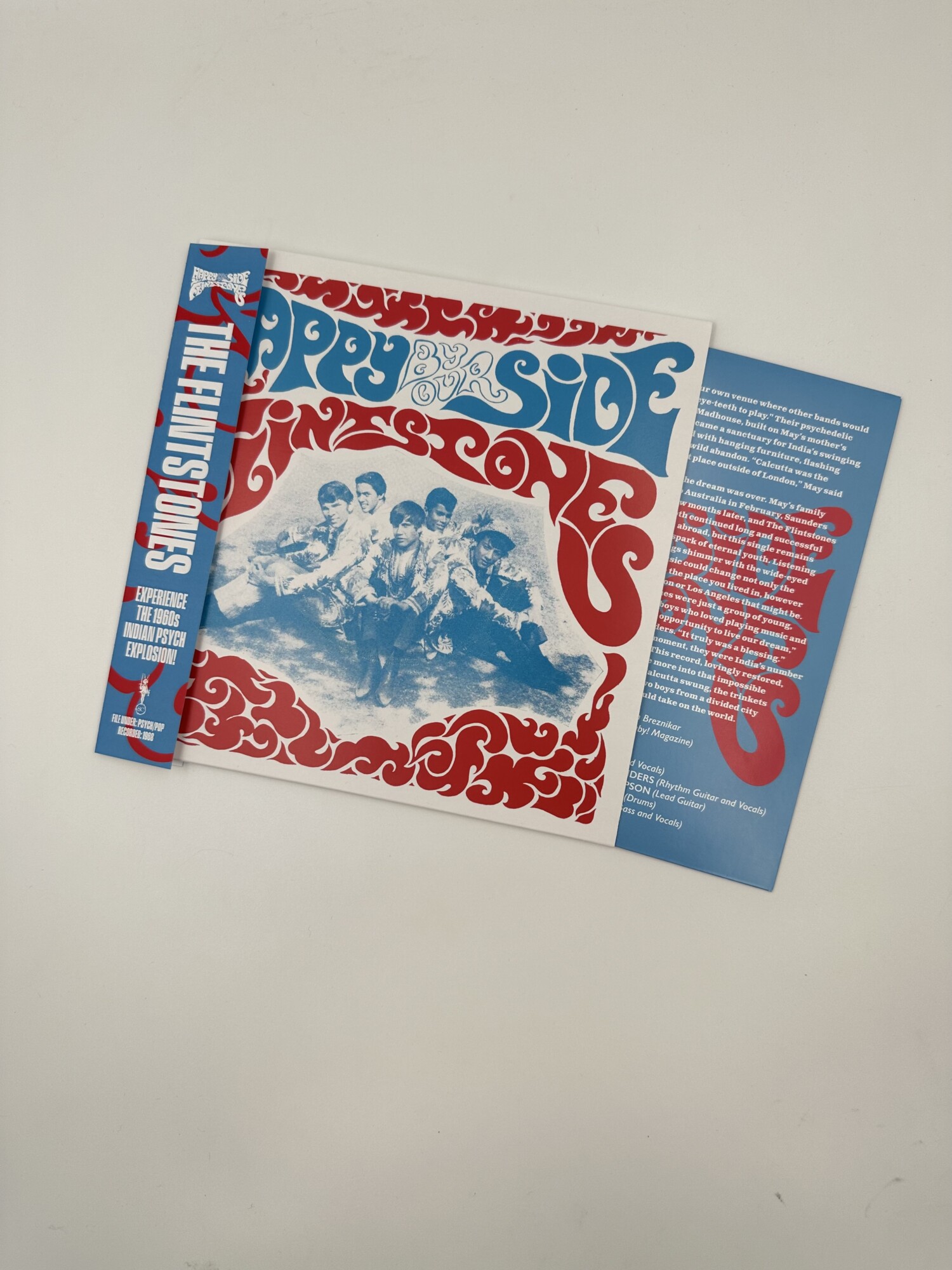
Their recording for His Master’s Voice stands as the only document of this period. Issued as a beat-pop 7-inch with a light psychedelic edge, ‘Happy By My Side’ / ‘Be Mine,’ it has been reissued for RSD 2026 by Seelie Court and Good Time Records. The session was carried out in a single studio space, with the group performing together without separation of instruments or multiple takes, a common practice in India at the time. The result reflects the band’s live approach, with close vocal harmonies and a direct ensemble sound. Following the departure of Saunders and May, later versions of the group appeared as a backing band on recordings by Usha Iyer, including singles such as ‘Dizzy’ and ‘The Trip,’ and ‘Summertime’ and ‘Blues Train,’ also issued on His Master’s Voice in 1969.
Shortly after the release of ‘Happy By My Side’ / ‘Be Mine,’ both Saunders and May left India for Australia, bringing the group’s original line-up to an end. No further recordings were made under that formation, and the single remains the sole recording of their work in Calcutta during this period.
What followed took shape elsewhere. In Australia, both musicians became involved in new groups and circuits, working within a different environment that did not extend directly from their work in Calcutta. The connection remains, but the music developed along a separate line.
Seelie Court has begun to bring this later material into view. It stands alongside the Flintstones recording rather than continuing it directly, emerging from the same origins but shaped by different conditions. Further details will be announced soon, pointing to a move into 1970s heavy rock!! Liner notes by yours truly are included in the release.
“All I can remember is an incredible music scene.”
Where were you born and where did you grow up?
Clayton Saunders: I was born in April 1950 and grew up in Calcutta, India. I lived there until I was 19 years old before I moved to Australia.
Rhett May: I was born in Calcutta, India, on 27 January 1950. I was sent to an orphanage boarding school at the age of seven. The school was called Dr Graham’s Homes, located at the foothills of the Himalayan mountains in Kalimpong, India. I was there until the age of thirteen, after which I was raised in Calcutta until I was nineteen.
You were raised in Calcutta, India. What was life like growing up there?
Clayton Saunders: Calcutta was a vibrant, colourful and interesting place for a kid like me to grow up in. It had many different cultures, castes, languages and religious beliefs. There were twenty-five different dialects in Calcutta alone, as far as I can remember. I never learned to speak Bengali or Hindi, just what was called the servants’ Hindi, a mixture of English and Hindi words.
I was exposed to and witnessed the sporadic clashes between Hindus and Muslims. Still, I am glad I had my upbringing in Calcutta, as it taught me many life lessons, including humility, kindness, forgiveness and empathy toward those less fortunate.
Although, growing up as an Anglo-Indian, we were not really accepted by the majority. Anglo-Indians did not feel like they truly belonged to any country. Still, it was a good foundation upon which my character was built and nurtured.
Rhett May: In the 1960s, Calcutta was a turbulent city – dirty, chaotic and, because of the frequent power cuts, a dark city.
Lifestyle, fashion and Western music influences were spreading rapidly, and Calcutta was the go-to city for contemporary musicians who wanted to make it big.
At the time, the only Western pop and rock music on the radio was on Sunday – the Binaca Hit Parade via Radio Ceylon. It had become popular in the 1950s when India’s national broadcaster, All India Radio, had banned all Western music apart from Indian classical.
The greatest and most influential catalyst for pop and rock music was a publication called The Junior Statesman.
It was the brainchild of Alfred Charlton, Editor of The Statesman, a major Indian newspaper. He conceived JS as a children’s magazine and wanted to create something for adolescent readers so that brand loyalty could be developed from a young age.
In 1966 he hired Desmond Doig as Editor in Chief of The Junior Statesman, and in doing so, changed the course of Western music in India.
In 1967 Doig recruited Dubby Bhagat and Jug Suraiya to write. The typical JS reader was an urban, English-speaking person, and soon The Junior Statesman took off like a rocket – introducing all the latest music from bands like The Beatles, Jimi Hendrix and Led Zeppelin. They frequently travelled to England and brought back the latest news and records to write about, promote and discuss.
This blew open the music scene in Calcutta and the rest of India, with venues opening everywhere and bands battling it out in competitions and fashion trends.
A couple of the cinema theatres would hold Sunday jam sessions with Elvis movies, Cliff Richard films, Herman’s Hermits, The Dave Clark Five and others, with kids dancing in the aisles. Every Sunday the cinemas were packed.
From 1965, when I was fifteen, all I can remember is an incredible music scene – living, breathing, fashion, music, all within the Indian culture we lived in.
There was no television, so almost every house had parties and singalongs. Almost every weekend there were dances and shows somewhere.
Was there a particular moment in your life when you knew you wanted to become a musician?
Clayton Saunders: As far as I can remember I always wanted to become a musician from a very early age. I remember seeing the baby book my mother kept on me when I was about 12. In the ‘What do you want to be when you grow up’ section, I had written the letter M. I asked my mother what M stood for and she told me musician but that I didn’t know how to spell it at the time. In fact I had two dreams on the go, one was to be a jockey and the second was to be a musician/entertainer. I did train to be a jockey but eventually grew too tall for the sport, and music won out in the end.
Rhett May: In boarding school and at a very early age we would crowd around the radio listening to the Binaca Hit Parade from Radio Ceylon and we knew every word to every song.
I was…as most kids were…knocked out by Elvis, Fabian, Cliff Richard. My father and mother were always dancing to records by Nat King Cole, the Inkspots, Frank Sinatra…music was a way of life for me.
All I wanted to do was sing.
Clayton, you started taking piano lessons very early on. What sparked your interest in music?
Clayton Saunders: I was taught the piano from the age of seven and played light classical tunes such as The Blue Danube Waltz, The Teddy Bears’ Picnic, Barcarolle, the Skaters’ Waltz and other favourites. I was invited to be a guest performer on the AIR (All India Radio) children’s half hour program. The program was held on Sundays with a massive listening audience tuning in from all over India. I became a favourite and was invited back to perform on a semi-regular basis. I did this for two or three years from memory.
I used to listen to a lot of music on the radio when I was very young. My mother had a His Master’s Voice stereogram. I’d sit with my ear pressed to the speaker and sing along with the popular songs of the day. The reception of course was terrible, very static but that didn’t deter me. My early influences were many: Bing Crosby, Nat King Cole, Dean Martin, Perry Como, The Andrews Sisters, Jim Reeves, The Kingston Trio, The Bachelors. In my early and late teenage years, it was Cliff Richard and The Shadows, The Beatles, The Monkees and early Rolling Stones.
What led you to join your first bands?
Clayton Saunders: Christmas of ’65 I had left school looking to forge a career in music. I met two brothers and their cousin who were interested in forming a band. We called ourselves The Skylarks and performed at various clubs around town. Being 15 and looking like I was 10, I was always given a tough time about getting into the clubs to perform. For NYE, we were booked to do a floorshow and asked to provide different elements to the show. Being the innocent-looking one, as the other members were older (and not as cute looking as I was haha) I performed the famous dance of the seven veils. I fooled everyone into thinking I was really a girl, till the end of the number when I pulled out the tennis balls I had in my bra and bounced them on the dance floor. It got a good laugh though some of the ‘men’ were ‘curious’ about me. It was a great experience for a novice stepping onto the world stage. The band didn’t last long though as the older members had full-time jobs.
I then joined a vocal harmony group, can’t remember the name, and that was short-lived as well. It seemed no one was serious about making it a career in music except for me.
I was then asked to join a talent agency run by an agent called K C Sen and teamed up with his son who was a drummer to do a few gigs. The band was called Robin and the Redbreasts. I also performed at the regular Wednesday cabaret where I was given a solo spot, but I didn’t like the way the agent was running the business so I opted out. Although, it took some doing to get out of the contract, but my father managed it somehow.
Rhett May: Three of us got together at the ripe old age of 15.
James Payne, Preston Botello and I. We used to sing a lot…harmonise with early Beatles and Stones, etc.
At the time Brooke Bond Tea had just released their new product ‘Brooke Bond Coffee’ and organised a statewide competition…a ‘Battle of the Bands’ to find who could come up with the best lyrical and musical commercial for their new product.
The three of us decided to enter under the name of ‘The Wooly Bullys’. (Remember the hit single by Sam the Sham and the Pharaohs?)
We won the competition and suddenly we were in demand as a trio.
Were you or any other members of The Flintstones involved in other bands before coming together?
Clayton Saunders: The Wooly Bullys! I don’t believe the other members were in previous bands but I don’t know for sure.
Rhett May: As just mentioned…I was in the ‘Wooly Bullys’.
I think the other guys were very good musicians but had been playing around in various groups here and there and with other musicians.
What was the inspiration behind forming the Flintstones, and who were the other members?
Clayton Saunders: Well, when I first met Rhett May we hit it off instantly, and because of our mutual interest and passion for music, we both decided to form a pop-style band based on the influences of The Beatles, The Monkees, The Rolling Stones, The Searchers, and other popular bands of the time. We came across the other members through word of mouth if I remember correctly.
The band consisted of Eddie Rynjah on bass and harmonies, Rodney Thompson on lead guitar, Steven Booth on drums and harmonies, Rhett May lead vocals and harmonies, and myself on second lead vocals and harmonies.
Rhett May:
Clayton Saunders: Rhythm Guitar/Keyboard/Vocals
Stephen Booth: Drums/Vocals
Rodney Thompson: Lead Guitar/Vocals
Eddy Rynjah: Bass Guitar/Vocals
Rhett May: Lead Vocals
At the time, I didn’t know the other guys…who were involved with their own musical projects.
‘The Flintstones’ was actually put together for a ‘ONE-OFF’ performance.
The story goes that a major church charity were planning this massive concert with local artists to raise funds and needed a headliner act.
I was approached…probably because of my work with the ‘Wooly Bullys’…to perform as lead singer for this new band called The Flintstones…the name was a joke…a hybrid of the Flintstones cartoon and the Rolling Stones…to give it some musical credence.
We only learnt 4 songs…and one instrumental…for the timeslot allocated.
The problem was that the response was so huge…we repeated the songs three or four times over and over…they wouldn’t let us off the stage.
What was the original concept behind the band?
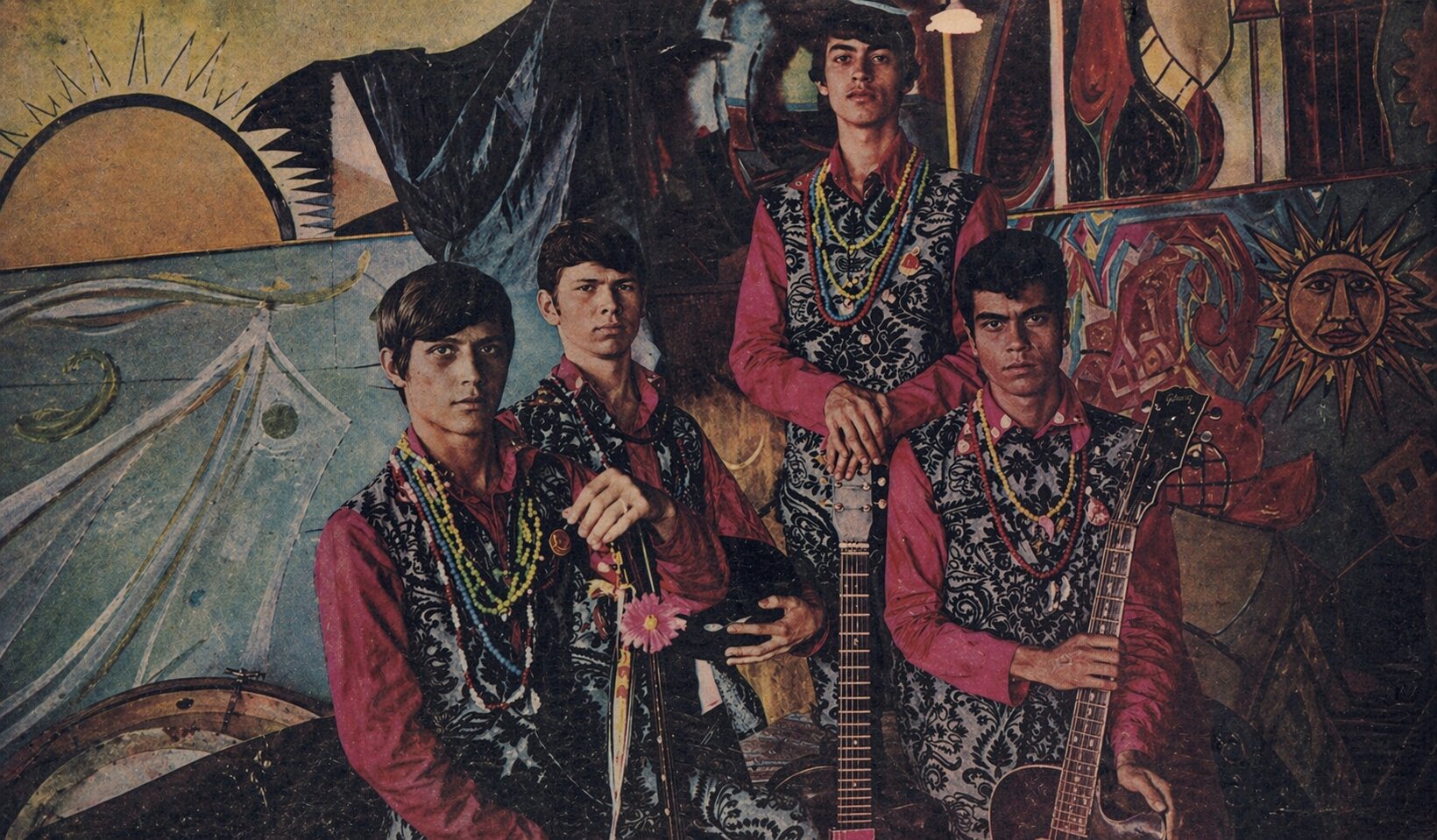
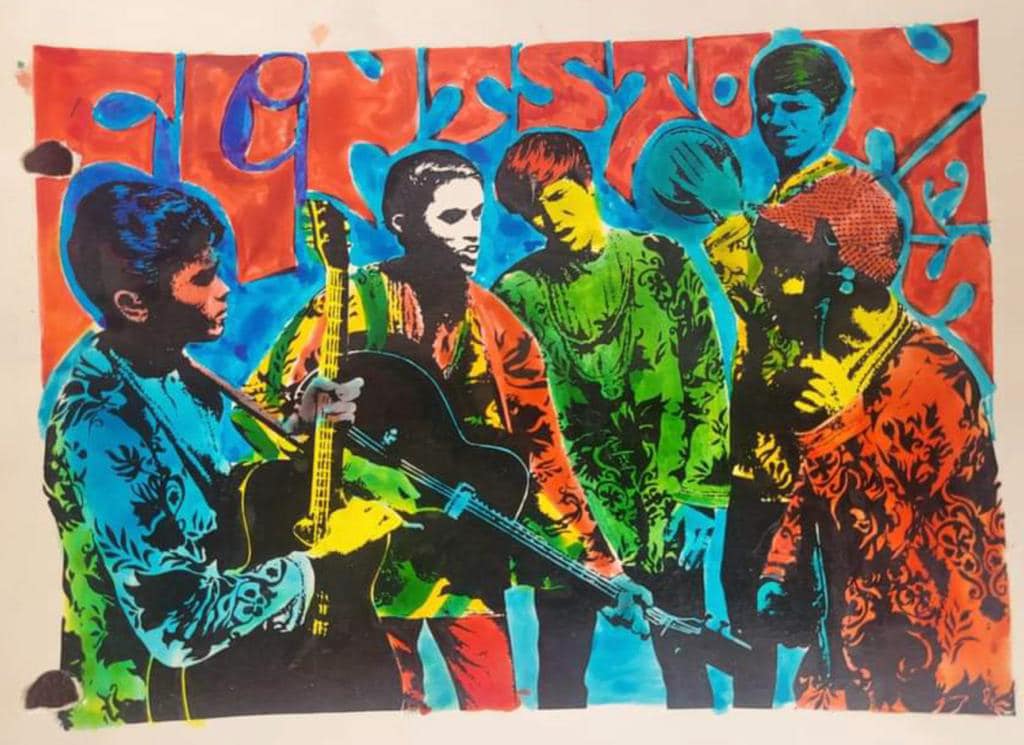
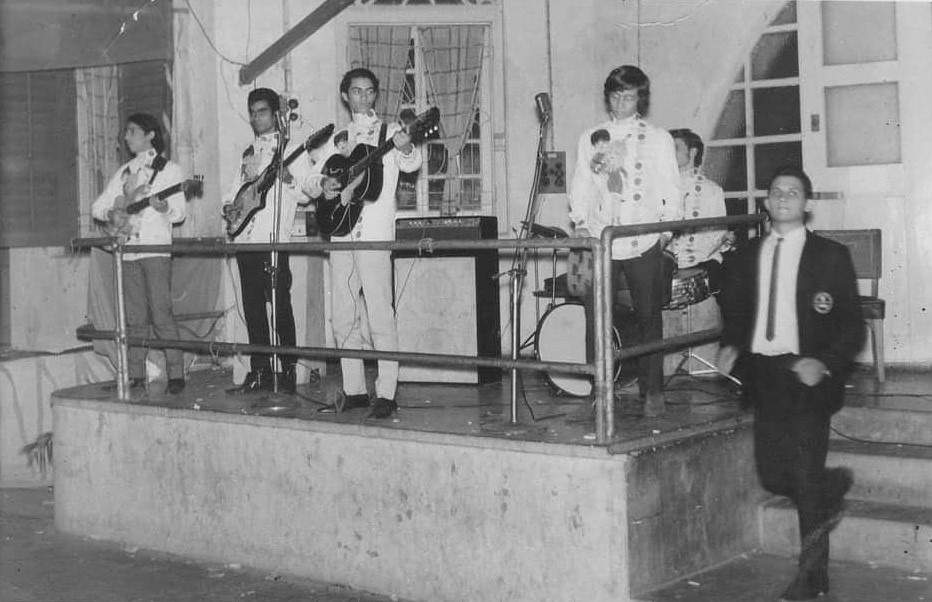
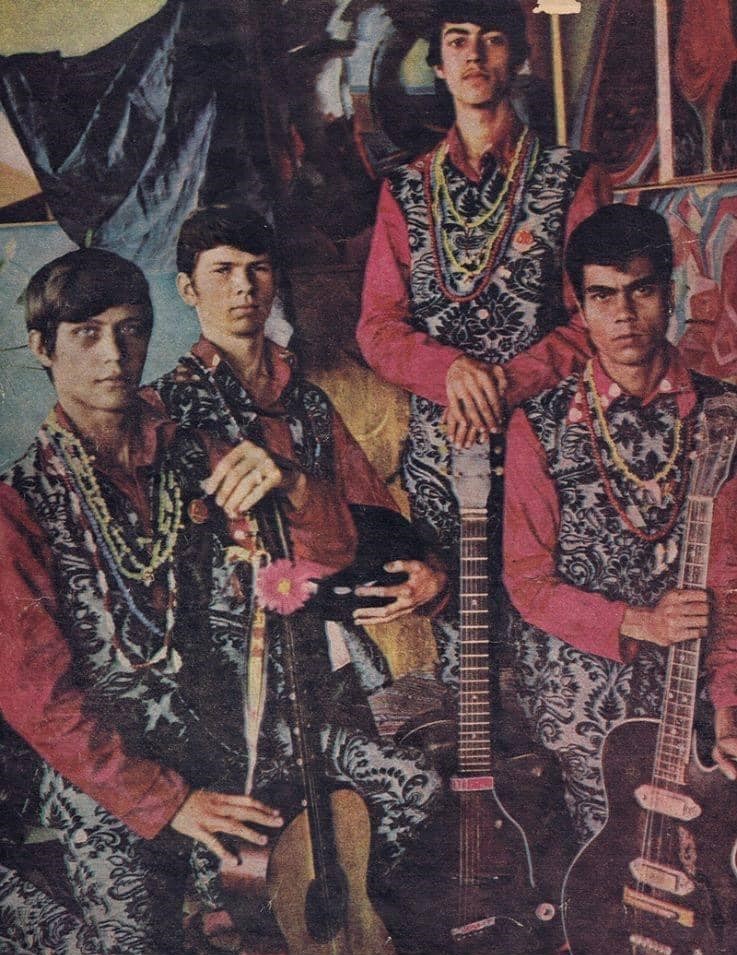
Clayton Saunders: Rhett and myself wanted to create a psychedelic, hippie-influenced group reminiscent of the 60’s music and dress style. We dressed rather flamboyantly, akin to the Monkees and The Mamas and The Papas. Rhett’s dad was the manager of the band. From memory we were the only band that presented that way.
Rhett’s mum, who was an artist and dressmaker, made all of our outfits from curtain material (very chic and cheap) and hand-painted our boots. She also handmade all the giveaways, they were little trinkets with all different faces of the cartoon characters. They said, I love Rhett Flintstone, I love Clayton Flintstone including the other band members’ names as well. Rhett and my trinkets were the most popular ones that the fans fought to get hold of. Rhett’s sisters and other helpers took the baskets filled with the trinkets around the tables of fans who literally went crazy trying to grab their favourite Flintstone trinket. It was very scary for them, but thankfully no one got hurt.
The Flintstones were a very talented group of musicians who became the most in-demand and India’s number one pop group at the time. There was a newspaper called The Standard which was widely read and because The Flintstones had become so popular they created a smaller version of the paper called the Junior Statesman, especially for the fans. We were featured almost every week and the articles received great reviews from the fans.
We were just a group of young, naive teenage boys who loved playing music and were given the opportunity to live our dream and got paid for it as well. It truly was a blessing and the experience we got from the live performances was invaluable and held us all in good stead for our individual careers later in life.
Can you tell us what the songwriting process was like for The Flintstones?
Clayton Saunders: At the time, I was the only songwriter in the group. I wrote both sides to our one and only single. I also arranged all the harmonies and arrangements of the songs. I remember there was one competition that we entered and won for writing the best arrangement of a popular French song required for a commercial at the time. The song was called “C’est si bon” (translation “It’s so good.”)
I’m not aware if the other members got into songwriting later on but Rhett developed his songwriting skills when he came to Australia, and is currently writing and releasing great rock songs as an independent artist. Rhett was always more rock orientated and I’m very proud of his talent and achievements.
Rhett May: Clayton was the musical genius behind the songs written at the time.
I was barely able to strum the guitar enough to work on chord progressions…but boy…I could play a mean tambourine…hehehehe
However, we all contributed with ideas, especially from a lyrical and vocal perspective
“The iconic Park Street…was abuzz and well patronised.”
I’d love to hear more about the music scene in Calcutta at the time. Were there any rival bands? Do you recall any bands that released singles, similar to what you did?
Clayton Saunders: The music scene in Calcutta in the mid to late 60’s when I was around was fantastic! It was vibrant, constantly evolving, colourful, creative and fun. The iconic Park Street, the hub of nightlife, was abuzz and well patronised. It was an exciting time for an Anglo-Indian boy like me as opportunities were abundant. The most famous nightclub of course was Trincas where so many bands’ careers took off from, including The Flintstones. There were other clubs as well such as The Blue Fox, Mocambos, Moulin Rouge and a few others whose names escape me at the moment. If you weren’t playing in a band you had to be 18 to get into any club and I remember my older established musician friends in famous bands such as The Cavaliers & The Hellions, would sneak me in. Memorable times and so much fun.
The only rival bands that I can recall were the Mustangs, The Savages, and The Diamonds from Darjeeling. There were others whose names I cannot remember. It was wonderful that there was so much talent emerging all around us and music lovers came from everywhere to be a part of it all and had so many styles of music to choose from. I don’t recall if these other bands released singles.
Rhett May: I’ve covered some of this in detail above.
There were many, many bands around Calcutta, however we were too busy working and our paths rarely crossed.
The Diamonds, Mustangs, The Sen Brothers…one of them recorded a song called ‘Love is a Mango’.
One of the main gigs on Park Street in Calcutta was ‘Trincas’…and the owner Mr Joshua would bring in bands from Darjeeling, Sikkim, Bombay, Delhi…
We had a residency there for a long time…on and off for a couple of years…and he would allow us to play at other venues or go interstate when we needed to.
To be honest…I didn’t socialise with other musicians…I was never into the ‘scene’ as such…didn’t drink, smoke, do any drugs of any kind. I detested going to parties and mixing with the stink of Ganja, marijuana, etc.
I got high on singing and writing lyrics and poetry.
How did you end up getting signed to His Master’s Voice?
Clayton Saunders: Our manager Robert May negotiated that deal for us. We would have certainly released more singles but Rhett and myself ended up moving to Australia. Unfortunately, while the recording of our single was exciting, the engineers and producer at the time, in my humble opinion, weren’t very experienced or knowledgeable in recording a band. We were all shoved into one big studio and recorded all tracks simultaneously. No separation of instruments or vocals. Such was the time. Being new to recording, we didn’t know much about the finer points of the recording process at that time. Still-in-all, having a single that reached #4 on the Ceylon Top of the Pops was a great thrill!
Rhett May: The guys from The Junior Statesman…Desmond Doig and Dubby Bhagat…were insanely ‘in love’ with The Flintstones.
Every issue…right from the first issue in 1967 with the Beatles on the cover, they were writing about us…photos of us…organising car rallies around us. We even had one issue where we were on the front cover, the back cover, the two-page centre spread.
They organised the recording contract with His Master’s Voice and were there for every minute of the recording sessions.
They organised a private gig for us to do in front of the Queen of Bhutan and her family…acoustically…I still have a photograph of this.
They organised for us to play at the world-renowned Charlie Byrd (Jazz Guitarist) reception.
Could you share more about the recording process behind your single? Where did you record it, and what was the studio and producer like?
Rhett May: We’re talking about 1967/68 which was over 55 years ago.
It was quite intimidating at the time…but the facilities were fairly archaic and unnatural…none of us were comfortable and I think the recordings reflected our discomfort and unease.
The engineer and producer who worked with us had never recorded a pop or rock artist prior to us entering the studio…and we were extremely dissatisfied with the end result.
And Desmond Doig and Dubby Bhagat were quite upset too…in fact in one of the Junior Statesman issues Dubby did mention the problems with the recording process.
The Flintstones became very well known in India and played together for about three years. What were some of the clubs you performed at?
Clayton Saunders: I stayed with the band for two years before coming to Australia. Rhett May left for Australia a couple of months before me.
We cut our teeth at Trincas where we had a full-time contract. We performed 5 nights a week doing floorshows. A 6pm, 10pm and a 12 midnight show as well. The room was always packed out. Students (our loyal fans) in their school holidays would travel from interstate to come down and see us perform. We also performed every Friday night at the Calcutta Swimming Club. There were numerous country gigs as well, don’t ask me where.
We had a regular Sunday show in an upstairs venue that was created especially to further promote The Flintstones called The Madhouse. There would be a different guest band every week. It was hugely popular and you had to come very early to get a look in, the line was two deep and a mile long. This was definitely the craziest gig we ever did. The fans who loved us were wild in showing us just how much they enjoyed our music. Shouting and screaming and when the baskets with the Flintstone trinkets were passed around they went nuts trying to get the one with their favourite Flintstone name on it. The girls probably should have got hazard pay, poor things.
One of the highlights for us was being invited to perform for some VIPs visiting from Tibet. The Queen and her two princess daughters. It was a private, acoustic performance. Quite a thrill for us lowly Calcutta boys. The other highlight was when we met the famous Charlie Byrd who created the Bossa Nova sound and came to Calcutta to tour. We were invited to his concert as special guests. There was a photo op with him as well.
We were also the main guests at a talent competition at a big venue where we were the opening act. We opened the show with The Shadows hit tune ‘The Rise and Fall of Flingel Bunt.’ Steven on drums kicked it off then Eddie walked on and started playing bass, followed by Rodney on lead guitar, then me on rhythm and finally Rhett on percussion. It was a great introduction to the show and the audience (it was a full house) went nuts.
Rhett May: The Madhouse was an innovation that began when my mother approached the Park Hotel with an idea to start a pop music venue for teenagers…and in the process, a residency for the Flintstones that would reflect what we stood for from a brand and musical perspective.
The Flintstones had been the most popular pop group in Calcutta and had been appearing at Trincas for a long time…we were looking to move on and create a ‘home’.
The idea was to create a psychedelic/pop music venue, that was a one-of-a-kind unique ‘first’ in India.
The entire concept was built around my mother’s ideas, and she convinced the Park Hotel to let her take charge…on condition that the Flintstones would be the headline, resident act.
What’s the craziest gig you ever did?
Rhett May: The ‘MadHouse’ was a concept at the Park Hotel on Park Street…I’ve given you some details above…but this place was unlike anything Calcutta…perhaps India had seen during that period.
We had tables and chairs hanging from the ceiling…special kurtas, wristbands, necklaces, badges with band members’ names on them…these were all giveaways at the door for anyone attending the gigantic dance parties…Calcutta was the ‘Swingingest’ place outside of London.
Looking back, what was the highlight of your time with the Flintstones? Where was your most memorable performance? Are you still in touch with the other members of The Flintstones?
Clayton Saunders: On reflection, it was a privilege being a founding member of The Flintstones, one of the biggest bands in India at the time. It was humbling knowing that our music had such an impact not only on our fans but the culture of music in the late 60’s. Great memories that still remain strong to this day.
Except for Rhett May, all the other members have passed away, sadly. Rhett and myself keep in touch via social media.
Rhett May: The incarnation of the Flintstones and how it came about was a wonderful journey…which involved me running away from home because my father refused to let me sing in a band.
I’m actually extremely proud of everything we achieved and the lessons I learned in life at that young age…the experiences of living every day were astoundingly eye-opening.
Thank you so much for your time. The final word is yours.
Clayton Saunders: My musical journey has certainly been a fascinating one, and one that has brought numerous life lessons along the way. From playing in the streets of Calcutta to releasing songs that have reached gold and platinum status, an award for best gospel song and being a Golden Guitar nominee, I’d say is success in and of itself.
The many talented musicians I’ve met and performed with along the way, many who have become lifelong friends, is a real bonus. Being featured in media promotions and newspaper articles both in Australia and overseas and appearing on numerous radio and TV shows in Melbourne, Sydney, Brisbane and country Victoria, I have been living my dream of sharing my music with the world. I am truly blessed and ever grateful that my passion for music and the performing and recording of it has been realised. I will continue to do so until my time on earth is done.
Thank you Klemen for the opportunity to share the story of my music journey with your readers. I hope they enjoy reading about the musical exploits of this little Anglo-Indian boy from Calcutta.
Rhett May: It’s been a pleasure Klemen.
Klemen Breznikar
Headline photo: The Flintstones (This image has been digitally altered for clarity) (Credit: Seelie Court / Good Time Records)
Seelie Court Facebook / Instagram
Good Time Records Website / Facebook / Instagram