
Jon Madof on ‘Netzach’, Rashanim and John Zorn
Guitarist Jon Madof discusses ‘Netzach’, his new trio album for John Zorn’s Tzadik Records, and looks back on Rashanim, Zion80 and the music that led him here.
Some of the first ideas for ‘Netzach’ were saved on Jon Madof’s phone under names such as ‘New Rashanim Idea #3’. He had spent several years working with his ten-piece band Zion80 and, more recently, recording music alone at home. But he was beginning to miss playing with other musicians, and the new material reminded him of the guitar trio he had led more than twenty years earlier.
Rashanim’s first album appeared on John Zorn’s Tzadik label in 2003, followed by three more records over the next six years. Madof later formed Zion80, where the larger lineup and horn arrangements often left his guitar less prominent. After spending some time recording on his own, he found himself writing material that seemed better suited to three musicians playing together.
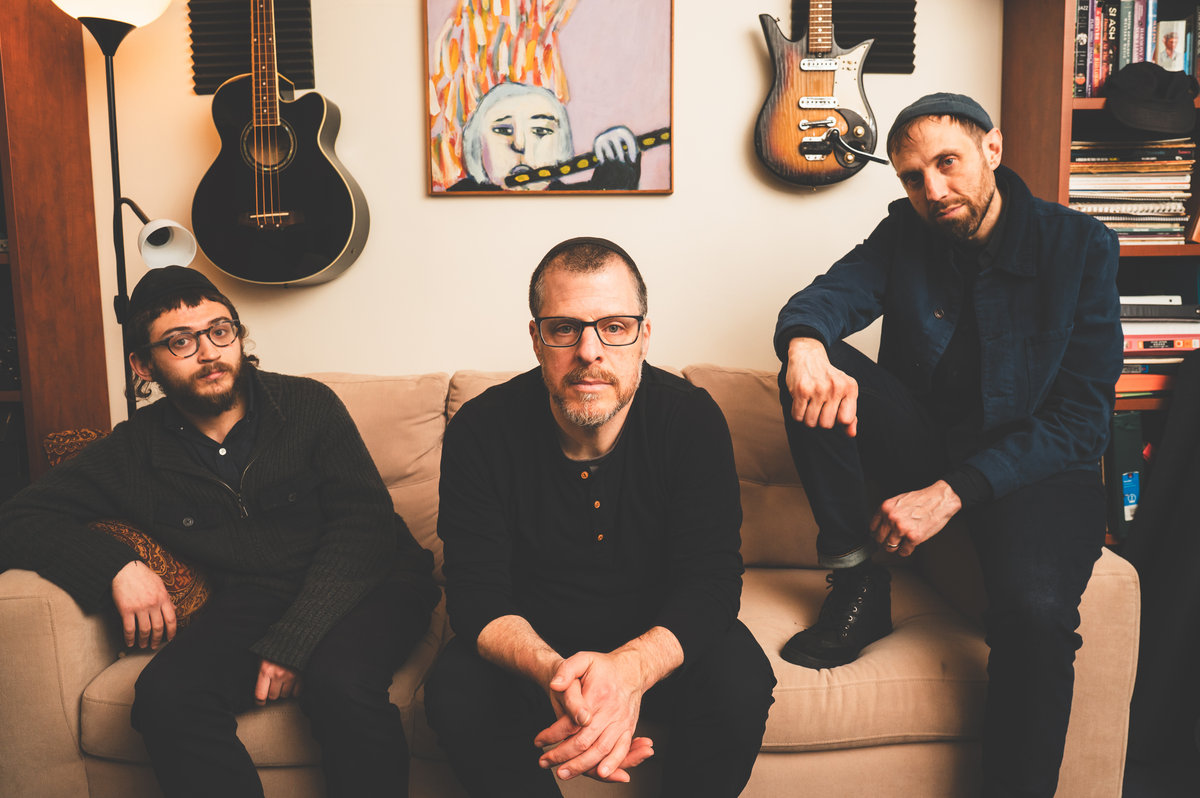
The result is ‘Netzach’, released by Tzadik in August 2026, with Yoshie Fruchter on bass and Nate Rappaport on drums. The album includes ‘Achdut’, inspired partly by the West African guitar playing of Ali Farka Touré, and pieces dedicated to John Zorn and Derek Trucks. The record itself is dedicated to Madof’s father, Frank, who gave him his first guitar lessons and died while he was working on the album.
“Each song has its own sound, its own rhythmic and textural fingerprint, and other unique qualities.”
You were listening to everything from Freddie Hubbard to Fugazi, while also becoming interested in Buddhism and, later, Judaism. What were you looking for during those years? When did music and spirituality begin to connect for you?
Jon Madof: That’s a great question. I’m not sure if I was aware of searching for something with respect to music. I was just checking out as much different music as I could, buying records and tapes (and then CDs as I got a bit older). I always wanted to hear new sounds and was obsessed with getting as much music as I could, from jazz to punk to classic rock and everything in between. On the spiritual side, I grew up secular so I didn’t have much of a tradition to explore when I became interested in spirituality. I read a book on Buddhism that was very interesting and compelling, so I read more and eventually started going to meditation classes and retreats. In college this continued with classes and a lot of reading. I think I was mainly searching for a deeper connection with life, beyond the surface level of how people usually communicate and how they orient their lives as they get older. I wanted something more than what I perceived as a largely materialist lifestyle. As I moved to New York with my wife, discovered more about Judaism, and started exploring Jewish music, all of these threads started to connect more and more.
When you moved to New York in 2000, you were determined to work with John Zorn. You handed him a Rashanim demo at Tonic, and he called you a few days later. What do you remember about that call? What did it change for you?
I really remember it like it was yesterday, even though it was over 20 years ago. It was right around the High Holidays (Rosh Hashana and Yom Kippur). I handed him the demo as you said, and then a few days later I remember dropping my laundry off at the laundromat in Park Slope, Brooklyn where we lived. My wife came running down the street as I was walking home and said, ‘Zorn called and he wants you to record an album!’ It was really thrilling. I called him back and he was really nice and very encouraging on the phone. And we mainly talked about the logistics and schedule for when we’d go into the studio and when the album would come out. It’s hard to say what it changed, but it was the fulfillment of something that was really important to me and a lot of the impetus for me wanting to move to New York (other than the important fact that my wife wanted to live there too!).
After Zion80 and your solo recordings, what made you want to start another guitar trio? And when did you realise these weren’t simply going to be new Rashanim songs?
Zion80 (my 10-piece band, active from 2012–2019) was very horn-focused, and my guitar playing was not really at the center of the sound. After that, I worked on a solo project that started during Covid, where I played all the instruments and used studio production in Logic to create music. After releasing some of that music, I found myself wanting to play with other musicians again because the solo project felt kind of isolating. So the desire was there first. Then I started to have ideas that felt to me like Rashanim songs. So I would record them and put them in my phone and call them things like ‘New Rashanim Idea #3.’ After several of those ideas, I realized that I could have a new project here. It felt very natural to return to the guitar / bass / drums format. It seems like the most basic or foundational way to make music on the guitar.
Why did you choose Yoshie Fruchter and Nate Rappaport? Once the three of you began rehearsing, what did each of them bring that changed the music?
Yoshie was the first person I thought of to reach out to. First, he’s a great guy and a great friend. He played guitar in Zion80, but would also play bass when our bass player Shanir Blumenkranz wasn’t available. He sounded better and better on bass every time I heard him play. Around the time I felt like I wanted to start playing with other musicians again, I happened to get a message from Nate Rappaport, whom I didn’t know previously. He asked me to play a wedding gig, and we started talking on that gig about various music that we’re into. I knew he was a great player, and we kept talking.
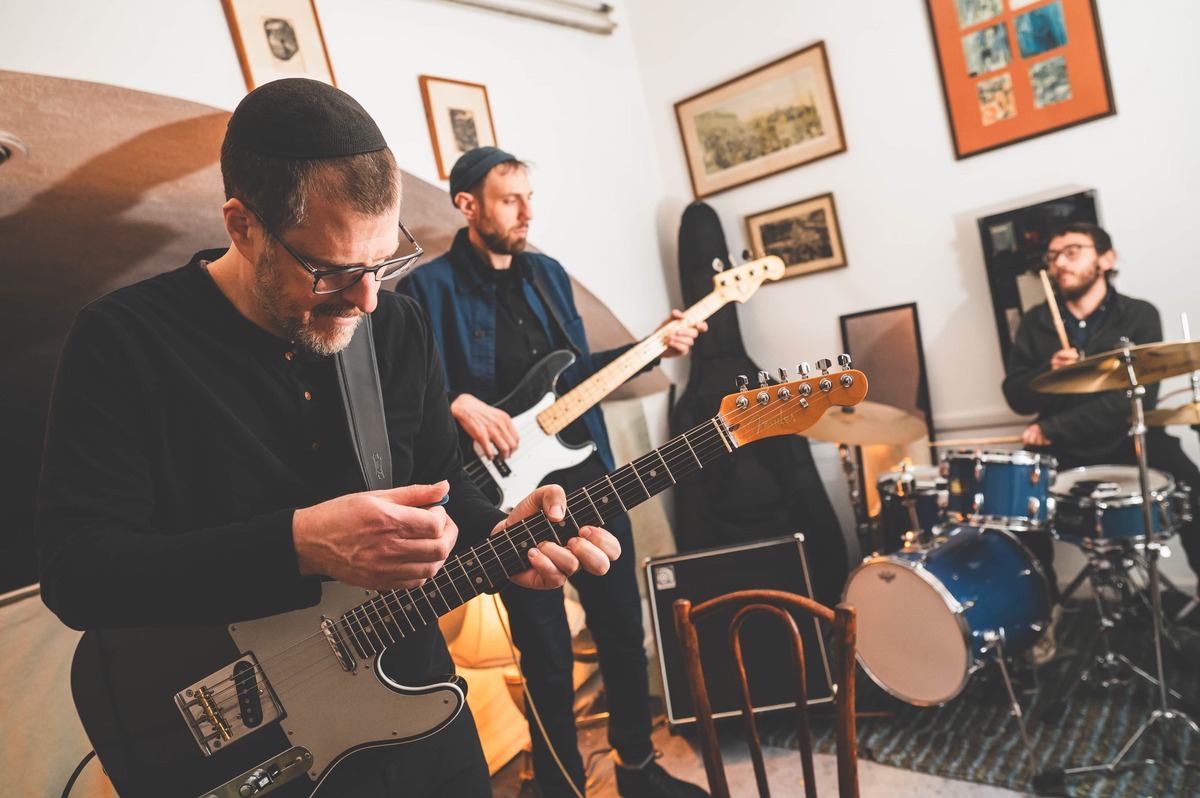
When we began rehearsing, the music changed significantly. I always want to incorporate the personalities of the musicians I’m working with. So it’s not just about having a bass player and drummer in the band, it’s about having Yoshie and Nate specifically. It’s a matter of finding a balance between the music I’ve written and each musician bringing their own spirit to the music.
What does the title ‘Netzach’ mean to you, and when did it become the name of the album? How did you arrive at the final order of the nine pieces?
‘Netzach’ has many meanings. It’s one of the ‘sefirot’ in Jewish mysticism, or Kabbalah. Each one of the 10 sefirot is like a spiritual building block of reality. Netzach is often translated as ‘eternity,’ ‘endurance,’ or ‘victory.’ I was thinking about different titles for the album, and that one stuck. We’re living in a time when antisemitism has seen a massive resurgence in many places where we thought it was gone. Jews are marginalized, harassed, and demonized and attempts are made to erase our history and connection to our homeland. The idea of ‘Netzach’ is that we are eternal, and those connections cannot be erased, no matter how many lies or how much propaganda is spread.
I played around with different sequences of the songs on the album. When I find the right sequence, it just ‘feels’ right and the story of the album has an arc that makes sense. That’s how I felt when I came up with the sequence for this album.
John Zorn’s advice to you has often been, ‘Play the tune.’ How did that principle shape your own writing on this album? What did Yoshie and Nate receive on the page for pieces such as ‘Makaf’ and ‘Urim’, and what was left open?
Yes, that’s great advice! One thing I’ve learned from Zorn is that each song is its own world. Each song has its own sound, its own rhythmic and textural fingerprint, and other unique qualities. Developing the music involves finding that fingerprint and letting the band express it. I want to write down only the information on paper that’s necessary to express that ‘world’ of the song, that fingerprint. ‘Makaf’ is a longer chart, with parts written out for the different sections. ‘Urim’ is a much simpler chart, with a short A section and B section. The arrangement for ‘Urim’ that appears on the album was largely created in my home studio, where I added guitar parts to the basic track. ‘Makaf’ was performed live in the studio with fewer guitar overdubs.
Zorn described ‘Netzach’ as having a heavier sound and more orchestral production. How much of that came from playing together at Orange Music, and how much did you add later through overdubs and working with James Dellatacoma?
This relates to the last question. We played most of the music in the studio the same way we had been playing it live. ‘Urim’ was the biggest exception, but I also added to the scale of many of the tunes by overdubbing guitar in my home studio. For example, on ‘Shimi’ I was hearing lots of guitar harmonies in my head with a particular type of sound, so I added those in the studio by overdubbing guitar parts. Once all of the additional parts were added, I sent them to James who masterfully mixed everything.
‘Achdut’ is dedicated to Yossi Klein Halevi, and it’s the only track featuring Moshe Sobol on percussion. How did the dedication come about, and what made you want the extra percussion on this particular piece?
This was the first new song I wrote for this band. I had the idea to combine a Jewish-sounding melody with what feels to me like a West African guitar style, kind of inspired by Ali Farka Touré. I then started thinking about the unity of music—how all music exists in the same world and how sounds can influence each other and combine. And when I thought of unity, I thought of Yossi Klein Halevi. Through his writing and other work, he expresses a sensitivity, openness, and a true desire for unity. He’s a very deep and inspiring person.
Once the West African element was established, I knew I wanted to add percussion. To me, that type of a sound always needs layers in the drums. So Nate lays down the beat on the drum kit, and Moshe adds to it on percussion. I could listen to that sound all day!!!
‘Invisible Alchemy’ is dedicated to John Zorn. What made you think of him when writing this piece? After so many years of listening to his music, how much of his influence do you still hear in your own playing and composing?
A lot of Zorn’s music involves ideas about alchemy, magic, and mystery. The vibe of the tune reminds me of his music. I’ve had his sound in my head for so long that it often comes out naturally. Not in an imitating way, but more as something I’ve ingested and hopefully made my own, but which still has the spirit and ‘stamp’ of his influence. I never get tired of listening to his records!!!
‘The Beautiful Six’ is dedicated to Alexander, Almog, Carmel, Eden, Hersh and Ori. Could you tell me how the composition came about and why you chose that title?
I’m not sure when I began writing it, but the idea of ‘six’ is reflected in the song’s time signature. And it feels like a very emotional song to me, moving from calm and sensitive to aggressive and loud. That pendulum of emotions and the number six made me think about the six hostages murdered by Hamas terrorists in August of 2024. Rachel Goldberg-Polin, the mother of Hersh Goldberg-Polin, calls the six hostages ‘The Beautiful Six.’
‘These Broken People Are the Messengers of God’ takes its title from a conversation between Nick Cave and Rick Rubin. What stayed with you from that discussion, and how did it find its way into the music? And what was it about Derek Trucks’ playing that inspired you to dedicate ‘A Pure Heart’ to him?
You know, I actually forgot that’s where I heard the phrase! I write down song titles when they come to mind, but I usually don’t note where I heard them. Thanks for reminding me of that! I love Rick Rubin’s podcast, and I love Nick Cave. Cave’s music just hits me right in the heart every time I hear it. I’m actually not so well-versed in his whole catalogue, but it doesn’t matter. I listen to whatever he does and I’m transported to a different place. The film he did in 2022 with Warren Ellis, ‘This Much I Know to Be True’, is absolutely brilliant. It always has a depth that is very dark but also very peaceful. It’s like going to the depths of what life is at its core. That’s the sound I wanted to convey with the song.
A good friend, who is a huge fan of the Tedeschi Trucks Band, introduced me to their music. They were the first live band I saw after Covid, and I absolutely love Trucks’ playing. It’s so deep and spiritual, while also grooving and rocking. Coltrane and the blues and Ali Akbar Khan all rolled into one! When I came up with the idea for that tune, it just reminded me of Trucks, so I made it a tribute to him.
The album is dedicated to the memory of your father, Frank Madof. What place did music have in your relationship with him? Does ‘Netzach’ feel different to you because it now carries that dedication?
I was working on the album when my father died. He played guitar and gave me my first guitar lessons. I also have two of his acoustic guitars in my studio. So music was always a fundamental part of our relationship. The album for me is now connected to him and his memory.
Klemen Breznikar
Headline credit: Bryan Sargent
Jon Madof Website / Facebook / Instagram / Bandcamp / YouTube