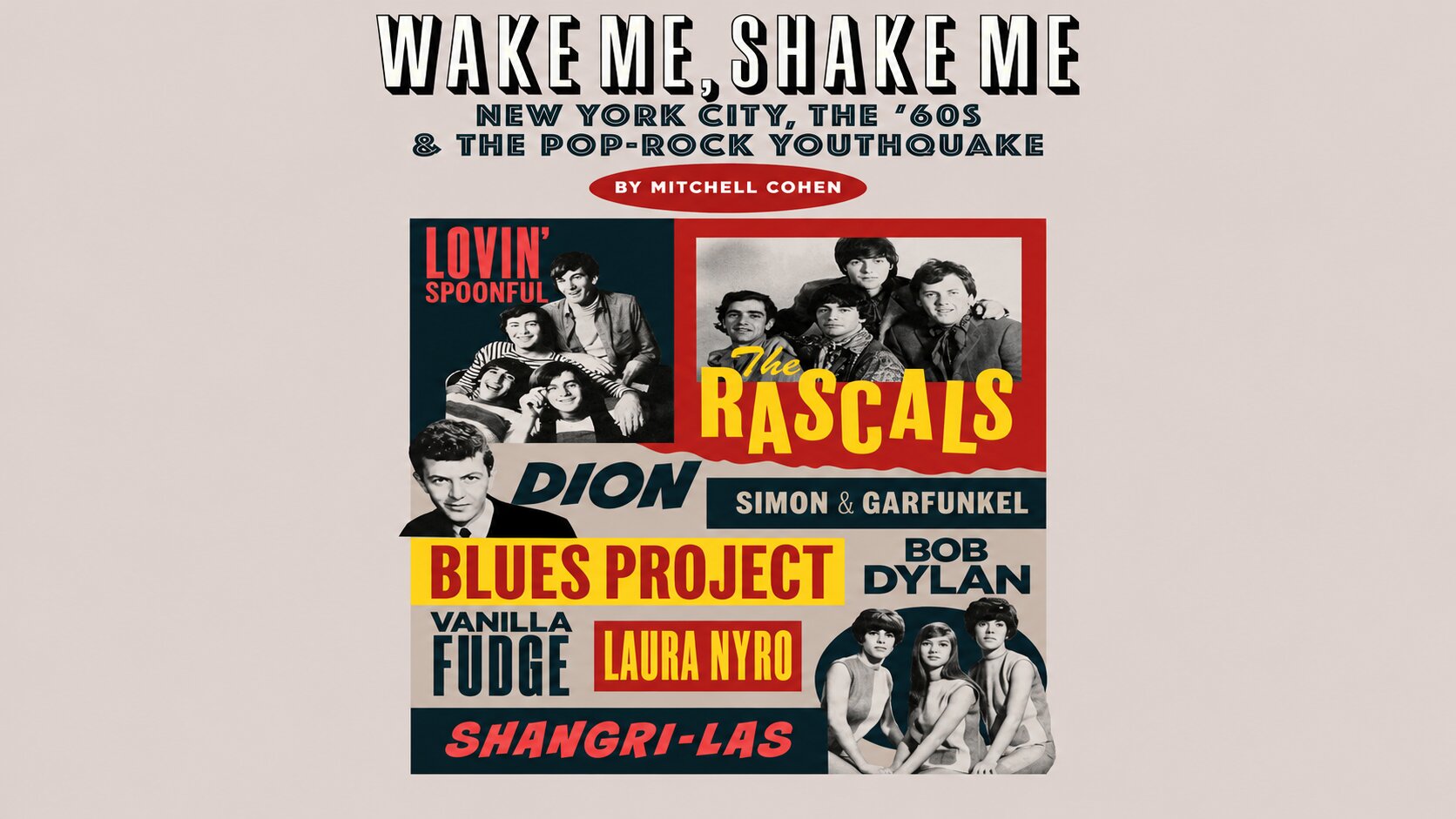

Mitchell Cohen on ‘Wake Me, Shake Me’ | “There Is No One Rock History”
Mitchell Cohen talks about his new book, the Lovin’ Spoonful, the Blues Project, New York’s forgotten bands and the records that made the 1960s such an exciting time for music.
Mitchell Cohen was at the Brooklyn Paramount in April 1961 when Dion, Del Shannon, the Shirelles, Ben E. King and the Isley Brothers appeared on the same bill. This was supposedly a quiet period for rock and roll, between Buddy Holly and the Beatles. It certainly doesn’t sound that way.
Cohen grew up in New York, listening to the radio, buying records and going to shows. He later became a music journalist and worked in A&R at several major record companies. His latest book, Wake Me, Shake Me: New York City, the ’60s & the Pop-Rock Youthquake, published by Trouser Press Books, takes him back to the music he grew up with. He has spent years going through old music papers, advertisements, reviews and interviews to find out how it all happened. The Lovin’ Spoonful, the Rascals and the Blues Project are at the heart of the book, but Cohen has just as much time for the Magicians, the Myddle Class and all those other bands who never quite got their due. We talked about those records, the people behind them and why so much of the music deserves another listen.
You explain that one of your aims with Wake Me, Shake Me was to follow the story in “real time”, using the articles, reviews, advertisements and trade reports that appeared while everything was still unfolding. You also experienced much of this yourself, from your first rock and roll show at the Brooklyn Paramount in 1961 to Woodstock in 1969. Did anything you found in those old papers surprise you, or change the way you remembered certain shows? How did you decide when to bring yourself into the story and when to stay in the background?
Seeing so many of these artists live, and being able to recall what it was like to be “in the room” when they were at their peak, certainly gave me an entry point to capturing that period in pop music in New York City. What I mostly uncovered as I started to do research was the mechanism of pop, how the record labels, the trade and consumer press, Top 40 radio, pretty much all of which were within a few-mile radius, worked together. I wouldn’t say the scene looked different from how I experienced it as a young music fan, but there were many artists I wish I’d gotten to see, like the Magicians. I don’t see me as a character in the story, but as a narrator with some first-hand perspective.
The book challenges the old idea that American rock and roll went into decline after Buddy Holly’s death and only came back to life when the Beatles arrived. You show those supposedly empty years as an incredibly active period in New York, with vocal groups, girl groups, independent labels, Brill Building writers, producers and radio personalities all feeding into one another. Why has the idea of those “lost years” been so hard to shake?
The “lost years” idea is based on so few actual examples, as if, as I point out, Frankie Avalon and Fabian were still having hits in the early ’60s. How anyone can listen to the Drifters’ records with Leiber and Stoller, Phil Spector’s and Brian Wilson’s early productions, Sam Cooke and Jackie Wilson, Dion, Del Shannon and Gary U.S. Bonds, the first singles by the Miracles and the Marvelettes, the music being made in New Orleans, and call it a creative valley is beyond me. It’s just cultural shorthand, and when the Beatles came along, they provided an exclamation point that said, thank goodness that’s all over. Except so much of their early music was taken from “lost years” sources like the Shirelles, early Motown and the Isley Brothers.
I was especially interested in your descriptions of the music business around 1619 and 1650 Broadway. A young singer or group could knock on several doors in one building, find a publisher or producer, record nearby and possibly have a single out within weeks. Could you walk us through how a record might travel through that world, from the first audition to radio play?
Through my years as a music journalist and A&R guy, so many people I got to speak or work with — Doc Pomus, Richard Gottehrer, Dion, Kenny Vance, Ron Dante, Don Rubin — talked about how casually interactive the business was then. The companies, not just record companies, but management and production companies, were in such close proximity, so someone like manager Bob Cavallo and producer Erik Jacobsen could cut “Do You Believe in Magic” with the Lovin’ Spoonful, bring it to Kama Sutra Productions at 1650, and Artie Ripp at Kama Sutra could walk down the hall to Charles Koppelman and Don Rubin’s new offices, and through Kama Sutra’s distribution deal with MGM Records, have the single in the marketplace within weeks. Ads in Billboard, appearances on the Clay Cole TV show, an offer to be on Murray the K’s Labor Day Brooklyn Fox show, features in Hit Parader and 16 Magazine. This all happened in a matter of months, after other labels had turned the Spoonful down.
You call one chapter ‘The Original Summer of Girly Pop’, and you make a strong case for the girl-group era as one of the great periods in New York music rather than simply a lead-in to the Beatles. Young female listeners were hearing other girls sing frankly about desire, jealousy, sex and uncertainty, even though most of the songs were written, arranged and produced by men. How much of the singers’ own personalities and experiences still came through? What did records by the Shirelles, the Chantels and the Shangri-Las make possible that hadn’t really existed in pop before them?
First of all, whoever came up with the line “It’s my party and I’ll cry if I want to” made a lasting contribution to the literature of pop. And any history of pop that skips over “Sally Go ’Round the Roses,” “One Fine Day” and “Give Him a Great Big Kiss” is just negligent. There was mystery, and optimism, and elation in these records, a sense that the girls singing them were going through a whole gamut of emotions, “My baby’s got me locked up in chains,” “Mama said there’d be days like this,” “He’s the kind of boy you can’t forget.” The records had men behind them, but they spoke directly to the lives of girls in a way previous “girl groups” (the Andrews, McGuire and Boswell Sisters) never did. It was exciting, that energy.
After the Beatles, the group became the ideal, but many of the people who first answered the British Invasion were already established writers, producers and studio musicians. The Strangeloves even invented an Australian identity, while their recording of “Hang on Sloopy” was turned into a hit for the McCoys, with Rick Zehringer and his band adding overdubs. At that point, what actually made a group “real”? Did listeners care who had played on a record, or was the idea and personality created around it just as important as the line-up?
Ron Dante speaks about “ghost groups” in the book, singers and writers gathered in the studios with session players, and giving themselves band names like the Changin’ Times and the Trade Winds. The McCoys were a “real” group, but most of them weren’t on “Hang On Sloopy.” You could say the same thing about Gary Lewis and the Playboys in LA. Listeners didn’t care whether a group was real, whatever that means. The Strangeloves’ backstory was fictional, but in the studio they were as real as the Beach Boys, insofar as they produced, sang and wrote most of the songs, backed by pros.
The Lovin’ Spoonful, the Rascals and the Blues Project are at the centre of the book, and its title comes from the Blues Project’s arrangement of “Wake Me, Shake Me” on Projections. All three first made their names as exciting live bands, but each drew from a different mixture of folk, blues, soul, jazz, gospel and older rock and roll. Why did these three groups seem to you like the best way into the larger story of New York in 1965 and 1966? Their classic periods were also surprisingly brief. Was that simply the normal life of a band at the time, or did success bring pressures that these particular groups couldn’t survive for long?
It’s because they came at their music from different directions that made them so representative of the city. There were a lot of young bands everywhere who wanted to be the Beatles or the Stones, and used The Beatles’ Second Album and 12 X 5 as templates, but these three bands were outgrowths of the folk and jug bands, the Twist-frat bands, the downtown and outer-borough scenes. So when the British Invasion hit, it wasn’t as though they were high school kids who decided to pick up guitars and drums. Al Kooper was already a midtown songwriter for acts like Gene Pitney, Danny Kalb and John Sebastian backed up artists like Phil Ochs and Judy Collins, Steve Katz was in the Even Dozen Jug Band, the Rascals backed up Joey Dee at the Peppermint Lounge. As for the lifespans, in the cases of the Spoonful and the Project, there were internal clashes and external events that broke them apart. The Rascals hung around longer, of course. “Wake Me, Shake Me,” the song, is a perfect example of how the music worked: a gospel song, later a novelty record by the Coasters, then a blues-rock showpiece for the Blues Project and a garage-rock standard by the Myddle Class, with an end-of-decade version by the Endless Pulse, featuring one of the original Belmonts.
The book covers everyone from the Lovin’ Spoonful, the Rascals and the Velvet Underground to Vanilla Fudge and Laura Nyro, alongside jazz musicians such as Herbie Mann, Gary McFarland, Larry Coryell and Jeremy Steig. It’s difficult to speak of one clear New York sound. Was New York’s real strength the fact that all these different musicians were hearing and learning from one another? How important were the jazz musicians who moved into rock clubs, pop material and electric groups, even while parts of the jazz world were still suspicious of rock?
There wasn’t a New York Sound, or rather, there were many, and they coexisted and drew on one another. That was the essence of the city scene. Part of it was adventurous co-bookings at the clubs, rock, blues, jazz, folk on the same bill, artists watching what others were doing. Another factor was the Vietnam War: protests, marches, fund-raising concerts for anti-war causes and candidates were very likely to have performances by rock bands, jazz artists, folk and blues singers, poets and playwrights, movies by indie filmmakers, so audiences were exposed to a widening cultural menu. The “Angry Arts” movement against the war was passionate, and eclectic, and it broke down musical divisions.
You also write about how much the way people discussed popular music changed during the decade. At the beginning, Top 40 radio, teen magazines and the trade papers had enormous influence. By the middle of the 1960s, Crawdaddy!, Richard Goldstein’s writing in the Village Voice and freeform FM radio were helping to create a more serious rock culture. You also mention the beginning of “major statement” syndrome, when a perfectly good collection of songs could be criticised for not saying something larger. What did this new seriousness add to popular music, and what did it push aside? Did singles, dance records, humour and simple entertainment begin to receive less respect than they deserved?
“The New Seriousness” is a good way to put it. It led to a lot of excess and wild ambitiousness, when the appeal of groups like the Spoonful, the Rascals, the Magicians, the Vagrants and even tertiary groups like the Wild Ones was the compression of joy into perfectly formed pop moments. On the West Coast, the Beach Boys and the Mamas & the Papas had that as well. After Sgt. Pepper, the Pursuit of Art took hold in a major way, and produced some amazing music, but I think any student of pop music would concede that some of the spontaneous magic was lost.
Something I liked about the book is that you don’t treat the record business as a simple story of brave independent labels against cautious major companies. Columbia could appear completely out of touch and then release highly adventurous music, while labels such as Atlantic and Verve could move between mainstream success and experimentation. At the same time, the story is full of hustlers, questionable contracts and people trying to claim part of a song or record. Did researching the book change your view of how much of this music came from artistic vision and how much came from people gambling on the next trend? Were there business figures whose musical instincts surprised you, even when you found other parts of their behaviour difficult to admire?
Shenanigans were part of the music business hustle. The rules, such as they were, were slippery, and it meant that money often didn’t trickle down to the artists. I wasn’t surprised or shocked by anything I learned about payola, or shady contracts, or revenue streams; I’d always assumed that the record business in the ’50s through the ’60s was not run by strictly ethical figures, but almost everyone I talked to, musicians, writers, session players, producers, looked back on the period as one of great opportunity and creative camaraderie. Some wished they hadn’t signed certain contracts, or felt they’d picked the wrong record label, or were disappointed by their share of the loot, but I think all that was part of the whole Wild Westness of the business at that point.
Laura Nyro’s appearance at Monterey has often been described as a disaster, although the story that she was booed has been disputed. Lou Adler later said that the closest thing they could hear to a boo was someone shouting “Beautiful”. He also remembered her black gown and background singers as looking unmistakably New York rather than California. Why do you think the story of her failure became so deeply established? Later in the book, Lotti Golden describes receiving almost no help from Atlantic to perform or promote Motor-Cycle, while noting that Nyro had David Geffen behind her. How much did an artist’s future depend not only on talent or the record itself, but on having somebody who understood how to present and protect them?
I know people who were at Monterey who say Nyro’s set was catastrophic. Maybe it depended on where you were sitting, or how much attention you were paying, or how high you were. You never know about these things. There is no one Rock History. Of course, Laura was blessed to have Geffen as her advocate; if Clive Davis, who saw her at Monterey and was unimpressed, wasn’t pitched on her by Geffen, he might have passed outright, instead of saying, sure, have her come up and play some songs. The music business turns on moments like that, finding the right match. On the other hand, Lotti had Atlantic Records and Bob Crewe. You never know.
By the end of the decade, the centre of the national rock story seemed to have shifted west, even though an enormous amount was still happening in New York. Your Woodstock chapter has the feeling of looking back at a local scene that had been thriving only a few years earlier. During the same summer, the Harlem Cultural Festival was presenting Nina Simone, B.B. King, Stevie Wonder, the Staple Singers, Mongo Santamaria, Ray Barretto and many others, but it almost disappeared from the wider cultural memory. Was New York music really losing its strength, or had it simply become too scattered and varied to fit into one clear story?
New York City music was always scattered and varied. Joe Cuba, the Left Banke, Janis Ian and the Blues Magoos don’t have a lot in common, but they all felt like some version of “New York.” Woodstock the Myth was a ready-made narrative, hundreds of thousands of people, one weekend, Peace & Mud, but musically, it was like every other rock festival that summer. And less wide-ranging than a lot of them. The Harlem Cultural Festival was spread out over weeks, and was more about the music than the Message of Love. I think, and local musicians have backed me up on this, that in the late ’60s and early ’70s, the scene felt drained of energy.
In the postscript, Patti Smith, Bette Midler and the New York Dolls bring back something that you feel was missing from much late-1960s rock: humour, theatricality, surprise and the simple pleasure of putting on a show. They were creating something new, but they were also reaching back to doo-wop, girl groups, rhythm and blues, standards and garage rock. Do you see that next New York wave as a reaction against the 1960s, or as a rediscovery of parts of the decade that serious rock culture had pushed aside? After choosing the 100 albums and 100 singles at the end of the book, which overlooked artists or records do you most hope readers will go away and discover?
At different points over the years, I’ve gotten to talk with Patti Smith, Lenny Kaye and David Johansen about this. From what I gather, it was both a rediscovery and a counter-reaction. Their music was spirited, funny, hopeful. Trashy and smart. If you were a certain age and of a certain temperament, you were simply delighted by what they were up to, and it led to the mid-late ’70s rock renaissance (Ramones, Blondie, Television, etc.). As far as the discography goes, I hope it gives readers a sense of just how crazy that era was, how nothing, not Brute Force, or the Fugs, or the Third Rail, was too out-there, because the labels knew that they didn’t really know what was going on. The singles list is to bow to all those groups that didn’t get to make albums: the Magicians, the Myddle Class, the King Bees, Goldie & the Gingerbreads. Maybe someday there’ll be Wake Me, Shake Me: The Album that collects all these NYC 45s…
Klemen Breznikar
Trouser Press Books Official Website / Facebook / Instagram / X