
Snailgun Interview: ‘Glass Walls’ from Melbourne’s Underground
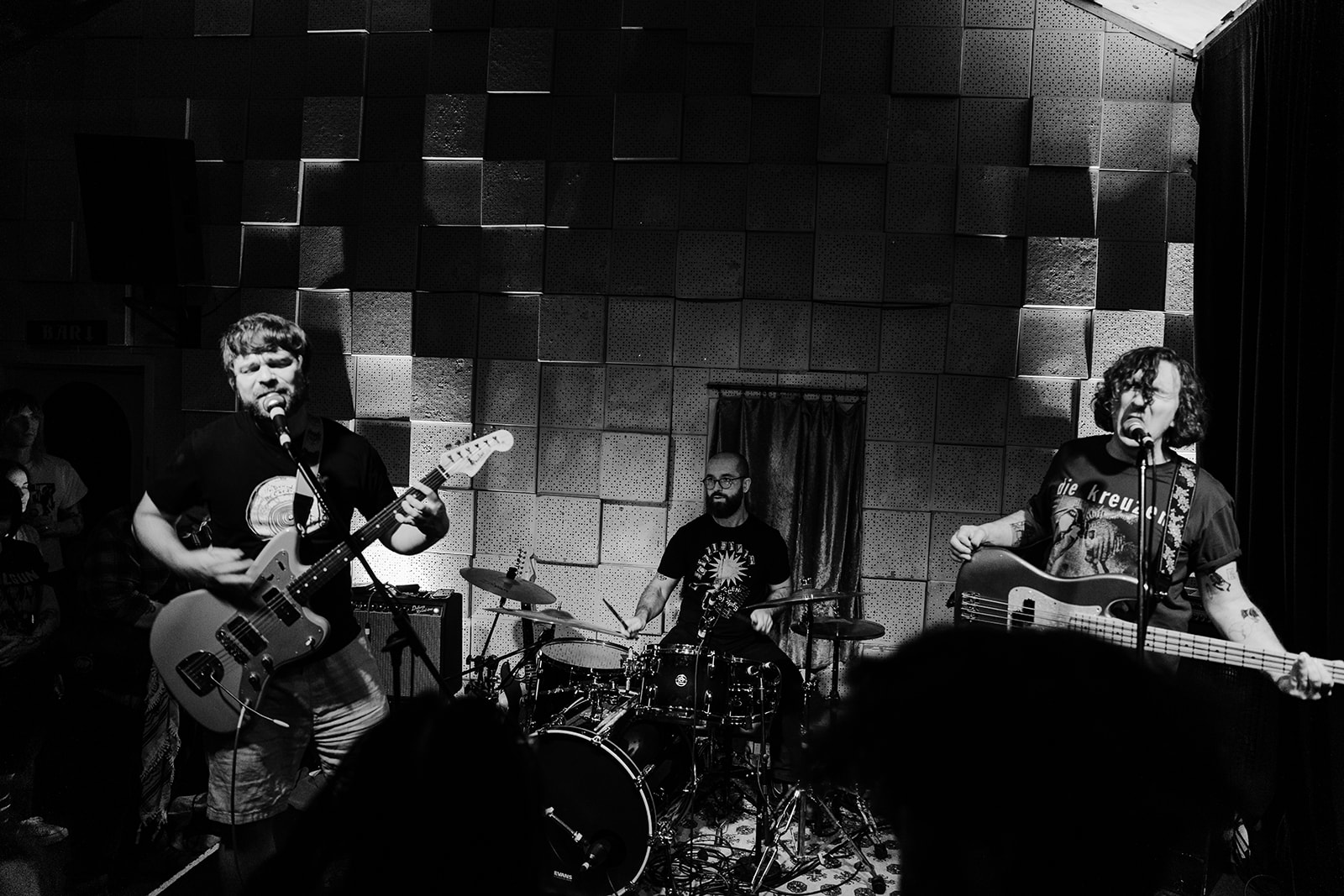
Snailgun are a three-piece from Melbourne/Naarm made up of Adam Osth, Daniel Little and Sam Maher. Their debut album, ‘Glass Walls’, arrived in April 2026 through Undunn Records, mixing short blasts of post-punk and noise rock with songs that run close to nine minutes.
Adam and Dan first worked together as a duo with a drum machine before Sam joined on drums. Some of the songs on ‘Glass Walls’ go right back to those early sessions, while others changed considerably once the three started playing together.
We spoke with Snailgun about the records that shaped them, their DIY outlook, the Melbourne underground and how ‘Glass Walls’ came together.
“Drawn to the music, stayed for the politics!”
Let’s start at the beginning. Where did each of you grow up, and what music first pulled you in? How did you end up playing the instruments you do, and what were you doing before Snailgun?
Adam: I grew up in Orange County, California in the mid to late 90’s. I was hearing a lot of grunge and pop punk on the radio, and while I liked some things here and there, not a lot of music really grabbed me. At about 15 years old I got exposed to indie/underground music – bands like Pixies, Trail of Dead, Pavement, and Shellac, and I got pretty hooked instantly. I pretty much threw away all my old music and dove in headfirst. Within a year or so, I got a guitar and started learning to play. I jammed with bands here and there, but I never really had a serious attempt at making music until playing in Snailgun when we started a few years ago!
Dan: My grandfather played bass in country and western bands around central Pennsylvania where I grew up. I wasn’t very conscious of that or its effect on me until much later. I switched on to music around ‘91-92 when grunge was starting to hit. I gravitated towards bass; we had a family friend who was a great bass player (in the New Wave/punk band Friction and later Rotten Belly Blues) who I had lessons from. I played in a punk cover band and then a horror-punk band writing original songs. The scene in central PA was skewing more toward hardcore/post-hardcore, but I think my interests were going more in the weird noise rock direction, especially Scratch Acid, Jesus Lizard, Big Black, Swans, Captain Beefheart, Die Kreuzen, Gang of Four, Fugazi. I discovered The Birthday Party in 1995 and that became my favourite band, probably seeding the idea of a move to Australia, which I did in 1999. It took a while to get back into music after I had sold all my gear to make the move. In 2007, I played in a no wave trio called Red Music in Perth; experimental, Sonic Youth inspired. I also played a prepared tape machine in a noise project called Vincent Price. After moving to Melbourne and another break from playing, Adam and I met Sam and got rolling with Snailgun.
Sam: Probably Dad was my start – he had positioned radios around the house all playing ABC Classic 24/7 so that there wasn’t a dead zone in the house, so my family quite literally grew up surrounded by music. However classical music didn’t quite take me so I followed a few other threads: prog rock like Led Zeppelin and The Mars Volta, post-punk with Interpol and The Cure, hip-hop with OutKast and MF DOOM and math rock with Toe and Piglet to name a few, whatever I could steal from my friends’ playlists. As for playing music, my motivation has always been to hang out with mates. Whether drums were just the only instrument my mates didn’t play at the time, or because I like playing that supporting role I can’t quite remember, but it’s what stuck. Before Snailgun I had two other projects with high school mates, Great ~ Falls and Cold Open, who are both still active! It’s been a real treat however to have stumbled upon Snailgun for the music initially, and then to find out these two are legends and being able to become mates all the same.
Adam and Dan, you first tried writing together as a duo with a drum machine. How did that begin? And Sam, how did you end up joining?
Adam: Dan and I work together. Funny story – Dan was on my hiring committee and I met him before I even got the job. I noticed we had similar music and that he played bass and I liked the idea that if I moved to Melbourne we could form a band together. It took a long time for that to happen – we tried in 2017 but it didn’t quite work out, but tried again after the Covid lockdowns in 2023 and things came together much more quickly.
Dan: I don’t think there was a coherent original idea; we just wanted to jam. We both had similar tastes but the first attempt didn’t go so well. My skills with the drum machine were pretty rudimentary so we’d end up with long tracks that were sort of interesting but not cohesive. Second attempt, we had both been writing songs in the meantime; I had improved a little on the drum machine, but the main change was we had some songs with structure that we could rehearse. We settled into a routine where Adam would send me a riff or a few parts and I would program drums for it and write a bass part. The first batch of songs all came together that way. Adding Sam changed the whole dynamic. I could concentrate on bass and vocals and we started writing more in the rehearsal room. There were things we wanted to do but couldn’t quite pull off with the drum machine that were possible with Sam. For example, there’s a section in the ‘Screamy Cat’ outro where the drums drop out and then come back in heavier, sort of a false ending.
Sam: I met Dan out and about, and pretty much within a few minutes had him send me some of their demos. I was the happy chosen third for these two and have enjoyed contributing what I can to the sound but also being able to help deliver on the vision these two have had since day dot.
You’ve mentioned late 70s post-punk, the SST bands, Dischord and 90s noise rock as big influences. Was it mainly the music that drew you in, or the DIY side of those scenes too?
Adam: Drawn to the music, stayed for the politics! I remember around the time I got into that music, ‘Our Band Could Be Your Life’ came out and when I read it, it was a pretty transformative experience. That book featured bands like Hüsker Dü, The Minutemen, Fugazi, etc. It was an odd time to get into that DIY noise rock/post punk/hardcore scene, because that was around the time indie rock was blowing up and becoming hugely mainstream, becoming the exact opposite of what these scenes were about both sonically and in terms of the ways of operating as a band.
Musically, what I respected was a way of exploring a lot of different sounds without necessarily diving heavy into effect pedals and studio wizardry. Bands like Shellac and Fugazi proved you could just recombine basic guitar, bass, and drums in endlessly interesting ways. We’ve tried to carry through that ethos. Guitar-wise, I use a bit of reverb and distortion but otherwise don’t really explore effects too much. I instead try to get interesting sounds out of my hands and my imagination.
Dan: I’ve been a DIY convert from my earlier music endeavours. I think I just accepted that this was niche music; there’s only a certain number of people who are going to be into it, it’s noisy and loud and that appeals to us. It’s great that there are other people who seem to dig it, but I knew if we wanted to release anything we would have to do it ourselves. I think the main thing I took from Touch & Go and Dischord is that having integrity matters, and that the process of doing something is as important as the “product”.
Adam, you’ve said you’re always playing around with your guitar sound. How much does that change from rehearsal to rehearsal, or even gig to gig?
Adam: I’m always toying with guitar sounds. I feel like I still haven’t finished! I have a sound in my head, and I keep tweaking it almost from gig to gig.
We don’t really think too much about some of these things. We know it’s right when we play it together and we can feel it and have fun playing it. Sometimes we know when we’ve got a jam when we’re rocking out to it in the rehearsal room.
Sam: We have some anchors to the sound, Dan and I hold down rhythm most of the time and let Adam go wild. But other than that it’s really just following our noses, I like to think our sound is developing and we’re finding new angles but at the end of the day it’s really just what makes us happy in practice.
How does a Snailgun song usually start? Who tends to bring in the first idea, and what happens once you get it into rehearsal? And how do you work out the vocals between Adam and Dan?
Dan: Usually Adam or I will send a riff or part of a song around and then we will take it into rehearsal and work it up from there. I think it varies between something that’s just a short riff and a change to something more complete. But we’ve had pretty complete songs that we’ve been playing in rehearsal for ages that don’t feel finished. And other songs that come together quickly just off of maybe a single short riff. I think it just depends on how it sounds with the full band. The drums make a huge difference. Sam’s playing changes the whole dynamic.
As far as lyrics, I think it’s somewhat unspoken that whoever comes up with the riff can take the first stab at the vocals but that’s not a hard and fast rule. Just something that tends to happen. Then whoever has the vocal tends to also have an idea about the backing. I like the intensity of when bands trade off vocals.
Sam: I feel like often we have some honest kernel of a song or style we’re trying to emulate, and it can be exciting seeing how we can deliver that in a Snailgun fashion. As for the drums, I love writing for these tracks, and it typically comes together pretty quickly. Dan’s bass genuinely always kills and sometimes it’s as simple as punctuating that.
Your first EP, ‘Reset Power Eject’, came out in 2024. When you hear it now, what do you notice about the band at that point? Did making it change how you approached ‘Glass Walls’?
Adam: We were incredibly proud of it at the time, and for me it was my first time in the recording studio. We love all the songs off of it, and we still play them live. I think we could have recorded them better. We recorded at a great studio with a really good engineer (Jason Fuller) – the weak link was us! We were still figuring things out – me especially. I had no idea what I was in for. I remember Jason explaining that we were going to double track the guitars, and I had no idea that was even standard practice. That was pretty stressful for me because I’m a fairly off-the-cuff guitar player and sometimes have entire sections that are entirely improvised.
Dan: Adam sings two songs and I sing two songs on the EP. The vocals on the two tracks that I sing (‘Back in Time’ and ‘I Dreamt I Played Bass’) felt a bit weak or the style wasn’t quite right or I was just self-conscious about them. When we did the tracks for ‘Glass Walls’, we demoed some vocal ideas first. I was much happier with the chorus vocals and screaming on ‘Labyrinth’ and the screamy vocals on ‘Midway II’.
“All hail the Motorik beat.”
How much of ‘Glass Walls’ goes back to the drum-machine days? Were any of the songs changed quite a bit once Sam was in the band?
Adam: I think almost all of them started from the two-piece era. The one exception was maybe ‘It’s Called Fear’ – we might have rehearsed that as a two piece, but we definitely completed it as a three piece and Sam really brought that one to life with his drums during the extended sections. ‘Straight Ahead’ was one where we jammed initially as a two piece as a midtempo song, but I think we revisited that with Sam as a three piece.
Looking back, it’s pretty crazy that even our longest tracks like ‘Screamy Cat’ and ‘Shadow Operator’ were initially done as a two piece. I wouldn’t necessarily recommend to anyone else to have extended jammy songs with a drum machine!
Dan: ‘Midway I’ was written as a three piece. It was initially improvised and probably was improvised on the album version as well. ‘Midway II’ also changed and we didn’t play this live until Sam was in the band.
Sam: The Snailgun sound on the album is still essentially the one devised with the drum machine, I’ve actually learned quite a bit about different drumming styles and influences – all hail the motorik beat.
The words “glass walls” appear in ‘Labyrinth’. What made them stick as the album title? And where did those old family photographs on the cover come from?
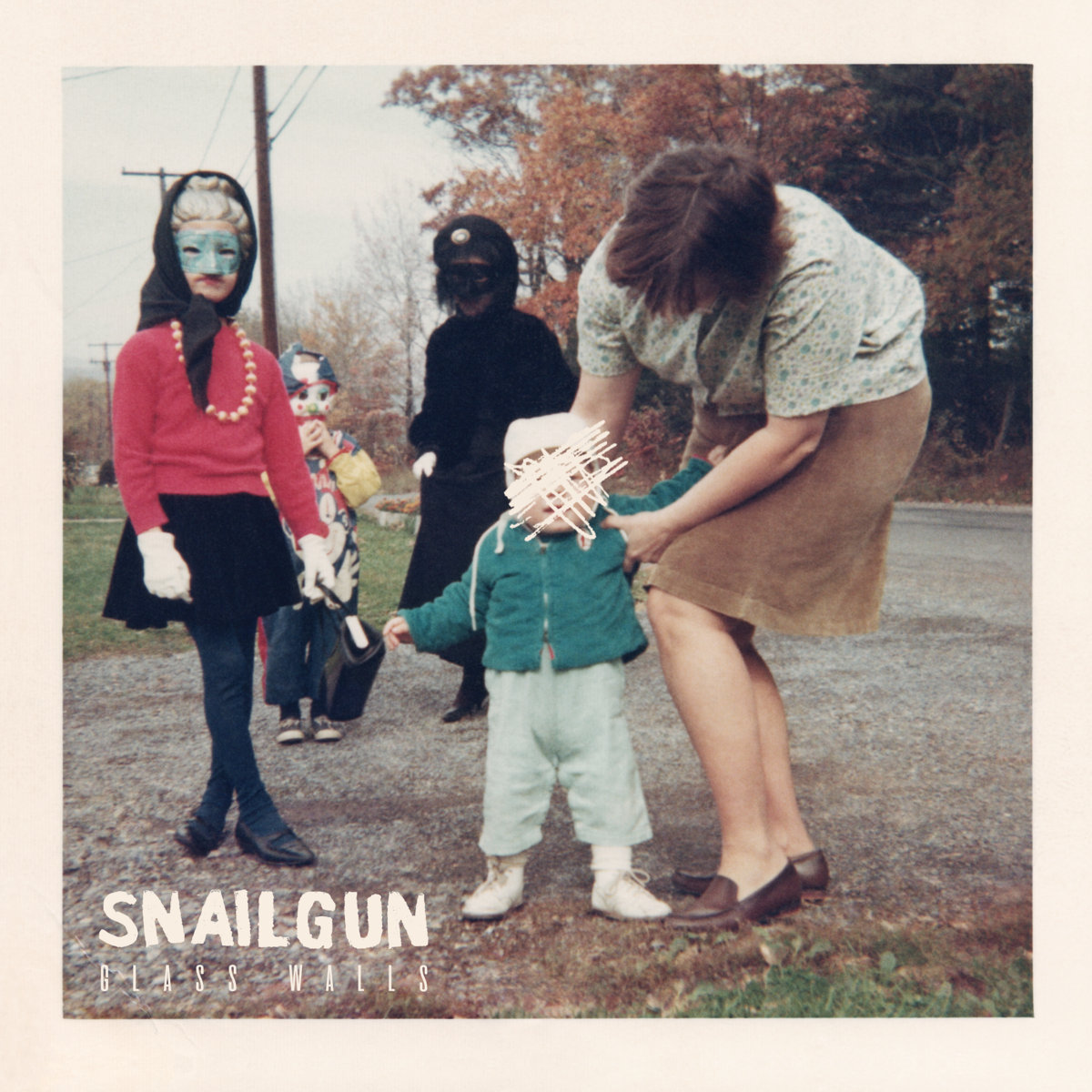
Dan: I think ‘Glass Walls’ had a nice ring to it when we were thinking about titles. I’m not sure if it connects to any of the other songs. The front cover is a family photo from 1964 that I found digging through a box of old photos. It has that sort of weird accidental Renaissance quality to it that makes it a bit uncanny. The back cover of the house underwater is also an old family photo from a flood in 1972.
There’s a lot of bleakness and dry humour in the lyrics. Where do the words usually come from for you? And do you like people knowing exactly what a song means?
Adam: Speaking for myself, I almost treat lyrics like a homework assignment. I’ve got a deadline, and I’ve got to write something! It’s not a natural process for me the way writing music is, but it’s been fun and interesting to explore. Sometimes I draw from personal experience, sometimes from politics, and sometimes I don’t really know where the lyrics come from at all. There have been times where I’ve heard them in my head and wrote around them. Often, I’ll listen to a rehearsal instrumental track on repeat to meditate on the lyrics. I remember for ‘It’s Called Fear’, I heard the title of the song shouted over the chorus. I didn’t know where it came from, but I just kind of wrote the lyrics around it.
I’m happy for people to interpret the lyrics how they want to. I have had many cases where I’ve loved the lyrics of a certain song, but it would get spoiled for me by hearing the writer’s interpretation. This has happened to me a ton with Kate Bush songs – her lyrics are so dreamlike and evocative, but they can be kind of a letdown when you hear that a song with such cryptic lyrics about hiding from the government and burying a yo-yo in the garden is about a son’s father who builds a weather machine.
There’s a lot going on in ‘Labyrinth. You’ve got mirrors, a mechanical tiger, a permit, and then the whole thing starts spreading. Where did all of that come from?
Dan: Most of the initial inspiration came from a few phrases I remember from a prank phone call tape made by some friends as teenagers. One had a whole story about needing mirrors to build a labyrinth. Another one was looking for a diesel engine for a mechanical tiger. The line about not having a permit is all real. I had that combination of funny ideas and this idea of just repeating the words building and laughing over this repetitive bass line. Adam suggested just to keep it really simple. He added the lines about it expanding into the neighbours house and then the whole city.
I recorded a demo of the vocal that just kept getting increasingly more unhinged. I was going for something like Gibby Haynes from Butthole Surfers in their song ‘Mexican Caravan’. When we recorded it, I added a bunch of screams at the end that are mostly buried in the noise but lend a bit of insanity to the song.
The idea to get David Waldie to play sax came about when we were rehearsing for a gig with David’s band Gun Laws (highly recommend!). Adam had the thought of creating a massive wall of sound as song builds like The Stooges ‘Fun House’.
Where did ‘Shadow Operator’ come from? The lyrics have this strange mix of colours, bodies and elements. Was there a particular image behind them?
Dan: ‘Shadow Operator’ is just a couple of words that I took from an M. John Harrison sci-fi novel called ‘Light’. The novel is a weird combination of something like Strugatsky brothers ‘Roadside Picnic’, a hard boiled detective novel, and some beat authors.
For the lyrics, I liked the idea of different colours in the verses pink, yellow, blue, ivory mixed with different elements; sand, bone, skin. That came together as a sort of stream of consciousness but gave off a creepy vibe. There’s a line about too many probabilities in the book and that transformed into the end line.
How did ‘Midway I’ and ‘Midway II’ become two separate pieces? Were they always meant to go together?
Dan: ‘Midway II’ was written first. Adam is always writing little parts that sort of sit somewhere in between a full song and something like connective tissue between songs. We ended up writing a long intro section to ‘Midway’ that we would play while people were coming into the gig from outside. That was always improvised and could go on longer until the room filled up. I think we felt like the tension that the intro built made the actual song better. So that all happened pretty organically. ‘Midway’ became ‘Midway II’ and the intro became ‘Midway I’.
Adam: Yeah ‘Midway I’ was written for that purpose. We kinda said “fuck it” and recorded it and it sounded good on the record. Definitely wasn’t the original intention.
You recorded part of ‘Glass Walls’ at Goatsound with Jason Fuller and the rest at Cellar Sessions with Max Ducker. Did the two sessions feel different? And was it difficult getting everything to sit together as one album?
Dan: We recorded ‘Labyrinth’, ‘Shadow Operator’, and ‘Midway I’ and ‘II’ at Goatsound in April 2025. And then ‘SD’, ‘Straight Ahead’, ‘It’s Called Fear’, and ‘Screamy Cat’ were recorded at Cellar Sessions in Sept 2025. We also recorded a cover of Chappell Roan’s ‘Good Luck, Babe!’ at Cellar Session during the same session. That track is on Bandcamp.
I was pretty happy with the sounds in both sessions. I think Al’s mastering made them cohere so they sound like an album. I think what both Jason and Max did that suited the band’s sound was spend a lot of time on getting the drums right upfront. The bass tone was dialed in pretty quickly I think. Just set it up “yep, that’s rockin” next. And then we spent a lot of time getting the guitar sound perfected.
Adam: I’m really fussy when it comes to guitar sounds.
You first met Max Ducker when he was doing sound at one of your shows. How did that end up turning into working together in the studio?
Adam: Pretty much exactly like that. Max was always a really stand up dude. He got what we were about right away and was really encouraging. He also offered to record us at a time when he only was recording bands he liked, which was really flattering.
In the studio, he’s pretty relaxed and very patient about helping us get the sounds we want. I really appreciate that because as a guitar player, the first thing that I find about recording is that hearing the recorded guitar always sounds way thinner than what I’m used to hearing live, which can make me panic a bit! But he’s always been really helpful and patient about taking the time to get the sounds I want. He’s told us repeatedly that he wants to make a record that we like.
Sam: Recording with Max has just felt like being in the rehearsal room, relaxed and collaborative, but always about writing serious music! It’s been a pleasure to work with him.
What’s the Melbourne/Naarm underground like around you at the moment? Who do you find yourselves playing with and spending time around?
Dan: I feel pretty lucky to get to play music with the bands that are around Melbourne. There’s definitely a little scene that ebbs and flows at various points. Max is doing some great stuff with Undunn Records and No Hoper. FACS released the Australian press of ‘Wish Defense’ on Undunn so that’s a cool little international link. I think when we were trying to figure out where we sort of fit there were some natural allies just based on sound with Waxman and Tench. Adam and I were big Bench Press fans. Sam and I have a big shared love of Screensaver. We are all right into Frons, Gun Laws, Going Swimming, Dolls, Winternationale, Tongue Dissolver, and Ex.Ek. Big shout out to friends in Mirror Clippers, Flocks, Nova Fiends, Anglerr.
Eoin Clements from The Mean Times put us on as a duo with a drum machine for our first gig. Sam plays in Great Falls and Cold Open, and his bandmates there all play in other bands so we have a little community. Who else? I’m a huge fan of Zipper and Beat Panic. As far as venues, I think we are big fans of The Tote, The Last Chance, and the Old Bar. We also love playing at Cafe Gummo and Cactus Room. Two great venues with great vibes. Paul and Renae at Record Paradise have been really supportive as well. As has Rauri who hosts the show Fang It on the community radio station PBS and Sal who hosts Tight Pants on 3MDR.
You’re already playing newer material. Does it feel different from the songs on ‘Glass Walls’, now that most of it is being written as a three-piece?
Dan: Pretty much all of the new songs are written as a three piece. And I’d say they’re a lot rawer sonically. Some of the ideas might have been kicking around for a while. There are a couple of songs that just come together really quickly in rehearsal. I’d say we still have a mix of longer improvisational pieces and then shorter punk songs but those are maybe pushing into noisier territory if that makes sense.
Sam: I suspect the next album will feel similar in a way, a variety of sounds, and a mix of levity and dirge. I’d be surprised if we end up following any particular thread but who knows! If anything has developed it’d be that I think we’ve settled quite a bit as a unit, and learned a good deal about our sound by getting in the recording room with Jason and Max.
And what’s next for Snailgun?
Adam: We’re working on album #2! We’ve recorded a few tracks already and are writing another batch as well. It’s going to sound pretty different, as almost all of these songs have been written as a three piece.
To finish, if the three of you came round and could choose anything from my record collection, what would you put on?
Dan: There’s a new Fall album coming out right? We could check that out.
Adam: Personally I’d love to hear whatever albums really influenced you!
Klemen Breznikar
Snailgun Facebook / Instagram / Bandcamp