

Evan Parker Interview | Six Decades of Listening, Risk and Free Improvisation
Evan Parker discusses Cecil Taylor, John Stevens, Derek Bailey, Incus, solo saxophone, electronics and ‘The Heraclitean Two-Step, etc.’
For more than six decades, Evan Parker has been a central figure in European improvised music. His career runs from the Spontaneous Music Ensemble and Peter Brötzmann’s ‘Machine Gun’ to Incus, the Schlippenbach Trio, the trio with Barry Guy and Paul Lytton, his solo saxophone recordings and his work with live electronics.
This interview begins in New York in 1962, when an eighteen-year-old Parker heard Cecil Taylor, Jimmy Lyons and Sunny Murray at the Take 3 on Bleecker Street. What remains clearest is Murray’s drumming: “the floating, shifting quality worked beautifully.” Parker then looks back on John Stevens and the Little Theatre Club, Derek Bailey and Incus, Peter Brötzmann, AMM, large ensembles, electronics and the demands of solo playing.
Throughout, he returns to listening, practice, acoustics and the accumulated knowledge of long-running groups. He speaks precisely about reeds, circular breathing and cross-fingerings, but is wary of explanations that make improvisation sound fully knowable. Asked what he is looking for when he plays, he answers: “All of the above, including the unnameable.”
The four-CD set ‘The Heraclitean Two-Step, etc.’, released by False Walls in 2024, places a 1994 solo from Warwick’s Unitarian Chapel beside a return to the same room in 2023, followed by three discs recorded at Arco Barco with engineer Filipe Gomes. The title invokes Heraclitus: the room can be revisited, but neither the music nor the player remains the same.
“My job is to keep finding new material and variations on old material.”
You were born in Bristol in 1944 and began on alto saxophone at 14, with Paul Desmond as an early influence. In New York in 1962, you heard Cecil Taylor with Jimmy Lyons and Sunny Murray at the Take 3. What stayed with you from that night, and how did it change the way you thought about music?
Evan Parker: That was 64 years ago. My memory is by now a strange compound of certain specific details and a generalised set of memories of memories, which are fuzzy, blurred if not distorted, and I hope not invented. There are few accounts—the one by Robert Levin is a good one. It begins: “In the summer of 1962, Cecil lands a three-month, four-night-a-week gig at The Take 3 coffee house on Bleecker Street.” I knew of Cecil Taylor via certain records, the most recent of which was the one on Candid called ‘The World of Cecil Taylor’, or perhaps the Gil Evans side of ‘Into the Hot’.
I may not have heard this until I got home. I’m guessing, but I think I may have bought it on that trip. This was prior to their first visit to Europe and the Café Montmartre recordings.
To set the scene: I had arrived with what I hoped would be enough money for two weeks and the address of a friend of a friend who I had been assured would be happy to have me stay at her place in Greenwich Village. In the event, she had gone to Europe for the summer and had sublet her place. I was recommended the now-infamous YMCA on 34th St. It is no longer a Y. The Wikipedia entry notes that it was the country’s largest residential YMCA; it was sold in 1993 and later converted to apartments.
I was definitely a “budget traveller”. Checking in there, I got into a conversation with a young Dutchman (about my age) who suggested we could save money by sharing a room. He was there for similar reasons to mine. I was there to buy records and go to jazz clubs in the evenings. He was there to go to art galleries and exhibitions in the daytime. I cannot remember his name or explain to myself why on earth we did not stay in touch. If by any chance he reads this and recognises himself, I hope he will get in touch. These are precious memories.
That night on Bleecker Street will have been some day in the second half of August, and now memory is playing tricks. I seem to remember being alone and refusing to buy a drink until CT showed up. It all seemed so unlikely. But I also remember that my new roommate friend was there.
The single most significant impact was the drumming of Sunny Murray. I have heard it called “broken time”, but the floating, shifting quality worked beautifully. The trio had a sound unlike anything I had heard before. This is the first and most significant of the “specific details” I mentioned at the outset.
We hung around after the music had finished, asked questions and absorbed impressions.
Jimmy clearly was not in for what we now call “the Hang”. He put on his trench coat and split as soon as he had packed his horn. Cecil and Sunny were in no hurry to get anywhere; they were excellent raconteurs and real night people. I remember being embarrassed by CT. When he learned I was from London, he asked me what Margot Fonteyn was doing. I knew she was a ballet dancer and famous as such, but… There was much talk of the upcoming trip to Denmark… Sunny’s fear of flying… Sunny whistled the theme from the John Wayne film ‘The High and the Mighty’, about trouble in the air—described as “an aviation disaster movie”. And that’s it for the specifics.
Having later played with both Cecil and Sunny, I can say that neither of them lost their enthusiasm for staying up late and talking…
“There is certainly a kind of telepathic understanding which is part of the living system that is a group.”
Before music took over, you studied botany. Did its emphasis on close observation, classification, structure, patience and living systems carry into the way you listen and improvise?
Close observation, classification, structure, patience, and attention to living systems: each of these has an equivalent in music. The equivalent would be a kind of analytical listening which differs according to whether playing solo or in a group. Obviously, it is only (and then perhaps only ideally) in solo playing where decisions about change and development can result in pronounced, specific, audible outcomes. In group playing, a lot depends on the real-time analysis—perhaps “tracking” is a better word?—of the input from the other players. How well do I know the other players? How easy are their decisions to anticipate? How predictable are my responses? Some of this thinking might involve “classification” in terms of idiomatic norms. There is certainly a kind of telepathic understanding which is part of the living system that is a group. This would be clearest in a duo situation. Recent concerts in duo with Peter Evans and with Sylvie Courvoisier have been characterised by a clarity of shared intentions on patterns determining musical material from microstructure to overall form. It is almost certainly strongly influenced by the degree of formality in the playing situation, the unspoken assumptions, the necessary dialogic nature. Moving on to trio, quartet, quintet… there are corresponding layers of clarity and complexity, but also the potential for cancellation, cross-purposes and confusion. The larger the group, the more the analogies are with mountain climbing, mud wrestling and team rowing.
When you moved to London in 1966, the musicians around the Little Theatre Club were beginning to develop something distinct from American free jazz. Were you conscious that a new musical language was taking shape, or did it feel more immediate—a few people in a room finding out what they could do?
I heard a BBC broadcast while I was still living in Birmingham. I was working nights as a factory labourer and they broadcast over the PA. This in itself seems very unlikely, but it’s how I first became aware of John Stevens. I heard a late broadcast of jazz from the BBC—the radio used to play throughout the factory. I think the band had been put together by John Stevens; I am fairly sure that Kenny Wheeler, Ray Warleigh, Alan Skidmore and trombonist Chris Pyne were the frontline, Mike Pyne was on piano and Ron Matthewson on bass. It was about as far out as anything I had heard on the radio at that point. I made a mental note of John’s name.
I got the sack from that job soon afterwards and moved back to London.
Through friends at the university I had come to know Dave Chaston (see page 73 of Keith Richards’s ‘Life’), who was doing postgraduate studies at the Royal College of Art, and through him I was asked to make some music for a science fiction film by another student, Gavin Owen. For years, decades in fact, I thought this film was based on Ray Bradbury’s ‘Fahrenheit 451’, but in fact the narrative was of a girl, clearly at some point in the future, watching colour TV and using a handheld gizmo to change channels. It was a clever structural device which allowed Gavin Owen to roam around recent history as though seen from some time in the future. The experience of imagining futuristic music was a mind-changing experience for me—up to that point I had been assiduously attempting to play like Coltrane in his modal period.
The music was made, the film was shown at the graduation Diploma Show, and Alfreda Benge, who was studying in the RCA Film Department with Gavin Owen, introduced me to John, who was at the Diploma Show to see the work of his friend Geoff Rigden. Alfreda worked at Ronnie Scott’s in the evenings and knew John. She urged him to check out the music I had made for the film. We got talking. Conversation was a high art form with John, and he was keen to discuss the innovations of Sunny Murray and Milford Graves. In a sense, the conversation was an audition. He told me he had started a new club and invited me to come down and play. In retrospect, I can see that I was treated like a protégé, and I was very fortunate to have been introduced to John that day.
Two phrases often presented as John Stevens’ rules—if you cannot hear another musician, you are playing too loudly; and if what you play does not relate to what you hear, why be in the group?—have come to sum up the SME’s ethic. Where did those ideas come from, and how closely do they reflect Stevens’ approach?
These famous “rules” were taken down as notes by the music journalist Hannah Charlton from a short talk I gave at the ICA back in the mists of time. They are increasingly attributed to John himself, but this is the way history works. By the way, that talk was also the source of the term “atomistic” as a general description of the SME approach and “laminar” for AMM.
There were many aspects to John’s playing, but the approach which I believe was closest to his heart was free or open playing. The small kit that he assembled and used for the ‘Karyōbin’ recording was actually a kind of junior drum set with a rack of small double-headed drums and very small brass discs to replace the cymbals, and Chinese hand cymbals to replace a standard hi-hat. This allowed for intense playing but produced less volume than a regular trap set.
The studies in his workbook ‘Search and Reflect’ are designed to encourage close listening and detailed interaction and are good preparation for totally open interaction.
The Spontaneous Music Ensemble’s ‘Karyōbin’ is now regarded as a central document of early British improvised music. How did that quintet come together, and what does the record preserve of that moment?
‘Karyōbin’ was my first official recording date.
I had survived the changes of line-up that took place as John Stevens gradually assumed leadership, and the SME at this point had become a duo. John called me to say that Island Records were interested in a record and asked what I thought we should do. I am fairly sure that the way he asked the question was meant to convey a sense that we should think of a larger group.
Exactly how we arrived at the decision to add Kenny Wheeler, Derek Bailey and Dave Holland I no longer remember. The photograph by Jak Kilby on the original LP sleeve shows the five of us together at the Little Theatre Club. Dave and Kenny, with their jackets and ties, look like they came over after gigs elsewhere.
All the possible combinations of duos, trios and quartets happened subsequently but that quintet never played again.
Eddie Kramer went on to fame and glory as the engineer for Jimi Hendrix.
Chris Blackwell made Island Records into a major label almost overnight.
And we all did OK too!
‘The Topography of the Lungs’, with Derek Bailey and Han Bennink, became Incus 1. How did you arrive at that trio, and what happened to the earlier session with Tony Oxley?
The recording that became Incus 1 came about after a very English sequence of “After you.” “No, after you.” They both insisted that I should make the first record, and finally my response was to propose a trio with the two of them. How very English! We made a recording in a small demo studio in Gerrard Street, close to the original Ronnie Scott’s. I was not happy with the results and decided to start again with Han Bennink instead of Tony. This probably soured relations with Tony. It is a long time since I listened to TotL. I will listen now…
I say in the notes that it was hearing their duo recording for ICP that made me so sure it would work.
I had played with Han as part of the ‘Machine Gun’ band.
Did founding Incus feel mainly like a practical necessity, or did it also have a political meaning for you?
Since the original impetus to start a label came from me, I would identify both the practical necessity and the political meaning. Thinking about the forerunners—Harry Partch with Gate 5 Records, Milford Graves and Don Pullen—perhaps they would also acknowledge both aspects.
I think, in the end, meaningful political action has to come from practical necessity, so both issues are intertwined.
Did running the label change how you thought about records and the apparent contradiction of fixing improvised music in a repeatable form?
My whole motivation to play improvised music came from listening to records. The first jazz record I bought as a schoolboy was the 10-inch original version of ‘Bird ’n’ Diz’. There was no great worry about the philosophical contradictions. When the time came and I felt ready, the rest followed very naturally. If I had not made records, you would not be asking me these questions.
All recordings of music fix the details of a specific performance, but they also allow repeated listening, which makes it possible to become familiar with the specific musical “language”.
“My roots are in my record player.” — Evan Parker, date unknown
In 1968 you played on Peter Brötzmann’s ‘Machine Gun’, followed by ‘Nipples’ in 1969. How did you find a place for yourself in music that was louder and more physically demanding than the small-group London scene?
I met Peter at the first Südwestfunk Free Jazz Meeting. Peter Kowald had negotiated a place for me. I had never heard so much sound from a saxophone! I knew what I needed to do in order to contribute to his concept for the ‘Machine Gun’ band. Later I joined Alex von Schlippenbach’s trio with Paul Lovens, and so I had a regular situation for playing tenor saxophone in addition to my trio with Barry Guy and Paul Lytton. Those different combinations each called for a specific response, but had in common the need to sustain a decent sound on the tenor. It is a very demanding instrument in terms of physical effort.
AMM were developing a different approach to sound and collective improvisation alongside the SME. How did you hear their music at the time, and what seemed most distinct about their way of playing?
In a public discussion at the ICA back in the mists of time, I used the term “atomistic” to describe the SME approach/language and “laminar” for AMM. That still seems a useful distinction in describing their differing approaches.
I have worked with various versions of AMM and with E. Prévost, Keith Rowe and John Tilbury individually, and I would need to give more thought to the best way to describe their individual approaches. As a generalisation, attention to tone colour is a specific characteristic—but this doesn’t really say very much!
“I have been working on solo playing for more than fifty years.”
Listeners often describe your soprano playing through its techniques—circular breathing, multiphonics, split tones and cross-fingerings. When did those methods begin to feel less like separate techniques and more like ordinary musical language?
I have been working on solo playing for more than fifty years. Techniques which are fundamental—circular breathing and cross-fingering—have come under stable control, and combining them has allowed complex combinations to emerge. Some of these combinations become the platform for further extensions of range and articulation. This is an ongoing process, but the improvising ethos remains strong, and at the edge of things there is still risk-taking.
Perhaps in the meantime I have learned how to construct escape routes if things get messy!
You have said there is no method independent of a particular situation: the room, the people, the instruments and the acoustics all shape what happens. Has that idea helped you reconcile an open improvising process with the fixed form of a finished recording?
Yes, this feels like a kind of enlightenment. I will try to tread lightly with my concept in group situations, but it has really opened the way to reconciling the contradictions between the fixed nature of final recordings and the open improvising state of mind. A conceptual breakthrough like this is perhaps the only advantage of old age!
In a 2025 interview for Uncut, you said that you choose the right reed for the room and play until there is “nothing more”. What tells you it is time to stop—physical exhaustion, loss of concentration, musical completion or something else?
I am really happy that you have grasped the essential significance of this approach. I must thank Filipe Gomes, the studio manager and recording engineer at Arco Barco, with whom this way of working has gradually evolved. I think any one of the reasons to stop that you suggest could apply. Perhaps the most elegant is what you call “musical completion”—perhaps this is what is also called “resolution”, but these feelings are often intertwined. This is not to say that I have abandoned the possibility of making recordings of isolated pieces, but I seem to need a well-communicated sense of the specifics of time, place and people.
You have described a practice routine that includes memorised material, self-invented patterns, interval exercises, tone rows, scales, arpeggios and overtone control. How does that private preparation enter an unforeseen moment on stage?
It is necessary to keep the physical and mental processes working in parallel. Quite how much of the repertoire of memorised patterns and melodies feeds into so-called “free” playing varies from context to context and night to night. That repertoire, or repository, is a stable foundation from which to venture off the path of the “known” into the unknown. And as Machado says, “The path is made by walking.”
By definition, there can be no specific preparation for the unforeseen moment, but there is an old musicians’ saying: “If I don’t practice for one day, I know. If I don’t practice for two days, my friends know. If I don’t practice for three days, the audience knows.”
Adolphe Sax designed the instrument with tonal music in mind, and a central part of the range has fingerings duplicated across two octaves. I have various ways of generating new fingering patterns which accustom the fingers to avoiding note-choice duplication in that central region. This relates to “chromaticism”, “atonality” or perhaps “tonal ambiguity” or “polytonality”. As the great Booker Little said, “I don’t hear any note as being wrong.”
You have described improvisation as a compositional method. In what sense do you mean that, and what makes an improvisation compositionally strong?
This is a very difficult question, but perhaps I should clarify my idea: it is simply that improvisation is a way of creating music that, once it has been played, has a fixed form. It is only in this rather obvious sense that improvisation is a “compositional method”. After the event, analysis of a recording or memory may reveal structures or structuring methods, repeated stock ideas (clichés), habits, surprises, contradictions, clumsy decisions, slow reactions, moments of ingenuity…
Elsewhere you have returned to the word “open” rather than “free” to describe the music. How important is that distinction to you?
In fact, the use of that term goes all the way back to the original duo with John Stevens.
It’s not a big distinction.
Your trio with Alexander von Schlippenbach and Paul Lovens has lasted for decades. What keeps a long-running group alive, and how do you avoid becoming too comfortable with one another?
You have identified the danger of complacency. With a long-standing group playing a tour with daily concerts, there will obviously be nights where nothing essentially new happens. How do we avoid that comfort? Rivalry and irritation between the individual group members may play a significant role!
The trio with Barry Guy and Paul Lytton has developed a language of its own. Does a long-standing improvising group need to resist that identity, or can it remain the basis for discovery?
Your questions are good! I think it was Jim O’Rourke who, speaking on this subject, said of the trio: “They’re not improvising. They’re playing Parker/Guy/Lytton music.” Perhaps there are ways to avoid the familiarity? We seem to still enjoy conversations in the language we have co-evolved.
Given the entire COVID “interlude” and the fact that we live in England, Belgium and Switzerland respectively, we have not been playing as a trio much of late. In September, we have a studio booked in Belgium. It will be interesting to see how much of that group identity remains intact.
Barry Guy’s London Jazz Composers Orchestra combined written structures with individual freedom. What did playing in a large ensemble make possible that a duo or trio could not?
It can be very empowering to be a soloist with such support. Phrasing in loose counterpoint with the written material was always an enjoyable challenge.
With the Electro-Acoustic Ensemble, live electronics became part of the interaction rather than an added layer. What did that change in the way you played, and how did it affect your sense of control when others could transform your sound in real time?
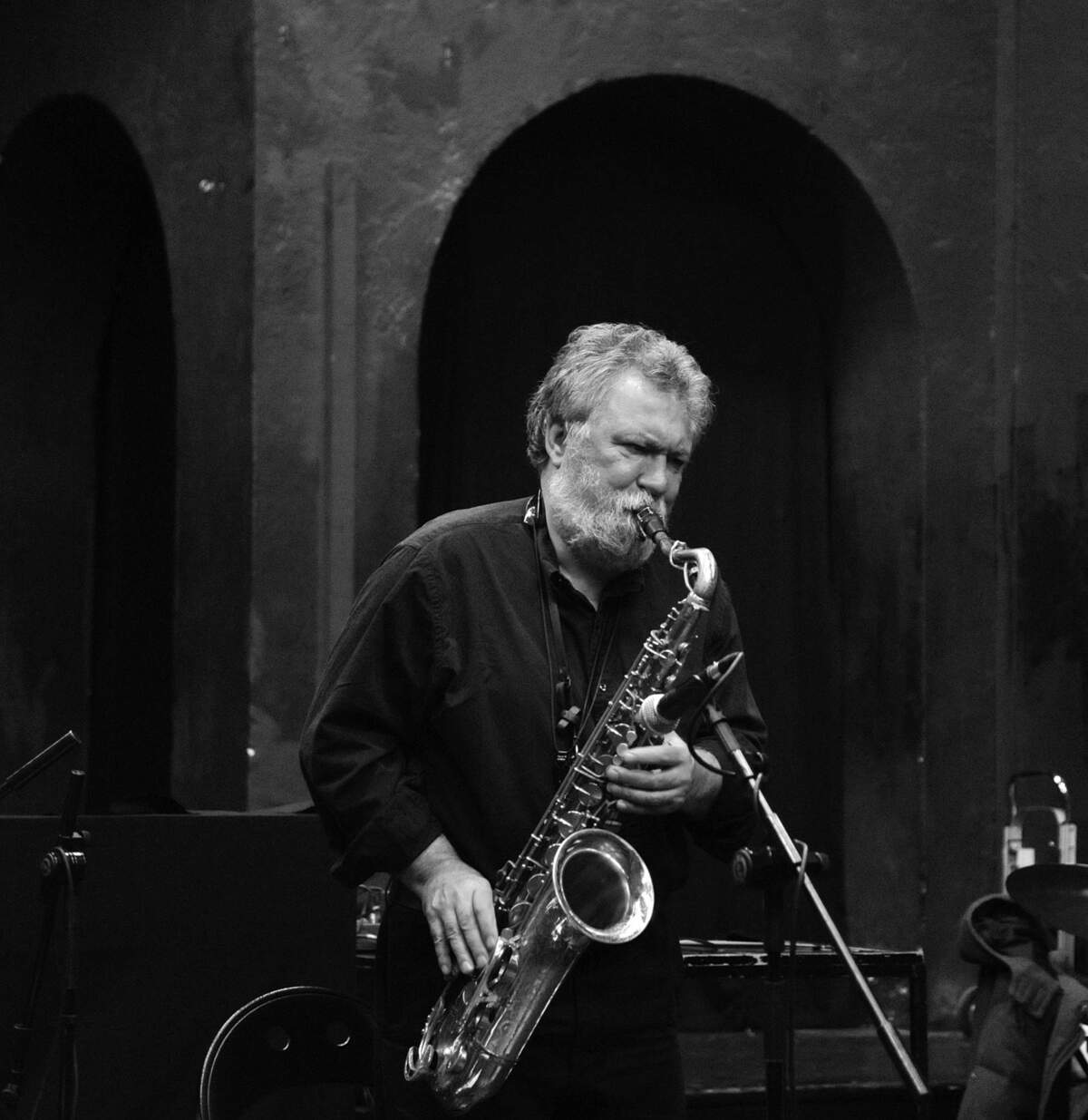
There are many approaches to interaction with live electronics, and as the technology advances the electronics become more powerful, more stable and more user-friendly. I abandoned attempts to control the electronics myself very quickly after some primitive stuff with contact microphones and foot pedals very early on. The spectrum ranges from playing with an electronic instrument to being played by an electronic instrument. In real time, this creates loops of interaction whose sound varies with the player and the degree and modes of control. I also play with musicians whose output is electronic but who do not use my sound as an input. Since the early days, it has become a field with wide variations in instrument specifics and approaches. Recent work with FURT, Matt Wright, Ikue Mori, Walter Prati and Jean-Marc Foussat illustrates this range.
‘The Regenerative Landscape (for AMM)’ on ‘Toward the Margins’ is dedicated to AMM. What did their music represent to you by then, and how directly did it shape the piece?
After the recording, when the piece needed a title, I felt it was perhaps influenced by their pioneering music and had adopted some of that more “laminar” way of playing. There was no prior preparation as in “Let’s play like AMM!”
You have described solo playing as a dialogue with the instrument, reed, room, memory and body. Do earlier players and musical relationships—Coltrane, Desmond, Dolphy, Stevens and Bailey—also remain present?
All of the above!
These days I am more than ever preoccupied by reed control and response to the specific acoustic qualities of the performance space. The variables “reed” and “acoustics” are in constant “dialogue”. Of the two, I would say the reed has the dominant role.
I am finding a lot in classic lines from Lee Konitz at the moment.
Do the tenor and soprano lead you towards different kinds of music, or are they two routes into the same set of problems?
While the soprano and tenor have much in common in terms of construction, they pull me in different musical directions. Filling the tenor with air is much harder, but when it works it is an amazing feeling of power, and it has been my primary instrument in the Schlippenbach Trio and with Paul and Barry. I have used soprano for solo playing. Lately, the material is becoming very dense and complex in rehearsal. I am a little worried that it is only achievable from one particular reed, and I ask myself: am I really in control if some details are only possible with one specific reed?
You have worked in settings outside improvised music, with Scott Walker, Robert Wyatt, Spring Heel Jack, Spiritualized, David Sylvian and Daniel Blumberg’s score for ‘The Brutalist’. What interests you about entering someone else’s frame?
Each of the connections you mention came in response to an invitation. I enjoyed the challenges, as well as the social connections and friendships that have come from these encounters.
The whole community of players interested in free or open interaction is expanding exponentially at this point. I think changes in film music have also opened up listeners’ ears to more abstract and electroacoustic approaches and resources.
“Not only is the river changing continuously but so is the one who steps in.”
‘The Heraclitean Two-Step, etc.’ began as an archival project before you turned to more recent recordings. What is difficult about hearing your earlier self—technical limitations, unfinished ideas or the sense of hearing a different person?
Technical limitations, yes. Unfinished ideas, yes, but in a sense this will always be the price of improvising freely. Simply another person? Cf. ‘The Heraclitean Two-Step’. Not only is the river changing continuously, but so is the one who steps in.
Younger musicians can now study a large archive of your playing. When a language that began as discovery becomes a vocabulary others can learn, do you see that as a success, a danger or simply the normal life of a musical idea?
If other people discover the same possibilities, they are inherent in the instrument.
My job is to keep finding new material and variations on old material.
Many younger improvisers now encounter the music through recordings, universities, workshops, festivals and online archives. How important are affordable, informal rooms to the music’s future?
The danger is that such small rooms are increasingly too expensive, but I think that the desire to play will be strong enough in a committed minority to ensure that this broad approach to playing—let’s call it FREE IMPROVISATION—will survive and evolve.
What are you looking for when you play: surprise, beauty, intensity, contact with other people, or something less easily named?
All of the above, including the unnameable.
After so many years of music made in the present moment, how has your sense of time changed? Has improvising also changed the way you live outside music?
Time is more precious.
John Stevens talked about playing as being “another little life”.
As Borges said when asked about God, “I try to be a good person.”
I can’t think of a better religion.
If there is one common misunderstanding about your work or free improvisation that you would like to correct, what would it be?
If there are misunderstandings, they have not made it impossible to play. I have been attacked by some critics and some colleagues for one or another of my views, but I am ready to explain my positions in any rational discussion and any civilised context.
After answering, Parker sent a passage from a conversation conducted by Marc Chénard on the terrace of Casa del Popolo on June 27, 2001. Asked what makes an improvisation work, Parker compared it to juggling ideas: when too many fall, the music is not working. But he also warned against pushing the analogy too far: “There are things you can’t put into words about improvisation; it’s as simple as that.” He had no wish to convert listeners who heard the music differently: “I’m not a missionary.”
Parker closed our extensive conversation with a line from David Tudor: “If you don’t know, why do you ask?”
Klemen Breznikar
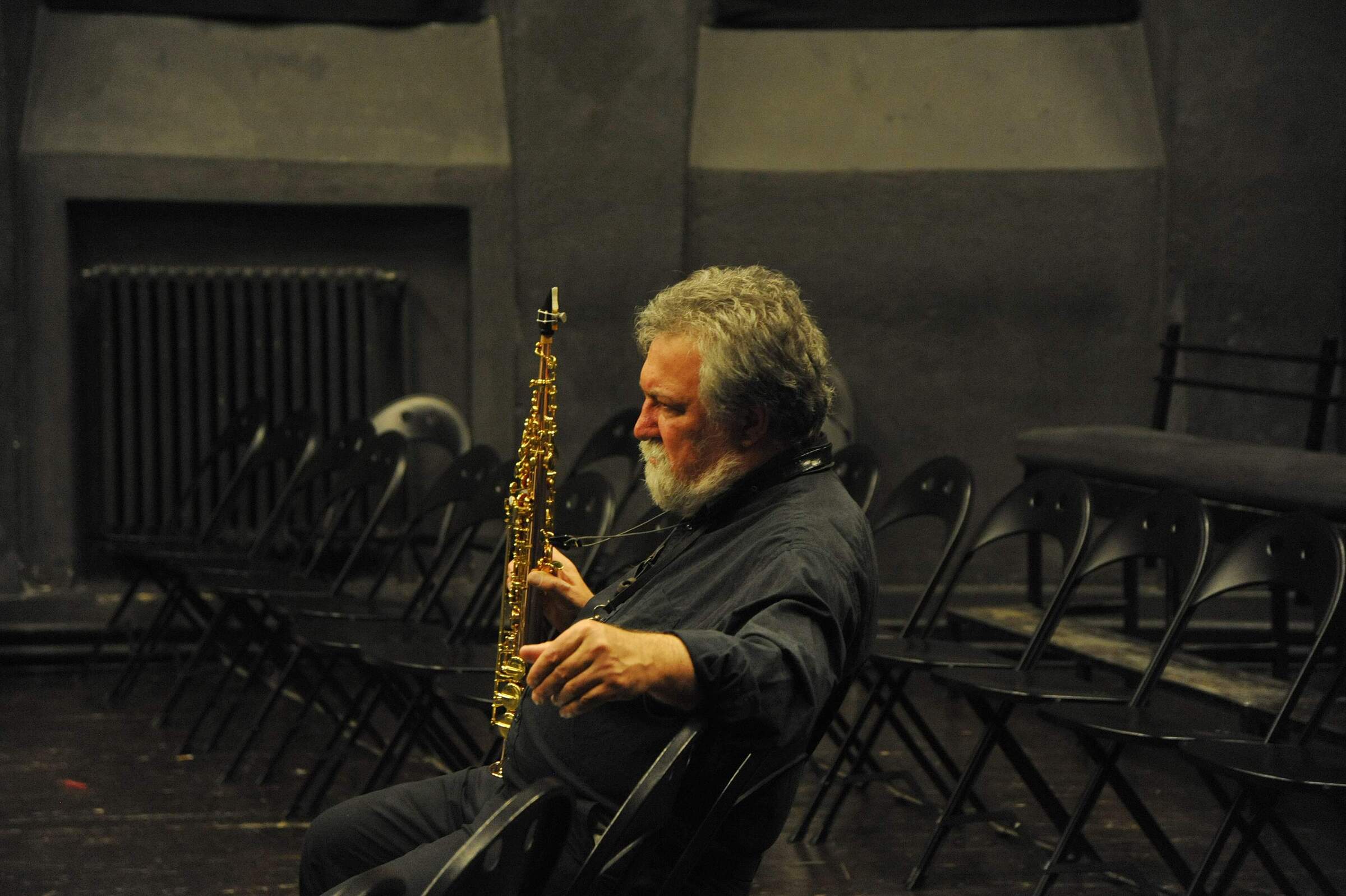
Headline credit: Evan Parker, Milan. Photo by Caroline Forbes.
Evan Parker Official Website / Facebook



Indeed the questions are good well done Klemen.
Evan’s responses are illuminating as usual, last I saw him he used four different reeds and asked the audience which one worked best in that particular acoustic