

Alan Clayson: The Argonauts, Outsider Spirit and the Making of ‘There’s Still Time’
Alan Clayson is the theatre-fed, rule-dodging mind behind Clayson and the Argonauts, and his new solo album, ‘There’s Still Time,’ out via Think Like A Key, finds him still breaking the frame he built around himself decades ago.
Clayson’s world was never built from one shelf of records, or from one idea of what a song should do. It came out of church music, scratched 78s, British beat singles, old comic routines, history books, Brel, Joe Meek, forgotten B-sides, and whatever else had lodged itself in his head. Turnpike gave him a start, but the Argonauts gave him a stage wide enough for the whole lot. Once that band formed, the door flew open: mediaeval turns, psychedelia, Merseybeat, vaudeville, cabaret, mock grandeur, sudden absurdity, and moments that could tilt from pop song to playlet in a bar. As Clayson puts it, “there appeared to be nothing they wouldn’t try.”
Clayson’s beginnings were hardly designed to produce a pop eccentric. There was choir practice, and a household in which pop music was treated as an embarrassment. His mother’s warning had the chill of a life sentence: “Alan, if you ever appear on stage with a pop group, I shall die of shame!” Fleet, the Hampshire town of his youth, supplied its own kind of inertia: respectable, muted, and built around the understanding that “nothing much” was meant to happen. Clayson’s response was not to escape into fantasy, but to make fantasy practical. He sang into mirrors, turned record collecting into research, turned research into books, and made the stage a place where private oddity came out alive.
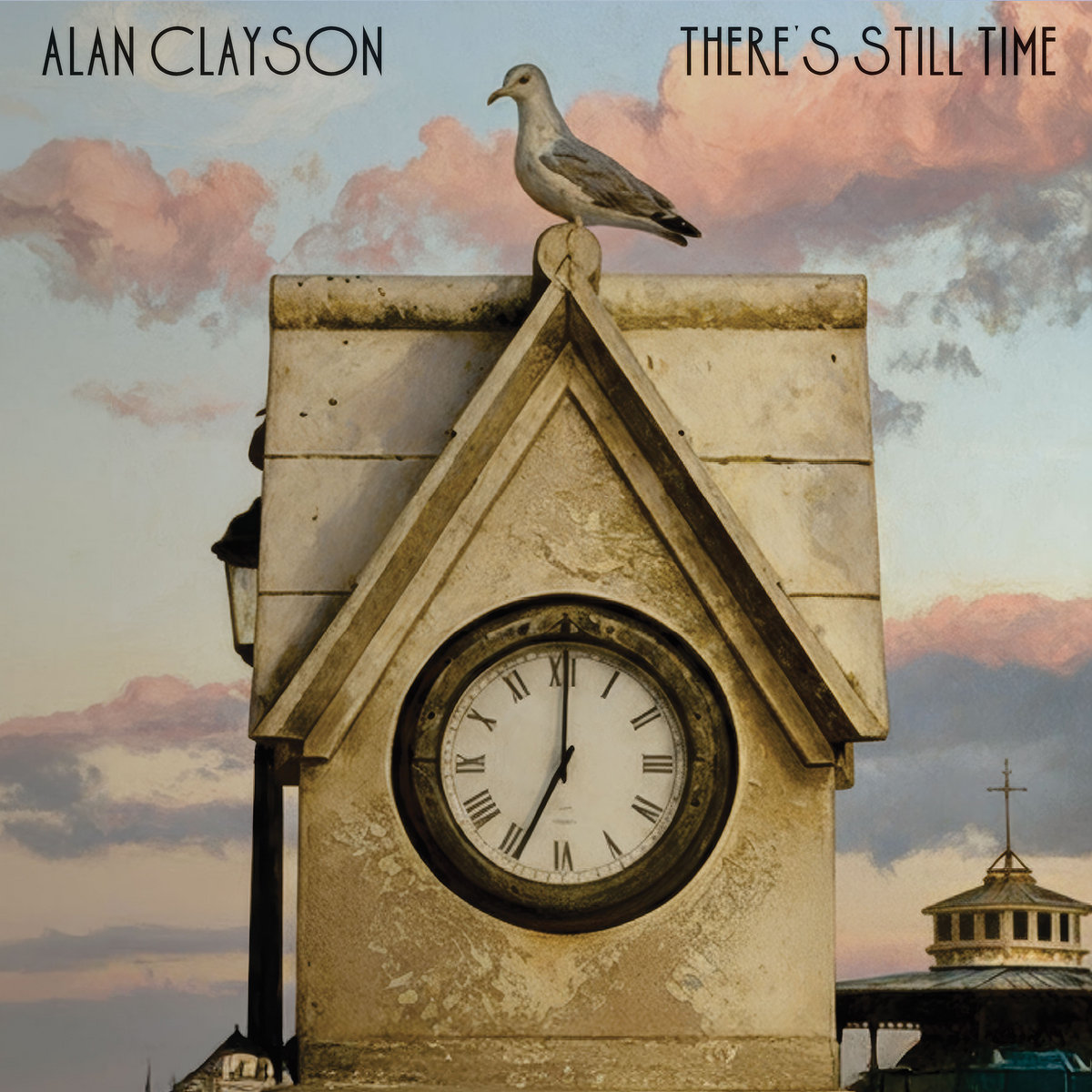
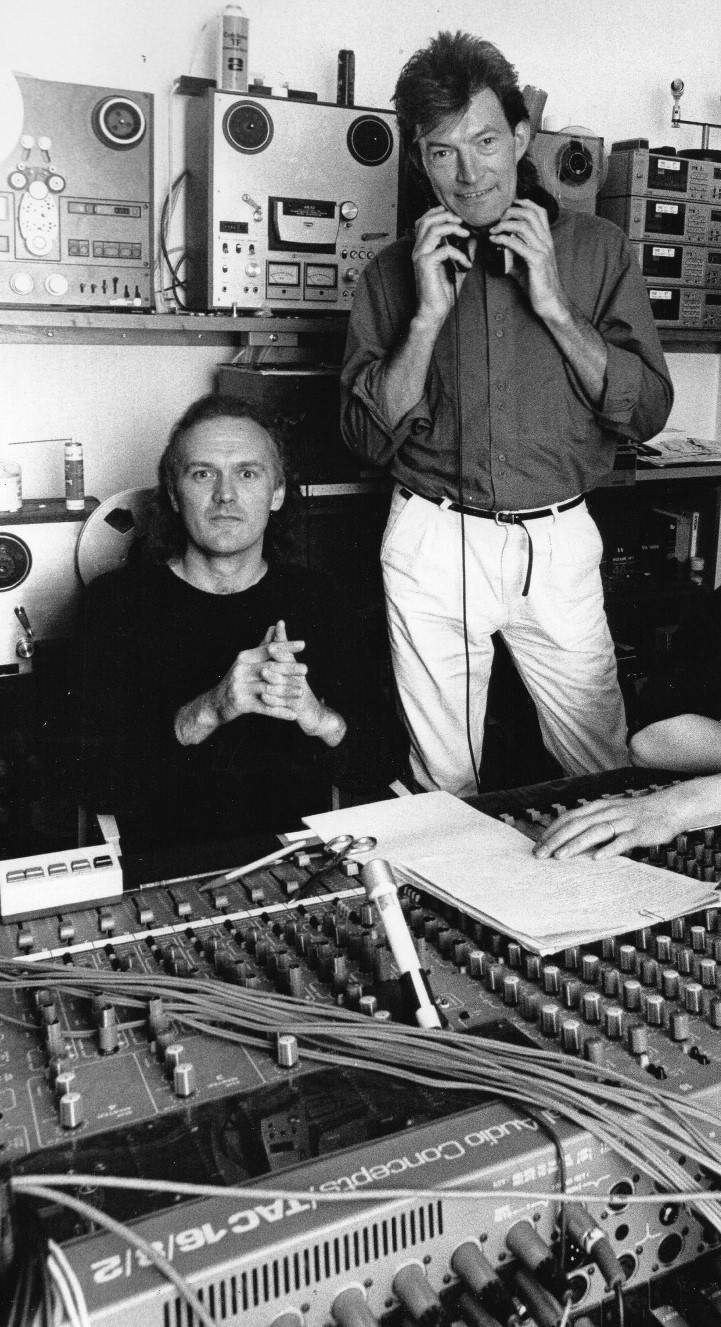
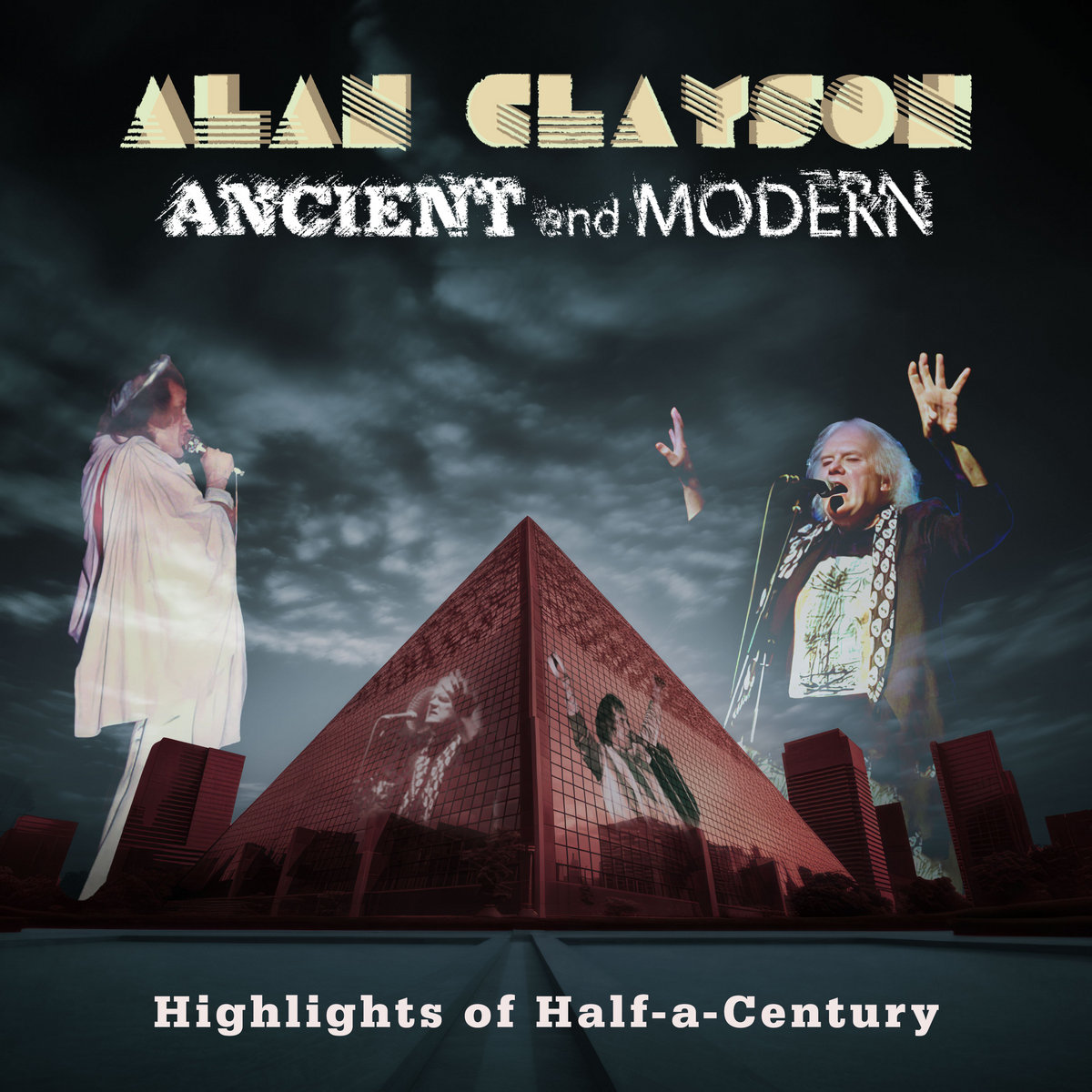
‘There’s Still Time’ follows ‘Ancient And Modern: Highlights of Half A Century,’ the 2024 collection released by Think Like A Key. After that retrospective, Roger Houdaille of TLAK and Clayson found a new album in an accumulation of fourteen tracks that had reached the mixing stage, developed at Argonauts bassist Paul Critchfield’s Blue Rocket studio in Reading and finished in post-production by Houdaille. Clayson says he “composed every note and wrote every word”.
The key line is his own: “Break any kind of formula.” Clayson has spent decades doing just that.
“Break any kind of formula”
Did putting together ‘Ancient and Modern’ clear the deck for this new one? I wonder if looking back to those early seventies Turnpike days nudged something loose, set ideas in motion that we now hear threading through There’s Still Time.
Alan Clayson: It goes back far before Turnpike. The exciting sounds that, from the mid-1950s, began pouring from a hitherto in-one-ear-and-out-the-other wireless during my childhood led me to become steeped in both chart-directed 45s and music of extremely challenging nature – as reflected in my “other” career as an author. For instance, my official biography of The Troggs in 2002 was followed two years later by a life of Edgard Varèse, the missing link between Stravinsky and John Cage – and the most far-sighted of modern classical composers. These interests – and a widening gap between art and commerce – cannot have helped but oil the wheels of ‘There’s Still Time.’
It feels like a record that has been waiting patiently in the wings. There are moments that sound almost beamed in from somewhere else entirely. Take ‘Martian Afternoon,’ which marries a kind of low level cosmic dread to a motorik pulse. When you are in the studio with something like that, where do you even begin?! Is it a matter of taming the energy, or do you try to preserve it and let the song find its own shape?
Roger Houdaille, supremo of Think Like A Key, released 2024’s ‘Ancient And Modern: Highlights of Half A Century’. Perhaps a greatest hits/best of collection like this ought to have come after rounding things off with an assassination or drowning in a shipwreck.
After the dust settled, however, Roger and I wondered whether there was a completely new Clayson album in an accumulation of fourteen tracks – including the speculation about our cosmic future that is ‘Martian Afternoon’ – that had reached the mixing stage. Most of the content per se as well as the approach to recording it were, well, unorthodox, developing as it did at Argonauts bass player Paul Critchfield’s Blue Rocket studio in Reading prior to post-production by Roger.
Although a continuous control of the thematic and structural elements of each item was always present, there was never any predetermined process in the studio. Indeed, my artistic instinct has always been to break any kind of “formula” as soon as it rears up rather than, like an alchemist of old, repeat the same sequences, over and over again from different angles in hope of finding gold.
Your childhood reads as quite structured. Religion, discipline, a certain suspicion of showbusiness. And yet your early appearances from Noye’s Fludde through to Billy and the Conquerors, lean towards something far more unruly, even theatrical. When you look back, do you see that later, slightly unhinged stage persona as a form of rebellion? Or was performance less an escape and more a way of confronting those early constraints head on?
‘Nemesis (The With-It Vicar)’ is germane to an upbringing centred on the Church, and the mortgaging of most waking hours on Sundays to divine worship. It slopped over into the rest of the week too as I trudged to choir practice every Tuesday and Thursday evening. This was in readiness for donning starchy vestments and cantillating at Holy Communion, Matins and Evensong on the Sabbath, year in, year out, beneath the stained-glassy gape of a blond-bearded God-the-Father, enthroned in bedspreads and golden crown, who made you think of Himmler’s Aryan exemplar. Nothing has ever bored me more.
I’d lost my faith quite painlessly while the holy sounds I made were still novel, and could no longer take seriously any adult that still believed in all that stuff. Nevertheless, there was hell to pay when after John Lennon’s pronouncements that The Beatles “are more popular than Jesus right now” were interpreted by a more general media as boastful “blasphemy”. I suggested to my mother that he should never have withdrawn that statement, and that, if faced with a choice between going to a Beatles concert and attending Matins, it wouldn’t be the latter.
Worse was to come because, for the scion of a “decent” family, even thinking for a moment about pop, its shabbiest and most corrupt branch, as a full-time living was neither honourable nor permissible, being roughly the equivalent of wanting to shake a torso in a burlesque troupe. It was a deal with the Devil.
Alan was going to be a vicar, believed Mum, counter to increasingly less insidious evidence to the contrary – and, despite my Noye’s Fludde renown, I was not to be either groomed for or encouraged to embrace the professional stage, be something I should never hope to be. When the family watched television together, I’d hear myself endorsing things that I either cared nothing about or found repugnant. Like 1984 and Winston Smith voicing his abomination of Goldstein during the Two Minutes Hate, I’d agree with Mum and Dad that The Rolling Stones were morons and join in the snarls of laughter when Max Bygraves, comprehending the prejudices of his consumers, centred his jokes on a blow-up of Mick Jagger with a super-imposed Yul Brynner pate on ITV’s Sunday Night At The London Palladium.
“Oh, they’re so far away,” would be Mum’s argument when I pointed out the pictures of long-haired pop stars from the pages of Jackie, Fabulous 208 and Mirabelle on the walls of my sister’s bedroom – though she knew as well as I did that most of them had surfaced from ordinary homes like ours, many after enduring the same incomprehension, lamentation, uproar and domestic “atmospheres” that I would in the years to come.
Yet powder kegs were exploding at home with increasing frequency. Without so much as a with-your-leave, he’d switch off the television if it was broadcasting anything he considered unsuitable – such as The Rolling Stones miming murkily to ‘Paint It Black’ on Top Of The Pops.
Not long after that, however, I was allowed to leave the choir, a legitimate colour given to this by the ‘O’ levels mere months away. Yet I needn’t think that I wasn’t going to stop putting in an appearance at All Saints once every Sunday, ostensibly in case some holy light penetrated the visor of the armour of my loss of faith – and wasn’t that Alan with freshly-shorn hair and in his Farnborough Grammar School uniform bearing the collection plate up the aisle?
Hitting where it hurt most, Mum would punish me by taking away my Dansette record-player. For weeks, it would lie under the double-bed – as would the acoustic guitar that she was to maintain I’d acquired through deceit.
With a pyjama cord as strap – more effective after I’d screwed in strap-buttons – it beat tennis racket or garden spade whenever I’d place a disc on the Dansette turntable, and get into position in front of my bedroom’s wardrobe mirror in that time-honoured ritual of frustrated eroticism. From the opening bars to the fade-out, I’d pretend to slash chords and pick solos with negligent ease while lip-synching the lyrics to a Hollywood Bowl-full of ecstatic females that only I could see.
Sometimes, unencumbered by an instrument, I’d mouth into a hairbrush or just my fist. When doing this, much of my self-image was formed with Dave Berry hovering in the background, prowling cobra-like as he stitched his take on the ‘Sound’ of his native Sheffield into the rich tapestry of British beat. Like Dave, I’d glower furtively behind an upturned collar, indulge in abstract hand-ballets and slide a pedantic micropphone over my shoulder. However, I was being Mike Smith of The Dave Clark Five, using the record-player itself as a keyboard when my ego-massage was watched with a crooked smile by Mum at the silently opened door.
After she stuck in a mocking pin and turned away, I wasn’t to hear the last of “your little game of make-believe.” Yet this episode goaded me eventually to stop working on just the visuals, and try to figure out how to play. The next phase was swapping my guitar’s gut strings for metal, sticking a tape-recorder mic – later, a magnetic pick-up from an electrical appliance shop – over the hole, and plugging into the record machine’s weedy amplifier – and thus stumbling upon the over-driven crunch of the riffs in which The Kinks’ early hits lived.
I went beyond mirror-freaking to records, and was now escaping from the unease downstairs by extemporizing a capella at the wardrobe, from close-miked sotto voce to full-blooded James Brown screech until checked by a “Thank you, Alan. That will do!” from Mum. I had gone so far beyond the embarrassment frontier that I couldn’t have cared less about what she and the rest of the family, least of all the neighbours, felt any more than guinea pigs do about humans watching their antics.
A more potentially gainful vista for the self-projection of a disturbed and disturbing youth snowballed when Trevor, an older boy at school, impressed by my break-time monologues about an impending ascent to pop stardom, said he had a drum kit, and what about the two of us forming a group? Without asking parental permission – because I knew what the answer would be – I told him to come over to my place next Saturday. I invited three other fellows too, simply because they had guitars, one of which was electric.
As we set up in the living room where stood the household’s piano, Mum, who had one face for the world and another for those with whom she lived, hid her fury from everyone but me with a façade of charming boys-will-be-boys informality.
I was so desperate to get involved that I’d written a letter to Island, Traffic’s record company, after pondering how to go about applying for the post that arisen in Steve Winwood’s new group – because I’d read they were looking, apparently, for someone with imagination rather than ability. What a quantum jump that would have been!
Less fantastic an impulse was a response by letter to a boxed advertisement in the Aldershot News And Military Gazette from The Canterbury Tales, who were after a lead singer. However, as soon as I posted it, I was filled with apprehension, mostly about how Mum would react.
Sooner rather than later, I found out when two fellows climbed out of a van and rang our bell. If accompanied by a worried individual who resembled a scoutmaster out of uniform, Adrian Neary was the mirror-image of a late 1960s pop musician with his drooping moustache and shoulder-touching dark hair Both of them were about five years older than me.
I wanted them to go away, especially as Mum was making her presence felt, scuttling in and out with tea, biscuits and mid-stride pauses to listen with interest to Neary’s explanation that I’d never heard of The Canterbury Tales because of long absences on cruise ships and in smart-suited northern cabaret. They didn’t go in for too much wild stuff. Indeed, the previous vocalist’s party piece had been “Maria” from West Side Story – but at least, I’d gain experience, I thought, and perhaps it would provide a useful shop-window for an ambitious entertainer.
It wasn’t to be. With Mum’s gaze boring into mine, I regretted wasting their time, but it wouldn’t be sensible for me to leave school at this juncture. For an instance, I caught Adrian’s eye, and got the feeling he knew I wanted nothing more than to join his Canterbury Tales, but couldn’t because of the situation I was in. As Mum with her customary prim pretence smiled him and his mate out, I was moving with speed towards the back door, which was locked. She cornered me in the kitchen, and the subsequent exchange spawned a sentence that would haunt me down the years: “Alan, if you ever appear on stage with a pop group, I shall die of shame!”.
You have spoken before about a near archaeological fascination with older music, going right back to the 1920s, which fed into the maximalist, time bending sound of Billy and the Conquerors. At that point, were you trying to revive lost musical languages, or gently parody them, or simply collapse different eras into something new? And did you have any sense then that this instinct for curation would spill over into your work as a historian and author?
It’s traceable to the petrifaction of UK pop’s tumultuous adolescence, its extremes represented by Top Of The Pops brushing a nadir one 1968 week when the only group featured was The Tremeloes – who, with Marmalade and Love Affair, were a prong of a beaming triumvirate that ruled this silver age of British beat – and the snowblinded applause for Cream’s ‘Spoonful’ on ‘Live At The Fillmore’.
This was released during my ignominious sojourn at Farnborough Technical College when fellow student Kevin Delaney and I would embark on lecture-cutting scourings of record stores with deletion racks and special deals – and, for all the scratches and hiss, items found “in the wild” in, say, bazaars bearing the signs “junk,” “second-hand” or “bric-a-brac” where my heart would pound in anticipation when hurrying towards piles of scratched 78s, grazed 45s and dog-eared LPs.
Many were pre-Merseybeat as instanced by The Diamonds’ ‘Little Darlin’,’ anything by Johnnie Ray, ‘The Village Jazz Band’ novelty foxtrot from Billy Hill and his Boys, yodeling whistler Ronnie Ronalde’s ‘Mockin’ Bird Hill,’ Alfred Hitchcock’s ‘Music To Be Murdered By’ LP (“mood music in a jugular vein”), Johnny and the Hurricanes’ ‘Red River Rock’ and ‘I’m Not A Juvenile Delinquent’ by Frankie Lymon and the Teenagers…
Of particular future import were an EP sans cover by Lord Rockingham’s XI, house band of mostly slumming jazzers on ITV’s Oh Boy! , that most atmospheric pop extravaganza on British television in the1950s – ‘She’s The One For Me’ from The Aquatones, Anthony Newley’s ‘Idle On Parade’ EP and Liberty’s ‘Rhythm ‘N’ Blues Vol 1: The End Of An Era’ retrospective of black vocal groups like The Pelicans. The Five Keys, The Sharp Tones and The Shaweez – and “the real thing” as opposed to The Mothers Of Invention’s ‘Cruising With Ruben And The Jets’ parody.
After starting at Berkshire College of Education in 1971, I was likewise uninterested in nearly everything to with the Melanies, David Cassidys, “supersidemen” and bridges over troubled waters of the then-present. Soon, I wasn’t buying records anymore – at least, not new ones other than ‘Sugar Baby Love’ by The Rubettes, regarded by more typical collegians as one more contemptuous blip on the test-card of a post-Woodstock era as devoid as it could be of whatever makes pop fun.
Glorious days! What would recapture the bliss of hightailing it in my friend Tim Fagan’s VW Beetle to Maidenhead, Wokingham, Abingdon, Oxford and as far west as Swindon: two young men bonded together with a sense of purpose time would never erase! A restricted code evolved, exemplified by the expression “to get like Edgar Myles” – a nod to the lead singer of The Shaweez making a boo-hooing spectacle of himself on having ‘No One to Love Me.’
I also investigated the few vintage record shops that existed in London before the publication in 1979 of the first edition of Record Collector. Among these was the prosaically-named Vintage Record Centre, a couple of stone’s throws from where Joe Meek’s RGM studio had stood above a handbag store – and where Joe Meek produced chart-topping ‘Johnny Remember Me.’
I was also served by proprietor Malcolm McLaren, yet to be The New York Dolls and then The Sex Pistols’ svengali, in Let It Rock – which specialized as much in Teddy Boy garments as antediluvian pop music – towards the wrong end of King’s Road, Chelsea. There, a regular customer was bragging about possessing the original US pressing of Roy Orbison’s ‘Oobie Dooby.’ When challenged for proof of ownership, his response – considered perfectly acceptable by McLaren – was to grimace that no-one gets to fucking look at it, let alone hear it.
For my twenty-third birthday, Tim bought me an LP retrospective by ‘The Big Bopper.’ From less patent sources came child-like ‘Little Star’ by The Elegants, The Fabulous Flee-Rekkers EP, Billy Fury’s ten-inch ‘The Sound Of Fury,’ and the sheet music to ‘Rhythm Of The Rain’ with The Cascades’ teeth blacked-in. The Pretty Things’ ‘Rosalyn’ surfaced for five pence at a summer fête, and I nearly had kittens when ‘An Evening With Wild Man Fischer’ revealed itself on a market stall, and the rarest Kinks track, the ‘You Do Something To Me’ flip-side, was uncovered a week later in a Help The Aged shop. Often, the initial attraction was the cover photo, the song title, the artist’s name or the label – Fontana, Top Rank, Palette, red Parlophone, London-American, even Embassy, the cheap Woolworth’s disc outlet.
If an expedition wasn’t that rewarding, there might follow an enthralling evening of previously-acquired B-sides of the calibre of ‘I Want You’ by The Troggs, ‘I Need You’ by The Kinks, Michael Holliday’s 78 rpm ‘Rooney,’ ‘He’s A Raver’ from Dave Dee et al, Adam Faith’s ‘With Open Arms,’ ‘Santiago’ by The Highwaymen, The Dave Clark Five’s ‘Mighty Good Loving,’ Marty Wilde’s ‘Danny’ and The Merseybeats’ ‘Really Mystified.’ On other occasions, there’d be singles spun at 33 rpm whereby The Small Faces would sound just like Howlin’ Wolf.
Such activities – led haphazard cells of archivists – and then performers – to grow in impetus and became more interconnected a reaction against the distancing of the humble pop group from the everyday, and approval of the foundation of a Melanie Depreciation Society whose doings embraced loud disruptions of her London concerts.
Our record sessions evolved into attempts by Tim and I – plus others within our circle – at reproducing the sounds on guitar, piano and voice. During these fun-and-games, we mulled over suitable names for a hypothetical group – and it was drummer Alan Barwise who, perhaps thinking it might appeal to a historian like me, suggested ‘(King) Billy and the Conquerors.
My co-existent – and correlated – livelihood as a writer – in which I’d prosper financially far more than I ever did or would as a musician – left the runway on a winter’s afternoon in a musical equipment store in south-west London. Its proprietor was Rick Huxley, once bass guitarist with The Dave Clark Five, the idols of my mid-teens.
During my ensuing chat with him, we decided I was to return the following week to conduct an interview that would form the bedrock of features for Record Collector and The History Of Rock
Matters in this respect were to be ratcheted up many notches when I was offered a contract to write an actual book you could buy in shops by Blandford Press, in 1983’s late summer. Most of the advance upon signing the contract was wasted on a dodgy car, but my attitude was more ‘so what?’ than it could have been, hunched over a typewriter deep into the night as I was with what would become Call Up The Groups!: The Golden Age Of British Beat, 1962-1967.
Turnpike has often been framed as the more earnest project, almost scholarly in its approach to folk rock, while Billy and the Conquerors felt like its unruly counterpart. Did you ever feel hemmed in by that seriousness? Or were the two bands simply different facets of the same impulse, each playing by its own set of rules?
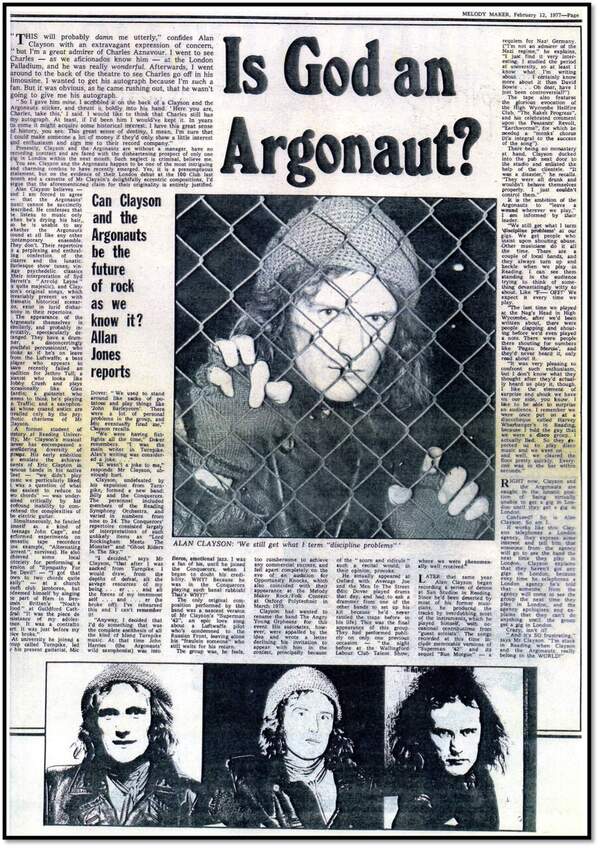
Billy and the Conquerors was, indeed, created as an escape valve from Turnpike’s all-about-the-music-and-nothing-but-the music earnestness – and the plain fact that, unknown to me, the high command of Turnpike’s ears remained to the ground for someone more suitable – like, say, a biological duplicate of Sandy Denny or Jacqui McShee.
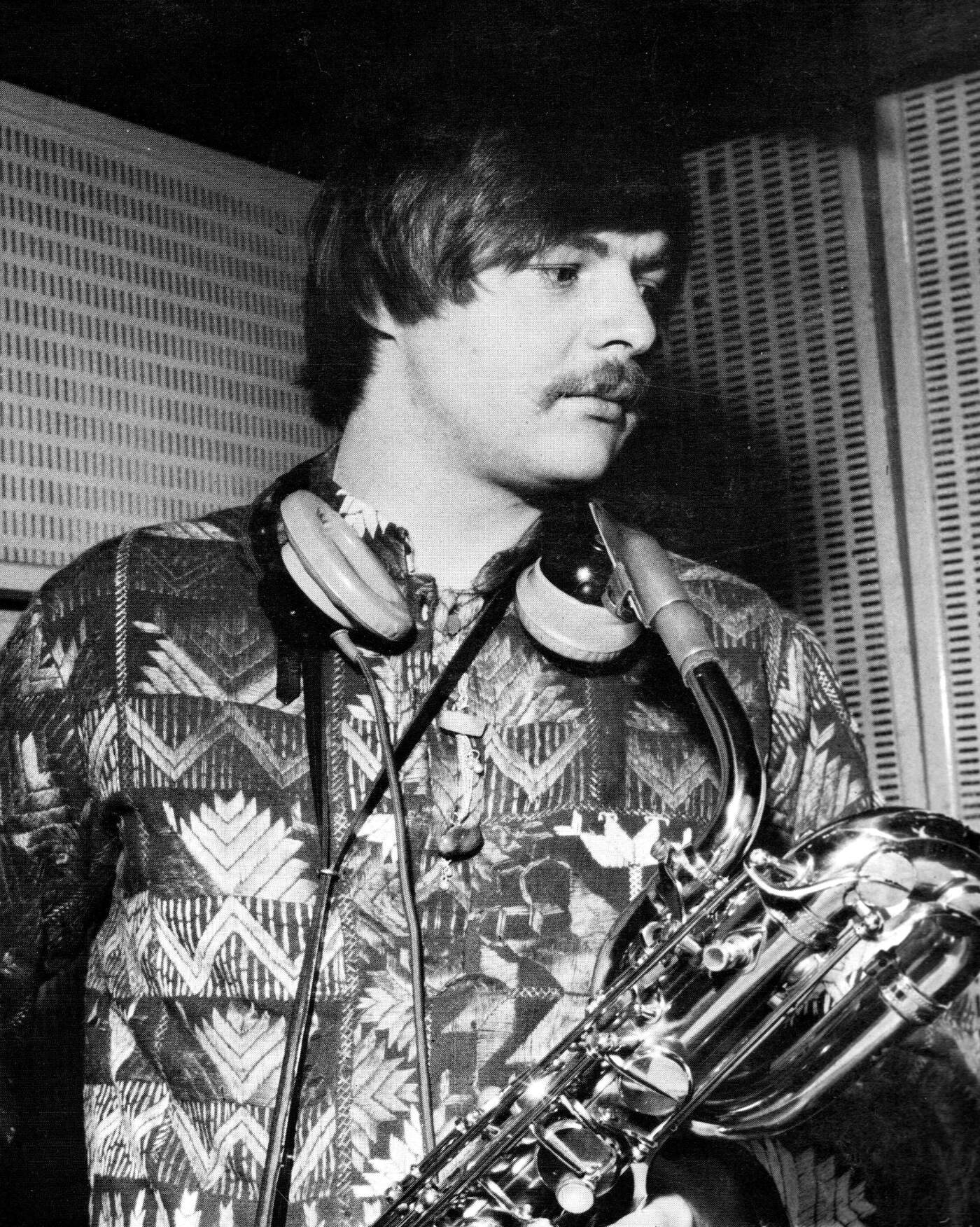
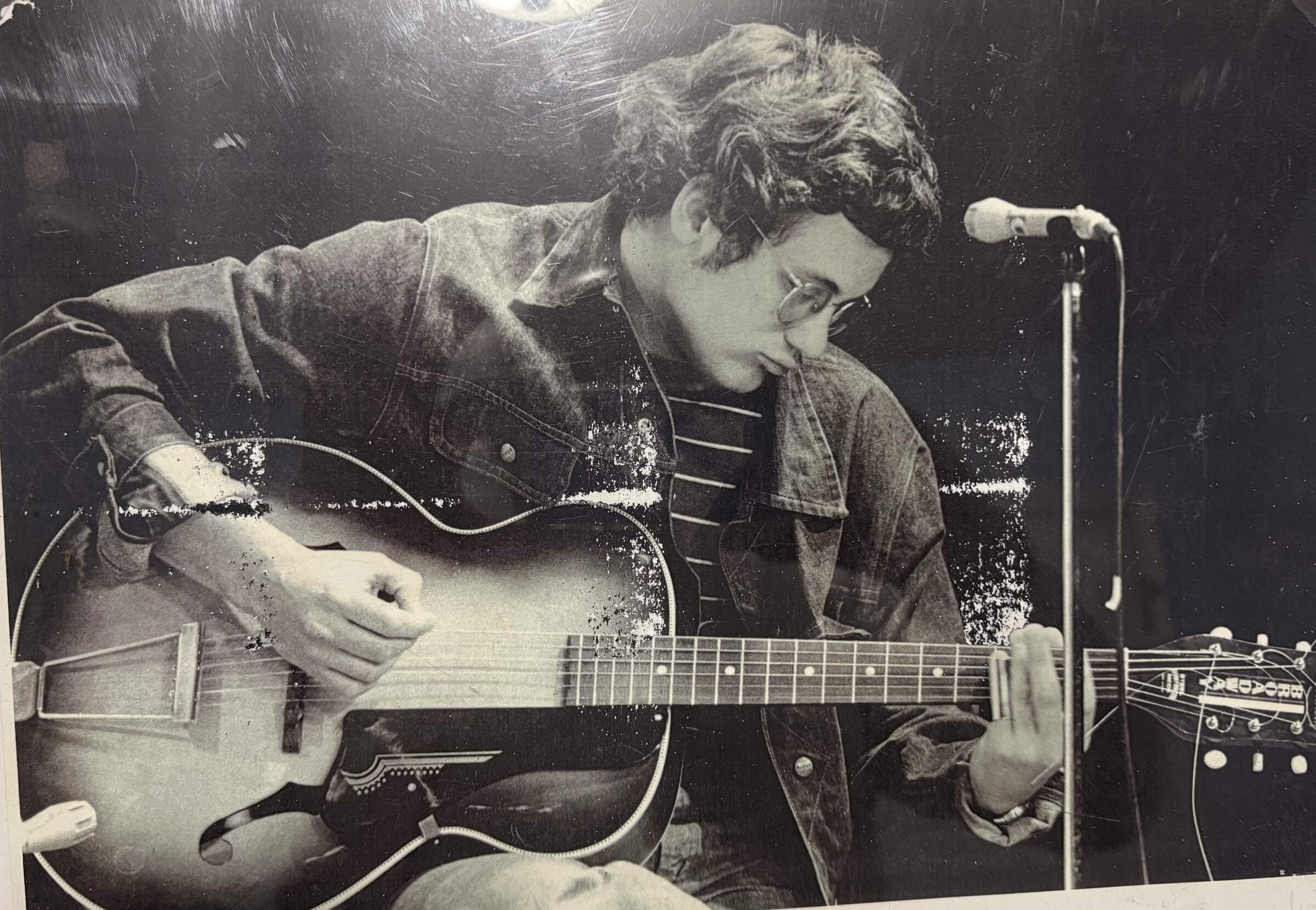
The group dwelt at Pond Cottage seven miles south-east of where Traffic had also “got it together in the country” – and, after my departure from an audition there in spring 1972, Ross Fergusson, one of the two guitarists, came straight to the point: “I’m not going on stage with a twit like that!,” but Mic Dover, the other one, thought my perceived eccentricities might lend some individuality. Eventually, Fergusson and bass player Clive Chandler nodded frosty affirmative.
At the maiden rehearsal – with Alan Barwise on drums – a whiskery face brought itself close to mine and gritted ‘flat!’ halfway through an opening verse, and a soon-to-be customary hell broke loose. Later, some sleight of verbal judo sparked off a scuffle prior to an ebbing away that left me glowering at Dover and him muttering darkly to Chandler and Fergusson. More insidiously, though Mic was de facto leader, Ross made it clear that he’d have nothing to do with numbers he didn’t like. That was OK by me after I persuaded Turnpike to try two pieces from ‘Five Live Yardbirds.’ I impinged my mouth-organ blowing onto the proceedings too, despite nearly every solo being based on that in a Dave Clark Five B-side.
Turnpike didn’t plummet simply because we never really left the runway. Nonetheless, our electric version of traditional ‘John Barleycorn’ – in which I was permitted a solo on a sort of toy melodica that sounded ‘mediaeval’ – tipped the balance for Paul Jones, once of Manfred Mann, who judged us runners-up in the University of Reading’s Battle Of The Bands. A downward spiral continued, however, with us being ordered off-stage at a college in Maidenhead while still receiving the agreed twenty pounds. “We earned a quid for every minute we were up there!” laughed Clive bitterly from his corner of the dressing room.
By then, Ross was talking about leaving Pond Cottage, and Alan Barwise was only bothering with Turnpike when he felt like it. Yet Mic and Clive held on hoping, and were colluding with Ross on some undercover structural tampering. They told me they’d been thinking… If wary of people who’d been thinking, I registered no portent in their pessimism about how things were going with Turnpike and me, and a suggestion I concentrate more on Billy and the Conquerors. They left the subject there, and Turnpike carried on with the familiar routine of rehearsals, bickering and grubbing round for gigs.
Then, during one Pond Cottage Saturday, Ross answered the telephone. Covering the mouthpiece, he rasped, “It’s her!” to Clive and Mic. My presence was unfortunate as the mysterious caller was following up an initial response to a ‘wanted’ advertisement for the female singer they’d always desired. It had appeared in Melody Maker two editions ago. During the consequent repercussions, Ross maintained sham-dispassionately that the door was always open if I wanted to remain in Turnpike. It was just that…well, you know…
There is a kind of mythic quality to the stories around your early years with the Argonauts. Being thrown out of venues, skirting the edges of the pre-punk moment,… Looking back now, was that volatility essential to forging the band’s identity? Or do you ever wonder what might have happened if things had been allowed to develop in a more orderly way?
I’d had enough of “things being allowed to develop in a more orderly way” in Turnpike – and the initial Clayson and the Argonauts engage-ments infused me with the beginnings of a natural rampant showmanship that Turnpike had constrained. Like a convict fresh out of incarceration, I was dazed by freedom – not least because my accompanists were quite amenable to integrating my portfolio of compositions with not just Billy-esque absurdity, but ventures beyond a mere gathering of everything that had gone before.
There appeared to be nothing they wouldn’t try. Mediaeval, psychedelia, Merseybeat, most of the ‘Idle On Parade’ EP, ‘She’s The One For Me,’ quotes from the classics, vaudeville, the most archly kitsch cabaret, and even some ersatz avant-garde jazz were but some elements that entered the equation, each impregnated with a native inimitability. It was quite in order for, say, the high drama of an original entitled ‘Earthworms’ to segue into free improvisation before the opening bar of Beethoven’s Fifth brought about a modulation from D minor to Bb major for ‘On The Street Where You Live’ from My Fair Lady containing some business with a straw boater and Gustav Holst (!).
There is a track on the new album called ‘Jack Cade.’ You have long been drawn to historical rebels, going back at least to ‘Landwaster’. What is it about a fifteenth century insurgent that speaks to the present moment?
‘Jack Cade,’ the only such “historical” selection on ‘There’s Still Time,’ “speaks to the present moment” in that the fifteenth century rebellion central to it reflected the social, political, and economic grievances to do with corruption, maladministration and abuse of power.
This new record often blurs the boundary between song and spoken word. Your live work, particularly ‘Clayson Sings Chanson,’ leans heavily into storytelling. How do you decide when a piece needs melody, and when it is better served by being spoken?
Much of’ ‘There’s Still Time’s’ libretto explores mortality (perhaps because I’ve now passed three-score-years-and-ten, the Biblically-ordained span of a human life). In the case of the opening ‘Behind The Sun,’ its impact might have been undermined by singing rather than speaking over its series of underlying notes. The same applies to ‘Craig And Rachel’ which lives musically in its riff. In passing this concerns an occurrence in New York that combined Martin Scorsese’s After Hours with some film noir B-feature.
In the video for ‘The Legion of the Lost’ there is a line that lingers: “A shallow soul of candy floss might be all that’s lost.” It lands like a quiet barb. Is that a deliberate swipe at the way things are now, or something more ambiguous?
‘The Legion Of The Lost’ is about Heather, a voluptuous, blue-eyed Valkyrie with gold-orange hair, with whom I was to enact in real life that soap-opera staple whereby the greater the differences, even antagonism, between two characters, the greater the likelihood they’ll end up together.
Precisely a year-and-a-day older than me, a big deal back then, she appeared dauntingly well-travelled and culturally sophisticated to me – and even as Kevin Delaney dismissed her eventually as a suede-o-intellectual [sic].
Second nature to Heather were vers libre, “spontaneous music,” the Ballet Rambert – and interminable movies not meant to “go any-where.” Blocking out the impure thought in my unspoken question “How could anyone like this stuff?,” sometimes bits of them touched me for reasons I couldn’t put into words – thus making myself prone to roundabout disdain not so much from Heather as some of the acolytes that buzzed round her as wasps would a jam-jar, and threw out comments like “So-and-so is the finest tracking shot editor in the French New Wave.”
So Heather would still make excuses and imply she found me attractive on grounds other than the questionable depth of my “intellect.” A couple of times, she made out she wasn’t with me, even letting the cock crow thrice by denying I was actually her boyfriend. It’s all down to Heather, nonetheless, that I know who Antonioni and Fellini are; that I don’t switch channels as soon as the last word is uttered in a television film before the credits – or that I even saw non-mainstream classics like The Seventh Seal, the 1957 Ingmar Bergman olde-tyme yarn that lent its name – and plot – to the first track of Scott Walker/Engel’s ‘Scott 4.’
She was to express later regret at not making enough of our “relationship” – which deteriorated to an odd loneliness when we were together.
Songs such as ‘Nemesis (The With It Vicar)’ and ‘KX54 WVL’ are tightly drawn portraits. Given your work on figures like Jacques Brel and Serge Gainsbourg, does the discipline of biography shape the way you construct fictional characters in your songs?
During free periods at school then and even during lessons, I started tinkering with lyrical verse, much of it seemingly opaque, having noted that Bob Dylan was revealing possibilities beyond boy-meets-girl and the old moon-June travesties. Frequently bereft of ante-start agonies, I was churning out reams of the stuff at a rate of knots. Rhymes, if I needed them, presented no trouble at all.
Should one not pop out instantly, I’d just work through the alphabet, putting each letter in front of the root syllable until I found something that would do. Who cared if the result knocked the scansion out? What did substance matter either when even The Troggs were soon to be singing about “the bamboo butterflies of yer mind.”
When under commercial pressure during Clayson and the Argonauts’ imperial; period in the late 1970s, I proved incapable of not interfering with, say, a plain four-four backbeat or a standard twelve-bar blues sequence; not smoothing out harmonies described as “oblique” – and not polluting simple lyrical expression with native quirkiness and chanson-esque verbosity with much emphasis on words and their literary resonance as melody and chord structure.
The closest I come to this on ‘There’s Still Time’ might be ‘KX54 WVL’ – significantly, the first spin-off single – which is a requiem for my Vauxhall Corsa after the failure of a new thermostat to stay its demise had brought me almost to tears. Undeniably, having driven her for fifteen years, I was almost overcome with melancholy when the truck arrived to carry off KX54 WVL to be pummelled into a cube.
You wrote ‘La Vie Bohème’ about Brel, whose work is so adept at building pressure and revealing uncomfortable truths. Do you hear his influence in the more claustrophobic corners of this record, in songs like ‘Underpass’ or ‘Dust Devils’?
I used to hearken to the chansonniers with as much attempt to distinguish between each as a shopper does between wedges of supermarket muzak. To ask my opinion about Brel, let alone Charles Aznavour, Georges Brassens, Charles Trenet, Juliette Greco or Serge Gainsbourg, was like asking me about railway lines or donkeys’ false teeth – because I couldn’t say anything objective about any of them. They were just there – though occasionally the maddeningly catchy tune of something like ‘Dominique’ by The Singing Nun might have embedded itself in my head for maddening weeks on end.
However, I discovered Brel via Scott Walker, but when I acquired an actual Brel vinyl long-player – as opposed to a Walker one with Brel in it. At first, this was purely for display because I imagined that if anyone noticed it when thumbing through my record collection, it would bolster my artistic position with a credible influence. Certainly, it was months before I actually gave it a spin – and most of it went in one ear and out the other – but I listened again and again and again – and became convinced that here was the most sophisticated form of the popular song.
Furthermore, when the likes of ELP, Melanie, ‘Tubular Bells,’ Weather Report and Steely Dan were emanating from college hostel rooms in the pre-punk 1970s, Aznavour sneaked upon me as a guilty pleasure through his one-song spot on some ITV variety spectacular. So enraptured was I by this, that, though I could ill-afford it, nothing would do but I had to order ‘Aznavour Sings Aznavour Vol. 3’ from my local record shop. Having made that investment, by God, I was going to get my money’s worth. Thus I span it until it was dust, absorbing every groove – to the extent that one track ‘Le Cabotin (The Ham)’ entered the equation after Clayson and the Argonauts formed in summer 1975, the same season of first experience of an Aznavour recital.
This took place at the London Palladium, but decades later I was on press accreditation at the Royal Albert Hall – where Charles spat out every word of his million-selling She’, and was frank-and-unashamed about reliance, albeit not conspicuously, on a tele-prompter. Yet he wasn’t merely “marvellous for his age,” he was marvellous in absolute terms – and ear-stinging decibels of foot-stomping ovation only fizzled out a full ten minutes after the playout to ‘Emmenez-Moi,’ the final salaam to past glory – by which time, the great chansonnier’s limo was probably halfway back to the hotel.
Finally, my seat was mere yards from the stage, close enough to meet his eyes when he glanced fleetingly in my direction. Maybe you’ll think I’m being daft, but I believe, however erroneously, that a telepathic message was projected from him to me. “I understand you and you understand me,” it read, “We know each other in a secret way as victims of the same artistic passion.”
Back in the early nineties you wrote ‘Death Discs,’ which catalogued pop’s more fatal moments. There is still a thread of morbid humour running through the new album. Is that something you consciously cultivate, or simply where your instincts tend to lead?
I dunno. All I will say is ‘Death Discs: Ashes To Smashes – An Account Of Fatality In The Popular Song’ turned out to be a project I enjoyed more than any of its predecessors – insofar as I found myself anxious to return to working on Death Discs when obliged to attend to other activities. So jubilantly labour-intensive was it that, following the typing of the last word, I slept virtually non-stop for two days.
When the book came out, the press calls undertaken (among them a dialogue for Capitol Radio in what remain-ed of RGM studio) and royalty statements nose-dived into a downward spiral after the buzz faded from reviews cleanly divided between those who liked it (typified by Thunderbolt, the Joe Meek Appreciation Society magazine’s “an essential book on a fascinating subject”) and those who didn’t. There were no half measures.
Five years later, ‘Death Discs’ was to be granted a second life more fulfilling than that of a zombie just as another publisher was about to publish an unabridged coffee table-sized printing (with cartoons). However, the first edition version had already reached the eyes of Trevor Dann, Head Of BBC Music Entertainment, who was sufficiently charmed to decree a one-hour radio show on the subject, scripted and presented by me, under the supervision of Jon Lewin, former singing guitarist with Cambridge post-punk contenders Perfect Vision before coming into eventual harbour as a Radio Two producer. Trevor and Jon recognized that while mine wasn’t everyone’s idea of a voice for national radio, it was interesting,” even novel. Indeed, The Times was to praise my “chirpy style” that drove “the most entertaining example of book-to-radio transference this week…a programme both nauseating and riveting.”
There had been, however, a moment of doubt over whether ‘Death Discs’ would be actually be aired because some who heard the pre-recording were taken aback by Radio Two’s boldness in scheduling such a potentially explosive show. Certainly, it provoked not exactly a log-jam, but a long string of calls on both the BBC switchboard and my own telephone for hours afterwards.
During the week that followed, moreover, I signed an autograph whilst wheeling a supermarket trolley – and, in a wider world, there was coverage in all the quality Sunday newspapers, assorted dailies – morning and evening – and regional periodicals such as Nottingham Evening Post, The Scotsman and Eastern Daily Press, many feeding off the BBC’s hand-out containing the following statement by me: “Anyone stumbling upon the show may be struck by either a sort of beautiful repulsion – or just plain repulsion.”
You came up through the Reading scene, playing a range of instruments before settling into your own voice. Do those early, more traditional roots feed into the unusual time signatures and structures you favour now?
For a long time after I’d first positioned yet uncalloused fingertips to shape an E chord on six taut strings when I was in my mid-teens, I had no awareness of the basic structures that recurred in virtually all categories of pop: the “three-chord trick,” the twelve-bar blues and the blues and the I-VI minor-IV-V ballad cliché plus the frequent complications of “middle eight” or “bridge” passages.
Even before arriving in Reading circa 1971, I’d create tape-recorded second-by-second patchworks of sound and loops of funny noises (of which excerpts were to be incorporated decades later into three released Clayson tracks) and write songs untroubled by the do’s and don’ts that traditionally affect inventive flow, developing little discrim-ination between unhummable dissonance and serene melody. A lot of the results were not usually not unalike the more unfathomable aspects of Scott Walker during his The Drift-Bish Bosch period.
And while we are there, what did that scene actually feel like at the time? How did those first bands come together, and what did you think you were trying to do back then?
A storm-centre of the local rock scene was the Dove, a bohemian pub in Cemetary Junction, a vibrant and cosmopolitan district of the Berkshire county town reckoned by makers of television documentaries to be the most “average” in Britain. A lot of groups came to form, change line-ups and disband over pints and frames of bar-billiards up the Dove. It would be pleasant to say that, united by artistic purpose and mutual respect, we were all mates together, chasing the same dreams. Yet, well before a couple of those dreams started coming true, sly competitiveness, doing of bad turns, glee at another outfit’s misfortune and dropping of even the pretence of aiding each other.
This was the pub-rock era when, during jovial evenings in licensed premises, such as Ace, Ducks Deluxe, Bees Make Honey, Brinsley Schwarz, The (Guildford) Stranglers and Eggs Over Easy had been rewarded with extolations from a fairweather pop media for performing with more thought for the paying customer than any monied megastars – The Who, Led Zeppelin, Rod Stewart, Pink Floyd and so on – throwing Green Room wobblers and keeping everybody waiting in US stadiums designed originally for big-time sport, because of an error about an amenities rider in the contract about Remy rather than De Kuyper apricot brandy.
Yet I hadn’t much time for pub-rock, simply because most of its early practitioners bored me almost as stiff as the Woodstock Generation stuff. Somehow, it was too pat, too snug and, as characterized by Chilli Willi’s swirls of country-rock pedal steel, too North American. Moreover, for all their ‘street level’ emphasis, Ace, Brinsley Schwarz et al still stank of the trundling “craftsmanship,” “funky” intensity and heads-down cleverness that had always disenfranchised me from acceptance as a credible musician. Not that it mattered because over half of me had long ceased wanting to be one.
‘Ancient and Modern’ includes the theremin-led ‘The Local Mister Strange,’ and you are often described as a particularly English kind of eccentric. Is that a label you recognise, or does it risk obscuring the more serious, analytical side of your work?
‘The Local Mister Strange’ theremin was played, incidentally, by John Otway.
To merely keep going, how many artists have been put in the position of making compromises they find embarrassing, even repugnant?
Despairing of me composing something, anything, he considered squarely in one of prevailing styles of the day Tony Satchell, Clayson and the Argonauts’ then-manager, was urging me to stop trying to be clever and complicated with ‘Landwaster’ and all that. I needed to take to heart directives that another way to achieve even a flicker of interest from record companies was by coming up with a would-be single as straightforward as ‘Road Runner’ and ‘Whole Wide World,’ Jonathan Richman and Wreckless Eric’s respective two-chord wonders, both of which had been at least on the wireless as 1978 came into view.
With the chances of gaining us a contract lower with each succeeding week, Satchell found a vehicle for this plan in ‘The Taster,’ grounded in an inexorable I-minor VI-IV-V chord cycle, from ‘An Evening With Wild Man Fischer,’ which we were employing as merely a recurring segue in an encore medley.
Tony asked me if he could borrow this double-LP. Then he got moving again. Within days, ‘The Taster’ was functioning as a demo after he arrived for an appointment at Virgin where he convinced Simon Draper – the Grand Vizier to company boss Richard Branson’s Sultan – that, while meant to be rubbish, it was a chartbound sound. OK, so it wasn’t an original, but Devo’s recent and peculiar revival of ‘(I Can’t Get No) Satisfaction’ on Stiff wasn’t either, but it’d made the Top Forty, hadn’t it? My boys are just as cranky as Devo, only English. You ask around the clubs. What’s more, X-factor Clayson is a sort of rock equivalent of William McGonagall, Britain’s most renowned bad poet, a human curiosity striving to scale the heights of artistic ambition in the face of ridicule, bemusement, condescension and only afford-ing glimpses of unconscious high comedy to the majority of his audience.
So Satchell landed a one-shot deal with an option on further releases if a revival of ‘The Taster’ gave reason for hope.
On ringing me with the news, Tony pleaded by agreeing to record ‘The Taster’ for all it signified rather than its content, we’d be feeding one naked instinct: survival. Almost as an aside, he added that he and Virgin wanted me to tack on a brief Clayson-as-nutcase dialogue after the song had finished. I could write it as long as it was compliant to the picture he’d painted of me – perhaps pre-empting the thrust of 2025’s The Genius Myth: The Dangerous Allure of Rebels, Monsters and Rule-Breakers hardback study by Helen Lewis – that a “genius” could also be a bit of a twit?
Shrugging my shoulders, I alighted on the 1972 film soundtrack of Man Of La Mancha – a recent charity shop acquisition – and devised an oration based loosely on the slightly bombastic ‘Life As It Really Is’ soliloquy by Don Quixote, his mind addled by the romance of mediaeval chivalry. Just as I cargoed this with a handful of private jokes and autobiographical allusions, I interfered likewise with the words of verses separating a chorus that ran “Come on, let’s do the Taster when my love was so grayster/When the things of the past were just as good as the rest.”
In the more glowing critiques of my later discs, much would be made of the lyrics. Indeed, rather than stringing together mere syllables to carry a melody, They are created as carefully as mosaics – so you can imagine how I felt when, with Satchell’s psychological rifle at my head, I was condemned to the three-minute waste of time that was ‘The Taster,’ recorded one a chilly Thursday at costly state-of-the-art SARM Studios, (most famous then as the source of Queen’s ‘Bohemian Rhapsody’), and then remade at a complex in genteel Primrose Hill in a main suite big enough to accommodate a symphony orchestra.
As the Primrose Hill session got underway, I was close to crying off and catching the next train back to Reading – and said as much when, during some boring mechanical process, Barwise, Dover and I – the Turnpike desperadoes – sloped off to a nearby pub. It was all over, I seethed over a lemonade, all the group could have been was being destroyed across the street. Yet, largely through the disorientation we all felt after hours of trying once more to make the single, I was cajoled to “get it over with” back where the alloted despotic producer, was ordering the replacement of our keyboard-player’s triplets with those of Tommy Eyre, formerly one of both Dave Berry’s Cruisers and Joe Cocker’s Grease Band, and predestined to be Wham!’s musical director. He’d be over shortly.
Now that the sonic aspect of the package had passed muster, next came the picture sleeve. Tony had decided the front was to be a head-and-shoulders shot of Clayson in laurel-wreath with a radish balanced coyly on his protruding tongue. Accordingly, I found myself posing before the lens of Richard Holt, a photographer who specialized in such tasks. Rather than a radish, however, I’d brought along a plastic bag of cold macaroni – and the skilful Richard caught the very spilt-second I splattered a fistful into my revolted gob.
After the package had been thus completed, Virgin’s upper echelon had been in two minds about it during their weekly scheduling confer-ence where, before committing themselves, the more time-serving recording managers probably tried to figure out the Head of A&R’s opinion about whether ‘The Taster’ was rubbish or a work of commercial genius. After a lot of “I don’t know – what do you think?,” it was given the catalogue number VS 215 and, coupled with an in-concert ‘Landwaster,’ timetabled to be floated on the vinyl oceans in the middle of May.
My narrowly-circulated denunciations of the entire ‘Taster’ project appeared to be echoed by Virgin’s press office who, as well as appointing a record “plugger,” concocted a NME advertisement that rendered the phrase the new smash hit from Clayson and the Argonauts as the new smash shit from Clason and the Argonauts. How frightfully funny. Nevertheless, the female secretariat stopped work to make a fuss of me when I had occasion to visit Virgin’s offices.
From there, review copies had been mailed to mixed reaction. To SOUNDS, ‘The Taster’ was “rather good, although the sixth form humour of the monologue palls rapidly, if not sooner.” The NME, nonetheless, dismissed it “the most meaningless record of the week.” Well, it was all publicity, I suppose – as were scattered spins on Radio One – as well as local outlets, sometimes tying in with Clayson and the Argonauts engagements in the vicinity.
The strains of ‘The Taster’ also poured unexpectedly from the sound system while I was passing Virgin’s Tottenham Court Road branch – where it stood at Number 18 in the residual New Wave chart. It was placed too at Number Three – just behind the latest from The Rolling Stones and Kate Bush – in Time Out’s Top Ten. Yet, if a “turntable hit” in London, its impact elsewhere was summarized by the Northern Echo’s correct judgement that ‘The Taster’ was “a certain miss” – though ‘Landwaster’ made the Top Twenty in Belgium when a radio presenter in the Netherlands kept spinning it by mistake.
By autumn, copies were tumbling into bargain bins and enquiries about a second single were met with curtness by those at Virgin who were permanently “in a meeting,” “out of the office” or “too busy” to get back to MMM about one.
More Tony Satchell’s creation than ours, ‘The Taster’ was, therefore, a murky sunset mistaken for a dawn – and a prelude to a voyage to a circle of hell for me and an Argonauts that was to spend what short time we had left together trying to repair the damage.
“I composed every note and wrote every word.”
You once collaborated with Jim McCarty of the Yardbirds on ‘The Moonlight Skater.’ On this new record, did you bring anyone else into the fold, or is it a more solitary vision?
I composed every note and wrote every word.
There is a strain of suburban unease running through titles like ‘Something Happened’ and ‘Grandmother’s Wedding Day.’ How much of your writing still draws on that sense of post war British claustrophobia?
Details will have to wait for my autobiography (which has the working title Nut Rocker) – but that part of that claustrophobia was an established middle-class pattern of graduating onwards and upwards, to a property that was an improvement on the one before. That was very much so when my family uprooted in 1955 from Dover to Fleet, a north Hampshire satellite town of Aldershot, “home of the British army” – and not comparable to Gauguin’s South Sea island or Byron’s Italy in its potential to bring forth greatness or at least accommodate it.
Dad was able to park his company car – a bulbous Ford Popular, registration number NHO 390 – without restriction along the sleepy high street where the offices of the Fleet Times would cook up its weekly dish of whist drives, jumble sales, winter farrowing, gypsies camped illegally near Blackbushe airfield and the more notable lots at Alfred Pearson & Son Estate Agents – in which Dad was to become a partner in 1964.
If the distance to commuter-close London was measurable in years as much as miles, England’s capital was as over the edge of the world in its way as it had been in the fifteenth century when Fleet Pond, the largest freshwater lake in the shire, had been fished for inmates of the Priory and Convent of St. Swithun’s at Winchester. To a gazer from the Number 12 bus to and from Reading to Aldershot, Fleet appeared no different then from any other glum country town of sufficient inhabitants to warrant a pewless Victorian parish Church – All Saints – an associated primary school, a sister Church of post-war tin, and a railway station.
Nothing much, therefore, was meant to happen, year in, year out – except once a year when Fleet went technicolor with an annual carnival week centred on a Wednesday evening procession of motorized tableaux flanked by bucket-shaking collectors for local charities. At the rear trundled the Fleet District Council dust-cart into which were tossed the last pennies.
It wound from Pondtail Road on the frontier of the army land to an arena on the summit of the Views Meadow off the High Street. At the bottom of the grassy slope was all the seedy-flash fun of a travelling fair: coloured light-bulbs and painted palisades of custard-yellows and tomato-reds; switchbacks and slot-machines; candy-floss and toffee-apples; hot-dog stands breathing fumes of frying onions; the cacophonies of pop music; the hum of an electricity generator and the chugging of machinery black with axle-grease. God, how that comes back to me!
To close proceedings on Saturday night, everyone ooo-ed and aaah-ed at a no-expenses-spared Views Meadow firework display, and the morning after, the town returned to Ealing movie monochrome.
The album ends with ‘Wood Pigeon,’ which feels like a bit of fresh air after everything that’s come before. What made that feel like the right ending?
If ‘Wood Pigeon’ closes as a flower does through the slow pageant of sunset, it’s deceptively stealthy, especially in the middle sections – which touch on social anxiety disorder – and the blacker shadows of “otherness.” While that may be something to be celebrated nowadays, it was written from hard-won experience as I’ve been on the autistic spectrum since before it was commonly recognised – with all the attendant social and domestic anguish, having been driven from earliest youth by what? Certainly, an endless creativity remains both a wellspring of bliss and a handicap as piquant as schizophrenia or drug addiction.
Does having the mind of a historian make it harder to silence the internal critic when you are making your own music?
Even outside musical contexts, the “internal critic” is forever operational. A case in point is King And Conqueror, a 2026 historical drama on BBC television, bloated with all manner of errors, omissions, over-simplif-ications and outrageous fictions. Yet the dramatic momentum is such that I watched it to the bitter end – though sometimes between the cracks in my fingers.
I started penning lyrics gleaned from history as, week after tortuous week, I attempted to get another composition of mine past Turnpike’s quality control. Because of the “olden days” nature of Fairport Convention’s ‘Liege And Lief,’ ‘Hark! The Village Wait’ by Steeleye Span and like albums scattered around the stereo in Pond Cottage’s living room, I began marrying tunes to lyrics gleaned from school and, more so, my research for the essays and theses I had to write as a history undergraduate – and related topics, some of which I continue to study to this day. As well as being nearly a decade ahead of that brief craze for UK chartbusting “historical” epics that got underway with Adam and the Ants’ ‘Stand And Deliver,’ a midsummer Number One, it became something of a stylistic trademark, peaking, I suppose, with ‘Landwaster’ – freighted with “witanagemot,” “fyrd,” “Westaweg” and further Anglo-Saxon-with-a-dash-of-Viking expressions. En route were the likes of ‘Pagan Mercia’, ‘Earthworms’ – concerning the Peasants’ Revolt the inspired ‘AUGGG’ – and, the daddy of them all, ‘The Rake’s Progress’ with its ‘John Wilkes, take your last chance tonight’ hook- line.
Wreckless Eric once called you a national treasure, and your influence has seeped into all sorts of corners of British music. Back in the late seventies, the Argonauts stood apart… Do you feel any sense of vindication now, seeing that approach echoed in later generations?
I hate that “national treasure” expression.
‘There Were Moments When…’, There’s Still Time’s most overtly autobiographical opus, relates directly to the saga of Clayson and the Argonauts in the mid- to late 1970s when persistent media coverage prompted a Radio One In Concert spot, and a long run of headlining treks round Britain and Europe – always, it seemed, one week after Wreckless Eric and one week ahead of The Adverts.
After our rotten Virgin single was unleashed, we were still famous enough, for example, to warrant a lengthy SOUNDS critique of an engagement at Manchester Polytechnic, albeit before “a thin scattering of punters” – a turn-out ascribed to us being “so tremendously unhip, so damned unfashionable, that an aura of “not the place to be” hangs over the building. New Musick and Power Pop stand light years away from the Argonauts. They stand alone.”
Yet there are still folk today who’ll tell you Clayson and the Argonauts were nothing less than the Greatest Group Ever Formed. I think so too – but then I was its Danton, its Robespierre, its Mirabeau and its Bonaparte. Certainly, there’s never been a time or a situation – or entity – like it then or when the group reunited in 2005 (with not a man on the boards below the age of fifty-two) and slew ’em as surely as we ever had during the first of more farewell performances than Frank Sinatra.
Finally, I feel even more vindicated in the light of uniformly favourable response to not only ‘There’s Still Time,’ but such as ‘Ancient And Modern’ – and 2017’s ‘This Cannot Go On…,’ the first non-compilation album by (Alan) Clayson and the Argonauts in over three decades. Its title is a line from a selection named ‘Looking For A Monday’ – which seemed apposite as it relates to careers founded on short-lived novelty and subsequent descent into a netherworld.
From a technical perspective, none of my earlier releases, both solo and with the group, has ever achieved such a profound depth of sound. Perhaps that was connected with a deliberate decision to minimise acoustic separation in Blue Rocket – apart from lead vocals sung in the hallway and a sax honked in the living room: all very Joe Meek. Other than backing chorale and necessary overdubs, certain selections were completely “live,” capturing a spontaneity and thrilling margin of error that could only have happened then and there. We were truly tearing it up.
You spent time exploring the world of Joe Meek, that brilliant and chaotic figure working out of a small flat on Holloway Road. There is something of his dense, inventive approach in your own recordings. How much of that do it yourself spirit do you carry into the studio?
I’ve kind of just answered that question. Both Wreckless Eric and I think that Joe is a leading contender for the record producer we dig the most. Also, ‘Telstar,’ a play concerning Joe Meek at the New Ambassadors Theatre in the West End was one of the most emotionally draining entertainments I have ever witnessed. The acting of Con O’Neill, who portrayed Joe (in the ensuing movie too) in his gradual deterioration into homicidal paranoia, was completely off the radar.
Your live shows always felt like anything could happen. You’ve written a lot about Screaming Lord Sutch too. Where do rock and English pantomime meet for you?
Perhaps as well as pantomime it’s to do with the frequent fusing of song and dialogue during those “musical evenings” before television became a domestic fixture – when front parlours were set a-tremble with sonorous renderings of refrains like ‘Excelsior’, ‘Come Into The Garden Maud’, or ‘The Spaniard That Blighted My Life’ (plus items from the pen of Noel Coward -or, for that matter, anything by Vesta Tilley, Stanley Holloway or Max Miller – who were to the British music hall what Maurice Chevalier was to its equivalent across the Channel).
Within my own latitudes, hostilities that, almost immediately, Clayson and the Argonauts brought out during our first engagements were epitomized by a shout of “When’s Brian Rix coming on!?” – a reference to the then-ubiquitous BBC television farceur, and a comment on performances often verging on not so much farce as music-hall, what with ‘Sweeney Todd The Barber,’ for example, as much a playlet as a piece of music via the contrasting spasms of faux-bel canto warbling and the purest Bethnal Green cockney during my recitative.
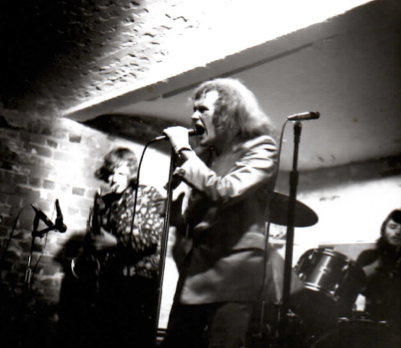
Some routines – such as me removing sunglasses to reveal a smaller pair underneath during “Superman “42” – were as slickly contrived as any in My Fair Lady, a lot depended upon what potential props were around at and the geography of a given venue I’d make a point of arriving early to study cold-bloodedly the acoustics, the lighting, the accesses and the overall situation. Already, I’d learned the advantage of making a Grand Entrance from unexpected directions like a fire-exit, a window, a broom cupboard or, on one occasion, a skylight – and it became habit to look for rafters to clamber up, tables onto which I could leap, anything that could be used in an endless effort to ensure customers” eyes never left the stage.
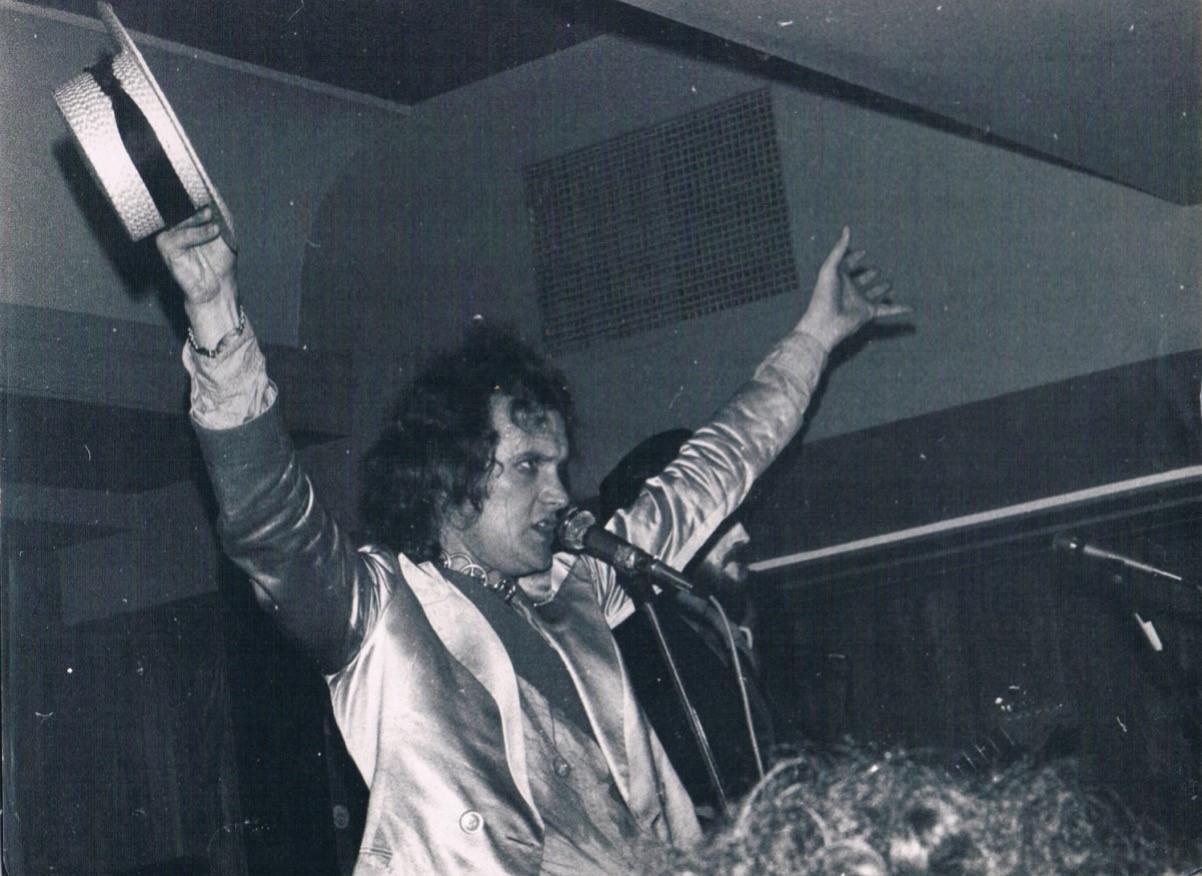
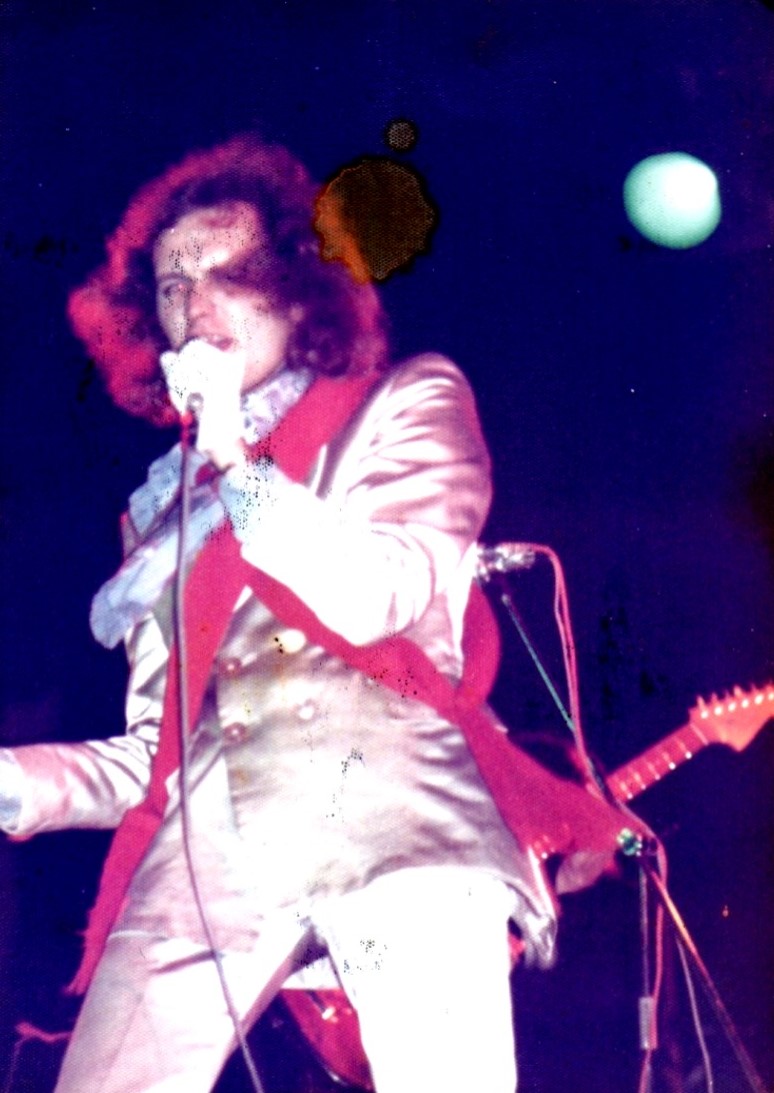
Another prime consideration was our wardrobe. Each musician was required to display non-conformity within a fundamental sartorial structure that was more New York Dolly than Gary Glittery. As well as the Jedson ‘Stratocaster’, Tim Fagan had surrendered unto me a shiny- off-white shark-skin suit that would be the core of my on-stage raiment until knee-drops, dry-cleaning chemicals and general wear-and-tear took their toll. Worn over a collarless shirt, I enhanced it with a criss-cross of broad, red tassel strips from a Victorian military bandsman’s uniform, and unused pince-nez shades dangling from a neck clamped loosely with a choker manufactured from a gold metal ring belt.
Aggressively gaping heterosexual chauvinists included the landlord of a one venue before we’d even planted a spray-painted silver chisel-toe on his rickety stage. Not one of the other oiutfits he’d booked had ever demanded a dressing room, and after he’d found us a mirrorless cell somewhere, I caught mutterings about ‘a poufs’ parlour’ from him and one of his bar staff – who, too shortly after the last cadence had resounded, was ordered to remove half-finished post-performance drinks from our very hands – and thus suffered the pouring of most of a pint of bitter over his head by road manager Paul Hearne. This fracas caused the gaffer to not only not pay any of the agreed fee – accusing us of ‘daylight robbery’ – but also to produce a revolver and twirl its chambers until we’d left the place.
You were there during what some have called the riot of the misfits. Many of your contemporaries from the pub rock and post punk years fell away, or settled into repetition. Yet you kept moving, writing books, forming bands, stepping into chanson. What allowed you to keep going when so many others did not?
While I’m unlikely to “give up” – chiefly because it’s long gone past the point of “enjoyment” to being addicted as surely as you can be to heroin – a few autumns ago, I experienced a sort of epiphany when the Argonauts and I were preparing to go on the boards somewhere in the West Country. From a frayed and cigarette-holed sofa in a malodorous and graffiti-festooned dressing room, I read the word “piss” among the scrawlings. It wasn’t the name of a group or performer or even an attempt at wit, just the mindlessness of someone who decided “I’m gonna write “piss” on this brick.” Suddenly, I felt disgusted – though God knows how battle-hardened I must have become after over half a lifetime as a professional entertainer. Yet in that frozen moment, everything seemed dirty and shallow. All the fun, all the glamour vaporised. I was sick of the business, sick of myself. Yet, though I would have preferred to have been walled-up in an anchorite’s cell to knock time off another kind of purgatory, still I went through the ritual again, leaving the stage after one encore an hour later. Into the bargain, someone I knew from school overheard me hassling about the money afterwards with the crook of a promoter.
Yet the “piss” revelation had dimmed almost to invisibility when we delivered a recital to a three-quarters-capacity crowd at Newbury’s Arlington Arts Centre – still as much the realm of choirs, opera, ballet and pantomime as pop groups. All the technical specifications – drum riser, microphones, lighting, monitors – were in place before we even arrived; the dressing and green rooms were tidy and clean, and there was front-of-house, band calls and refreshments supplied by from helpful and proficient staff.
What else currently occupies your life?
See my website. I’m still very much alive as a performance artist in three principal manifestations: Clayson and the Argonauts, Clayson Sings Chanson – and Alan Clayson as a solitary mister, which defies succinct description. I’m also pondering a follow-up to ‘There’s Still Time’ – and agitating for the publication – after fifteen plodding years (don’t ask!) – of a book that came about after my life of Edgard Varèse, the idol of Frank Zappa’s youth, brought me to the attention of widow Gail Zappa, who commissioned me to write Mother Superior: Frank Zappa In His Time, and kept me before a Frank-fixated public, beginning with my hand in Zappa At The Roundhouse, a three-day celebration of her his seventieth birthday where I super-intended a filmed Question Time-type discussion with former Mothers Of Invention. An incident the years left to me will never erase arose when devotees were milling around afterwards. A youth aged about twenty sat down and unscrewed an artificial leg to be autographed. I cannot go on…
Klemen Breznikar
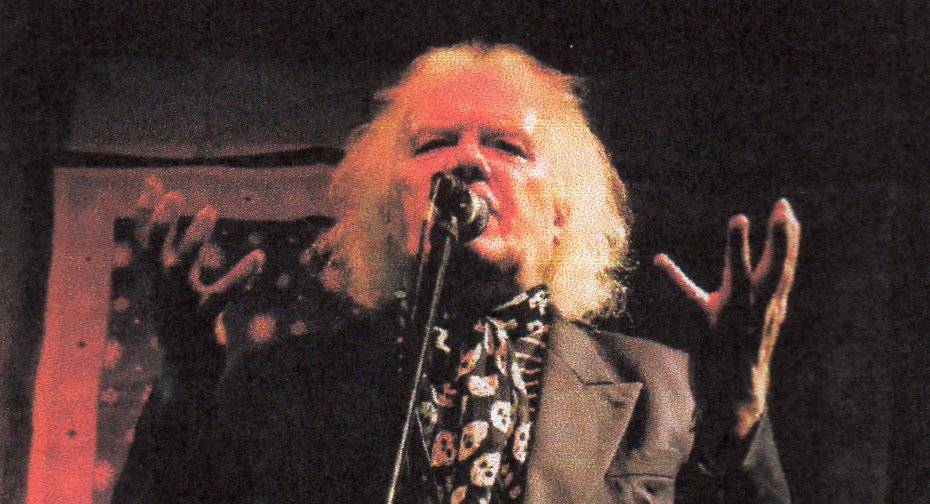
Headline photo: Alan Clayson performing at the 100 Club, London, 1977.
Alan Clayson Website
Think Like A Key Music Official Website / Facebook / X / Instagram / Bandcamp / YouTube


What a GREAT artice this is. Thanks !!!