

Structuring the Edmonton Popular Music Community: Rayal, Spane International, Park Lane, Molten and Pace Records by Brock Silversides
Edmonton’s popular musical community in the mid to late 1960s was in a unique position. They had access to local talent agencies, record labels, music publishing, and possibly of most importance, a professional recording studio – the first Western Canadian recording studio in the rock era (as opposed to radio stations where mono recording was occasionally done).
As a result they were arguably more advanced in the actual production of recorded music than many of their fellow musicians. All four aspects of the music infrastructure were dominated first by the partnership of Ray Schwartz and Al Johnson, and then by their successor Wes Dakus. All three were pioneers in a larger integrated corporate presence in the music community, and their agencies and studios affected the careers and lives of the majority of Edmonton musicians and those across much of western Canada from the 1960s and 1970s.
Part 1 – The Booking Agencies
Alan Johnson was born in 1938 literally into the entertainment business. His father was Joe Johnson, musician and band leader, and dance hall owner/manager. Joe joined his first professional band – The Rocky Mountain Rangers – in Lacombe, AB in 1935. He soon took over its leadership and moved it to Edmonton. They regularly played at the Palace Gardens and The Trocadero Ballroom in the capital city, and throughout the rural areas of the province. For nine years Joe managed the Alberta Beach Hall. He then purchased and proceeded to run Lakeview Pavilion at Cooking Lake, twenty miles straight east of Edmonton on Highway #14. It was a large structure – 21,000 square feet – fronting on twenty-one acres of attractive beach. Throughout the 1950s he brought in numerous bands such as Mart Kenny & His Orchestra, Happy Russell & His Prairie Ramblers, and Clarence Tomlinson’s Orchestra of Onoway. However most weekend evenings it was Joe Johnson’s Orchestra (with the vocal stylings of Mackie Dickinson and later Bunty Thomas) that entertained the guests. He also hosted the annual Fiddler’s Festival starting in October 1956. In addition to live entertainment, Lakeview also showed National Film Board features every Sunday and boasted that it played “… the best recordings on Wurlitzer Monday to Friday”. It had a snack bar, an adjacent campground and cabins to rent. Joe even hosted a program on radio station CKUA from 1950 to 1951.
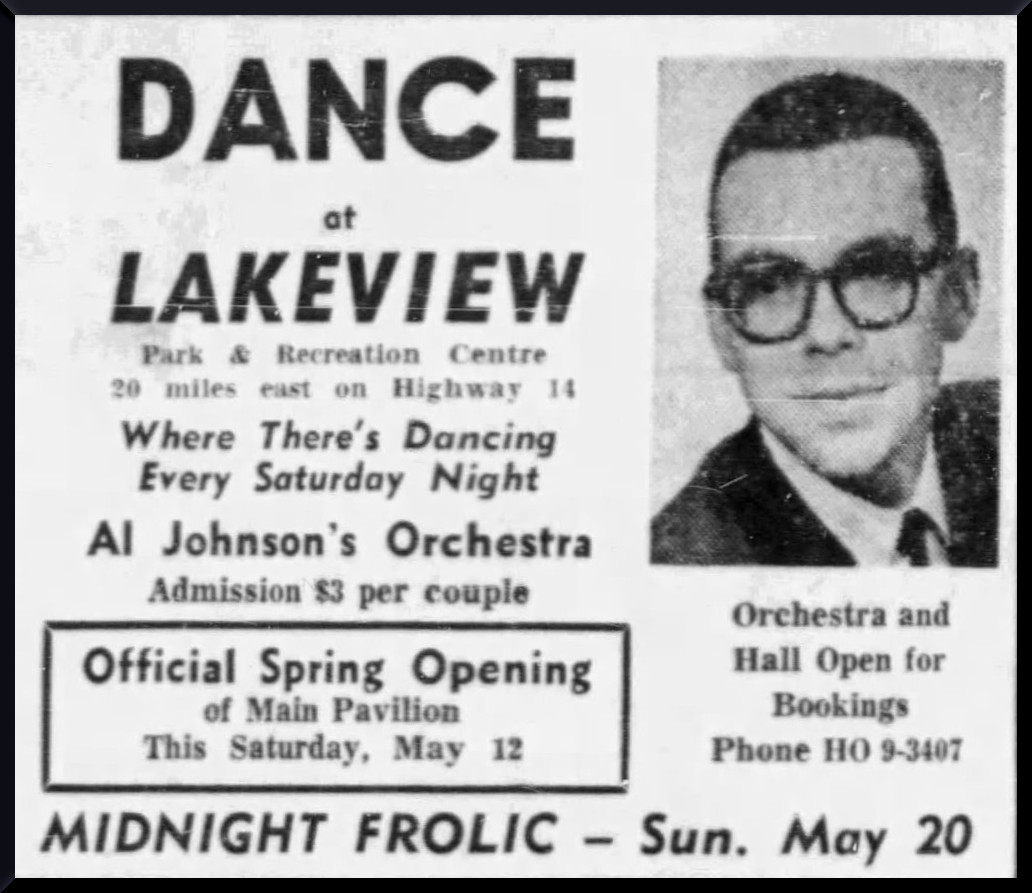
Edmonton Journal, 5 November 1962
Al thus was brought up on talent booking, music contracts, event-staging, promotion, band management, and radio. He started in broadcasting as an announcer for CFRN. A brief notice in the short-lived Canadian music trade magazine Music World mentioned him in January 1958: “From CFRN-TV in Edmonton, comes news that Al Johnson and Noel Wagner are planning a local live jazz program.”
Al increasingly influenced the Lakeview musical offerings, and after the premature passing of his father in 1960, assumed its managership. That year he started to engage local rock and roll artists such as Wes Dakus & The Rebels and The Nomads, then out-of-town acts such as Bobby Curtola (from Thunderbay), The Esquires (from Calgary), and Barry Ennis & The Keymen (from Saskatoon). He then started to widen his net and tap into touring American rock acts.
An article from June 1964 illustrates this change in the Lakeview offerings:
The summer scene swung into focus at Lakeview Friday night when Loreen Church of Regina headlined the regular dance. Tonight Paul Revere and the Highwaymen, a quaint and colorful rock combo from Oregon [before they became The Raiders], will take over the bandstand. There’ll be plenty of action at Lakeview during the coming months. Wes Dakus and the Rebels and The Pharoahs, will alternate the weekend dances and several visiting acts have already been signed.
“My bookings are a little heavier this year,” said Al Johnston [sic.]. “There is a definite increase in interest out there.” The acts already signed are Buddy Knox and the Rhythm Orchids July 10 and The Champs July 24. The Marketts [a surf music pioneer band from California] will do a midnight show Sunday Aug. 2. Dick and Dee Dee are slated for the end of August and Al is also trying for Nino Tempo and April Stevens, who were at Lakeview this time last year. The Crickets are also possible.
In the spring of 1965 Johnson used his radio contacts for Lakeview to host the 1st Annual CJCA Battle of the Bands. Running over two weekends – May 7 and 14 – there were sixteen local bands competing. The first prize was won by The Pharoahs, who received $500 and a recording contract with Apex Records. It was a wildly popular event, with over one thousand teens attending on each of the evenings. One aspect of the battle though, stayed with Johnson. Any band that wanted to enter the contest had to sendin a tape to CJCA. While there was clearly talented musicians in those bands, the tapes were very amateurish and would likely not attract the attention of any established record label. Johnson wanted to remedy that.
Lakeview became a popular destination for Edmonton teens in the early 1960s, and it even chartered buses on Fridays to pick up groups of kids from Bonnie Doon Shopping Centre and drive them to the concerts. Johnson staged ever more impressive showcases of local musical groups, as well as helping make Edmonton a desirable stop on the touring schedules of both national and some international artists. And although many bands and attendees hold golden memories of Lakeview, it appears it was not a particularly pleasant venue to manage in the 1960s. There are numerous accounts in the newspapers of excessive drinking, fights, dangerous driving, “necking” in cars, theft and vandalism, beer bottles thrown in cottagers’ yards and through their windows, and other incredibly immature and destructive behaviour. For years, the Lakeview Pavilion was a source of extreme irritation and even of fear for its neighbours.
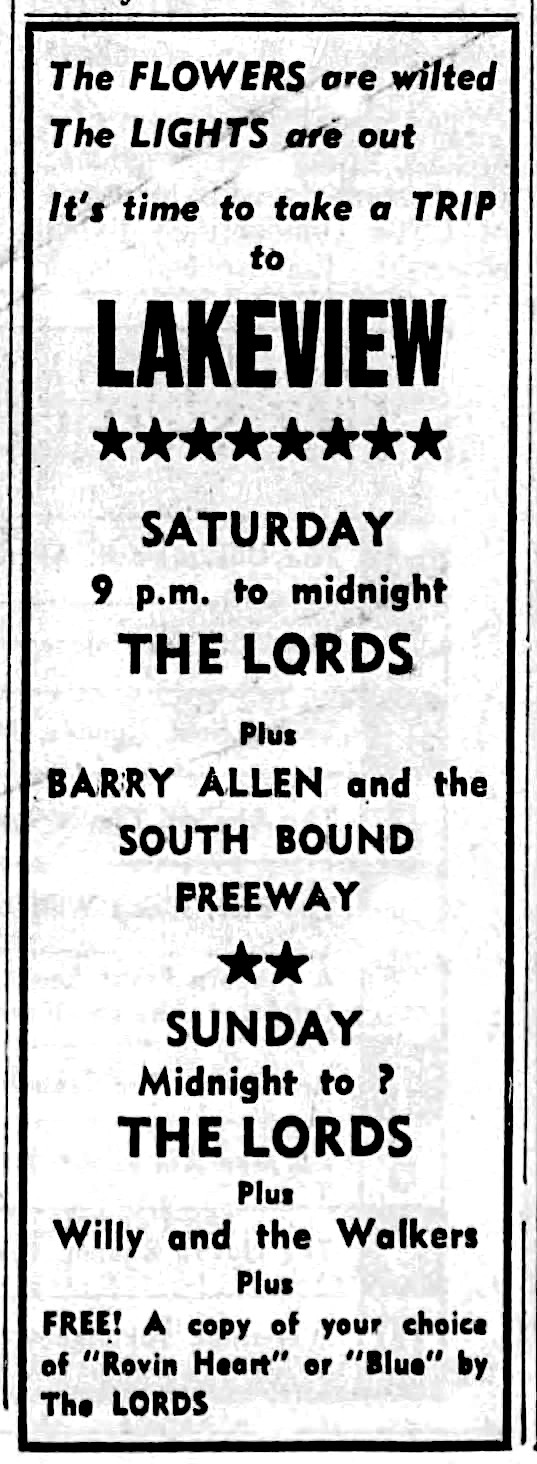
For example, in May 1961, a careless teen threw a cigarette from a car, starting a bush fire near the dance hall. A three-hundred-yard swath of flames burned to within 50 feet of the cabins beside Lakeview. A firebreak had to be bulldozed, and backfires started to prevent the main blaze from engulfing the pavilion. The measures were successful and although “…the blaze travelled half a mile from Highway 14 to the resort…Lakeview manager Alan B. Johnson reported no damage occurred.” Another report from that same month:
Continuing a clampdown on liquor law violations at summer resorts, RCMP liquor squad detectives raided a dance at Lakeview 20 miles east of Edmonton Saturday night and laid charges against 14 persons.
One cottager put it succinctly to a reporter, “Everytime we have a teenage dance, there’s trouble.”
It continued season after season. Edmonton columnist Barry Westgate wrote in September 1965 about a friend of his: “…he likes most of it, was really enthused with the swingy teen scene at the weekend. A tour of the hop spots showed crowded halls everywhere. Lakeview….was really jumping. I didn’t drop in. It’s getting to be too dangerous.”
This constant irritation with segments of his customers and confrontations with neighbouring cottagers, combined with a limited profit margin made Johnson realize he did not want to manage either a venue or teenage idiocy for the rest of his career. He started to explore other roles within the music industry, including artist booking and management. He had already made numerous connections with the local music scene. In November 1964 a brief profile of early Edmonton rocker Wes Dakus in RPM made mention of Johnson as Dakus’ booking agent, and for the first half of 1965 he became the personal manager of The Rebels’ vocalist Barry Allen. The same magazine wrote in April of that year: “There must be a special mold from which come all Western Canadian artists and their managers…Barry Allen’s no exception. Both he and his manager Al Johnson are perfect examples of how to succeed and still maintain respect for others.”
Johnson then hooked up with friend and fellow disc jockey Ray Schwartz. Schwartz on the other hand had no background in music. He was born in Edmonton in 1945. His father, Solomon (or just Sol), was a Brooklyn-born Master Sargeant in the U.S. Air force who was stationed in Edmonton during World War II. Sol had a hand in many businesses – he ran a catering company in the early 1950s, and was a director of the Acme Department Store. On the side, he was also a handball player of provincial and national importance. Ray entered the media industry at the age of thirteen as a radio announcer. For several years – 1963 and 1964 – he was a disc jockey with CJCA (where he worked the midnight shift), and then CHED where he adopted the air name Short.
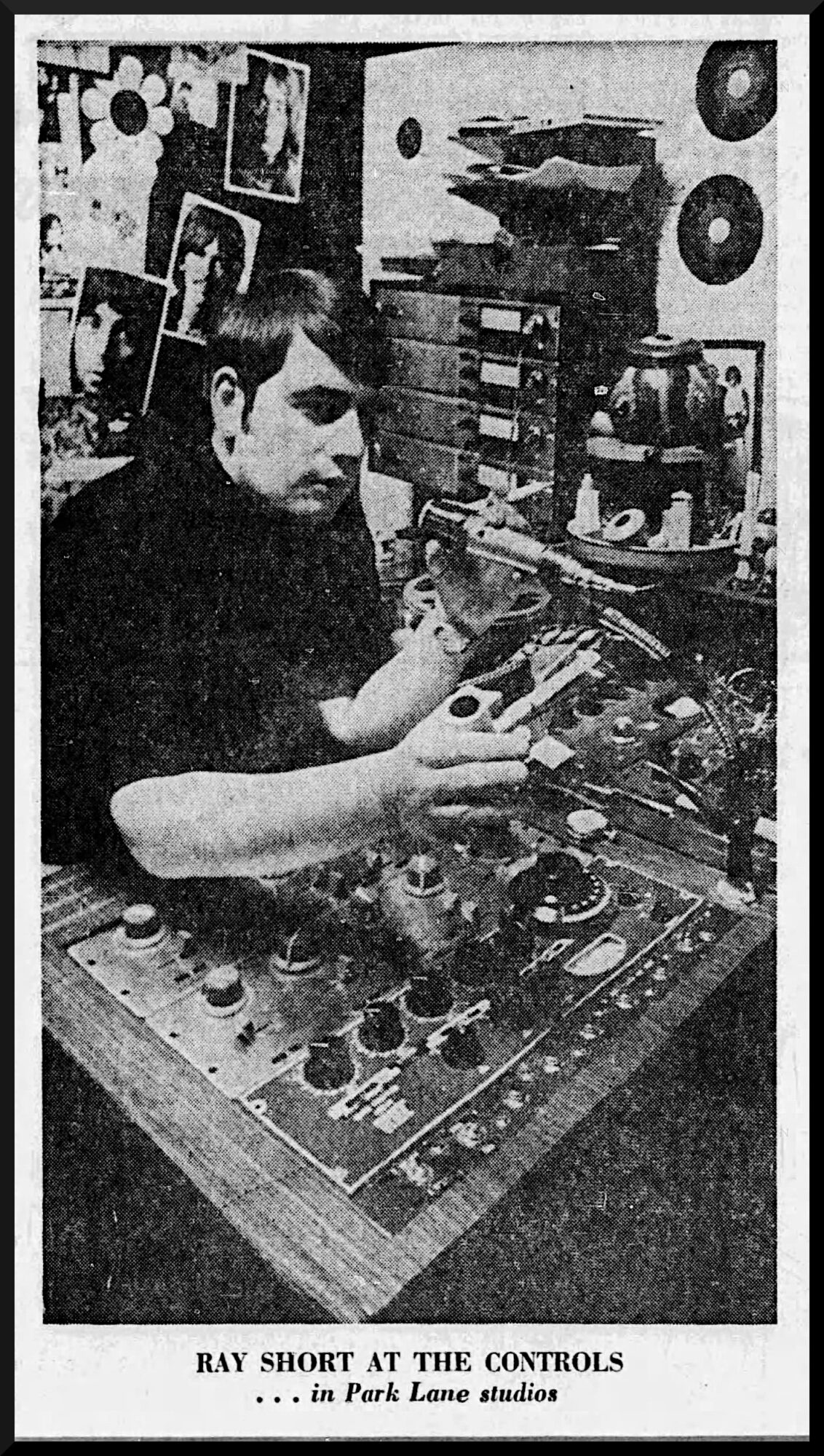
Short/Schwartz and Johnson appear to have devised a clever three-tiered plan to enter and then dominate the music industry. First up was a talent agency to connect bands with venues and events. Rayal Talent Agency was founded in August 1965 and worked out of an office at 10534-109th Street (just north of the now demolished railway underpass known colloquially as “The Rat-Hole”). This modest edifice will become increasingly important to the unfolding story. It was designed by the architectural firm of Eugene Olekshy & Douglas McIntosh. A permit for a two-story office building was issued to Pioneer Investments in June 1956. Construction proceeded quickly, and by September of that year the owners were advertising for leasees and renters. It was listed in city directories – fittingly as it would turn out – as The Star Building. It had a number of occupants in the 1950s and 1960s including the Baldwin Advertising Agency, North Star Oil, Aladdin Construction, A.V. Equipment Audio, and Olekshy himself.
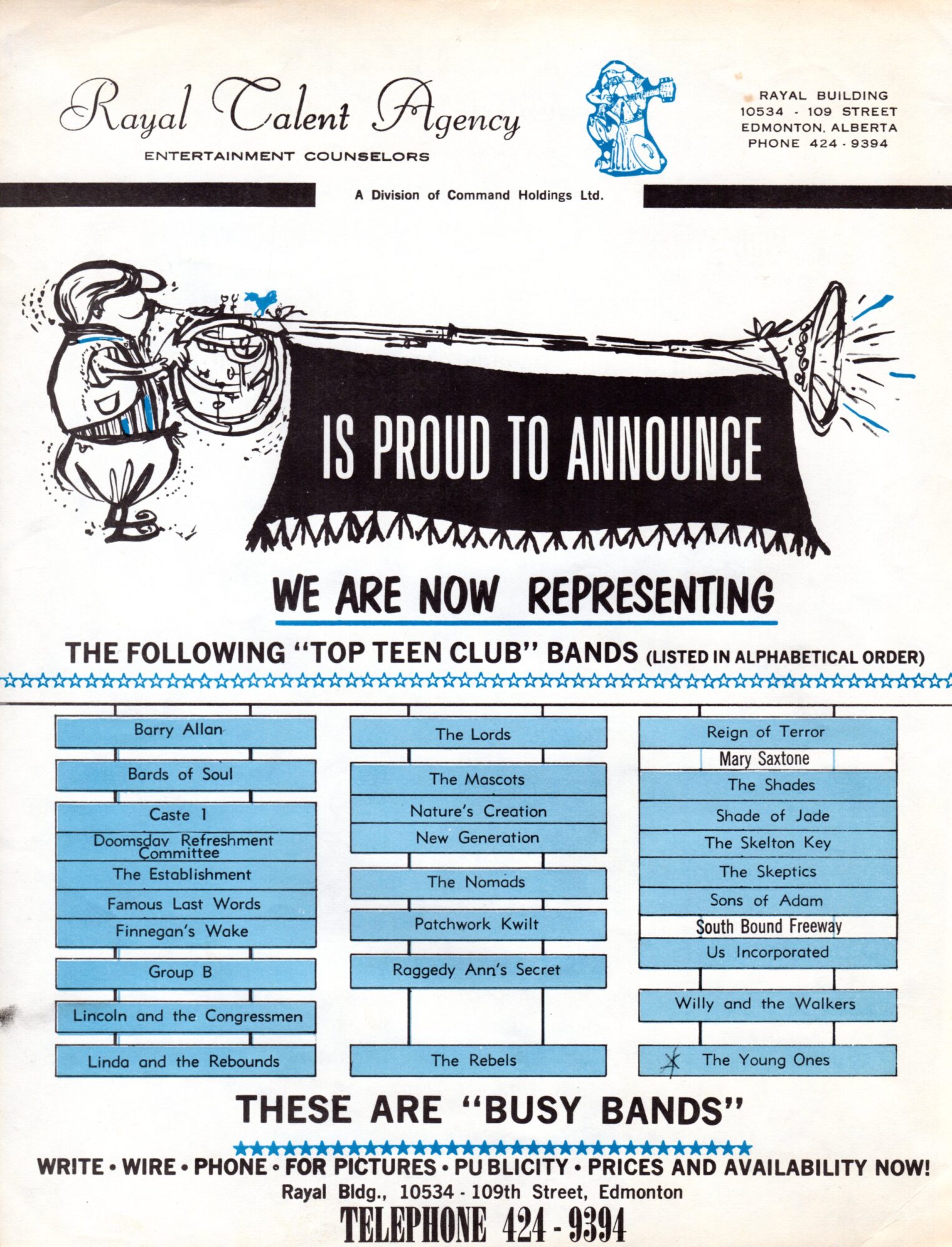
After Rayal moved in, it became known informally as the Rayal Building, and for the next two decades it became “music central” for Edmonton. Rayal promoted themselves as the Alberta capital’s first talent agency exclusively for popular music acts. Within months they had signed all the major local acts – Wes Dakus and the Rebels, Barry Allen, L’il Davey & the Drastiks, The Strollers, The Chessmen, The Fables, and The Shades. By the beginning of 1967 they had also added up and coming acts like Mary Saxton, Willie and the Walkers, Southbound Freeway, The Lords (featuring vocalist Mel Degen), as well as the two biggest bands from Calgary: The Skeptiks and The Shades of Blonde.
As agents they placed their artists with most of the high school and church dances (both in and around Edmonton), in clubs (Club Hawaii, Club Stardust, The Forum, The Rainbow Ballroom, Outer Limits a Go-Go, Zorba’s, etc.), in the various neighbourhood community halls, in coffee houses (The Cave-Inn, The Bleeding Moon, Inn the Beginning, Bunkhouse 2, Giuseppi’s, etc.), in various Legion halls, and at resorts (Ma-Me-O Beach, Alberta Beach, Seba Beach, Mulhurst Beach, and of course Lakeview).
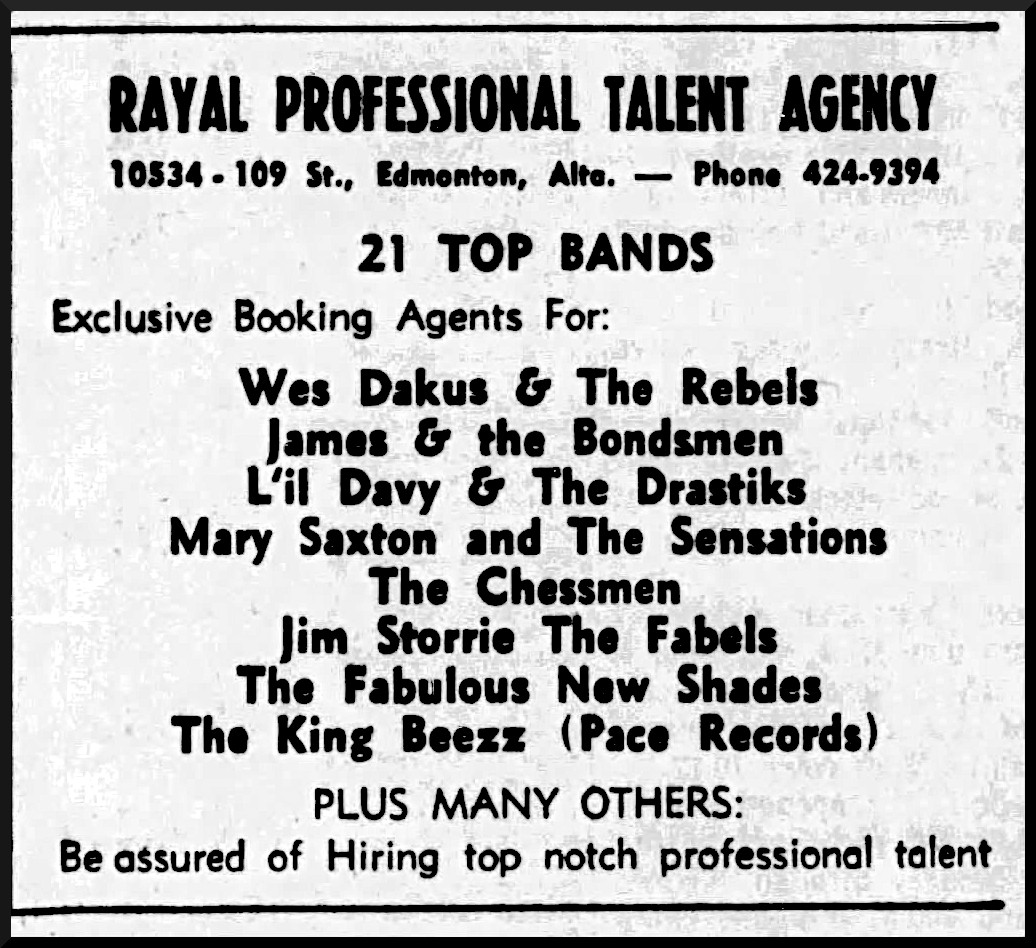
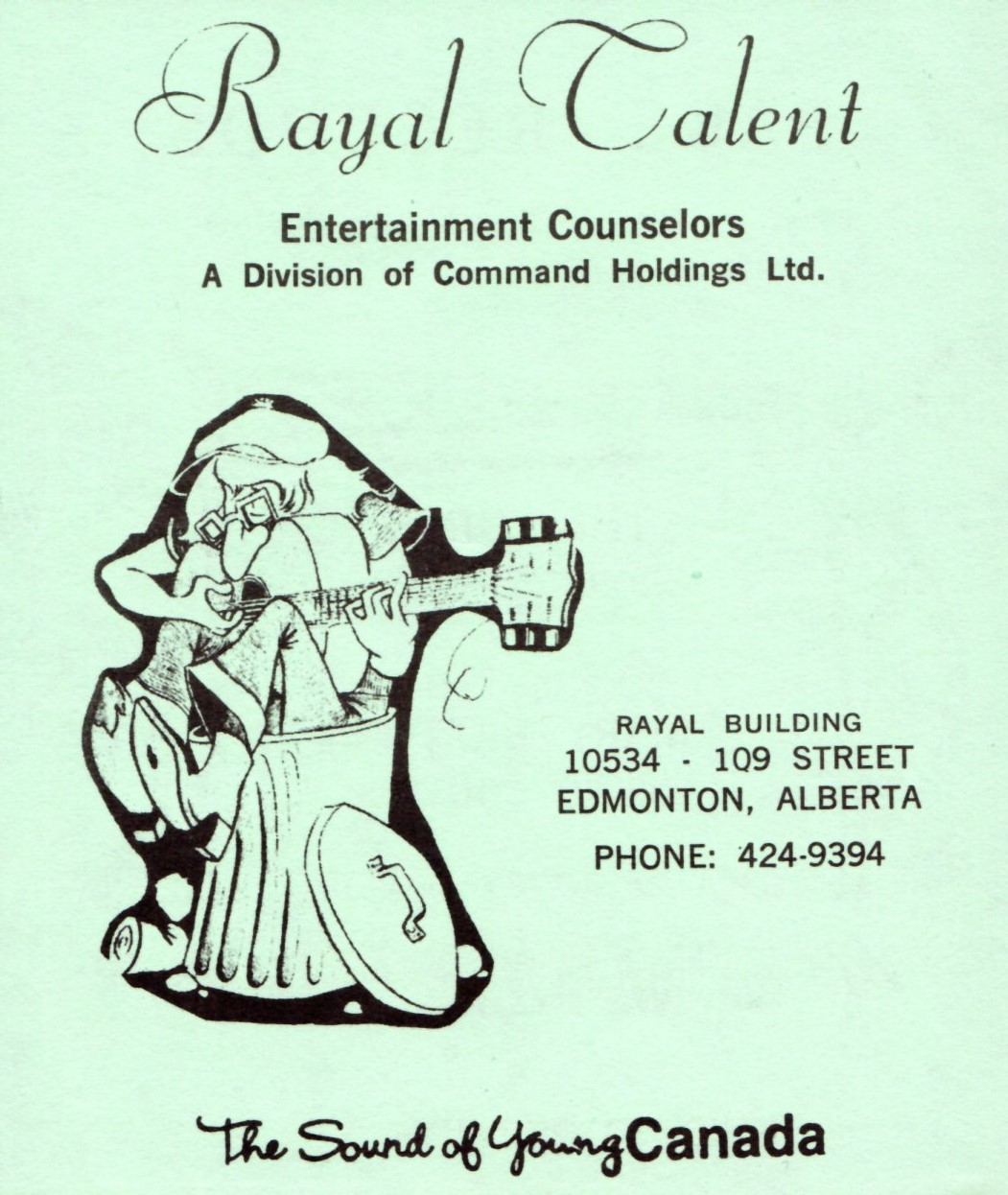
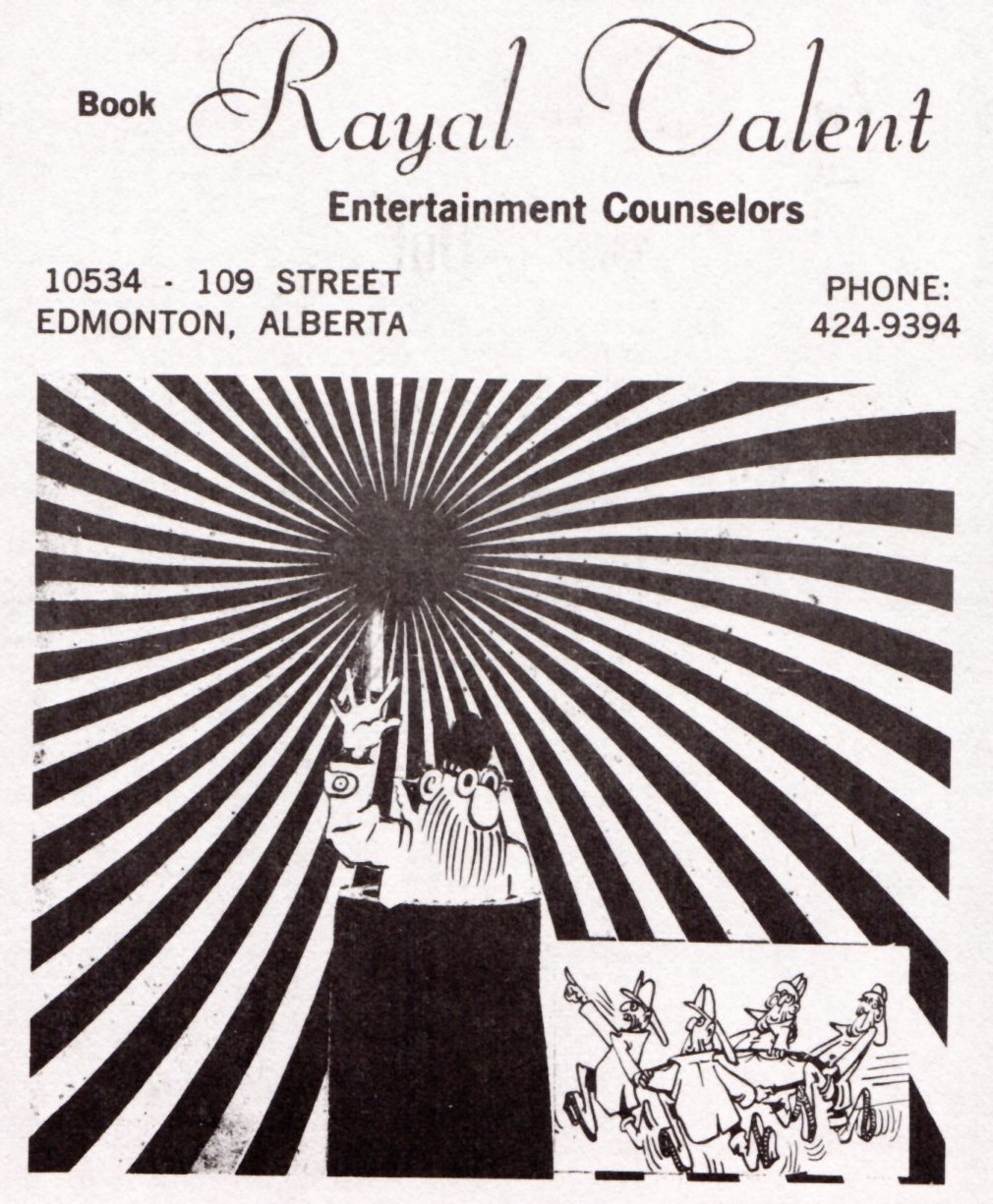
Using hip, tongue-in-cheek humour and comic book-like graphics they brought attention to their acts through an endless series of print ads in publications such as the weekly CHED charts, and handouts. For example one mimeographed broadsheet exhibited a large half-page hand-lettered word SEX. The fine print read “In order to sell products these days Madison Avenue, Hollywood, television, other publishers…everybody exploits SEX…but we’d never stoop that low” – which of course they had just done.
Short/Schwartz and Johnson decided they needed a more formal corporate context by the summer of 1966. On June 9th they officially incorporated as Command Holdings Ltd. Their Memorandum of Association outlined ten objectives: the primary business appears to have been as general contractors, but they also had their sights on investment as well as the purchase, lease and management of land, buildings and property. But two clauses clearly stated the activities for which they became known:
3f: “to carry on the business as talent agents, booking agents and promoters”
3g: “to carry on the business of entertainment and advertising agents”
The two directors were Short (as Schwartz) and Johnson, and their starting capital of Command Holdings was $20,000 divided into 20,000 shares of $1 each. Their lawyer and first shareholder was Joseph Shoctor of Shoctor, Kennedy & Cohen.
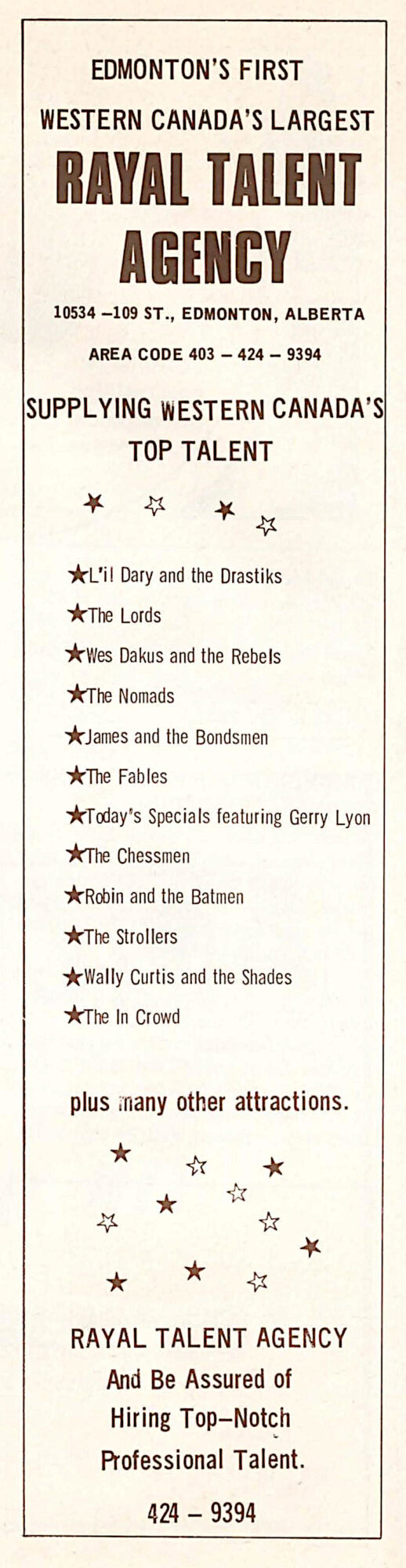
Rayal had a virtual monopoly on the booking business (one source claimed they represented more than fifty acts) until Amroux enterprises – co-owned by Chuck Camraux (disc jockey and manager of the King Beezz) and Al Amdam, and then Associated Entertainment Service – operated by Tommy Banks – started up in 1967. Although Amroux briefly lured away a few acts and brought to town several major acts, they did not last long, and Rayal continued to represent most rock acts until spring 1968. Associated Entertainment tended to book the jazz, lounge and easy listening performers, so they occupied a different lane.
While the one act/one venue arrangements were their bread and butter, both Short/Schwartz and Johnson wanted to organize larger events, and especially events to showcase local talent. Rayal accordingly organized three major happenings – The Citadel Goes Mod”, “Preview ‘67” and “Klondike Teen Festival” – all multi-band extravaganzas.
The first event was “The Citadel Goes Mod”, which ran over six consecutive evenings from July 11 to 16th, 1966. The Citadel Theatre, founded in 1965, was so-called as its first home was in a Salvation Army Citadel building at 10030-102nd Street. Funded by the previously mentioned Joe Schoctor and headed up by its first artistic director John Hulbert, it was a “cozy” venue containing a mere 277 seats. The main theatre season ran from September to April, but the company tried to come up with summer programs – known as “The Summer Festival” to keep the building in use. The innovative “mod” event was suggested by Bud D’Amur – local jazz musician and co-manager of The Yardbird Suite club – but it was organized by Rayal.
The Edmonton Journal wrote: “For some Edmonton’s legitimate theatre will go illegitimate next week. But for the swingers, this means the Citadel Goes Mod. Teen-age talent will take to the apron stage of the city’s professional playhouse.” The lineup featured Mary Saxton, Diane Senio, Bonnie Morrison, vocalist/saxophonist Mark Spacinsky, L’il Davey & the Drastiks, L’Heureux the Magician, Wylie the Hypnotist, and was headlined by The Lords. And as the Edmonton Journal remarked “A mod show wouldn’t seem quite right without go-go girls, and they won’t be overlooked.”
Mr. Johnson explains that this type of show is being staged at the Citadel to provide teenagers with a setting different than the usual “dance hall” type… he also added that it is to initiate Edmonton teen-agers to the Citadel. But judging from the reaction received at the Citadel when the rock and roll beat started at rehearsals perhaps it’s to initiate the citadel to teenagers as well. To say the least, the music was somewhat louder than the Citadel’s patrons are used to.
It appears that it was not a raging success. Barry Westgate related in his column “Nightside”:
Not so happy is the word from The Citadel where Bud D’Amur’s Summer Festival is making a bid for the teen trade…Standout performances in this fair-to-middling program are Mary Saxton and the popular band The Lords. That’s what The Journal’s teen editor Dave Laundy said after catching the show. He wasn’t too impressed with Diane Senio and Bonnie Morrison (“they lacked enthusiasm”), L’il Davey (“a screamer”), or Wylie the Hypnotist (“only moderate success”). “The show lacked rehearsal, but is bound to get better as the week goes along” he added.
Westgate ended with a dismissive “I still can’t see why Joe Schoctor and company at The Citadel find it necessary to open the theatre to this type of thing, summer season or not.”
It was a learning experience for all involved, and Rayal knew the next time around, the acts would have to be well-rehearsed. Their second event was initially announced in January 1967 in the Journal: “Rayal Talent Agency and CJCA are sponsoring a show at the Jubilee Auditorium in the near future. It will feature all-Edmonton talent.” A week later – January 27:
The show, tentatively called Review ’67, will feature local performers, all of whom have made records, with the purpose of promoting Edmonton talent…. prices will be moderate. The show is at the Jubilee Auditorium and a lot of hard work is going into it. It’s a pretty good package deal.
The line-up included Mary Saxton, The Lords, Willie and the Walkers, and for comic relief the Marvin Splatt Jug Band & Bugle Corps – known for their “Cesspool Blues” and “A Taste of Garlic.”
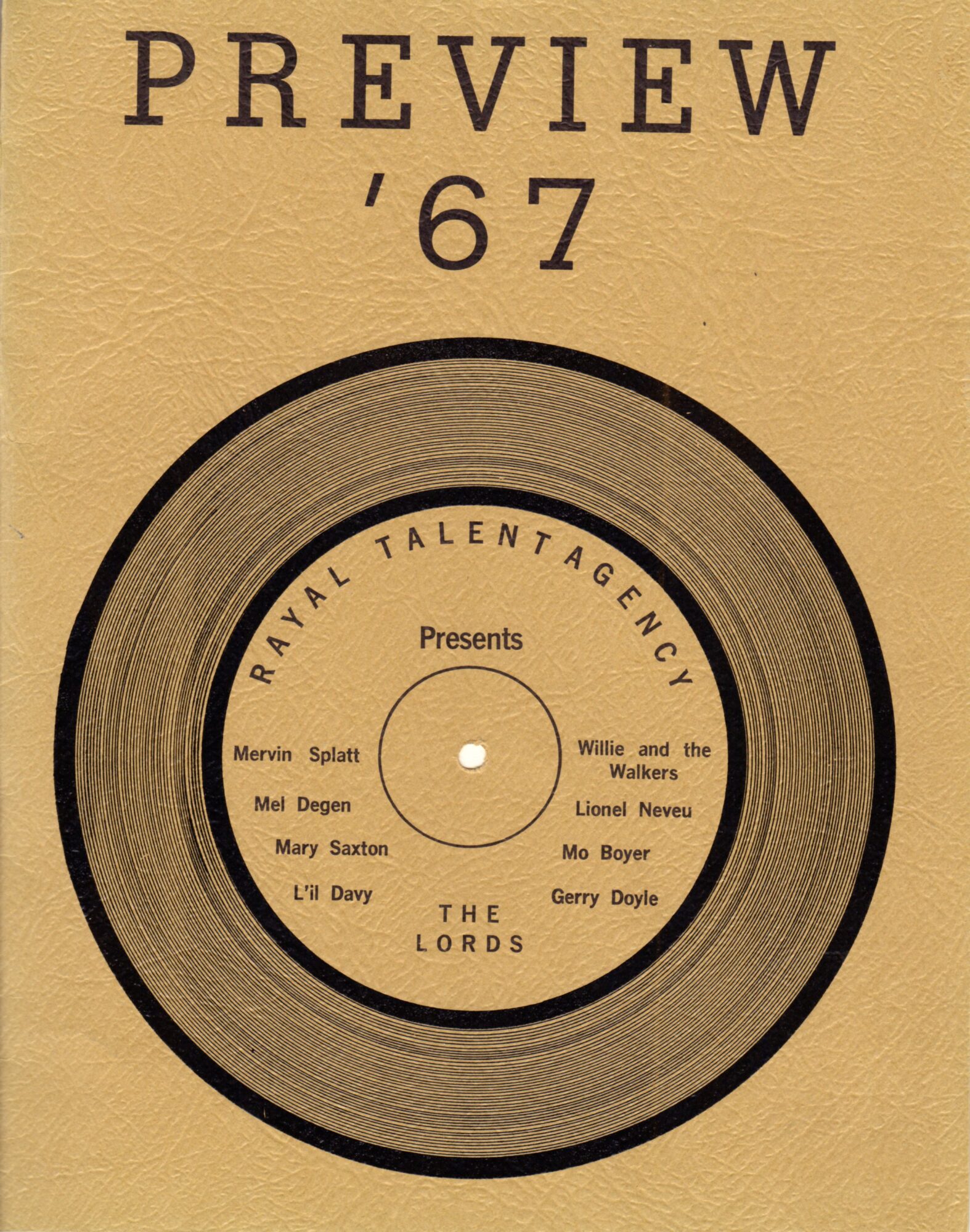
Unfortunately there were several delays – the most frustrating one being a double booking mix-up, but the event was ultimately held on May 4 and played out at the auditorium at Victoria Composite High School. A somewhat hesitant review was published in the Journal on May 5:
Preview 67, Tuesday night, was a step in the right direction. Like most shows it was not without its flaws, but it had many highlights as well…The Acts on the show were, as a rule, very well presented. Our personal vote for most professional performance of the evening is split between Mel Degen and Dianne James, but all the others must be given due credit for a job well done.
Diane James, who has absented the pop scene in favor of night club work, came on strong. A duet by Mel and Lionel was also a highlight. The Lords, supplemented by an extra drum section, a piano, extra horns and violins went through their paces with their usual skill.
The major flaw – which could not be ignored, was the live sound mix: “The sound set up was such that the instrumentation all but drowned a few of the vocals.”
Rayal’s third event was The Teen Festival, held over a six day period during Edmonton’s annual summer exhibition – Klondike Days. Co-sponsored by J.M.J. Music Centre, it was an undoubted success from beginning to end. The Journal reported on the lead-up in its June 2, 1967 issue:
The scene at Rayal Talent Agencies Monday evening was frantic, when members of 30 odd bands descended in force to apply for the Battle of the Bands at the Klondike Teen Festival. And, explained Ray Short, it was not just the band leaders who came, but all the members as well. It is expected that the 100 places in the competition will be filled by now, or shortly, as enthusiasm has run high all week.
It was claimed that there were entrants from all over Canada. While that was a slight exaggeration, The Chevrons from Regina and Renaissance from Saskatoon did make it into the line-up. Rayal decided to split the field into categories: bands that were already well-known and recording such as The Lords and Willie and the Walkers were deemed ineligible (although they were still part of the show), then there were the “Semi-professionals”, and for the newbies an “18 and Under” category.
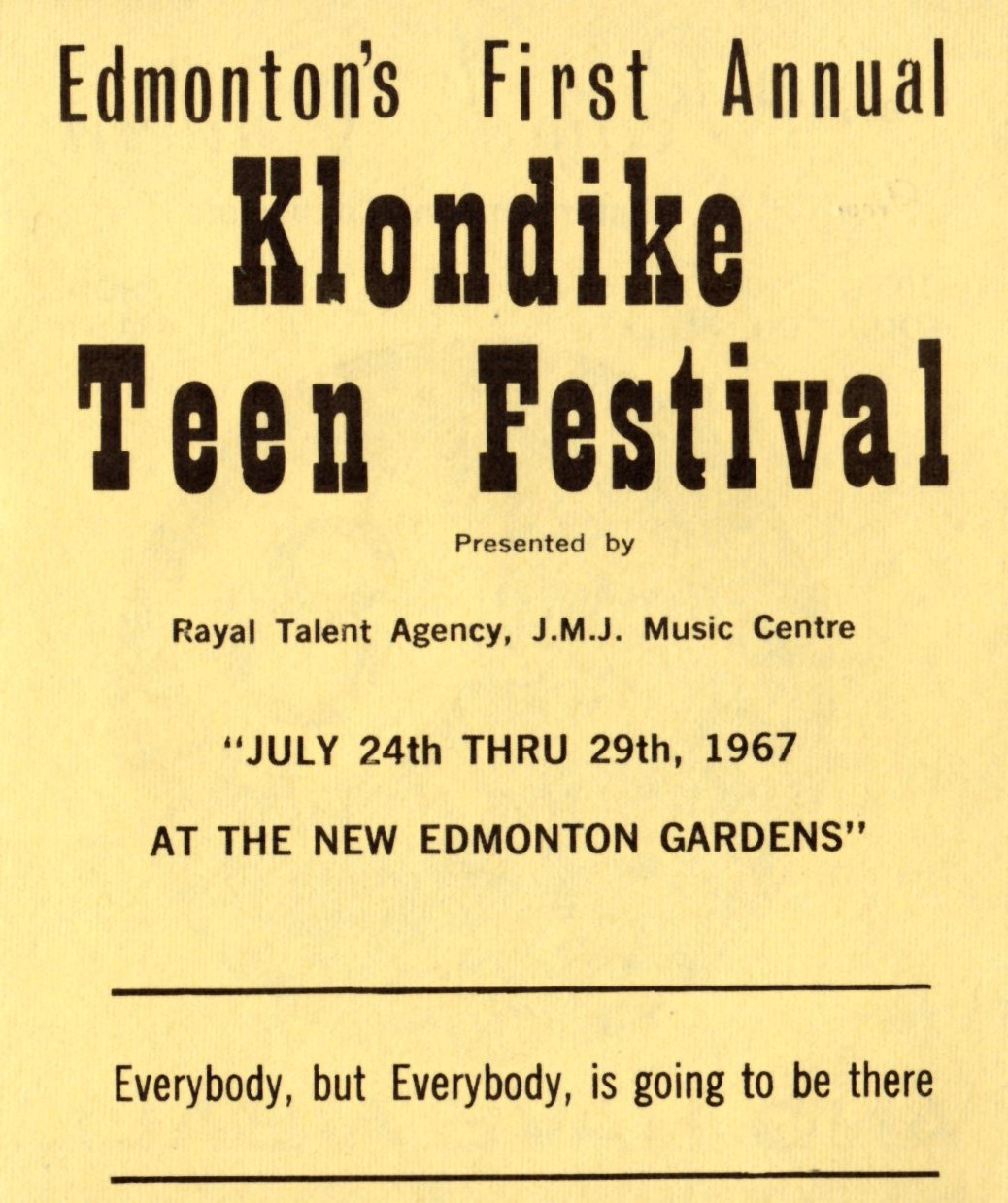
The Journal reported on August 4:
The Klondike Days Teen Festival ended on a much more cheerful and promising note than it began on. The last day crowds were both bigger and livelier than they’d been all week. They were particularly vocal during the finals of the Big Band Blastoff, which saw The Young Ones taking first in the 18 and Under category, and The Southbound Freeway topping the Semi-professional class.
The Young Ones earned an appearance on the Canadian television program Let’s Go in mid-December, while The Southbound Freeway won a trip to New York to participate in that city’s Battle of the Bands. There they placed third, and won a prize of $1500. Thus, with a Miss Klondike Teen and photography contests, and appearances from Toronto’s Robbie Lane & the Disciples and Neil Diamond (three nights – July 27 to 29), it proved to be an exciting week.
The success of the festival convinced Short/Schwartz that the company was ripe for growth into other territories. They mused about having agents in Red Deer, Regina, and Vancouver. The newspaper reported September 1, 1967 that “Rayal Talent agency is planning massive expansion. They are opening branch offices in Canadian cities, and Ray Short plans to fly out to Merry Ol’ to see about opening a branch in London.” In a listing of Canadian booking agents in a December 1967 issue of Billboard, Rayal gave two addresses: 201-10534-109 Street in Edmonton, and 606-261 Fort Street in Winnipeg, an office they shared with another up and coming firm The Peter Stone Agency. The idea of establishing a U.K. branch though was perhaps overly ambitious and never happened.
Although it was exciting to put together these showcases, Short/Schwartz had always been more interested in audio production, while Johnson preferred managing their two main acts – Mary Saxton and The Lords. Johnson then was the prime mover in their other division, Pace Management Ltd. It is not surprising that both were devoting less time to the Rayal agency. Fortunately there was a person waiting in the wings – someone who had already become an important part of their business, and who was already committed to talent promotion and booking. That person was Wes Dakus.
Dakus (born 1938 in Mannville, AB) entered the field of music in 1955 as a teenager playing steel guitar for the country band Mohawk Mountain Boys. After seeing Elvis Presley, Carl Perkins, and the Everly Brothers, he knew he was not long for the country scene. He formed The Rebels, named after the local motorcycle club who took tickets and kept order at some of their early concerts, in 1958. The band consisted of Dakus, guitarist/vocalist Barry Allen, bassist Dennis Paul, ex-Saskatchewanian drummer Stu Mitchell, and guitarists Bob Clarke and later Maurice Marshall. They developed a huge reputation by constantly crisscrossing the prairie provinces with a unique and exciting stage show, and even earned fans in Ontario by making an annual summer tour there. They won Best Instrumental Group at the 1st Red Leaf Awards (the precursor to the Juno Awards) in 1964, appeared on television numerous times, and raised their profile, as well as their coolness quotient, when they secured a recording contract with Toronto-based Quality Records in 1960.
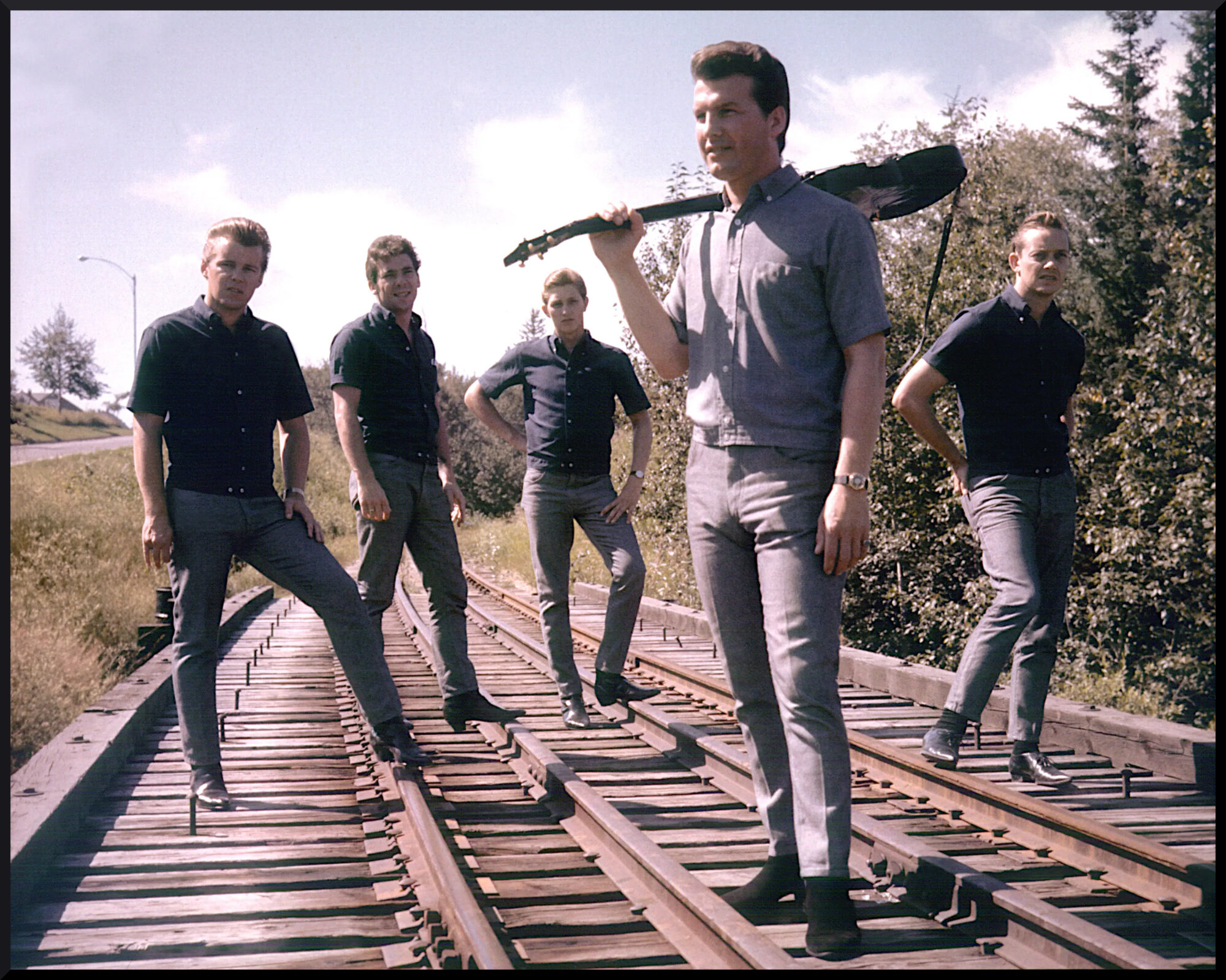
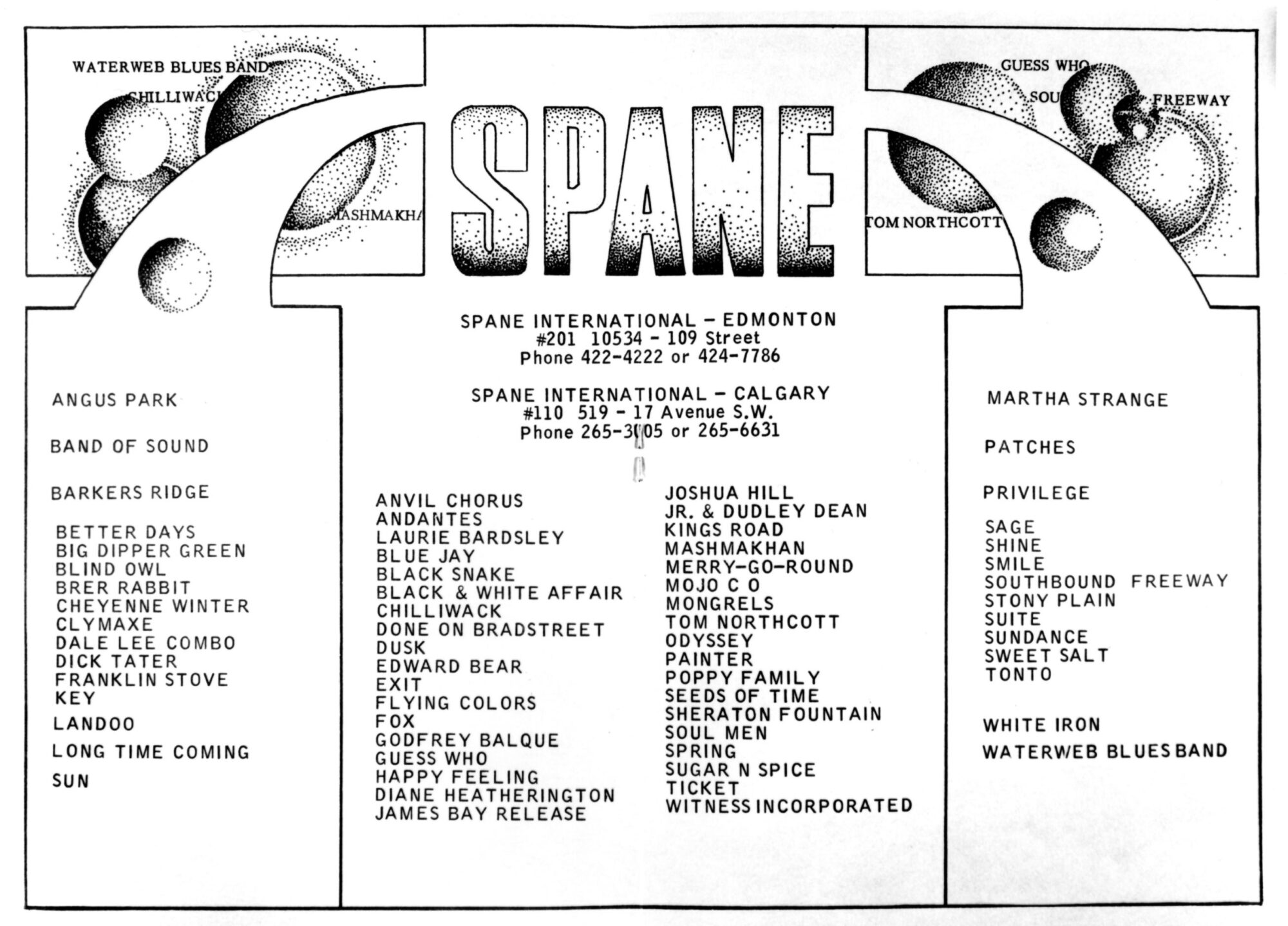
With his experience and his connections throughout Canada and into the U.S., Dakus – simply put – knew more about the music business than anyone else in Edmonton. He started to become intrigued with the financial possibilities of artist booking and management. He quit the Rebels in 1966 and stepped away from live performance. He started his own firm, initially under the name of The Wes Dakus Agency at 2208 Avord Arms, Edmonton, and which was shortly changed to Spane.
Dakus was interested in every aspect of the business, and tried his hand at everything. Not surprisingly he became the Edmonton rock community’s prime “mover and shaker.” He knew club owners all over Canada, he knew music industry executives both in Canada and the United States, he knew other booking agents and publicists, he knew record producers. With his finger in many pies, Dakus’ influence on Edmonton music in the last half of the 1960s was immense and omnipresent. He was able to advance careers with key gigs or recording sessions. He pushed musicians to think beyond their comfort zones, urged them to write original songs, and brought together musicians who might not have otherwise met. And for many bands he was a valued advisor, even a de facto, though always unnamed, manager.
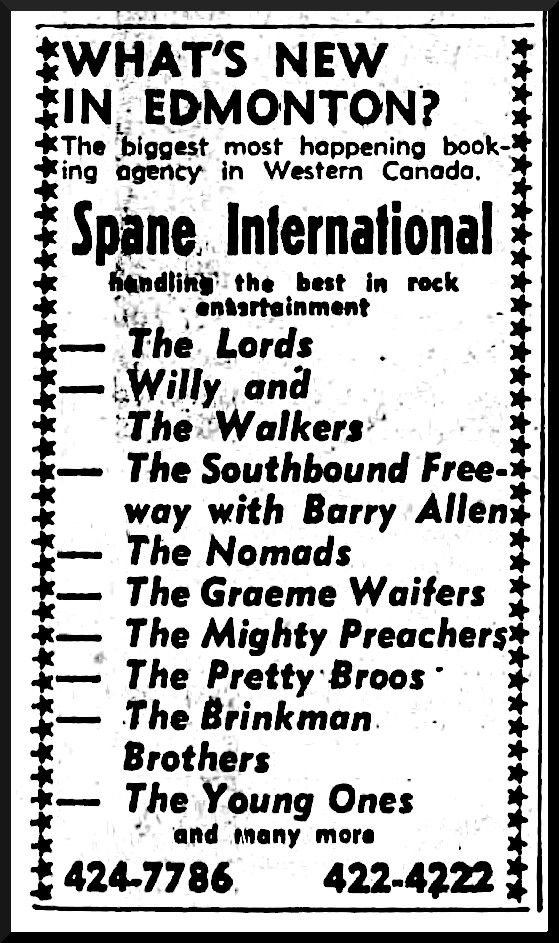
In 1967 Dakus assumed control of Rayal’s booking division, merged Spane with Rayal, and decided to add “International” to the name to appear less regional. The handover was made official at the end of September:
Spane International is coming. That’s the name of the new booking agency in town, which will take over from Rayal. Also a new record label as yet unnamed, hits Edmonton. One of our present local labels, Pace, will be affiliating with that one.
With the opening of Spane, almost every Edmonton rock musician immediately showed up at his door, and with his arrangements with other booking agents in the region, he amassed most of the talent in Western Canada under his umbrella. Spane would handle the majority of Alberta concerts as well as much of British Columbia and a bit of Saskatchewan concerts for the next five years. One of his first reciprocal arrangements was with Frank Weiner at the Hungry I Agency in Winnipeg. With this he secured gigs for The Kingbeezz, The Lords, and Willie & The Walkers in the Manitoba capital.
Dakus felt it was important to also get his acts to showcase down east in Ontario – much like he had done with The Rebels. So in April 1968, the Journal reported:
Spane International, the local talent and booking agency has made connections with a similar outfit in Toronto and started up a sort of “Make Canada Happen” movement. They will send eastern talent up here and we will send western talent down there and we’ll all be one big happy Canadian family.
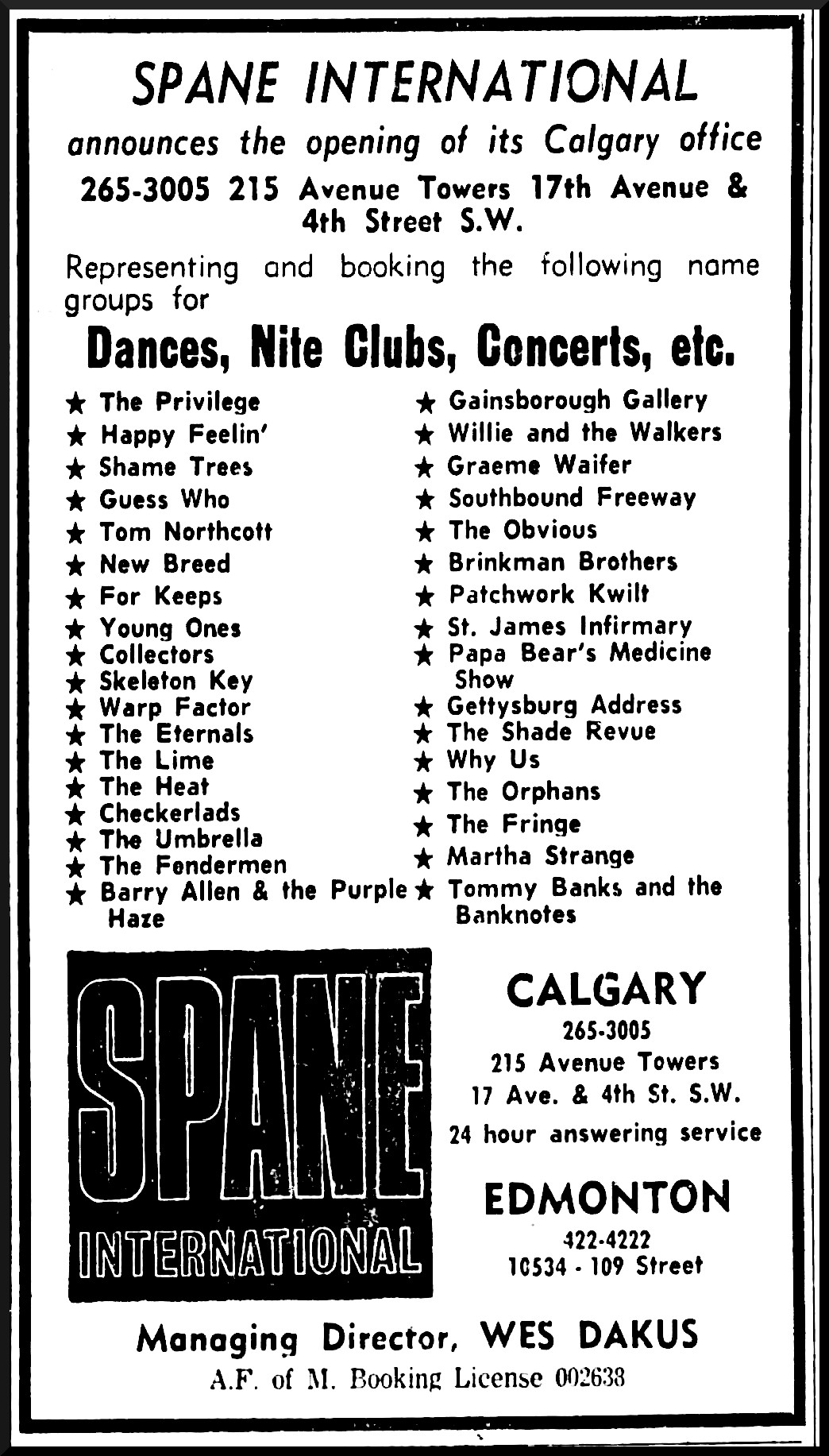
That similar outfit was The Bigland Agency in Toronto, the largest agency in Canada which was managed by Ron Scribner. Dakus then decided he wanted more control over the regional market and set his sights on attracting Calgary bands to his stable. The best way to do that was to open an office there which he announced in the Calgary Herald in August 1968. The address was 215 Avenue Towers at the corner of 17th Avenue and 4th Street S.W., and one of the staff was Candy Hanson who later went on to do promotion for Toronto-based Periwinkle Records. A period advertisement from Calgary showed his growing reach: listed in his stable were The Guess Who, Gettysbyrg Address, The Eternals, and The Orphans (from Winnipeg); The Gainsborough Gallery and The Happy Feeling (from Calgary), The Checkerlads (from Regina); Tom Northcott, Papa Bear’s Medicine Show, and The Collectors (all from Vancouver).
By December 1969 he was looking even further afield. According to the Journal:
Wes Dakus is expanding his Spane International booking agency again. Now that his Calgary office is established, he’s looking at Vancouver and Winnipeg. He’ll probably have an office in Vancouver soon after Christmas. That will mean more Vancouver talent coming to Edmonton, and more Edmonton talent going to Vancouver.
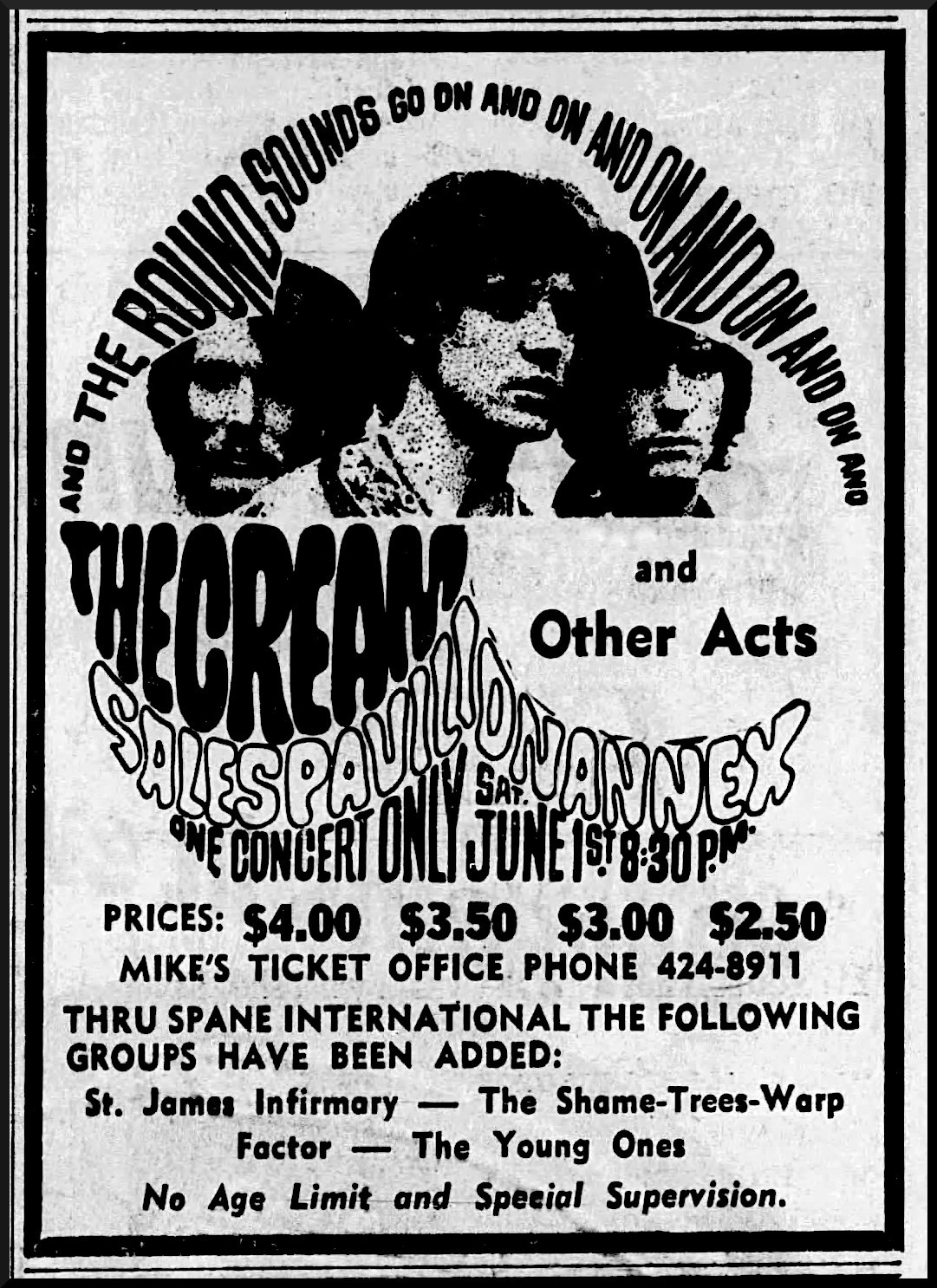
In addition to the placement of local acts, Spane started to book both national and international acts in tandem with promoters. The well-known Canadian acts Dakus would handle over the next few years included The Collectors (renamed Chilliwack), Five Man Electrical Band, Crowbar, Poppy Family, Mashmakhan, and Dr. Music. Amongst the international acts he booked in Alberta – sometimes on his own, sometimes as a local partner – were The Boxtops in December 1967, the Spencer Davis Group in November 1968, Cream in June 1968, and The Turtles in August 1969 (Youth Scene ‘69).
Spane’s role in helping to introduce new types and quality music to Edmonton was commented on by Bob Harvey of the Edmonton Journal in February 1969;
Several influences have combined to produce the new sophistication of the audiences here. More and more good groups are being brought to town by promoter Benny Benjamin, and Wes Dakus at Spane International booking agency has made Western Canada tours possible for Spencer Davis‘ group, the Collectors, the Mandala, Guess Who, the Infinite McCoys, and others.
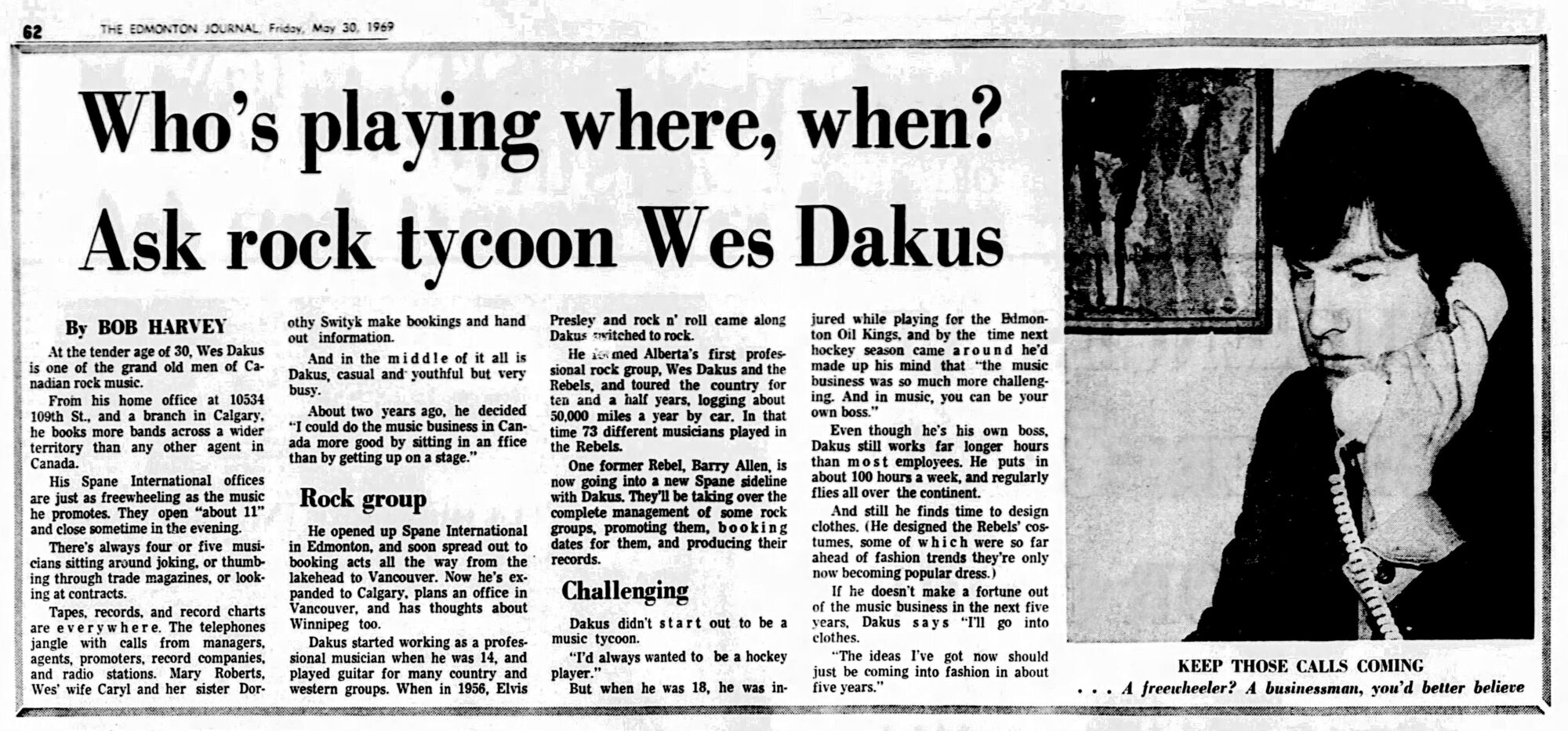
Dakus’ role was expanded upon with a complimentary profile again by Bob Harvey in May 1969. Under the headline “Who’s playing where, when – Ask Rock Tycoon Wes Dakus”, he was described as a freewheeling businessman:
At the tender age of 30, Wes Dakus is one of the grand old men of Canadian rock music. From his home office at 10534 – 109th Street, and a branch in Calgary, he books more bands across a wider territory than any other agent in Canada.
He goes through Dakus’ personal history;
Dakus didn’t start out to be a music tycoon. “I’d always wanted to be a hockey player.” But when he was 16, he was injured while playing for the Edmonton Oil Kings, and by the next hockey season came around he’d made up his mind that “the music business was so much more challenging. And in music, you can be your own boss.”
Even though he’s his own boss, Dakus still works far longer hours than most employees. He puts in about 100 hours a week, and regularly flies all over the continent. And he still finds time to design clothes. (he designed the Rebels’ costumes, some of which were so far ahead of fashion trends that they’re only now becoming popular dress.)
Harvey then describes the Spane office:
There’s always four or five musicians sitting around joking, or thumbing through trade magazines, or looking at contracts. Tapes, records, and record charts are everywhere. The telephones jangle with calls from managers, agents, promoters,, record companies, and radio stations. Mary Roberts, Wes’ wife Caryl and her sister Dorothy Swityk make bookings and hand out information. And in the middle of it all is Dakus, casual and youthful but very busy. About two years ago, he decided “I could do the music business in Canada more good by sitting in an office than by getting up on a stage.”
Then the new initiative:
One former Rebel, Barry Allen, is now going into a new Spane sideline with Dakus. They’ll be taking over the complete management of some rock groups, promoting them, booking dates for them, and producing their records.
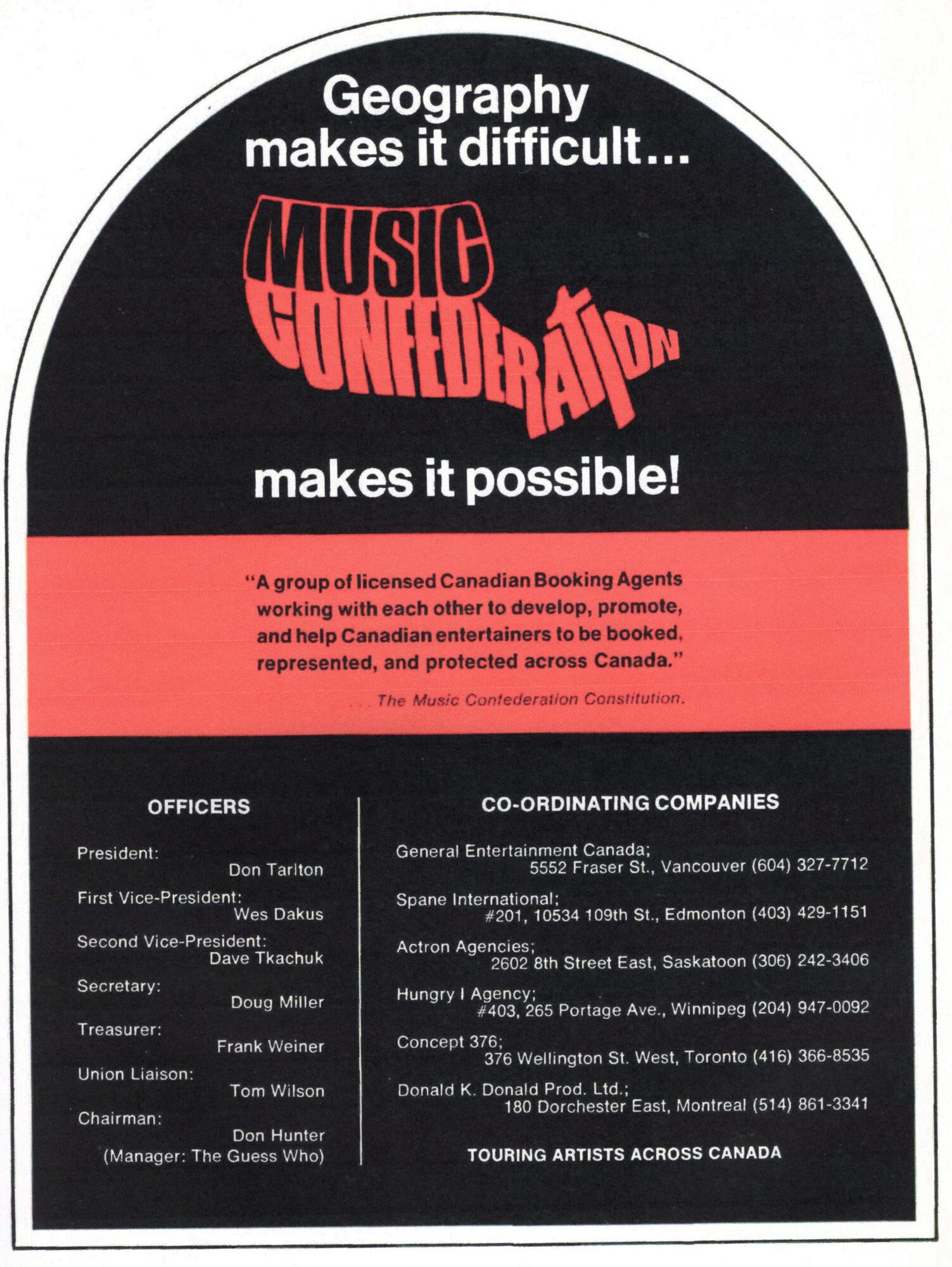
Dakus helped found an organization of a Canadian league of booking agents known as the Music Confederation in the summer of 1970. It formalized the previously informal links between agencies across the country – Donald K. Donald Productions (Montreal), Actron Agencies (Saskatoon and Regina), GEC (Vancouver), Hungry I (Winnipeg), Concept 376 (Toronto), and Don Hunter (Winnipeg). Dakus became its first vice-president. With this network in place, it became easier and more efficient to book tours of artists across Canada.
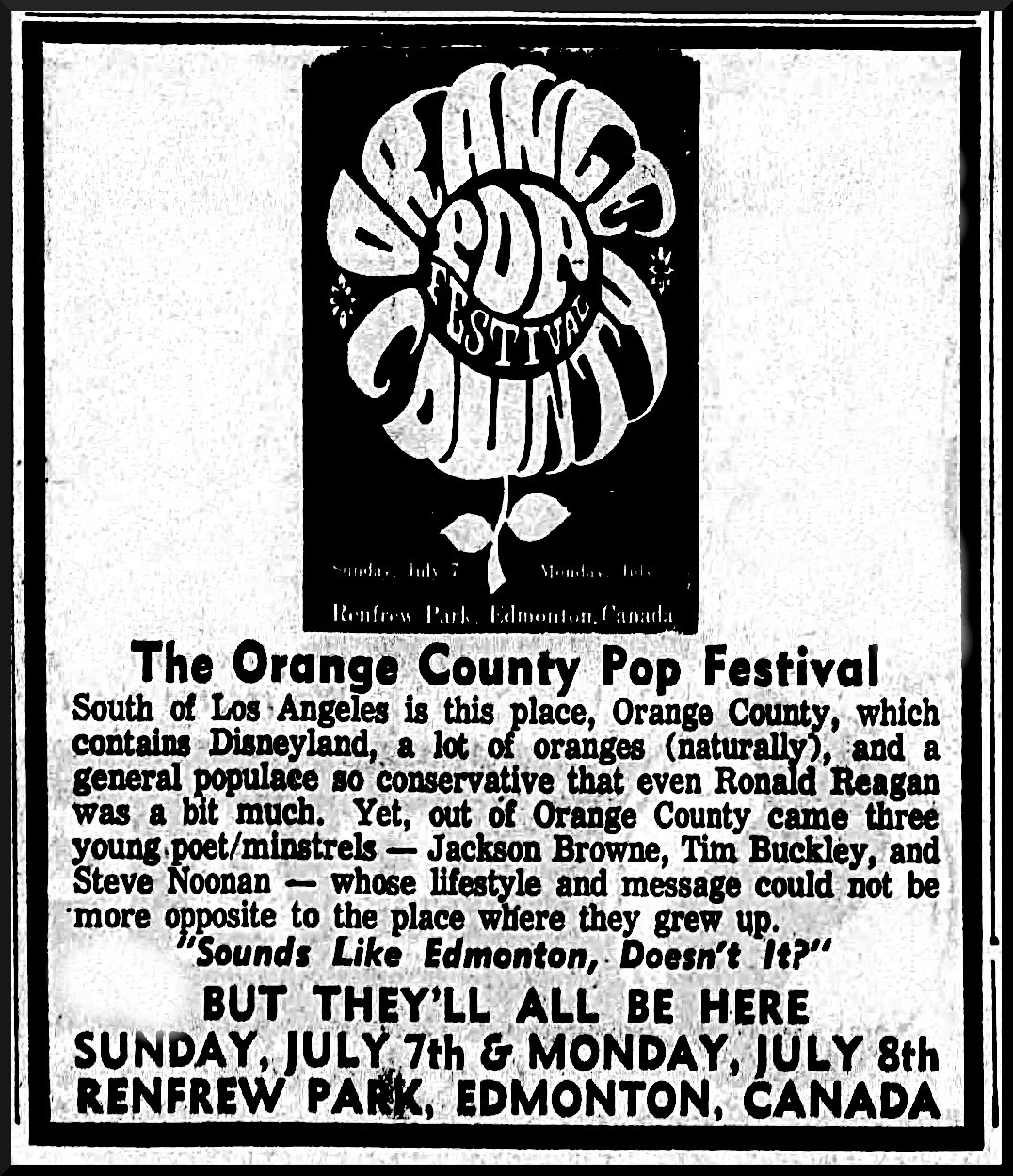
And keeping with the spirit of Rayal, Spane organized a number of local multi-band extravaganzas. The first, arranged in tandem with legendary Edmonton promoter Benny Benjamin, was the Orange County Music Festival It was held over two days – July 7 & 8, 1968 in Renfrew Park – a baseball stadium on the flats. The largest and likely the most memorable Edmonton outdoor festival of the 1960s, it was called Orange County for the large number of California bands that were originally scheduled to have headlined it, including Country Joe & The Fish. None of them made it over the border however (drugs, of course, were involved), and all the final talent ended up being Canadian. The festival organizers – promoter Benny Benjamin and Wes Dakus – knew they still had a strong lineup and went ahead anyway. The acts included Vancouver’s Tom Northcott and the Syndicate, My Indole Ring, and Papa Bear’s Medicine Band, a lone Saskatchewan representative The Mozart Group, and a palette of local bands such as Barry Allen and Purple Haze, the Young Ones, Shame Tree, The Heat, St. James Infirmary, Warp Factor, International Dateline, The Circus, Martha Strange, the Graeme Waifers. and the Harrad Experiment.
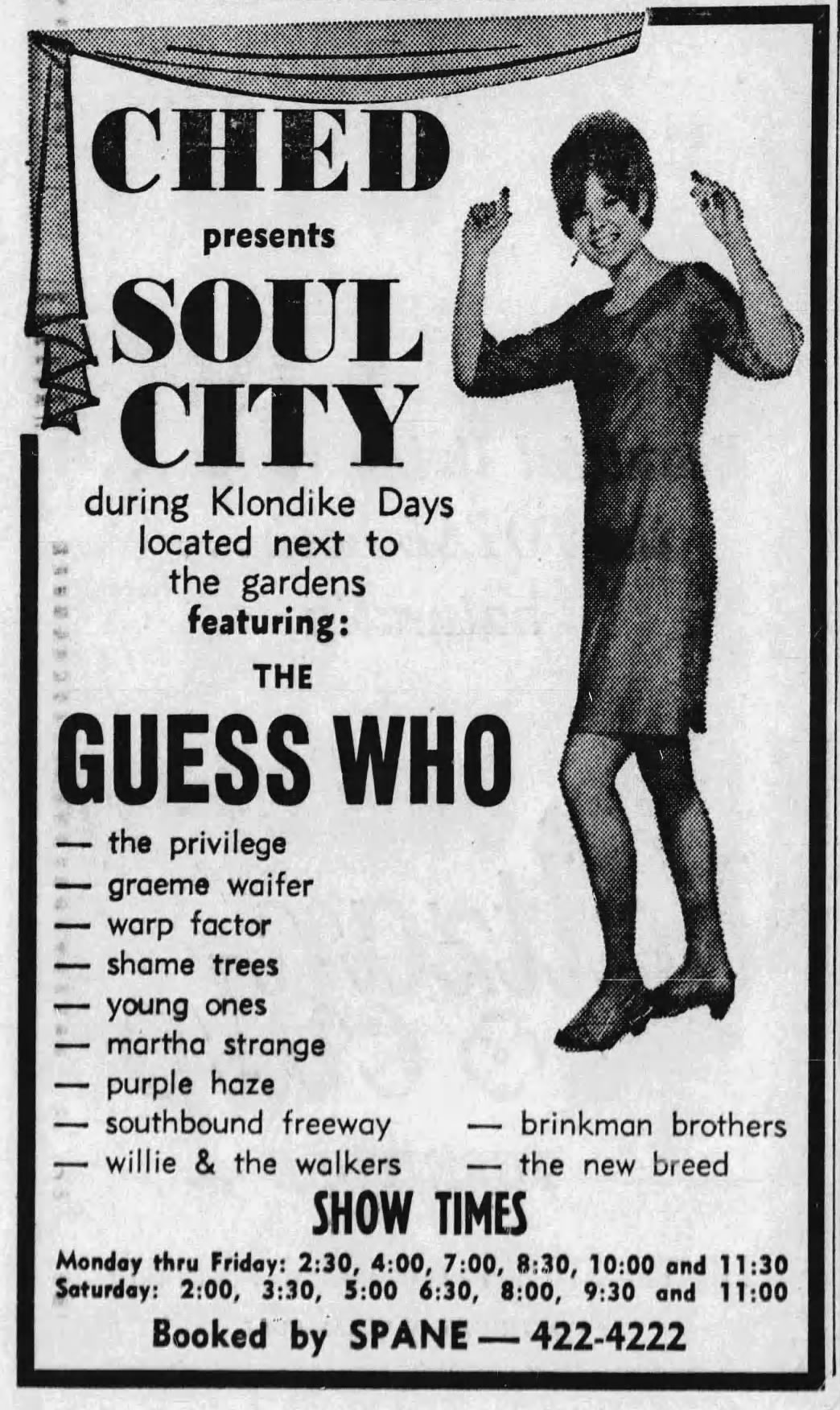
The second festival happened a mere ten days later – the six day event known as “Soul City”. Jointly put on by Spane and local radio station CHED, it was staged alongside Klondike Days at Exhibition Stadium. Headlined by The Guess Who, it included a plethora of local bands including Privilege, Purple Haze, Willie & The Walkers, The Graeme Waifer, The Young Ones, The Shametrees, Brinkman Brothers, Southbound Freeway, Warp Factor, and The New Breed (from Calgary). As well there was a youth film series with bands playing following the screenings. Amongst those were Patchwork Quilt, The Heat, The Obvious, and Why Us.
The next were two back-to-back Sunday afternoon concerts/happenings known together as The Banana Peel Special. They were personally emceed by Benny Benjamin and held at the Sales Pavilion in autumn 1968. The Journal noted: “As usual at Benny’s concerts, there’ll be incense, balloons, live monkeys, birds, sparklers and films in addition to the bands.” Dakus provided the talent.
The first Sunday – October 13 – featured the Graeme Waifer, Warp Factor, The Shametrees, Martha Strange, and a folk duo Arthur & Glover. The second Sunday – October 20th – saw the second appearances of The Waifers, Warp Factor, and Shametrees, plus one of Canada’s hottest bands then touring Western Canada – The Mandala. Both afternoons were a success: the first attracted 1,000 teenagers, the second topped over 1,600.
A second Orange County Festival – also in tandem with Benjamin – was staged in Clarke Stadium from July 14 to 16, 1969. Subtitled “A Mixed Bag of Pop” the festival attempted to balance unknown local acts with well-established crowd pleasers. The first night was given over to a battle of non-union bands. First prize was $300 (2nd place – $200) plus a full years musicians union membership for all the members of the winners The Sauce. The big acts on the following two evenings included The Collectors, Tom Northcott & The Syndrome, Jayson Hoover, Crazy Horse (not the Neil Young band), Buckstone Hardware (from Toronto), Motherlode (also from Toronto), Top Cat (a.k.a. Ray Arkinstall), and Vancouver’s town fool Joachim Folkis. The local bands were also well-received: Network (from Red Deer), Happy Feeling, Gainsborough Gallery (Calgary), and Martha Strange, Southbound Freeway, Everyman’s Tonto, Coloured Rain, The Dateline, The Key, Dick Tator, and Denim ‘n’ Lace.
The next multi-band event indulged in a little bit of nostalgia. On the Thanksgiving weekend of 1969, CHED cleared its entire schedule and broadcast a forty-nine hour radio documentary entitled The History of Rock and Roll. A monumental and groundbreaking production, it was produced in Los Angeles by Ron Jacobs and hosted by Robert Morgan. It covered the 1950s and 1960s in depth with over 800 songs and over 100 interview clips. CHED was the first Canadian station to bid on the program and added its own 1-hour segment exploring the contributions of Canadian musicians to the history of the genre. The program occupied the airwaves continuously from Friday October 10 at 5 pm to Sunday October 12 at midnight.
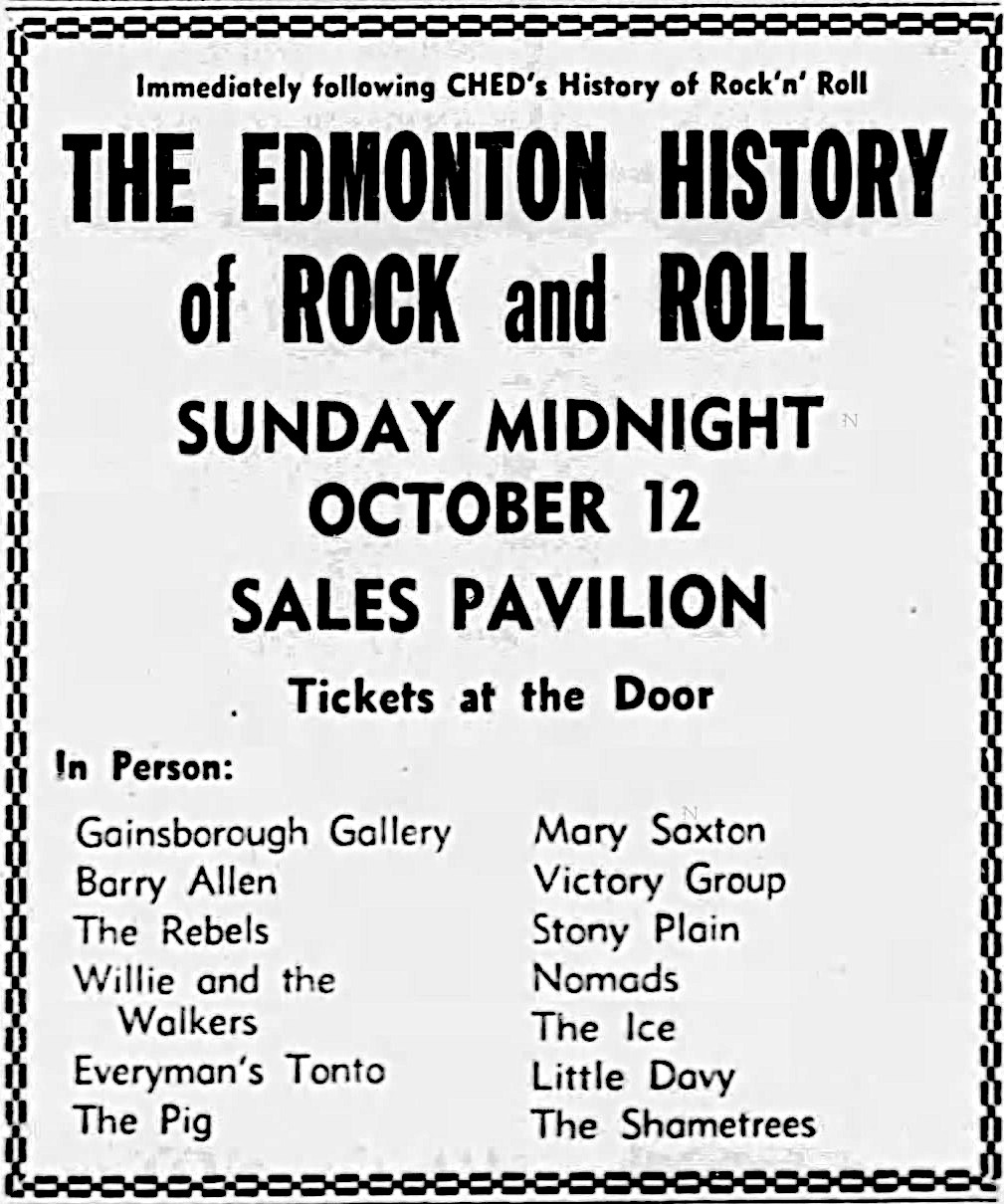
Immediately following the last notes of the broadcast, Spane International assembled a selection of past and present clients for “The Edmonton History of Rock and Roll” live concert at the Sales Pavilion. The performers included Barry Allen, The Rebels, The Nomads, Mary Saxton, Willie & The Walkers, Gainsborough Gallery, The Shametrees, L’il Davey, The Pig, The Ice, Victory Group, and Stony Plain. It lasted all night, and helped reinforce the idea that Canadians – and Edmontonians – were a part of that history.
Yet another event was the United Community Fund Expo, a benefit concert that directed funds into forty-six agencies helping youth such as the YMCA, YWCA, CGIT, Boy Scouts, Girl Guides, and the Red Cross. Jointly arranged with radio station CHED, it was staged at the Exhibition Grounds on October 11, 1970. The eight hour show featured Shinto, Privilege, Sundance, Sage, Angus Park, Dick Tator, and The Key.
For a foundational five-year period – 1967 to 1972 – Spane International was the only talent agency/booking game in town for Edmonton, and was a powerful presence throughout all the three western-most provinces. Through strategic connections and agreements, Dakus also built a cross-country stable of artists which included Lighthouse, Crowbar, Mashmakhan, Five Man Electrical Band, Dr. Music, Syrinx, April Wine, Bruce Cockburn, Madrigal, Leigh Ashford, Lickin’ Stick (with Paul James), Poppy Family, Seeds of Time, The Northwest Company, Valdy, Mock Duck, Brahman, Witness Inc. and Wascana. By any reckoning it was an impressive achievement.
Part 2 – The Labels
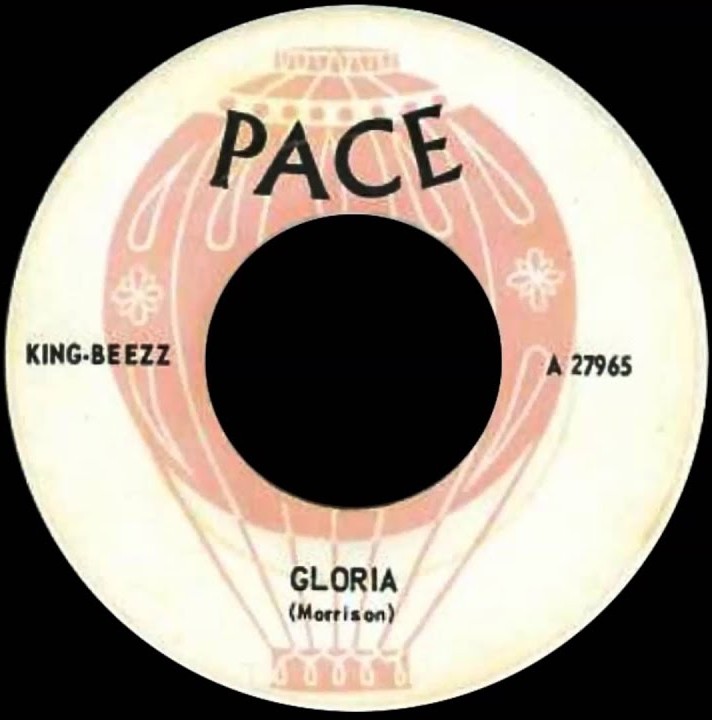
The second thrust of Short/Schwartz, Johnson and Dakus’s plan was to get their acts greater exposure through recordings – preferably national or international – but with a realistic appreciation for regional attention as well. This was to be achieved by negotiating with more established Canadian and American record labels, and failing that, by the operation of their own independent record label. With the profits from the talent agency, they initiated Pace Records in November 1965. Their first release was a 45 rpm by Edmonton’s bad boys – the King Beezz. Considered by many to be Edmonton’s equivalent to The Rolling Stones (for both their long hair and their surliness), the Beezz consisted of Carl Peterson (vocals), Bob Richardson (lead guitar), Alan Cramsie (rhythm guitar), Ray Carson (bass), and Ron McLachlan (drums). The A side was “She Belongs To Me” by Bob Dylan, while the B-side was a raucous cover version of Van Morrison’s “Gloria.” Supposedly only 100 copies were pressed, making it a true collector’s item. It caught the attention of most prairie radio stations and – with an extended tour of Ontario and showcase gigs at the Owl’s Nest in Yorkville and the Gogue Inn in Toronto, the band’s recording was picked up by Quality Records for a larger scale national re-release.
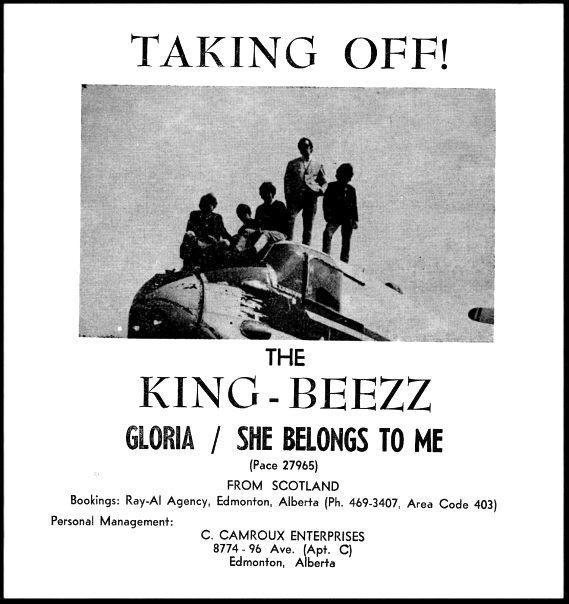
Billboard – the premiere North American music trade journal – reported in June 1966 on both Rayal’s corporate ambitions and their second release:
The indie Pace label in Edmonton, whose first release, by the King Beezz, was picked up for national distribution by Quality, is now planning to set up its own national distribution. New release is “Ask Any Girl” and “Do the Jerk” by Mary Saxton, off to excellent reaction.
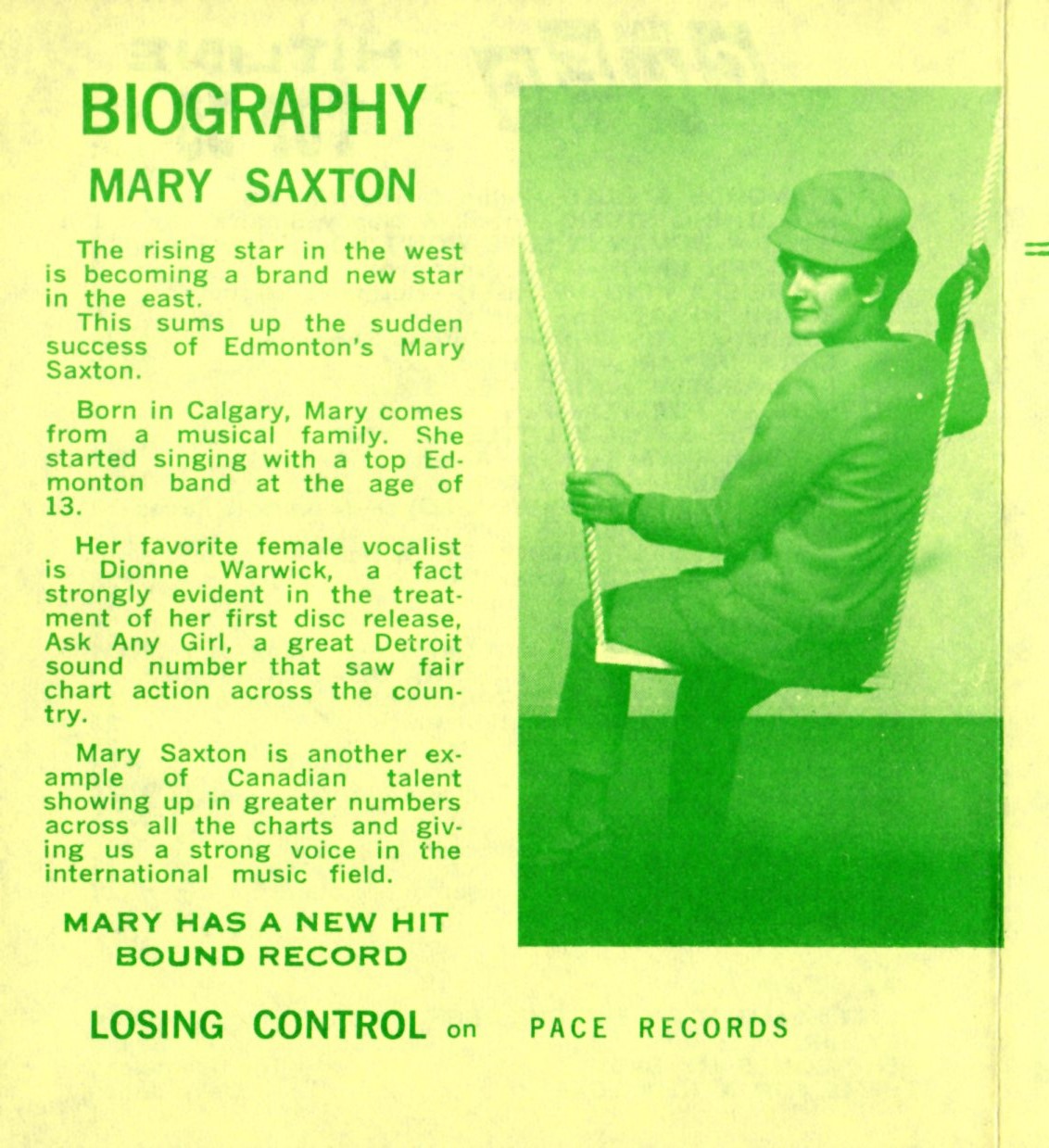
Saxton’s first single was a surprisingly authentic slice of northern soul. She had a powerful, soulful voice that belied her young age. “Ask Any Girl” was a Holland/Dozier/Holland Motown song originally recorded by The Supremes. “Do the Jerk” was the standout cut though. The Jerk was the latest dance craze to reach Edmonton. “Do the Jerk” was a 45 rpm done by the Los Angeles vocal group The Larks in 1964. It took off like a rocket, and over the next year many other artists piled on. Smokey Robinson & The Miracles released “Come On Do the Jerk”, The Contours did “Can You Jerk Like Me”, Dobie Gray put out “Monkey Jerk”, and The Capitols released “Cool Jerk.” With Saxton as the soundtrack, the youth of Edmonton did their fair share of jerking in 1966.
The next month Billboard again gave print to two more Pace artists on July 16, 1966: “The Edmonton-based Pace label, currently negotiating national distribution, has signed Dianne James, formerly on the Arc label, and new singer-songwriter Gary Donally.” Throughout the rest of the year Short/Schwartz carefully recruited local talent for the label. The two acts he was most excited about were The Lords and Mary Saxton. The Lords were a versatile live show band with rhythm &blues roots. It remained to be seen if Short/Schwartz and Johnson could find the right material for them, and if their obvious talents would translate to disc.
Somehow a connection had been made with Garry Paxton, an American artist and producer then active in Hollywood. Paxton appeared to have the “ear” for a radio hit, had an admirable track record for his songwriting, and had a team of writers and musicians working with him. On top of that he had a reputation as a producer who could guide new artists.
Paxton and The Lords thought they had found the perfect writer for them: Kenny Johnson. A writer and gigging musician from Bakersfield, CA, Johnson was a member of several 1950s and 60s rock, doo-wop and surf music bands such as The Ho Daddies, The Trippers, Chocolate Tunnel, and Mental Institution. He sometimes wrote alone – sometimes with others. Many of his compositions were written with his band members Jerry Ritchey and Bob Hopps, all from the obscure, but cool mid-1960s combo The California Poppy Pickers.
In the second week of November 1966 Short/Schwartz accompanied his two main acts down to the U.S.:
The Lords and Mary Saxton depart tomorrow for Hollywood and Gary Paxton’s recording studio. They will be gone about a week, during which time The Lords
will record six sides and Mary four. The material is being written by the man who has written songs for Leslie Gore and Gary Lewis and the Playboys. This sounds like a winning combination for the talented local entertainers.
The Journal followed it up a week later:
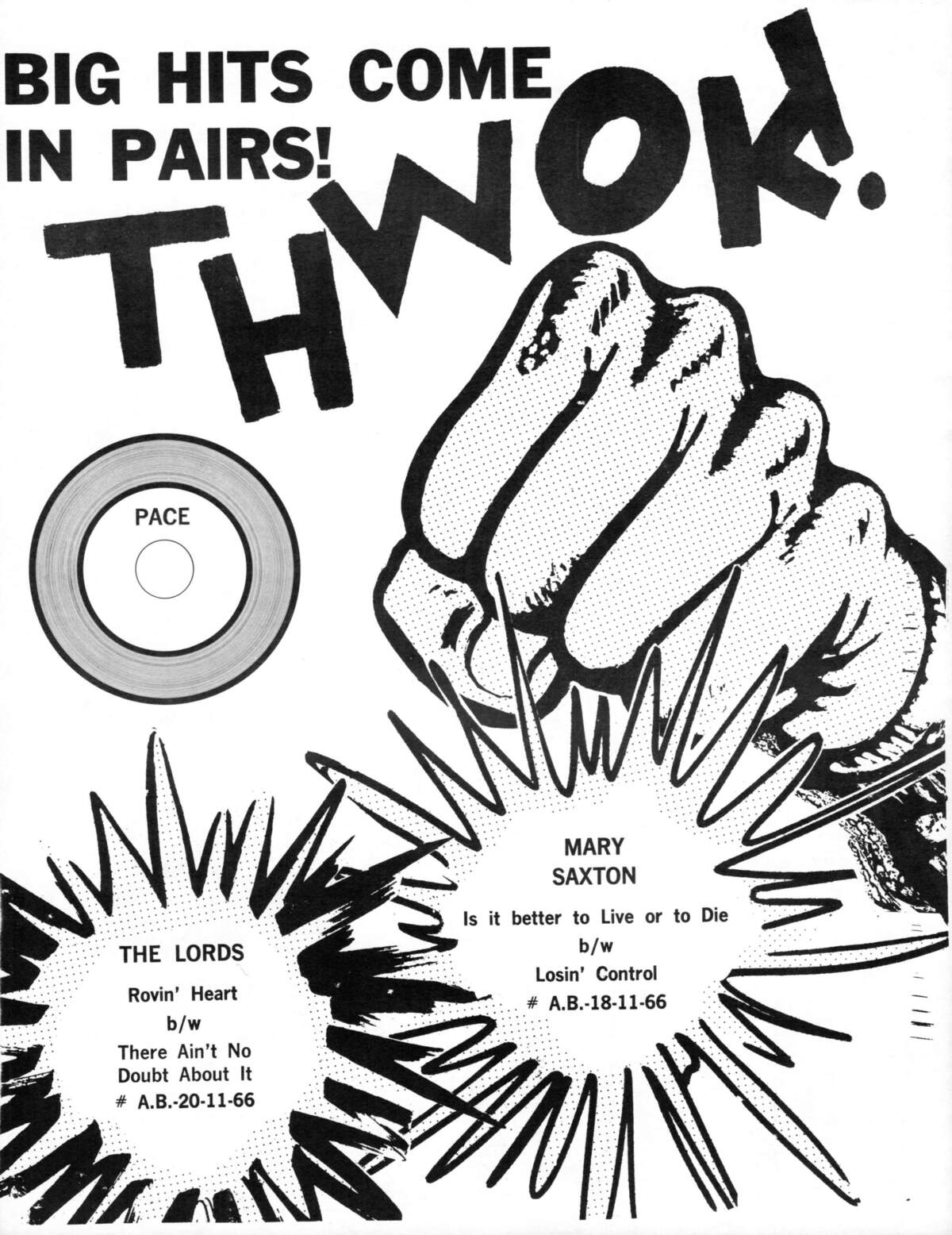
The Lords and Mary Saxton arrived back in Edmonton Monday after a successful week of recording in Hollywood. The Lords cut eight tracks and will release two singles THERE AIN’T NO DOUBT ABOUT IT and ROVIN’ HEART (the latter will go under the name of Mel Deagan). Mary Saxton will have a single out called LOSING CONTROL. The flip is a Bob Dylan-type ballad called TO LIVE OR TO DIE. Release date for these records is January 10. The Lords will be returning to Hollywood near the end of January to cut an album.
Its teen readers were alerted to three new Pace singles on February 10th1967:
The Lords, Mary Saxton, and Mel Degen all have records coming out on February 15th. Our personal favorites are Is It Better To Live or To Die by Mary, and Rovin’ Heart by The Lords. The former is a bluesy, negro spiritual-type tune that makes the most of Mary’s unique voice. Rovin’ Heart is a full-sounding song, with a definite beat and a syncopated introduction and finish. Both are very good starting discs for the Edmonton performers.
As March rolled around, The Lords started to think in bigger terms, and the idea for an album was discussed. They returned to Paxton’s studio to put more songs to tape. The Journal reported on March 17:
This has been a big week for local groups… The Lords just returned from Hollywood where they’ve been cutting material for an album. While performing in the RED VELVET CLUB in Hollywood, apparently SAL MINEO, ELVIS PRESLEY, and P.J. PROBY caught their show. How’s that for exposure.
These songs would make it onto an LP later in the summer.
Lydia Dotto of the Edmonton Journal put the optimism into words in her March 31, 1967 column:
Have you ever had the feeling that you were sitting on top of a bomb about to explode? This is the feeling we get as we watch our local groups going through their paces. They’ve been passed the preliminary phase – live performing – with flying colors. They’ve just entered the more sophisticated stage of recording – and most of them are doing exceptionally well at that. The next step – national and international recognition – is yet to come. It is the anticipation of this last phase that makes waiting seem like a time bomb.
This was soon followed by the second single from The Lords “Blue” b/w “Dirt Beneath Your Feet” (July 1967), an offering by the Southbound Freeway “Dead End Street” b/w “Something Better”, and another single by The Lords “Savin’” b/w “The Highly Successful Rupert White.”
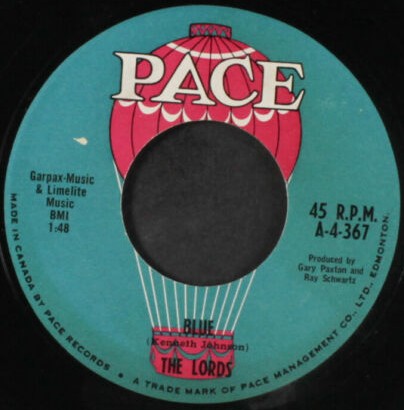
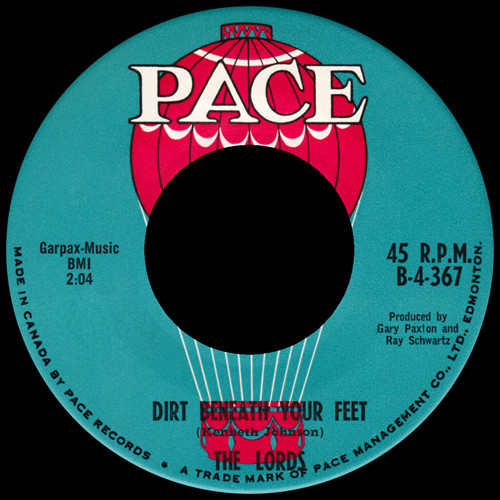
Pace Records’ most ambitious recording initiative was a compilation album, which Short/Schwartz had been planning as a souvenir follow-up to the “Preview ‘67” event. The idea hit the newspaper as early as May:
Rayal Talent Agency is putting out an album of all-Edmonton talent. It was pressed partly in Edmonton at Downtown Sound, and partly in Hollywood at Gary Patton’s [sic. should be Paxton’s] Studios. Some of the proposed artists are The Shade of Jade, The Cat Family, The Young Ones, and The Lords.
That was further solidified on June 30, 1967:
The album of all-Edmonton talent is to be released (hopefully) around Klondike Days. You’ll be able to hear the sounds of Mary Saxton, South Bound Freeway, The Young Ones, Us Incorporated, The Lords, and others.
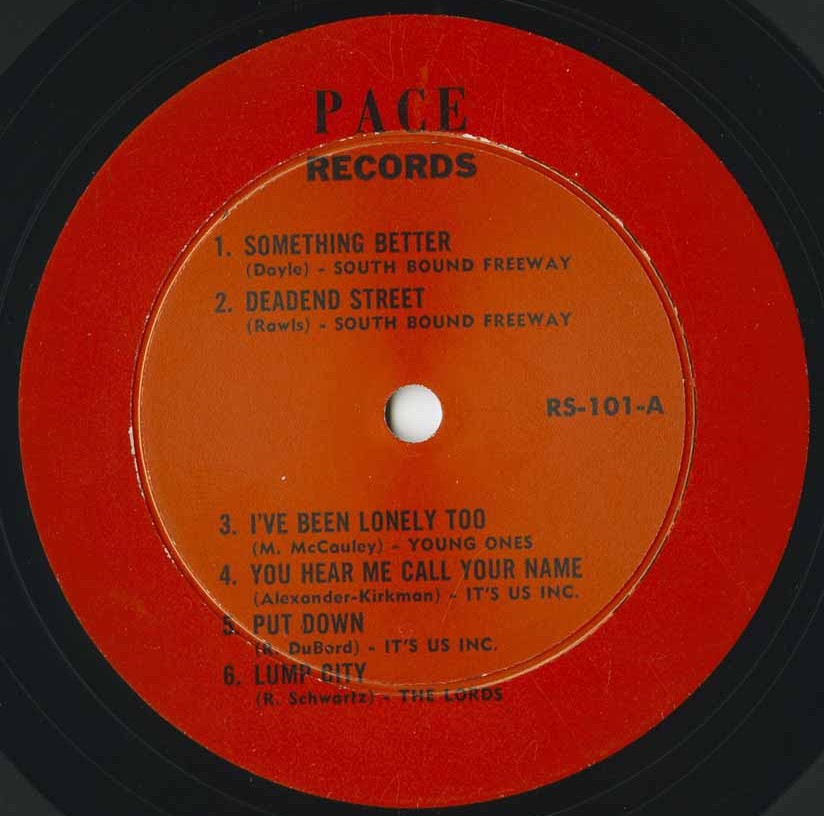
The album, entitled Direct From the Rainbow Ballroom – was finally released on August 1st, 1967. This album had twelve songs on it: two by Southbound Freeway (“Something Better” and “Dead End Street”), one by The Young Ones (“I’ve Been Lonely Too”), two by It’s Us Incorporated (“You Hear Me Call Your Name” and “Put Down”), two by Mary Saxton (“Just For You” and “Big City Guy”), four new tunes by The Lords (“Lump City”, “Shadows in the Sun”, “Books and Movies”, and “Journey to Nowhere”) and a surprise – a joint performance with both Mary Saxton and The Lords (“Go Ahead and Make a Fool of Yourself”). In a subtle act of self-promotion, the last song, as well as the intriguing “Lump City” were written by Ray Short/Schwartz.
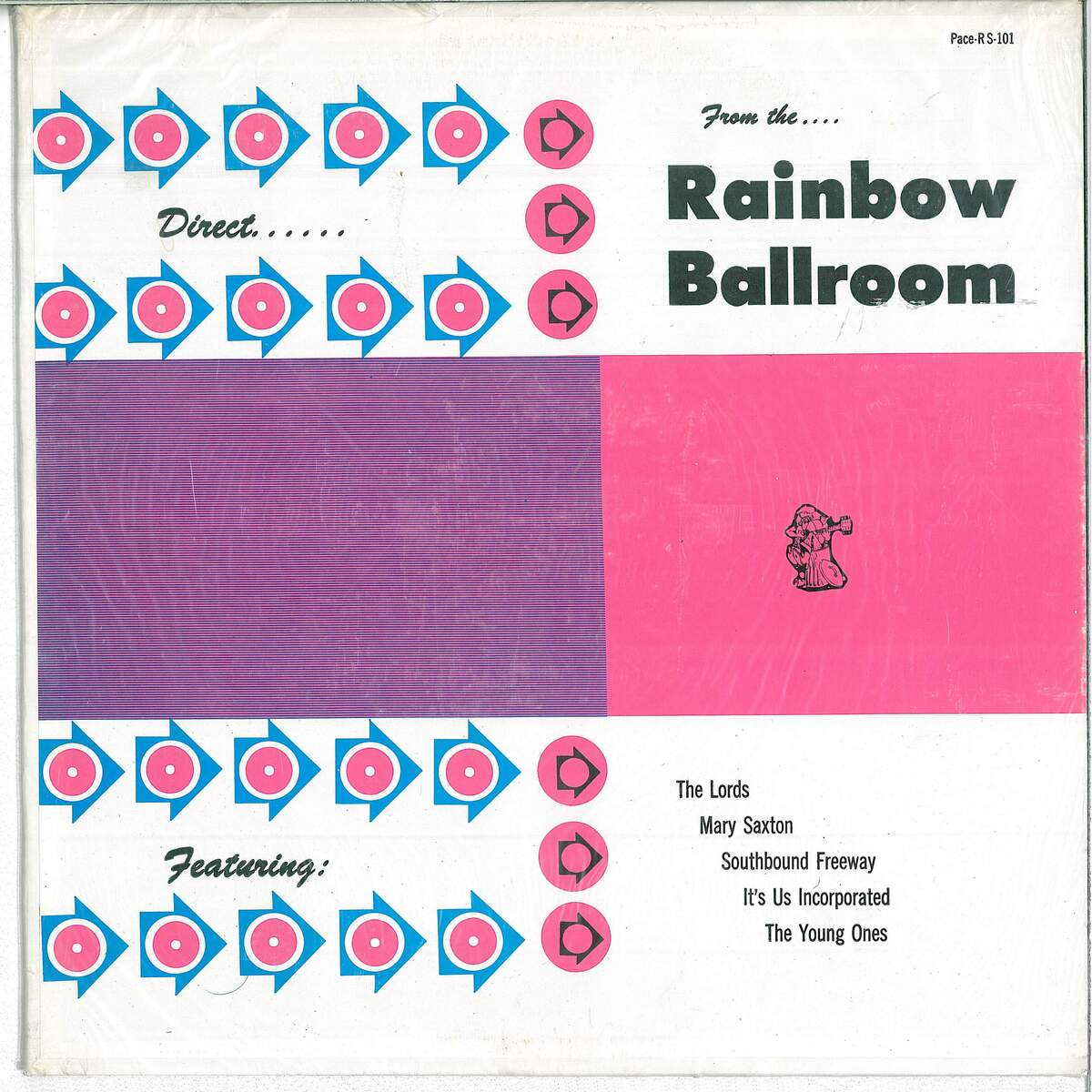
The jacket notes were pure Rayal – a few key hip phrases, a lot of filler, and some awkward wording:
Direct from the Rainbow Ballroom…on weekends in Edmonton it is the happening …the now place…the home of the swingers. Here within is presented some of the finest Rock groups in a kaleidoscope of sound…The Lords featuring Mel Degen incorporate a large big band sound that will make your record player come alive with dynamic vibrations. You will get the message that everyone is getting….The Young Ones, a composite of four young musicians between 14 and 15 years of age…bring forth an original sound that will cause talk as a unique discovery…The Southbound Freeway is a six piece group and have enjoyed great popularity in Edmonton. Mo Boyer is as exciting an entertainer as you will ever encounter. The mood…the feeling…the soul he expresses is a sincere presentation…Us Incorporated are a show band in the true sense of that description. They entertain you…Canada’s most promising female vocalist, Mary Saxton is the rising star of the west. Mary has been singing with top rock bands since the age of thirteen. A great gal with a dynamic sound.
It summed up with: “This album is a communication between performers and audience…it reaches out to you on a personal level and invites you to share in its fun.” Then “… All these great entertainers plus countless others are available only through RAYAL TALENT AGENCY. 10534 – 109th Street, Phone 424-9394.” The album was a major accomplishment. No other agency in Western Canada had put out a sampler album of its talent – on its own label and mostly recorded in its own studio.
Rayal clearly felt confident about its acts and started making connections with international distributors. The Journal reported on October 27, 1967:
Ray Short and Al Johnson got in from London, England, Monday, all enthusiastic about the British scene. They had talks with Pye Records and EMI, both of whom are interested in Canadian artists. Ray and Al, consequently, are opening a small branch office in London shortly.
Perhaps that was also a bit too ambitious. None of these conversations resulted in foreign releases. Undeterred, they kept talking to the major labels in Canada for wider distribution for their proposed second label. It was reported on November 24th:
RAY SHORT and WES DAKUS are heading east for negotiations with CAPITOL records. They want to set up national distribution for the new local label, FOUNTAIN, which is connected with the recording studio.
Their pitch was successful, and the pair arranged with Paul White, head of Capitol Canada A&R, for the distribution of Fountain Records. The first release was a 45 rpm by The Daisy Hill Puppy Farm “Counting Cracks in the Sidewalk.” Oddly there were to be no more.
By the end of 1967, it was clear that The Lords’ Pace singles were not selling, nor really getting attention outside Edmonton city limits. Part of the problem was that Pace had no promotion experience nor strategy, and part of the problem was that The Lords were constantly being mistaken for the Toronto-based band The Lords of London (who had a huge central Canada hit with “Cornflakes and Ice Cream”).
Johnson wanted to prove his worth to his band, and so he pushed on two fronts – a new name and a new nationally-distributed label for their recordings. A new year was a good time for the name change, and the band deepened its relationship with Capitol Records. R.P.M. announced both the name change and the first re-issue on the new label:
The Privilege (formerly The Lords, adopted the new name to avoid confusion with The Lords of London) from Western Canada, have debuted their first Capitol single “The Highly Successful Young Rupert White” which was recorded at Capitol Studios in Hollywood. Early reaction indicates it could top the charts shortly. A U.S. release is presently being negotiated.
The next re-issue was “Rovin’ Heart” which hit the charts in April 1968. R.P.M. indicated the single had finally made an impact outside of Edmonton:
Dauphin, Man: Ron Waddell has picked “Rovin’ Heart” by the Privilege (Capitol 72530) as the one to click in “Ugly’s Teenage Country” [Ugly Ron was his radio name]. The Privilege are favourites throughout CKDM’s listening area, mainly because of the impact they left last year as The Lords when they had another single going for them. The Edmonton group has also picked up considerable support from other western stations as well as those on the eastern seaboard.
Mary Saxton then signed a contract with Quality Records, and releases on the Pace label effectively came to an end.
Part 3 – The Studio
Johnson and Short/Schwartz’s third thrust was to facilitate the recording of their local artists – on their home turf. Up to the summer of 1966 few Edmonton bands had recorded. That was mostly due to the lack of facilities in town, but still there was a long history of recording services in the Alberta capital.
The first recording studio was established in 1933 by a musical instrument dealership Heintzman & Co. on Jasper Avenue. As reported by the Journal:
Mr. William Strachan, the manager, has had fitted up in the basement a regular recording studio where many artists in the city have recorded both voice and instrumental work.
In 1942 the True-Tone Recording Studio began at 10131 – 99th Street. A series of their advertisements touched on all the possible uses of recording:
“Have You a Loved One Overseas? Send Him a Recorded Greeting”
“Pupils – Piano, Voice, Musical Instruments! Check progress with Recordings.”
“Record the Voice of the Family for Future Days, Group or Solo Arrangements.”
“Recordings made on shortest notice of ORCHESTRAL, INSTRUMENTAL, CHORAL, VOICE AND SUNDRY RECORDINGS.”
Five years later, three war veterans – Jack O’Leary, David Ivor Roberts (formerly a CBC stringer in London, U.K.) and Elmer Roberts established Recordings Unlimited on 101 Street at the base of McDougall Hill. They offered to make “personal recordings of all kinds at their studio, where the latest equipment is always ready for use.” Their business plan included the recording of wedding ceremonies, and the recording of plays for Edmonton organizations. A notice in the Journal’s classified section: “For a Christmas gift the firm suggests a voice recording. Many Edmontonians have taken advantage of this popular plan and already are keeping engineer Elmer Roberts busy.” Not busy enough though, for Records Unlimited lasted only until late 1948.
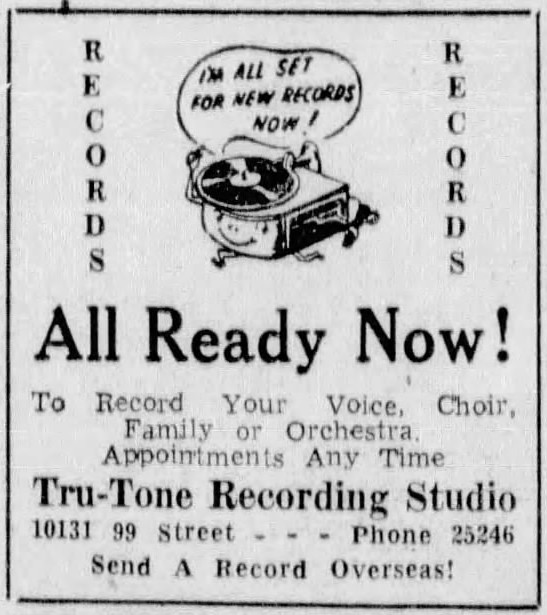
All these early studio operators used blank lacquer discs of various sizes onto which were cut the monophonic sonic grooves with a lathe. Each one would have been a unique one-off “vanity” recording. So unless it was broadcast on the radio for some reason, the audience would have been extremely limited.
Omar’s Recording Studio opened in the spring of 1951 at 10913 – 88 Avenue at the south end of the High Level Bridge. It used the oldest hook line in the book to attract customers: “You May Have Talent….” Customers apparently were not attracted, and by July of that year the studio had been taken over, updated, and re-named Harmony House. This was a much more professional organization and aimed their services at a more focused clientele – music teachers, students, and musicians.
They appear to be the first facility to use tape in addition to lacquer discs, and to utilize sound attenuation.
Improve your performance by hearing yourself play or sing. Harmony House fills a long-felt need in the City of Edmonton. Our modern sound-proof RECORDING STUDIO is filled with new up-to-date equipment. Our tape and disc recorders are built for high fidelity sound reproduction. The quiet noise-free discs, and the quality of Harmony House Recordings cannot be excelled for amateur,business or professional purposes…WE RECORD EVERYTHING.
Harmony House had all aspects of the business covered: they transferred tape recordings to disc, they copied old recordings, and they also engaged in mobile recording: “We use portable equipment and record in schools, churches, auditoriums, or right in your own home.”
In February 1958 the short-lived Royal Recordings Ltd. became active at 10054 – 10 Street. They advertised; “complete transcription service, recording, taping, pressings. For private business and gospel recordings.” Unfortunately at the end of March, they were burgled, their recorder was stolen, and they had to fold.
The final entry in the list of pre-1960 recording studios was The Harmony Kids music store. They added a small studio to their business in June 1958 and this would evolve into something of significance. Harmony Kids was Edmonton’s largest and most popular music store. It was established in 1954 by Roy Barabash, and named after the accordion band he had formed with his three sons Richard, Ron, and Don.
Their first store was located at 10633 – 101 Street, with a second at 10722 – 101 Street, and a third at 10722-101 Street. They sold instruments wholesale and retail, arranged rentals, and sold sheet music. They carried out repairs, cleaning, tuning and re-varnishing on instruments, but they were probably best known for their music lessons – individual and as part of a band – on almost any instruments that were available. As they called themselves “Edmonton’s Only School of Modern Music”, they made a point of keeping up with the newest technology associated with music. They were the first store to carry electric guitars – from Fender, Gibson, Rickenbaker, Gretsch and Hofner – as far back as 1958. They were convinced that recording and playing back student performances was one of the best ways to improve learning and performance, and so they established a small studio in their flagship store.
There was a personal incentive in this as well. In January1960, the Barabashes were approached by Leeds Music Corp. Canada to record an album. They had been recommended by Toronto bandleader and television personality Billy O’Connor who had seen a performance by the Harmony Kids when he was in Edmonton the year before. However Leeds first requested a tape of twelve songs in order to make their final decision. Apparently the Harmony Kids could not record a professional sounding demo with any facilities in Edmonton (including their own), and to the family’s regrets, an album was never released. That, plus the realization that an additional money-making opportunity existed in offering professional recording studio experience, pushed the Barabashes into planning for a multitrack studio. Leading the initiative was Don Barabash.
A few Edmonton bands had recorded single track songs at either the CJCA or CHED radio studios. Locals with more lofty aspirations had simply up and left going as far afield as Memphis (James and the Bondsmen recorded at Pepper-Tanner), Hollywood (The Lords and L’il Davey & the Drastiks had gone to Gary Paxton’s studio), Toronto (the King Beezz had recorded their second single there), and the favorite – Clovis, New Mexico (Wes Dakus, Barry Allen, The Nomads and Willie & the Walkers had all recorded at Norman Petty’s studio). So stereo recording was in the air. So was overdubbing, phasing, double-tracking, compression and equalization. Audio recording as a process, had become a creative art in itself, and there were many musicians who wanted to explore it – and on home ground.
The idea of a multitrack studio in Edmonton was not new. Chuck Camraux talked with an Edmonton Journal reporter in June 1966 and insisted that he had intended to start up a recording studio back in 1958, but “discovered that it took too much money.” Short/Schwartz and Johnson were in a slightly better financial position and decided it was finally time to construct a dedicated studio. In an article entitled “Rayal Expands” Billboard reported in its June 11, 1966 issue:
The Rayal Talent Agency here has entered the publishing and indie record producing fields. As part of the expansion, the firm has moved into new offices and built a recording studio. Rayal, founded by CJCA deejay Ray Short and Al Johnson, owner of the Lakeview entertainment centre, reports booking $74,000 in talent since being established in September 1965. The firm is now booking for all of western Canada, and is establishing working agreements with talent agencies in the rest of Canada and the U.S.
The building they chose to set up in was the same building where they had located their booking and management offices on 109th Street. The first floor studio – accessed from the back alley (which already made it kinda cool) – had a performance room and a small control room. A description of its construction relates:
The ceiling of the studio has three feet of insulation above it. The floor is solid concrete, with no basement beneath. The walls are also concrete and insulated with one and a half feet of soundproofing. For better acoustics, the walls are all constructed so there are no right angles in the room. The studio and the control room are so well soundproofed that, no matter how loud the music inside, nothing can be heard from the outside. Even in the adjoining control room little sound can be heard from the studio.
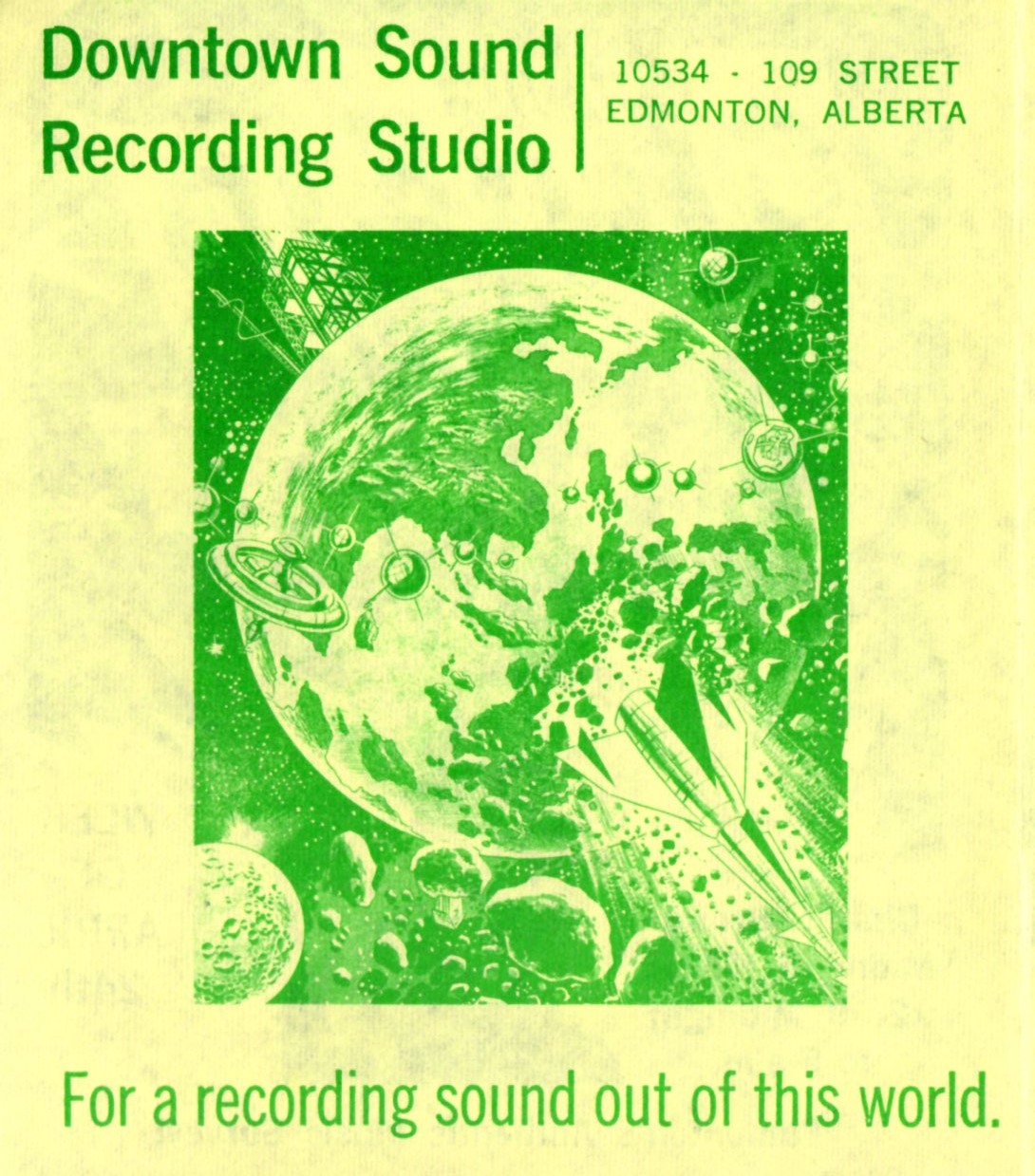
Gary Koliger, then a very young musician (who would later end up owning the studio) recalls that it “…had acoustic tile, but no other acoustic treatment to speak of.” Its initial equipment consisted of a 1/2 track – 1/4 inch tape machine, as well as a skimpy assortment of microphones and instruments.
It was anything but a first rate studio, but it was still leagues ahead of anything previously operating in Edmonton. At the start the admittedly primitive operation had only two-track capability (normally used just for demos), but it was still warmly welcomed by the musical community. Johnson and Short/Schwartz christened it Downtown Sound Studio.
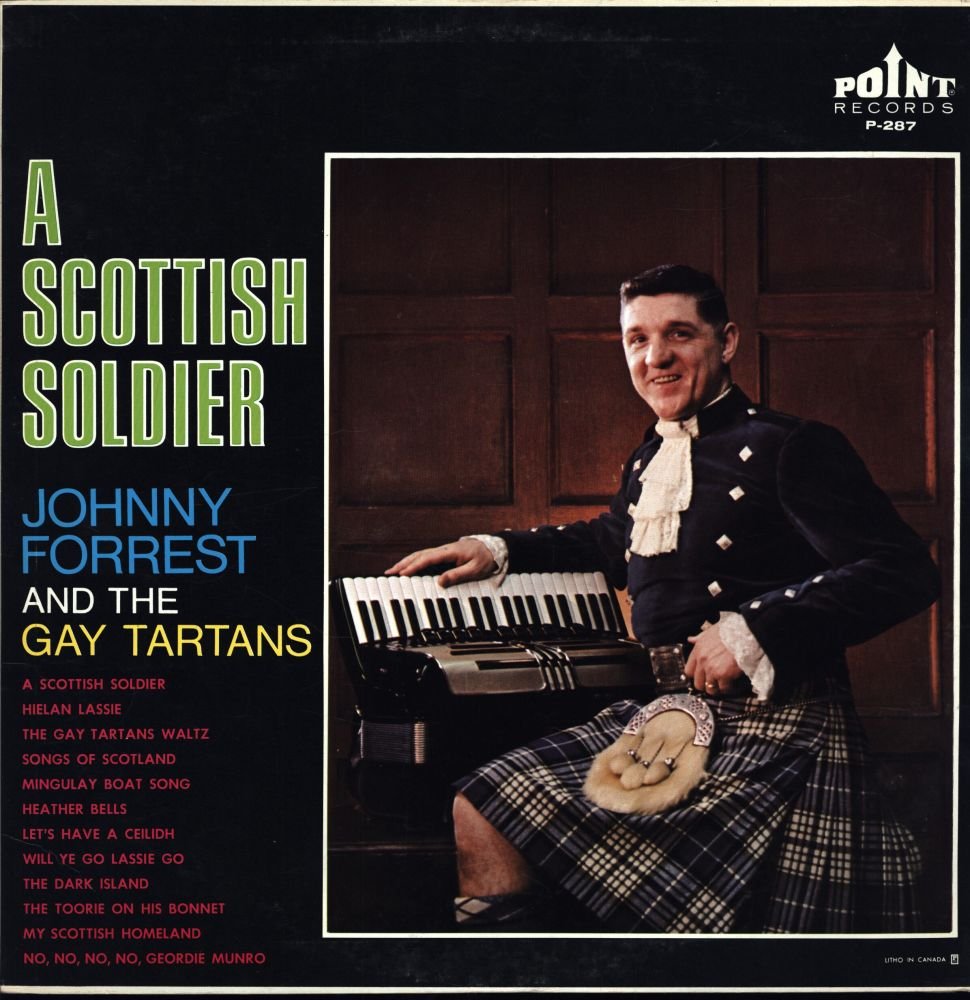
First in the door was the kilt-wearing, ever-smiling accordion player Johnny Forrest. Originally from Carluke, Scotland, Forrest emigrated to Edmonton in 1958 and started playing at the Hootenannies at the Rainbow Ballroom and on CFRN television. He was then given an impromptu audition for Don Messer when he came to Edmonton, and subsequently made numerous guest appearances on Messer’s program. In 1965 he was added to the permanent cast of CBC’s Don Messer’s Jubilee. His first album came out that year entitled Don Messer Presents Johnny Forrest, followed by his second The Waggle O’ The Kilt.
The Edmonton Journal profiled him in July 1966:
Johnny figures his two albums on the Point label have sold 15,000 copies to date, and he’ll have another out shortly, A Scottish Soldier. Now Decca wants two albums a year, and that shouldn’t be too hard for a fellow who has a repertoire of 169 songs.
Pleased to be able to record in his adopted hometown, Forrest (along with his band The Gay Tartans) recorded A Scottish Soldier, at Downtown Sound. It consisted of twelve traditional Scottish folksongs. Some of these included “Heilan Lassie”, “Gay Tartans Waltz”, “Heather Bells”, “Will Ye Go Lassie”, “The Toorie on His Bonnet”, and “No, No, No Geordie Munro”.
Shortly after the recording wrapped, Forrest up and moved to Halifax and became a full-time performer on Jubilee.
The studio was first brought to the attention of the North American music industry in Billboard on July 16, 1966:
Belated word from the west is that Downtown Sound Studios in Edmonton opened May 26 “western Canada’s newest and most up-to-date multipurpose recording studio” with plans to move to 4-track this fall. First session done at the studio was Compo’s new Point LP by Johnny Forest “Scottish Soldier” to be released next month.
A note in the July 18th edition of R.P.M.:
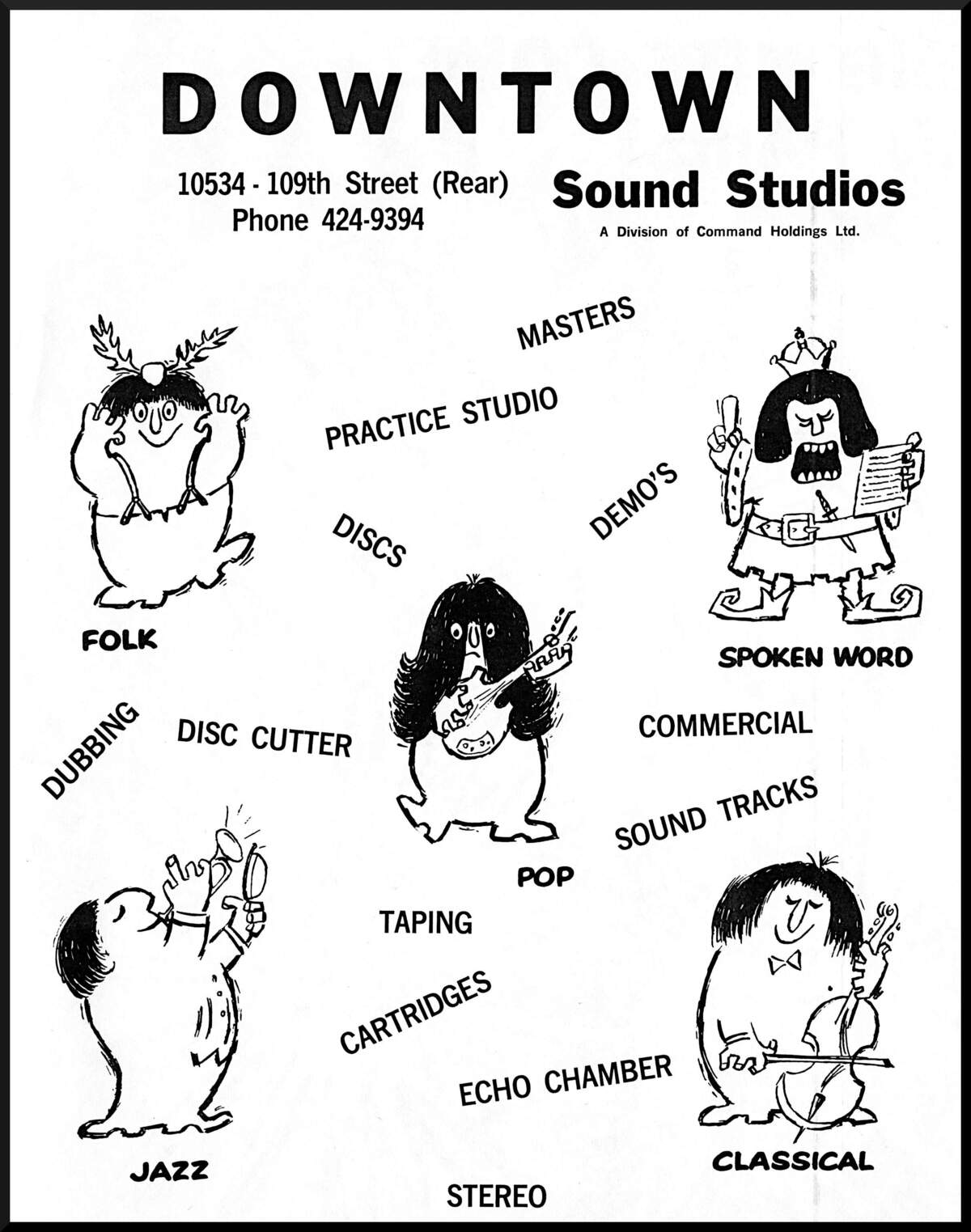
The Downtown Sound Studios have experienced a rash of new business. This studio is equipped with the latest of electronic equipment, complete with a live echo chamber, disk cutter, cartridge duplicators, Ampex tape machines and a custom built control board..
Their various services offered: taping, dubbing, commercials, soundtracks, practice studio, and disc cutting.
In most cities, the activities of a recording studio would not have merited in-depth reporting. Fortunately Edmonton did have a chronicler of an important period of the city’s music history. This was a youth reporter – Lydia Dotto – who authored a weekly column in the Edmonton Journal entitled “The Scene” at first with writing partner Lori Ball from October 1966 to July 1967, and then solo from July 1967 to September 1968. She was primarily interested in the activities of local musicians, but she frequently wrote about the booking agencies and the recording studio as well.
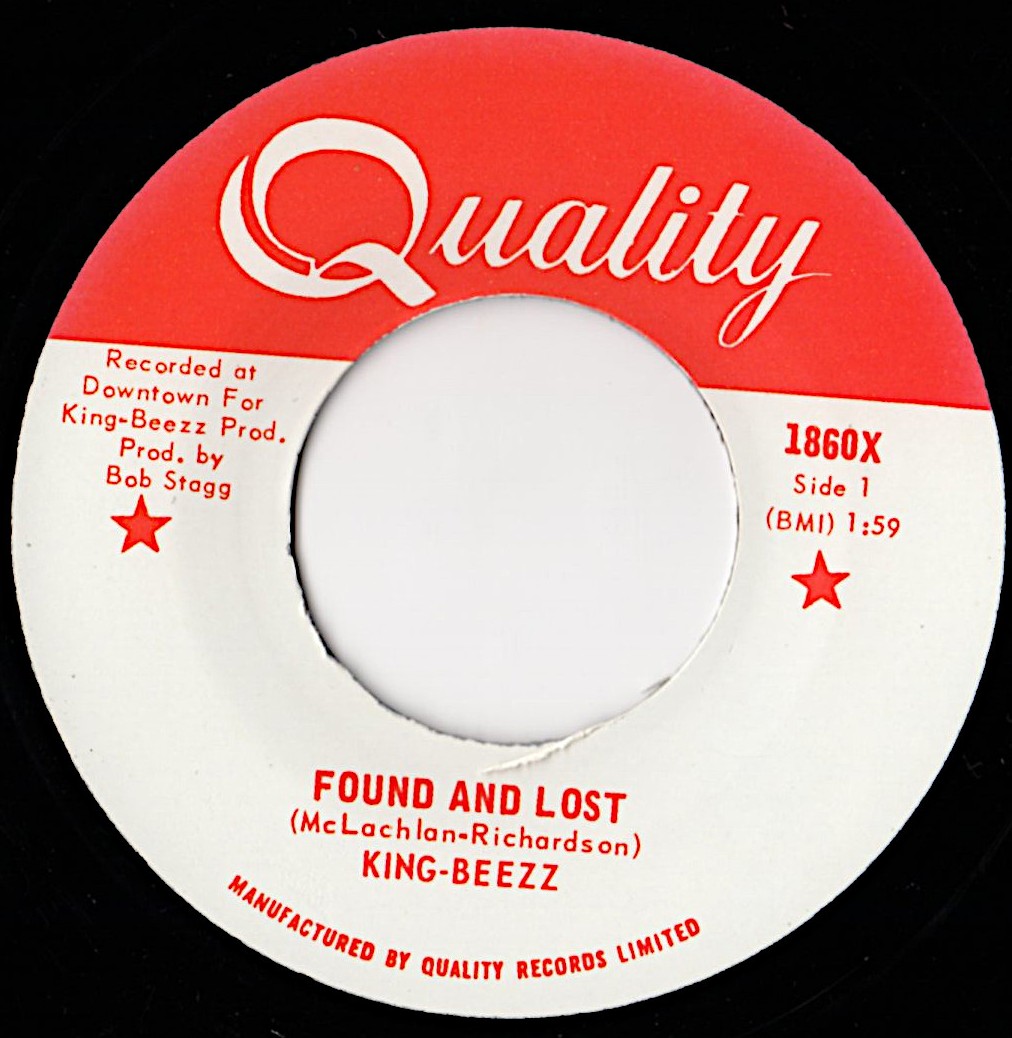
In October, the King Beezz recorded their third single ”Found and Lost” b/w “Now” at the Edmonton studio. Both tunes were written by Ron McLachlan (with Bob Richardson helping on ”Found and Lost”). Dotto teased her teenage readers on October 21, 1966: “Be prepared for something very different from the KING BEEZZ. Their new record, soon to be released, features two tracks unique and quite different from the usual KING BEEZZ style.” Billboard was also eager to see the new offering. In their December 31st issue they announced: “Quality moves into 1967 with three new Canadian talent releases, Peter Simpson’s “More Than I Can Ever Say” on Barry; the King Beezz’ “Found and Lost” on Quality, and “It’s Too Late” by M.G. and the Escorts on Reo.”
Both Beezz songs were solid efforts, and there was considerable interest within the regional market. The Journal reported on February 10th: “The King Beezz’ new record, Found and Lost, now in the Top 40 in just three weeks, has moved ahead much faster than either of their former records. The song, written by King Beezz Ron and Bob, was recorded in Downtown Sound Studios here in Edmonton.”
Dotto then directed her attention to a band that had been around since 1959 – The Nomads. Led by Gary McDonall (trumpet), the group included Wally Petruk (saxophone), Garry White (guitar & organ), Les Vincent (bass), Don Remeika (drums), and Hugh Brockie (guitar). They appeared regularly at Lakeview Pavillion, had recording experience at CJCA, at Norman Petty’s Studio in Clovis, NM, and most recently the RCA Studio in Toronto. They were one of the few bands in terms of showmanship and musical abilities, that could hold its own with Dakus & The Rebels. .
Dotto wrote in the Journal on November 18, 1966: “The new recording by The Nomads was first aired this week. Called CRY BABY, it is a ballad sung by Lenny Richards, and took one hour to record (which is a fantastic accomplishment).” RPM noticed this first single on December 19th:
Damon bows their new label with the release of The Nomad single of “Cry Baby” and “By Myself”. The Nomads are one of the most popular groups on the Edmonton scene and are used extensively on radio commercials.
They saw out 1966 with even better news:
THE NOMAD’S record CRY BABY now nearing the top on the local charts, went on national distribution this week. The song is being played from Winnipeg to Toronto and throughout Alberta, and is starting its way up on national surveys.
Their next two singles – “Dizzy Miss Lizzy” b/w “Walkin’ Mary Home” and “Bittersweet” b/w “Come On Now” used four of their Toronto recordings, All were released on their own label Damon Records.
The next local group to use the studio made the newspaper on April 7, 1967:
The Cat Family have been down at Rayal’s Downtown Sounds Studios this week. They’ve been recording their disc, to be released sometime in May. One side is an old Knickerbocker song, while the other is an original Cat Family composition.
Dotto’s column of June 2, 1967 introduced a new solo voice (although he was already well-known around Edmonton):
And yet another local young man arrives on the record scene. Gary Donnally (formerly of The Nomads) will be releasing a record on the Sounds 67 label in five weeks. Gary, who has been singing for years and years (i.e. a long time) has recorded two originals – SUMMER’S ALMOST GONE (A side) and YOU’VE GOT LOVE.
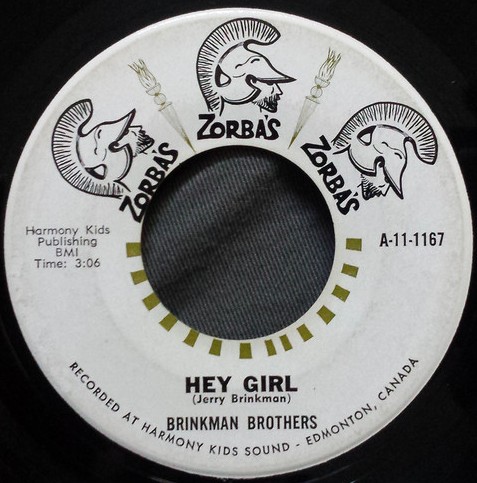
The last band to use the original two-track equipment was the Brinkman Brothers. The Brothers were an international anomaly. Consisting of Jerry Brinkman (bass), Jos Brinkman (guitar), Harry Brinkman (drums) and Ken Hillaby (keyboards), they had formed in 1962 as The Black Rockets in their home town of Gemert, Netherlands. In 1965 they made extended tours of Germany and Spain, then spent a bit of time in the Dutch colony of Indonesia. They emigrated to Edmonton in the spring of 1967 and quickly became part of the teen dance circuit. Although they played the hits of the day, the band were a bit different with touches of jazz and Broadway musical, as well as the inclusion of their own original songs in the repertoire.
The Brinkmans played a number of very popular gigs at Edmonton’s Zorba’s Club, and as a result secured a prime seasonal booking in their Jasper location as well. They so impressed the owner that he actually established a record label for the release of their recordings. The Journal gave them some good publicity on September 12, 1967:
Peter Mateos checked in from Jasper with the word that the Zorbas operation there will be in business right through the winter with food, dancing and entertainment. Included in the winter-long program will be the Brinkman Brothers, whose increasing popularity has just resulted in a record release, Maria – on the Zorba’s label, of course.
The band had recorded two songs: “Hey Girl” by Jerry Brinkman b/w “Maria” – a song from the production West Side Story composed by Leonard Bernstein and Stephen Sondheim. The single was released in November 1967 on the Zorba’s label, and by that time the studio had changed its name. The label on their 45 rpm proudly proclaimed the tunes had been recorded at Harmony Kids Sound. Columnist Barry Westgate was not particularly impressed: “Maria is the focal tune, but this local taping is all instruments and hardly any voices. It doesn’t at all do justice.”
Downtown Sound Studios was used extensively over the summer and fall of 1967, but it became obvious that a more sophisticated set up was required. However Short/Schwartz and Johnson were not able to do it by themselves and so decided to partner with Harmony Kids. Johnson and Don Barabash were family friends. Their fathers were contemporary big band musicians and good friends (Roy Barabash was a pallbearer at Joe Johnson’s funeral). Downtown Studios already had the premises – Harmony Kids had the funds for more advanced recording equipment and the much-needed assortment of instruments. It seemed like an ideal partnership, but the two parties had different visions from the beginning. Barabash – understandably – insisted on managing the studio and calling it the Harmony Kids Studio. Short/Schwartz and Johnson – equally justified – wanted to keep managing the operation and retain the name Downtown Sound Studio. For a while then it appeared that the one studio had two names and several people calling the shots. In mid-September the Edmonton Journal reported that:
Ray Short and Al Johnson with The Harmony Kids are planning to erect (or rather resurrect) plans for a four-track recording studio. The booking agency will be expanded but Ray and Al plan to leave the booking end and get into national recording and record distribution business.
Short/Schwartz and Johnson concentrated on the studio for the time being, lining up bands to record. Harmony Kids equipped the studio “with instruments so a group can use equipment to record that they might not ordinarily use or be able to buy.” To give their “side” more weight, Short/Schwartz and Johnson decided to bring into the studio the biggest star they knew. With his knowledge of engineering and production, Wes Dakus was welcomed into the recording side of the company and appointed studio manager in the summer 1967.
Dakus’ interest in recording came almost as an accident. According to one profile:
When Wes went into the clothing business with Jim Hand, a DJ for Edmonton radio station CJCA, Jim recommended the group try out the stations new recording facility with engineer Andre Picard…. the group would record at the station, and the station in turn would promote their recordings heavily. CJCA was at 930 on the AM dial, so their teen club show was titled Club 93, which The Rebels became the sponsored house band for. They suitably changed their name temporarily to the Club 93 Rebels. CJCA was affiliated through company structure with the Quality Records label of Canada, and the CJCA station manager was instrumental in getting their recordings released by the label.
For five straight years Dakus and the Rebels were on the road – mostly by themselves – but also opening for other more famous bands such as Buddy Knox, Dick & Dee Dee, Texan Terry Stafford (promoting his Top Ten hit “Suspicion”) and Donnie Brooks (the rockabilly artist who sang “Mission Bell”). One act in particular noticed how good they were:
When they were booked in late 1963 through George Nellis, an agent in Saskatchewan who was also routing The Fireballs through Canada for a tour, Nellis put Wes Dakus and The Rebels on a number of shows along with The Fireballs. Lead guitarist for The Fireballs, George Tomsco, recommended that Wes get in touch with Norman Petty in Clovis, New Mexico, where The Fireballs had recorded all of their tracks. George advised that Norman would be a good producer for The Rebels and had some strong industry ties.
Dakus did more than get in touch with Petty:
In April of 1964, Wes and the band drove to Clovis, to meet Norman Petty. Norman was impressed with the group, and wanted to work more with them, and signed on as their exclusive representative and advisor, initially for a 5 year period. The contract guaranteed that Norman would get them an offer from a major recording company within 12 months or they could terminate the agreement.
Petty was as good as his word. His experience and connections immediately paid off with US labels United Artists, UNI and Kapp signing distribution contracts for many of The Rebel’s next 45 releases. It was to be a connection that would change Dakus’ life and the lives of many other Edmonton musicians.
Noting their popularity in the United States, Capitol Records in Canada signed the band in January 1965, and shortly thereafter Dakus and Allen became Edmonton’s first recording artists with a national reputation. Billboard’s Canadian editor reported on their recording activities in its 16 January issue:
Upcoming disks by Wes Dakus and Barry Allen will be released on the Capitol label here, following a switch from Quality Records. Both artists are from Edmonton and record in Clovis N.M. under the aegis of Norman Petty. Dakus’ first single “Pedro’s Pad” was released in the U.S. on United Artists, and his second disk “Las Vegas Scene” is making the radio station charts across Canada. Allen, who plays guitar in Dakus’ instrumental group, also sings and his own record “Over My Shoulder” is doing nicely here and was released by Dot in the U. S.
Over the next twenty months Capitol Records released “Hobo” b/w “Rolling Back” and “Easy Come Easy Go” respectively. Dakus and the Rebels churned out the hits “Hoochi Coochi Coo”b/w “Feel Good”, “She Ain’t No Angel” b/w “Snooper”, “Come on Down” b/w “Honeybun”, and “We’ve Got a Groovy Thing Goin’” b/w/ “Bach’s Back”, “Midnight Hair” b/w “Mama’s Boy.” Allen responded with “It’s Alright With Me Now”, “Lovedrops,” and “Armful of Teddy Bears.” Drummer Stu Mitchell was also signed to Capitol as a solo act, and he released “Say I Am”, “Wildcat” and “Drumfolk.”
Dakus and Allen also became Edmonton’s first rock album acts in late 1965. A series of sessions at Petty’s studio resulted in two LPs. Dakus and the Rebels released The Wes Dakus Album in October which included other gems like “Rattlesnake”, “Nightwalk” and “Do Wah Diddy Diddy.” Allen stepped up with Going Places. Both were released in the United States as well – The Rebels on the Swan label and Allen on Dot. Dakus was involved in all the negotiations, and realized how important it was to know how the business side of the industry could be worked to his advantage.
Dakus could easily discern that the Petty-produced singles sounded so much better than the band’s early CJCA recorded singles. Under Petty’s tutelage, he learned how vocal and instrumental performances could be balanced, mixed and layered, and how better sound was directly related to better recording equipment. He convinced Short/Schwartz and Johnson and Barabash that the equipment being used was not professional enough, and that an upgrade was essential.
On October 20, 1967 the community was informed that:
The electronic gizmoes are all here. All it needs now is to hook it all up and presto – Edmonton’s first and only four track studio is born. To do this thing with style, the organizers are flying Norman Petty from New Mexico to put the place in operation and produce a few sessions.
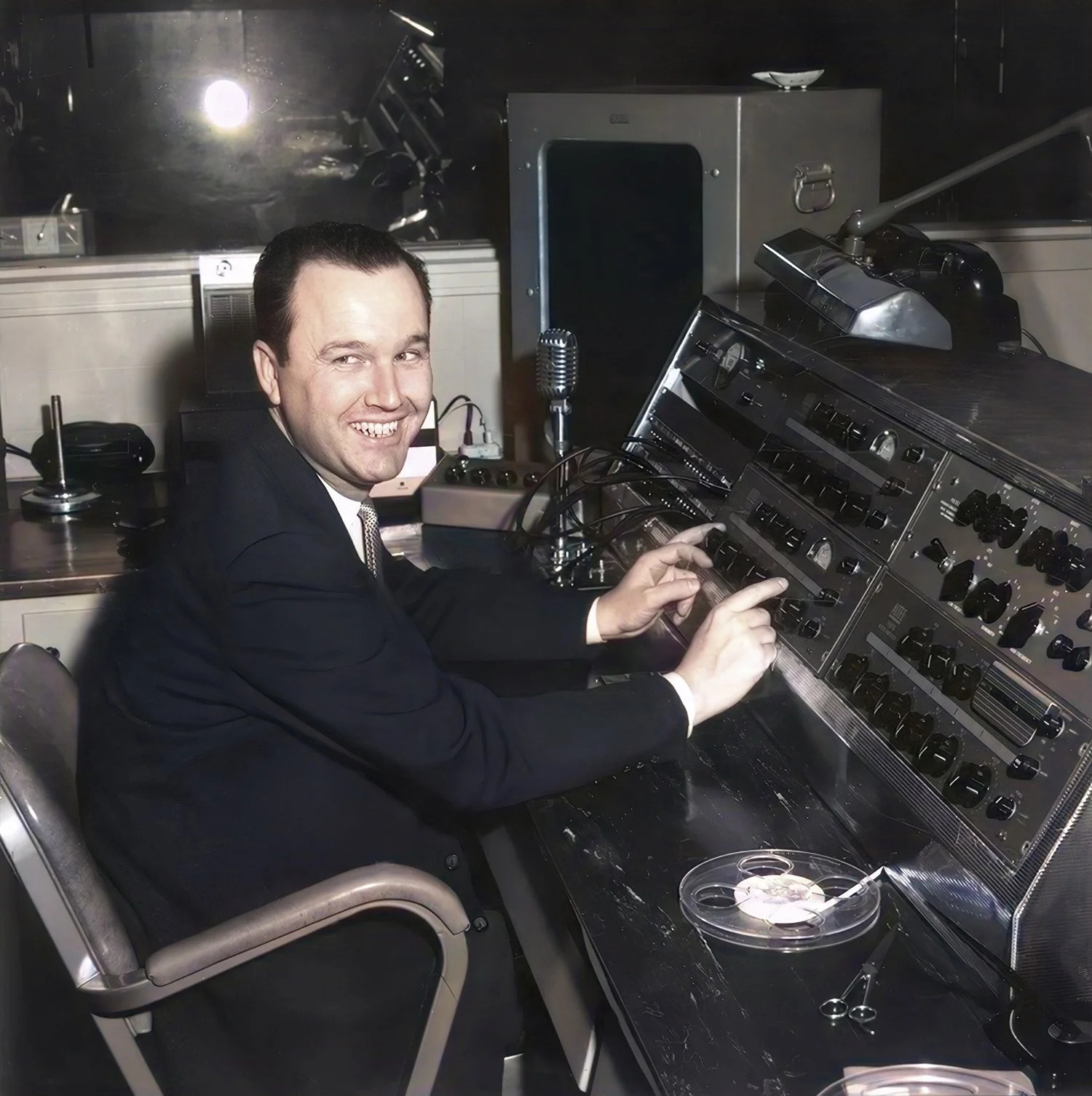
If one wanted a successful, respected, celebrity record producer to launch the new look studio in the year 1967 and put Edmonton on the recording map, no one could have been more ideal than Norman Petty. This Dakus connection was clearly golden. Even before he arrived, the studio was eager to get going:
Wes Dakus, who is managing the place, says they’ll be ready to move in for some preliminary work by the end of the week. He also said that one of the first out-of-town groups scheduled in the studio is the Gettysburg [sic.] Address. Groups from all over the west are coming too…Harmony Kids are equipping the studio with instruments, so a group can use equipment to record that they might not ordinarily use or be able to buy.
Petty arrived in Edmonton the first week of November and gave Short/Schwartz and Dakus a crash course in studio management, electronics, engineering and recording techniques. The Journal reported on November 10th:
Norman Petty was busy all this week, running here n’ there, hooking up all the little wires and what-nots in the new recording studio. It’s a big job alright, but by next week, things should be ready to roll.
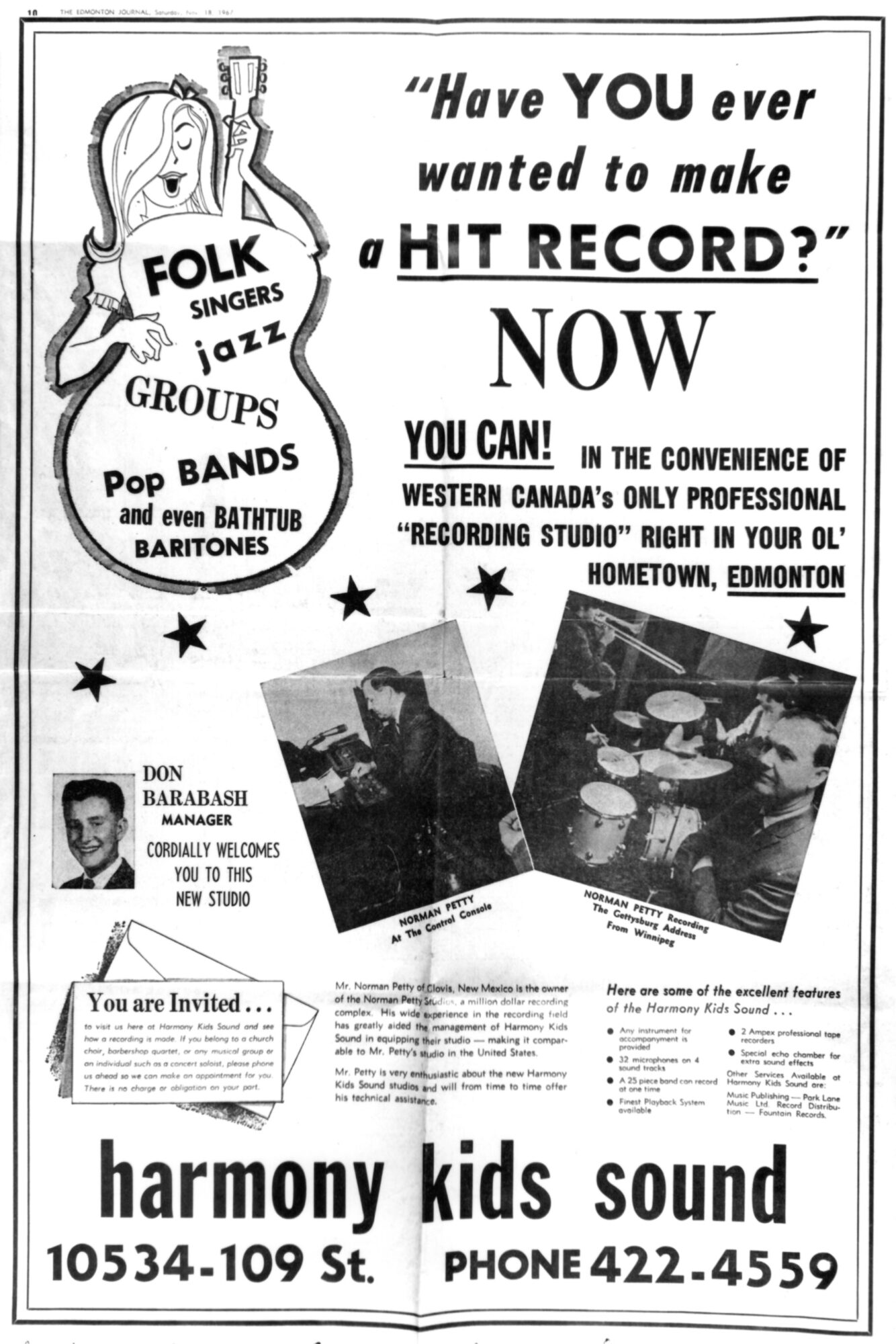
He also sat for several interviews and, by his presence, generated considerable excitement about the studio and the local musical community and managed to give both credibility. The big day finally arrived on November 13, 1967. The Journal announced that the new studio was finally open for business.
The man in the recording booth knew exactly the sound he wanted. “try that note again,” he said into the microphone. The group’s vocalist nodded obediently and began the same few bars. The man giving the directions was Norman Petty, a quietly-spoken American who’s climbed the Top-10 rungs of the record industry.
Over the past six years several Canadian pop groups have travelled more than 2,000 miles to cut discs at his studio in Clovis, N.M. Mr. Petty, 40, who penned the lyrics for most of the Buddy Holly hits, was in Edmonton. He had come to set up a new recording studio opened by Harmony Kids Inc.…..Monday he was seated behind the controls of the $75,000 studio listening to the Gettysbyrg Address, a group from Winnipeg. Said Mr. Petty; “I have never heard so many good groups in one town… A lot of local groups have been down to my studio in Clovis to record but now they will be able to do the same thing in Edmonton….I advised on the equipment and came up to get the place in operation. I really believe this will give the local groups a real opportunity…”
There was also a brief comment from “studio manager” Don Barabash:
It will cost about $150 a side to record here and I am sure the studio will start paying for itself very quickly
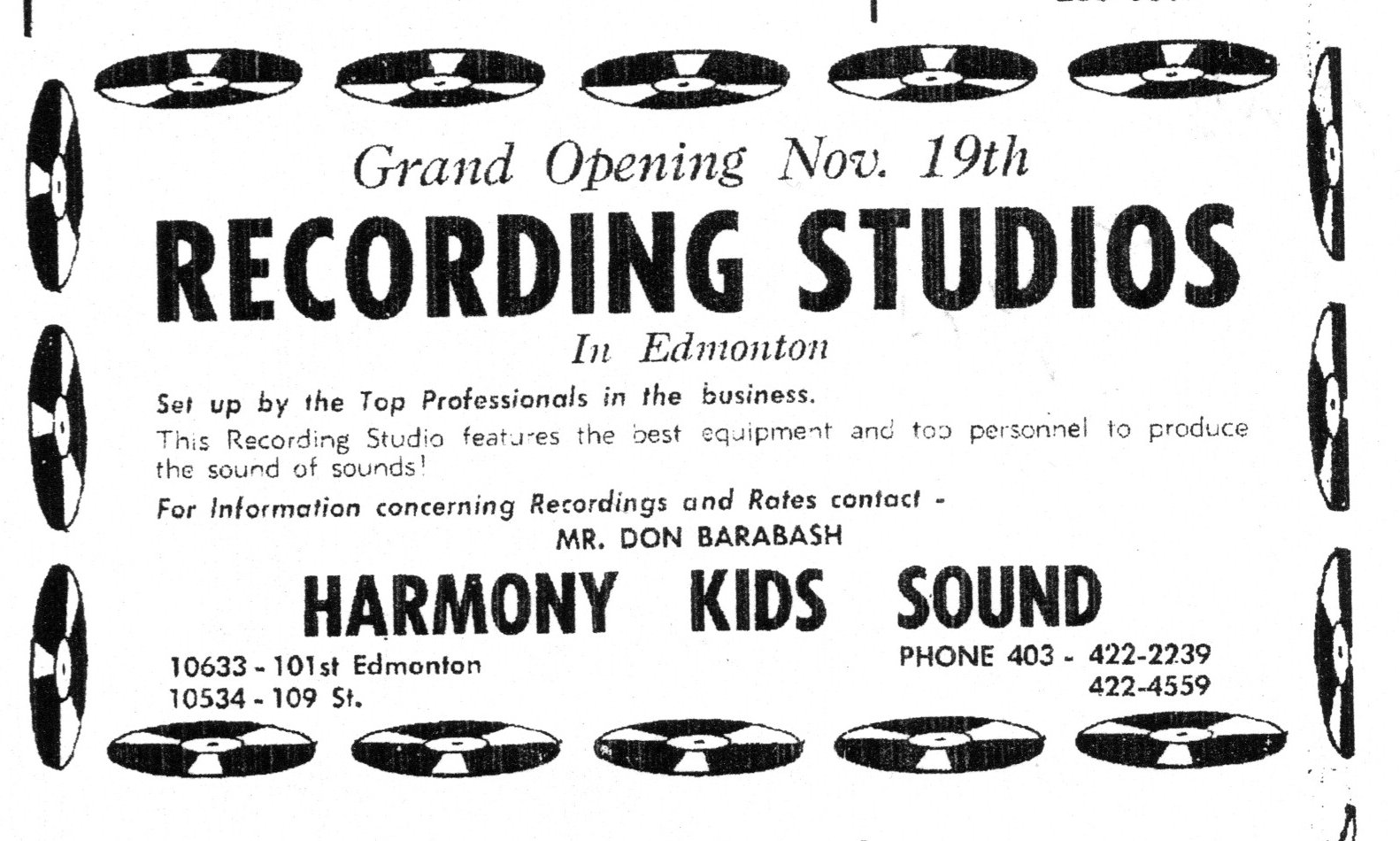
Harmony Kids took out a full-page advertisement in the Edmonton Journal on November 18 to highlight Pettys visit and to encourage local acts to try the studio. By the third week of November the Journal excitedly announced that:
The Gettysburg Address had a workout in the new Harmony Kids’ recording studio this week. They finished cutting four sides Tuesday morning, with members of The Lords and The Nomads helping out as studio men. Norman Petty, who was in town to wire the studio, left Wednesday morning, after spending over a week here.

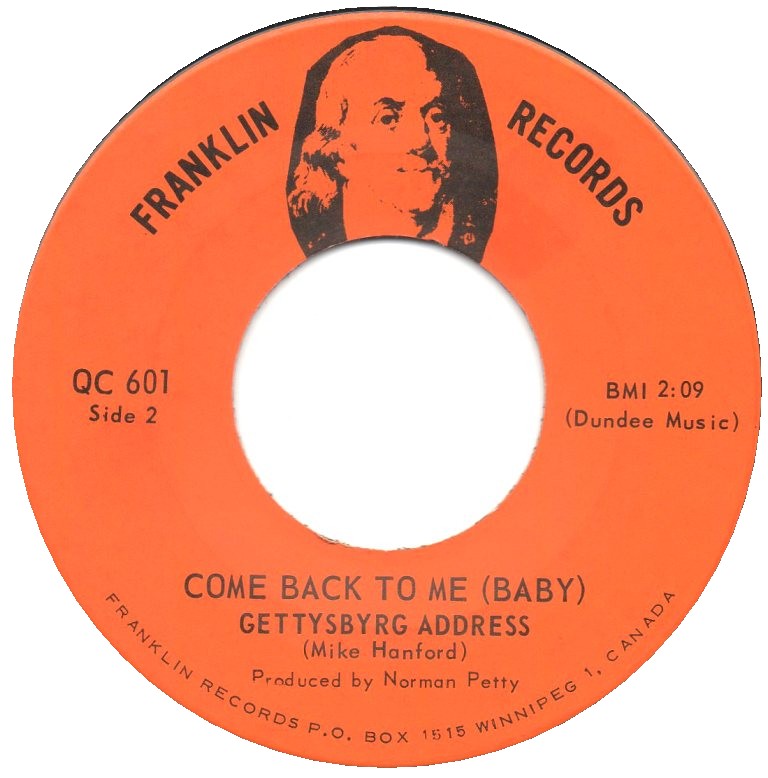
The Gettysbyrg Address (Version #1) was a recently formed band consisting of Mike Hanford (vocals, keyboards), Kurt Winter (guitar), Orest Andrews (guitar), Bill Wallace (bass, trombone), and Craig Hamblin (drums). They were signed to Franklin Records, based in Winnipeg and owned by Frank Weiner, the founder of the Hungry I Agency. It appears only two of their four Edmonton recordings were released: “Come Back To Me Baby” and “You’ve Got To Let Me Know”, both written by Hanford. The 45 rpm was released in January 1968. The local session musicians alluded to were Stu Mitchell of The Rebels on vibes, and Wayne Kozak of The Lords on saxophone.
Shortly after it opened, Harmony Kids Sound organized a studio band of crack musicians for sessions. It was not a totally new idea – a number of U.S. studios had done that in the early 1960s – The Funk Brothers at Motown Studios in Detroit, and Booker T. & The MGs at Stax Studio in Memphis. The Edmonton version consisted of Dennis Ferbey, Archie Southern, Ron Abbott, Brad Carlson and Barry Allen. They originally had no name or were sometimes called The Harmony Kids Band. However once they started to gell as a group, they adopted the name Purple Haze and not only backed other performers, but recorded a number of tunes on their own.
Following the relative success of their three singles and delighted with the arrival of 4 track recording in Edmonton, The Nomads decided to put out an album. The six songs from their 45 rpms formed the nucleus, but they needed to record more of their in-concert favourites to fill out the LP. Dotto informed her readers on November 24th:
Meanwhile, back at recordings, The Nomads have had the deadline for their album extended to Dec. 10 and they’re moving into Harmony Kids studio sometime next week to work on it… The master tape of yet another soon-to- be Edmonton release was made this week. Jack Henning, now lead singer for The Breaking Point, told me their song’s name is I Made A Wish. The five member group writes all its own material.
They recorded a number of sides – “Stagger Lee”, “The Letter”, “Hey Joe”, and “Shake and Finger Pop”. Dotto reported on December 1st 1967:
The Nomads were at the recording studio Tuesday, polishing off the last six tracks for their album, having finished the first six some time ago. One of these will end up as their next single release. The Breaking Point have decided to cut and release a song called Busy People before they do I Made a Wish. Sunday will see themselves in the studio
Breaking Point was comprised of Jack Henning (vocals), Murry Doyle (guitar), Terry Yaterman (drums), Ted Smith (bass), and Willie Verhagen (keyboards). Their single: “The Busy People” b/w “Maybe Tomorrow” was released late in 1967 on Cupid Records.
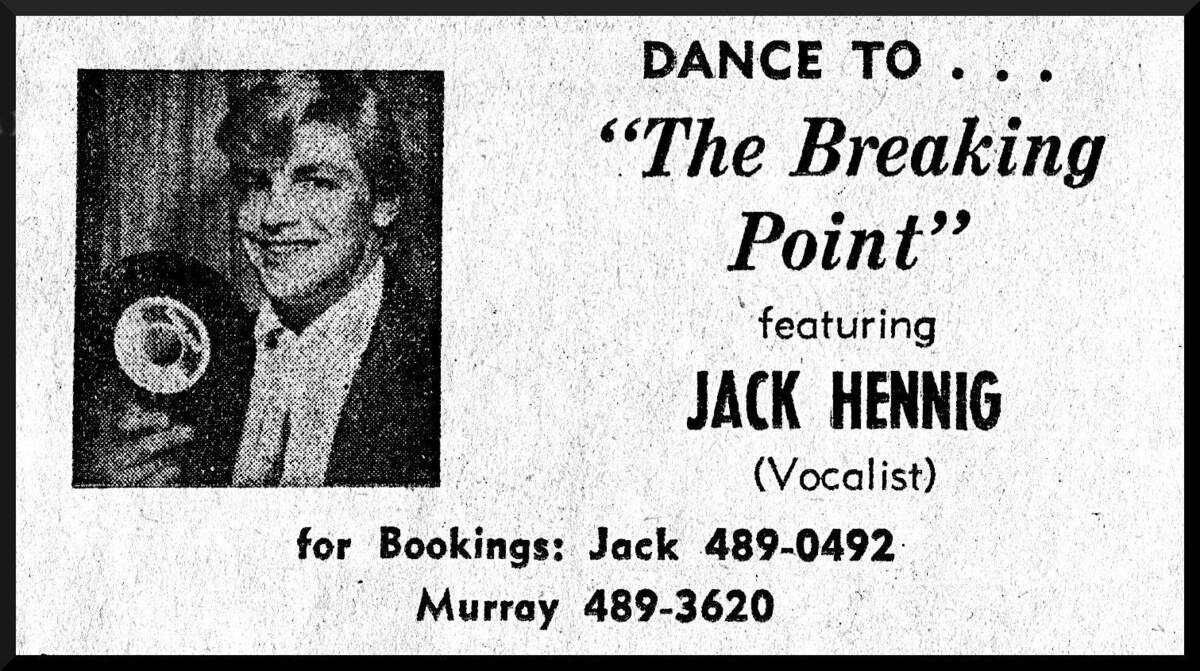
Lydia Dotto was excited about all the studio activity and wrote on December 5th:
In the studio last week, The Southbound Freeway and The Nomads and other sundry groups. The same is happening this week, which explains why poor Don Barabash of Harmony Kids is a busy, busy, tired, tired kind of person these days. There’s a Nomads album out around Christmas and the much awaited Walkers album in the New Year. Whole heaps of local singles will flood the market shortly, so watch out for them…then run!
By mid-December the album was unfortunately still not ready. According to Dotto:
The deadline for the Nomads album has been set back yet again. They [are] having trouble with the master tape because (quoth Gary McDonnell) “there are no full track heads here” (unquoth) Ask him. Anyway, this means the album should be out in February, would you believe? The group is going to release two tracks from the album on a single, the likely candidate being their own version of Hey Joe. Both the album and the single go into national distribution on Damon Records. Compo, the company that presses Damon Records has also asked the Nomads to record a “middle-of-the-road” album.
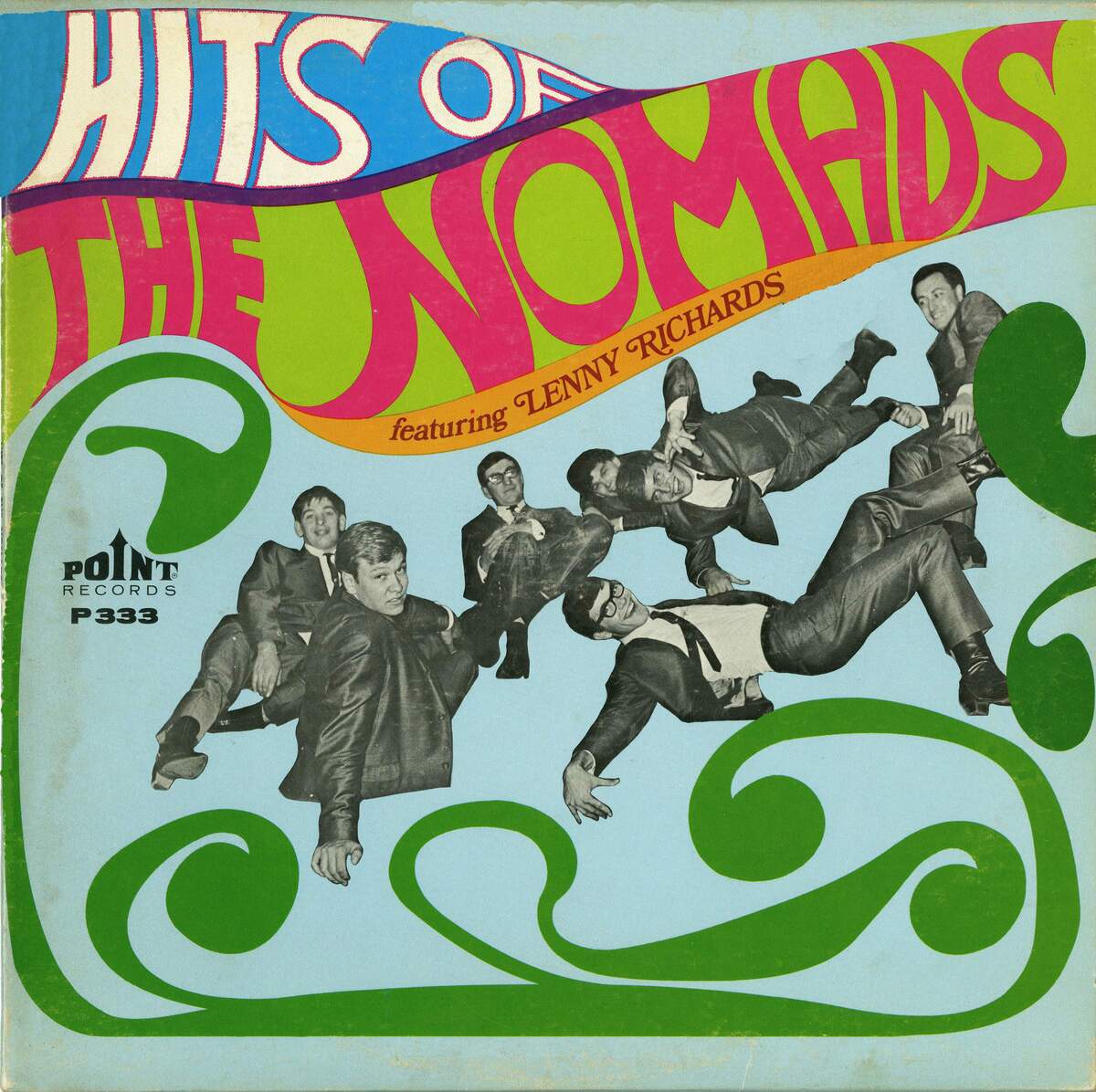
And on December 22nd she wrote:
I finally ran Don Barabash to ground this week and got the latest on what’s happening in the recording studio. Very elusive these recording people. Anyway Jack Henning’s Breaking Point were in there last week and so were the Harmony Kids studio group. I didn’t get the name of the group (It’s a dark secret till they find one) but it has an illustrious roll call. Dennis Ferbey, Archie Southern, Ron Abbott, Barry Allen and Brad Carlson. These musicians are available as back up men for people recording in the studio although they have been cutting their own material too. This coming week sees the Graeme Waifer and The Fendermen in the studio. I received many subtle and not-so- subtle hints about how great the latter group is, and how one really ought to have caught their act at Zorba’s. No doubt. I believe it all. I’m hoping to sit in on their recording session and see what they are like in the studio.
The studio’s reputation spread widely. The Gettysbyrg Address was obviously impressed with their studio experience, for the Winnipeg Free Press reported on 16 December 1967 that “many local record hopefuls are turning attention to Harmony Kids’ new recording studio in Edmonton. Praises of it being the best of its kind in Canada are being sung far and near by many who should know.”
The New Year 1968 started with a wonderfully full story by Dotto of a recording session by Edmonton’s newest band The Daisy Hill Puppy Farm.
Never again will I take the little black discs I put on my record player for granted. Even the most intrepid pop music fan today, I would venture to say, is largely ignorant of the fantastic amount of work that goes into making a record. The detail involved is staggering, as I found much to my amazement last week.
The group recording was the Daisy Hill Puppy Farm (an interesting, if not entirely original name). These five musicians were brought together by Ray Short as a studio group (the only one in Edmonton) but they may be doing live shows later on. All members of the group (Mary Saxton, Bob Ego, Mo Boyer, Dermond Murray and Mavis McCauley) are veterans of the local pop scene. They were recording one of Mavis’ compositions called “Countin’ Cracks” the evening I was there.
She briefly described the atmosphere:
Resident genius Don Barabash was in the studio that evening, messing around…with various wires ‘n’ things. The studio is an interesting place – small, a bit messy with cords, wires and electronic whatsis all over, and very expensive looking.
She continued:
Over three hours of grueling work and re-work went into that session, and that’s just the start. They began by putting on the basic instrumental track – bass, lead guitar, drums and piano. Three takes and then onto the second track went the lead (Mavis) and back-up (Mo and Mary) vocals. A few minor hitches here and then it was done.
Track three had Mavis putting in extra organ parts, Derm in sitar, and Mary and Mo adding an extra back-up vocal. Then into the final stretch; Mavis on clarinet and re-singing lead vocal. Synchronization problems here – Mavis had to sing right on top of her other lead track and that’s not always the easiest job, if you want perfect unison.
She mentioned the engineer:
Ray Short, at the panel in the control room, mixed the sounds, loud on some, low on others; that sort of thing. After each track, the whole gang trooped into the control room to listen to the sound, hash it over, decide what should have been done and what shouldn’t have been done and was. Then back to the session room for another try.
And at one a.m. there were nine tired people cramped into the tiny control room, draped over the chairs and counters, listening to the still-to-be-finished song. The four tracks were filled, but there was much more to do – the sounds had to be balanced, certain ones to be raised and others lowered – a whole range of different technical gambits to be attended to. So, if and when you get hold of Countin’ Cracks by the Daisy Hill Puppy Farm, listen to it very closely, and think about all this.
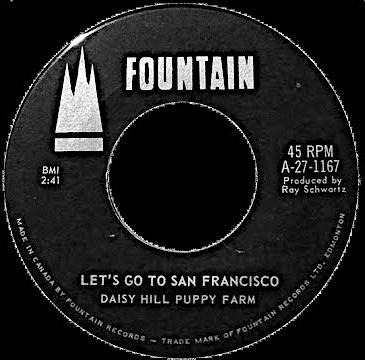
No doubt this article made some Edmonton teens consider just how technically sophisticated the music they were listening to was. The experience certainly paved the musical road ahead for drummer Bob Ego who would go on to greater renown with the bands Witness Inc., Painter and Streetheart. He clearly remembers:
I recall Ray Short as a professional and focused engineer / producer. I was very young and totally inexperienced in the recording studio, and he knew that, but he had a lot of patience. He was always sympathetic towards everyone when explaining what he was looking for in the music. When I recorded there…with Daisy Hill Puppy Farm I had my beautiful grey swirl Camco drum set. Camco drums are still one of my favorite drum sets to this day. Ray had me set up my drums approximately 6-feet from the control room window using about 3-microphones on the drums. We recorded wide open. There were no isolation booths used at all. I recollect us recording the songs in about five takes. I was so fortunate to have had the opportunity to work with Ray along with Daisy Hill Puppy Farm. It truly opened up another door to my musical career.
The buzz surrounding the studio was starting to be heard across Canada. Capitol Records Canada had signed several Edmonton bands, and head of A&R Paul White wanted to see for himself why the city had such a happening scene. Billboard reported in early January: “Paul White heads west mid-month visiting Capitol artists Barry Allen, Wes Dakus and Willie and the Walkers in Edmonton, touring the city’s new studio, and scouting new talent.”
The Nomads finally released their album entitled Hits of the Nomads on January 5th, 1968 on Point Records. R.P.M. were very supportive:
Several of the cuts are original. Exceptional cuts are “Bittersweet” which was written by Gary McDonal, leader of the group, but performed by Lennie Richards: “Walkin’ Mary Home” also written by McDonal and performed by him with an assist from bass player Les Vincent, is another well put together cut. An original by Lennie Richards “By Myself” is also done up in fine style.
This also called for another 45 rpm release – this time from the Edmonton-recorded material: “Hey Joe” b/w “The Letter” was released in January as well. The third week of January had a combination of good news and bad news for Nomad fans:
The Nomads have disbanded as a stage group. They intend to continue recording but they don’t want to do any more live shows because they’re “not enjoying it.”… they recently cut some tracks of an album in the local recording studio, and I listened to the tapes last week. They sound good…
For reasons not fully understood, there was a three-way shakeup at the end of January 1968. Al Johnson amicably dropped out of the Rayal partnership to take up full time managerial duties with The Lords (now renamed Privilege). He still remained a director of Command Holdings Ltd. until it was struck off the corporate registry (and thus dissolved) in December 1971. And he remained the owner and manager of Lakeview Pavillion for several more years.
Short/Schwartz had known several months before that Johnson was leaving, and he also realized that Command Holdings was too restrictive for all the things he wanted to do. Thus on November 21, 1967, he incorporated a new company entitled Park Lane Music Company Ltd. Its Memorandum of Association showed that indeed this new entity was more ambitious and wide-ranging than its predecessor. It had nineteen objectives, again many dealing with investment and managing properties, but there were many with a more pronounced focus on advertising, both for radio and television.
And the clauses relating to the core duties – audio production – were explicitly spelled out:
3a: To purchase, sell, lease, barter, own, rent, and otherwise deal in all and any auditory, visual and/or audio-visual matter including magnetic recording tapes, records, and recording discs of every nature and kind whatsoever, electrical transcriptions, movie sound-on-film, commercial photographs, advertising copies, commercial art, and such other articles as are necessary or incidental to the said business…
3c: To provide, employ and manage artists, actors, dancers, producers, writers, publishers, musicians, singers, acrobats, variety performers, concert performers, athletes, dance bands, and orchestras of every nature and kind whatsoever and all other entertainers and performers of every nature and kind.
3g: To purchase, sell, lease, barter, own and rent or otherwise acquire and deal in and with electrical transcriptions
3h: To make, buy, lease, hire, rent, own and sell or otherwise acquire and deal in musical instruments of any and all kinds and the rights to musical compositions of any and all kinds.
And the lengthy clause 3i:
In connection with the business of the Company:
1. To apply for, obtain, register, purchase, lease or license on royalty or otherwise acquire and hold, use, own, introduce and sell, assign, lease or license on royalty or otherwise musical, theatrical or other work capable of being copyrighted
2. To contract with persons, firms and/or corporations to furnish music, records, disc recordings, electrical transcriptions, concerts, singing, drama and the like as a medium of advertising or otherwise
3. To employ artists, speakers, musicians, writers and composers and to give prizes and wards
4. To secure, produce, create, sell, lease market or dispose of records, disc recordings, electrical transcriptions, pictures and photoplays and any and all rights and interests thereto…
5. To prepare, publish, and sell or otherwise dispose of booklets, periodicals, or other reading material relative to records, disc recordings, electrical transcriptions and like commodities
The starting capital of Park Lane Music was $20,000, divided into 1,000 Class “A” voting shares, and 19,000 Class “B” non-voting shares. The two directors were Ray and his father Sol Schwartz, who was also appointed treasurer.
There were obviously too many cooks in the studio kitchen, and having two names for the studio and two managers had become unworkable. At this point Short/Schwartz and the Harmony Kids Store had a falling out, with the store abruptly ending their involvement in the studio. The full reasons are not known.Short/Schwartz took it all in stride according to the Journal:
Short owns the building that presently houses the studio while Harmony Kids owns all the equipment. In the interview, Short said that, due to a disagreement over fees and allotment of time in the studio, Harmony Kids will be moving their equipment elsewhere. In its place, he said he was bringing in an eight track system of his own, and was, in fact, flying down to Los Angeles this week to pick up some of this gear.
A new name was obviously needed:
Short says the new studio will be called Parkland [sic – actually it was Park Lane] Recording, and will be able to offer many benefits to bands recording there. To begin with Paul White of Capitol Records was down this week, and Ray arranged national distribution of the local label, Fountain Records with him. The national distribution will give his recording studio impetus. Secondly all bands that book through Spane International will be entitled to reduced rates. The studio’s rates are to be pegged lower than those presently in operation anyway he said.
Short/Schwartz was already thinking outside the (studio) box to reach for more professional business. It was reported on February 2nd:
Ray Short’s new studio now has about 75 per cent of its equipment, and he hopes to have his grand opening in the middle of February. The studio equipment will have custom built cabinets that will allow it to be moved about in a van for remote recording in such places as the Jubilee auditorium. Short said they will be recording some work by the Edmonton Symphony Orchestra, and that there are tentative commitments to record picture sound tracks for organizations like the National Film board and various travelogue companies.
Finally the new studio – still four track – was operational in the last week of February 1968,
The next band in was the reconstituted King Beezz, who had recently changed their name to The Raga Moods. Dotto reported on February 16 (1968)
They have big plans for recording of course. As a matter of fact, the group intends to concentrate on recording more than concert or performance dates in the beginning. I’ll be hearing the tapes of their first release shortly – it’s a Small Faces number and – get this – there’s a good chance it’ll be a scoop – even on the Small Faces. More about the song when I hear it. It should be released in Canada within a month, and they hope it will lead to an American label signing them to contract as well as to a release of the record in England.
The song was “Talk To You” (by Steve Marriott & Ronnie Lane) and, even though the song was a scoop and their performance tight and enjoyable, unfortunately no label saw fit to sign the band.
Harmony Kids were not out of the picture though. They were intending to use its equipment to set up their own studio. According to the Journal:
Now comes the confusion. For the other end of the story, I consulted Don Barabash of Harmony Kids. He says that they are moving their studio within six months to a bigger location because they need “bigger and better facilities.” He said that the choice of the present location had been a temporary one right from the beginning. From what he says, the present four-track system is going to be greatly expanded.
Although the thought of a second competing studio appealed to many Edmonton artists, the Harmony Kids studio never really got off the ground. Barabash reconstituted Harmony Kids Sound at 14340 – 98 Avenue. They continued to record some local artists, but most bands continued to patronize Park Lane. Harmony Kids would get out of the recording business altogether in 1969, selling out to A.V. Bourcier who renamed the establishment San Vital Recording Studio.
On March 8, 1968 Dotto wrote:
Ray Short’s recording studio is going full blast. The Raga Moods were in there this week, doing some new material, and Ray says the bookings are increasing each week….
And in her March 15th column she introduced some new names into the recording community:
The Brinkman Brothers recorded SOMEDAY I’LL FIND HER here two weeks ago, and the United Aarab Republik are in the studio this week. Ray Short also has plans to record Mary Saxton, Roslyn Harper (who is now singing at Ciro’s), and Mavis McCauley. Bob McCord will be recording NOTHING BUT A WORD next week.
McCord was a disk jockey for CHED and a celebrity about town. He hosted a daily show on radio, did impressions and “funny voices”, invented an on-air alter ego named Pierre LaPuck, and also wrote and performed one-off specials such as CHED’s For Your Ears Only, which spoofed the James Bond phenomena in 1965. He hosted platter parties at high schools and community centres, and he was a much-used emcee for rock concerts (St. Valentines Day Massacre, Dino, Desi & Billy, Roy Head, Johnny Rivers, Harpers Bizarre, The Turtles). He also considered himself a musical artist as well. In 1964 when he was at CKLC (Kingston), he recorded a single with his band The Vibrations “I Missed My Year” on Star Records. It sold well in Kingston and Belleville, but nowhere else.
His relationship with Park Lane started in February of 1968 when he directed the recording of the introductory music to his radio program. He then was asked to be one of the judges in the Park Lane song-writing contest, and offered to record the winning songs by himself. It was a good publicity stunt. Lydia Dotto sat in one one of his sessions in April:
BOB McCORD’S recording session last week was very interesting. Not too much got done, but there sure were a lot of laughs. He’s going to have another go at it sometime soon. He will also be recording a comedy number he wrote himself.
In March Jack Henning returned for another session:
JACK HENNING and THE BREAKING POINT will be recording in the studio this week. Also the studio group will be doing an instrumental. Al Girrard has taken over the drums from Bob Ego, who stepped down due to conflicts with school work…Ray Short expects THE YOUNG ONES and THE FAMILY DOGS in the studio this week.
In April more new acts dropped in:
The recording studio has been busy as usual this past week. THE PURPLE HAZE will be recording in there soon. They already have one single on the way. THE YOUNG ONES will also be in there this week, and WALLY CURTIS and THE SHADE REVUE are scheduled a few weeks hence. A group from up north – THE TAIL ENDS – will also be recording.
Short/Schwartz was interviewed at greater length by Dotto for that same date. He first announced that the studio was being upgraded yet again:
He added that more equipment has arrived – a full track and an EMT plate (for echoing) for all you recording buffs – and that he’s waiting for more equalizers. This will enable him to have more record mastering done here but they’ll still be doing some at Capitol (in Hollywood) because they still have more equipment.
Then he proudly explained that his many conversations with potential record distributors had finally paid off: “Ray Short informed me that Parklane Music now has all the contracts signed with Capitol Records for national distribution of records produced by the local studio.”
Later that month Dotto related:
In the studio this week: THE PRIVILEGE, THE PURPLE HAZE, and possibly THE SOUTHBOUND FREEWAY. THE YOUNG ONES will be doing the vocal tracks for the tapes they cut last week. Also a new group in town, THE BROADWAY EXPRESS, plan to do some recording….The master tapes for MARY SAXTON’S latest song and for the instrumental thing…done by the studio group arrived back in town this week. Negotiations for release are underway.
Short/Schwartz engineered a demo session for local band Warp Factor in early May 1968. The group – consisting of Ken Chalmers, Larry Chalmers, Bob Walker, Steve Palmer and vocalist Ed Kilbride – recorded Lonnie Mack’s “Why” and an original – Steve Palmer’s “My Little Buttercup.”
Yet another local band – The St. James Infirmary – cut their recording teeth in Park Lane Studio in the late spring of 1968. A teenage rock band with an interest in blues, it included Steve Boddington (guitar), Larry Kjearsgaard (vocals), Art Lowther, Dwight Pederson, and Ernie Ryan. The session was not remembered as a pleasant experience. Recalls their vocalist Larry Kjearsgaard:
We paid an hourly rate for the session and were disappointed to get little or no direction from the “producer.” We struggled with the concept of laying down an instrumental track first. I struggled even more trying to sing with only the headphones as a guide. The end result was an off key disaster. Perhaps the instrumental part wasn’t so bad, but as the singer, I was horrified to hear the brutal vocals and didn’t pay much attention to the rest of the sound. I remember being angry (I guess I still am!) that the producer let me go on making a fool of myself. We were naïve enough to expect some help, but I guess they just looked at us as a bunch of silly kids who could pay their bills. I think we did three songs . . . our version of “Day Tripper” which we were quite proud of, and “Fat Lady Blues” which was our attempt at a mini rock-opera ala “Tommy.” No idea what the third might have been….
Dotto was back on May 10th:
The studio is busy as usual this week. THE PURPLE HAZE were in there during the week. There has been a delay on their record being pressed in the States. Apparently something went wrong with the lacquer that’s used on them. THE UNITED ARAB REPUBLIK will also be in the studio, but this is a re-formed group. They’ve added and changed members and want to re-do some already recorded material.
The last week of May 1968 was a busy time for recording:
THE SHAMETREES will be in the studio too…This week, THE SOUTHBOUND FREEWAY, PURPLE HAZE, BOB SMITH AND THE COMMON PEOPLE, and JACK HENNING AND THE BREAKING POINT were all in the studio.
The reporter added: “Incidentally, there’s only one person in the world who sounds more like Dean Martin than Bob Smith, and that’s Dean Martin himself.” The Common People were Bob Clarke – previously guitarist with The Rebels, Ray Normand on bass, Ray Martino on drums, and for one of the songs they brought in Mavis McCauley on piano. Smith recalls his initial impression of Park Lane: “It was like going into a video game parlour – lights blinking everywhere! It was a very small space, although the drums were isolated with dividers, and I recall a vocal booth.” He continues: “Ray was engineering, but Bob Clarke and I were co-producing. It was fun…we had a good time! Ray was kind of rotund, a fun guy to talk to, very relaxing.”
This particular session gave birth to two songs “Long Black Veil“ and “Love of the Common People“ It was released on the Damon label, and would be one of the last singles from Saskatchewanian Bob Smith. From this point on, his professional name would be R. Harlan Smith, and he would be the founder of another Edmonton-based independent label Royalty Records.
Dotto dutifully reported on the recording activities on July 12th:
The recording studio has been typically busy these past two weeks. The Bob McCord Show intro and that surf skimmer ad you’ve been hearing are some products of the studio group’s sessions. BARRY ALLEN will have a song called Wishing and Hoping (not the Dusty Springfield song) out soon. MARY SAXTON has a single lined up as well. THE YOUNG ONES and a new Edmonton group THE PRIME STUFF have also been recording recently.
She also mentioned that: “Ray Short left Wednesday for a week in Japan. It’s part holiday, part business – he’ll be looking for more recording equipment while there.”
Short/Schwartz continued to be enamoured of Mary Saxton’s voice, and pushed her to record another single. Over the summer of 1968 they worked on a number of songs, arriving at two that they felt would appeal the most. These were “Sad Eyes” (co-written by Schwartz and Mavis McCauley) and “Take My Heart” (co-written by Schwartz and Dermond Murray). Quality Records of Toronto expressed a strong interest in the songs, and as they already had a national distribution and promotions infrastructure in place, Short/Schwartz decided to go with them instead of his own Pace Records. It was released the second week of September, and hit the local charts immediately.
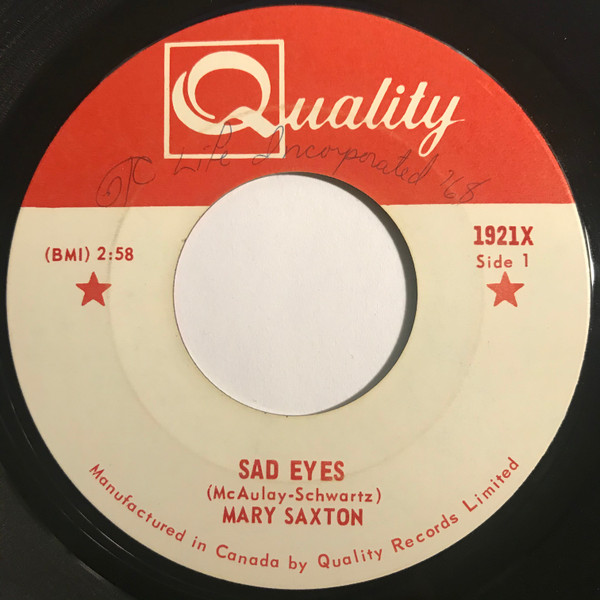
Geoff Chapman of the Calgary Albertan reviewed it in his column on September 17th (mistaking Saxton for a Calgarian):
I must confess I haven’t heard another Calgary performer MARY SAXTON before. But her Sad Eyes – Take My Heart (Quality 1921X) is extremely promising. On the strong ballad Sad Eyes, her voice is fruity and attractive, somewhere between Lulu and Sandie Shaw I’d say, and it promises a lot for the future. She’s also technically adroit, as the other waxing indicates. I’m sure she’s going to be a big name…..
On a parallel path producer Dakus, always on the lookout for wider distribution, kept talking with the Toronto-based record labels. He chalked up another success as reported in Billboard on October 12, 1968:
Compo has signed an exclusive contract with Wes Dakus, Edmonton recording artist turned producer, for his productions for its Apex label. First release under the contract will be by Barry Allen, who has national success with previous releases on Capitol, and upcoming singles by the Graeme Waifer and the Purple Haze.
Cash Box, which printed a similar announcement, also added that: “Dakus will function as Compo’s A&R producer in Alberta.” Apparently, there was only one Allen single to be released on Apex – “I Don’t Know What I’ll Do” b/w “Have You Ever Been in Love Before”, and one by Purple Haze “I Don’t Live Today” – a song written by Jimi Hendrix – b/w the Beatles tune “Ticket to Ride”. Co-produced by Barry Allen and Gary Paxton, its promotion by Apex was genuine, though a little over the top. In its advertisement in R.P.M. it boasted “Announcing…A NEW ERA IN THE CANADIAN RECORDING INDUSTRY!”
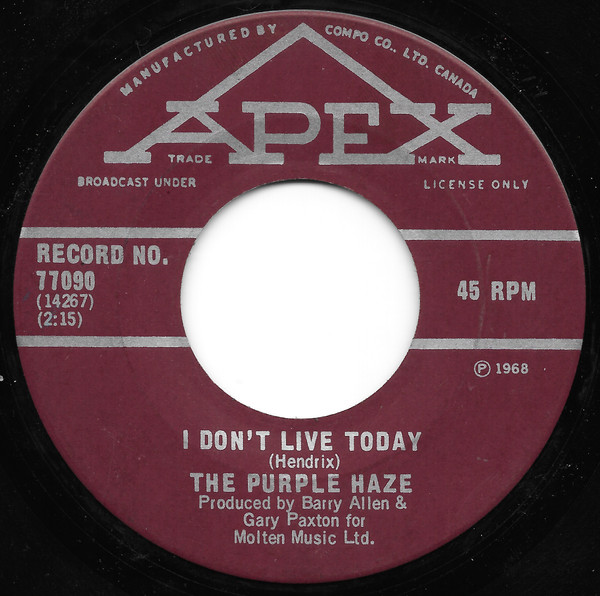
The first serious competition to Park Lane Studio finally arrived in May 1968 when Joe Kozak, the cigar-smoking former bassist for the Gaby Haas Band, started the Korl Sound Enterprises Studio in the basement of an apartment block at 10160-116 Street. As reported in RPM: “the whole operation is completely new and features a Crown International Stereo deck with a custom board using Bogen, Telefunken, AKG and other top-line components…Studio musicians are available as well as a string section and voice group.” This was soon renamed Project 70, and unfortunately for Park Lane, it became the studio of choice for most of the country and western artists including the majority of those on Royalty Records.
Gary McDonall and Wally Petruk, founders of The Nomads, next established Damon Studios (yep – that’s Nomad spelled backwards) in December 1969. Located at 6844-76th Avenue, it came into service with 4 tracks, going to 8 then 16 tracks by 1973. McDonall also imitated Short/Schwartz and Johnson’s business approach and founded his own label Damon Records. He would go on to issue recordings by The Nomads, R. Harlan Smith, Donna Adams, The Emeralds, Ted Wesley, Jack Hennig, and Jimmie Arthur Ordge.
Park Lane started to lose business rapidly at this point, as its equipment was no longer being updated. One musician who prefers to remain anonymous relates that: “Park Lane was not technically “clean”….there was tape hiss, glitches, noise within the electronics. It was no longer state of the art.”
Short/Schwartz’s enthusiasm for operating Park Lane had been slowly diminishing since the end of 1968. In January 1969 Bob Harvey wrote an insightful article on the state of Edmonton’s recording scene, most of it devoted to observations voiced by Short/Schwartz. Harvey introduced the piece with;
Fifteen years ago, Nashville had about the same recording facilities Edmonton has now. Today, it’s one of the major recording centres of the world. Edmonton has some of the potential Nashville then, and the city’s own recording studios are beginning to develop that potential. For its population, Edmonton is probably the most active musical centre in Canada. The country’s best western musicians are here, and so are some of the best rock musicians.
He then stressed how important it was for musicians to release recordings, both for making money, and for promotional purposes. Short/Schwartz was then asked for a few comments. He first talked about how active all three studios were, and his plans for Park Lane. Short/Schwartz indicated an imminent uptick in his own activities:
Few records made in Edmonton have ever sold as many as 10,000 copies. But that may soon change, with a whole new flood of records due to be released here soon. Park Lane has made only about 12 records in the last two and a half years. At the end of this month, it will issue six singles, by such groups as Victory Group, Bob Smith and the Common People, and others. Every month from now on, Park Lane hopes to release at least six singles.
However he was also very realistic about the current limitations:
In spite of all its facilities, Park Lane still can’t complete the process of making a record. The tapes can be made here, but they have to be sent away for the final steps. Most of Park Lane’s tapes are sent to Capitol Records in Hollywood, where the four tracks of tape made here are run through million-dollar echo chambers, and reduced to one track for the final pressing of the record, at a plant somewhere else.
“Our biggest failure has been not putting out a national hit,” said Ray Short. “If we could get one, it would establish Edmonton as a centre.” The biggest handicap for Edmonton studios is the attitude of Americans and other Canadians to anything that may come out of here. “They look down on our music….” His latest scheme to make people sit up and take notice of Edmonton is an attempt to induce top American record producers, and songwriters to come up to his studio. He’s writing letters to about 25 producers, and 20 writers, and offering to pay their travel expenses and fees if they’ll come to Edmonton for a week to write and produce records by local artists. “If we could get someone like Burt Bacharach to produce a record here, it would mean that every record company in North America would be after the record. And they might realize that something is really happening here…”
Then the article turned to the economics of the situation, stressing that, “…probably no one in Edmonton has ever made much money out of records.” It made it clear that once a record is released, “…it may plunge into obscurity…..The record business is highly competitive…only quality, and luck, will ever establish Edmonton as a record centre to be watched.”
Short/Schwartz ended on a positive note, but there were hints he was tiring of the business:
“We’ve got the musicians, and we’re beginning to get the sound. Now all we need is the material,” said Short. “I really believe Edmonton could be become the Nashville of Canada,” he said..
Short/Schwartz’s last two production projects at Park Lane Studios were full length albums. One was Mary Saxton’s first solo album entitled Sad Eyes. It contained the songs from her popular 1968 single “Sad Eyes” and “Take My Heart”, as well as her 1966 singles “Is It Better to Live or To Die” and “Losing Control”, two Gary Paxton songs: “A Tear” and “Big City Guy”, and seven tunes written by Mavis McCauley: “Wander By”, “I Gotta Go Now”, “Don’t Go”, “I Don’t Know”, “Lonely World”, and “Silent Thoughts” co-written with Butch Theuson. It was released on the Birchmount label (a subsidiary of Quality Records) in 1969.
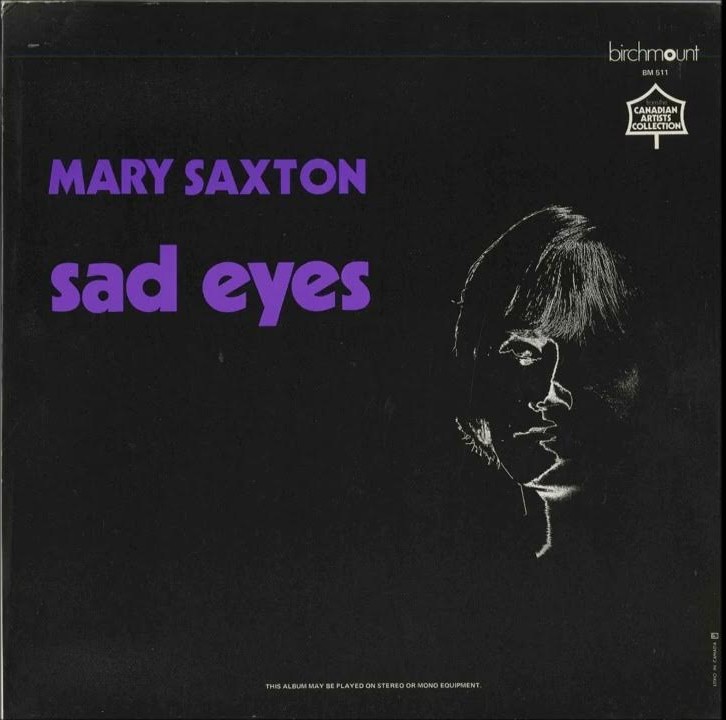
The other was an album by a deliberately anonymous studio band with the name The Rising Sun. The LP, entitled Born To Be Wild, consisted entirely of cover songs sung by Mary Saxton and Barry Allen (who also doubled as the engineer) backed up on different tracks by The Lords (Privilege) or Southbound Freeway, and with Mavis McCauley as musical director and arranger. It was a choice selection: from the Hendrix song “Fire” to “Love-Itis” by Mandala, from Arthur Conley’s “Funky Street” to “Wishin’ and Hopin’” by Burt Bacharach, it appealed to a large swath of the listening public. It too was released on Birchmount Records.
In May 1969 Short/Schwartz decided he had had enough and sold the Park Lane company and studio to Wes Dakus. The new owner immediately hired a secretary-treasurer in the person of Caryl Dakus. On July 7th, 1969 she informed the Alberta Registrar of Companies that “…on the 29th of May, A.D. 1969 Ray Schwartz and Sol Schwartz ceased to be Directors of Park Lane Music Company Ltd.” When the required annual reports for 1969 and 1970 were not filed, the company was struck off the registry in December 1971. The Dakus’ held onto the name however for publishing, and would reinvigorate it in 1978.
It was a logical, but still a bold move for Dakus. The takeover of the studio – combined with Spane International, and Park Lane Publishing meant he was going to be exceptionally busy juggling all the balls. Dakus thus turned to his long time associate for help in the studio. The Henderson Directory for 1970 noted that Barry Allen had taken over the management duties of the studio. He continued in this role until 1973 when he returned to live performance.
The idea of owning a studio came from Dakus’ role model – Norman Petty. As fellow musician/producer Dan Lowe remembers:
We had many discussions with Wes Dakus over the years and especially during the early years……and the role Wes wanted himself and Park Lane to play in the growth of Canadian music. I believe the relationship Wes had with Norman Petty was the genesis for the purchase of Park Lane… He was inspired by Norman Petty’s success in Clovis and the role he and his studio played in discovering and the making of several artists.
Carl Peterson – former lead singer with The Kingbeez – returned to Park Lane Studios in September 1969. This time around he had a new group called The Patmacs, and a new sound: Scottish and Irish folk songs. On the strength of two songs recorded in the new Damon Studio back in June, and hoping to spearhead a revival of his beloved celtic music for a younger, more “mod” audience, the band signed a contract with Capitol Records in August and immediately set to work recording a full album in Park Lane. The members were Peterson (banjo, mandolin, guitar), Steve Fearns (guitar, drums), Larry Lyons (bass), Brian Titley (bones, flute), Bill Gray (bagpipes), and sister vocalists Carol & Karen Tripp. Engineering was Barry Allen, while the producer’s seat was occupied by country artist Gary Buck for Bronco Productions.
The tunes included “Whiskey in the Jar”, “Liverpool Lou”, “Molly Malone”, “Dark Island” and “A Great Big Sea Cove”. The radio single, released in October, was “Verdant Braes O’Screen” b/w “The River is Wide”, which received considerable local airplay. The album entitled Open House, came out in the first week of November and was noted in Billboard. It was not universally praised though.
The Edmonton Journal review did not pull any punches: “The current Patmacs, on their first album, Open House (Capitol ST 6327) aren’t exactly the best of the lot. Regrettably. Open House only displays in greater details the deficiencies that plague the local five when they perform in person.”Music writer for the N.A.I.T. Nugget, Holger Petersen, was a little bit kinder. He wrote in his December 18th column:
Park Lane Studios are located at the rear of Wes Dakus’ Spane International just off 109th Street. It is run by Barry Allen, one of the nicest people involved in music in this city. The first album to be recorded in this studio “Open House with The Patmacs” (Capitol ST 6327) has recently been released…Unfortunately the recording quality of the album isn’t too good but the material contained within the album makes up for it.
In 1970 – like Short/Schwartz and Johnson before him with Pace – Dakus started his own label which he called Molten Records. Unlike them Dakus immediately secured an American distributor. Both Record World and Billboard reported on July 4, 1970:
NEW YORK – Molten Records, a newly formed independent label from Canada, will have its first singles product distributed in the U.S. on both the Decca and Uni labels. Molten is headed by Wes Dakus and Randy Bachman. Bachman is featured singer with Canada’s hit act, the Guess Who. Bachman is the composer and co-producer with Dakus of the first two singles releases from Molten, namely “Wednesday in Your Garden” by Barry Allen which will be released on the Uni label, and “Second Thoughts” by a new group called Cheyenne Winter which will be released on Decca……Molten is the first foreign label to be distributed in the U.S.under the newly created MCA Manufacturing, Marketing and Distribution division.
He then found a Canadian distributor, a company he had already worked with in 1968. On July 11, 1970 Billboard also published that:
The Compo Co. has signed an agreement with Wes Dakus of Edmonton for the distribution of the Molten label. The first two singles to be released on Molten were written and produced by Randy Bachman, former lead guitarist with The Guess Who. They are “Second Thoughts” by Cheyenne Winter, and Barry Allen’s “Wednesday in Your Garden.”
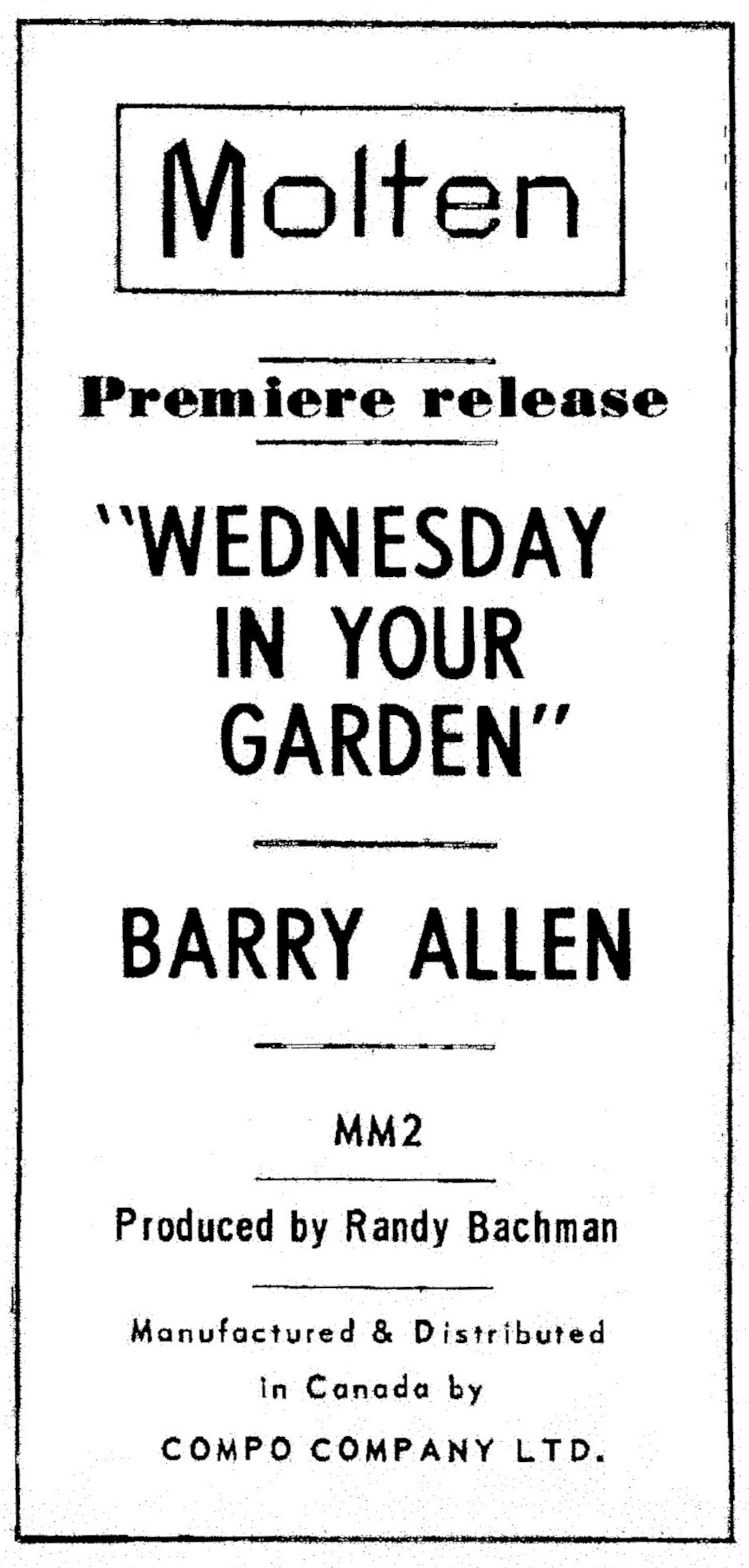
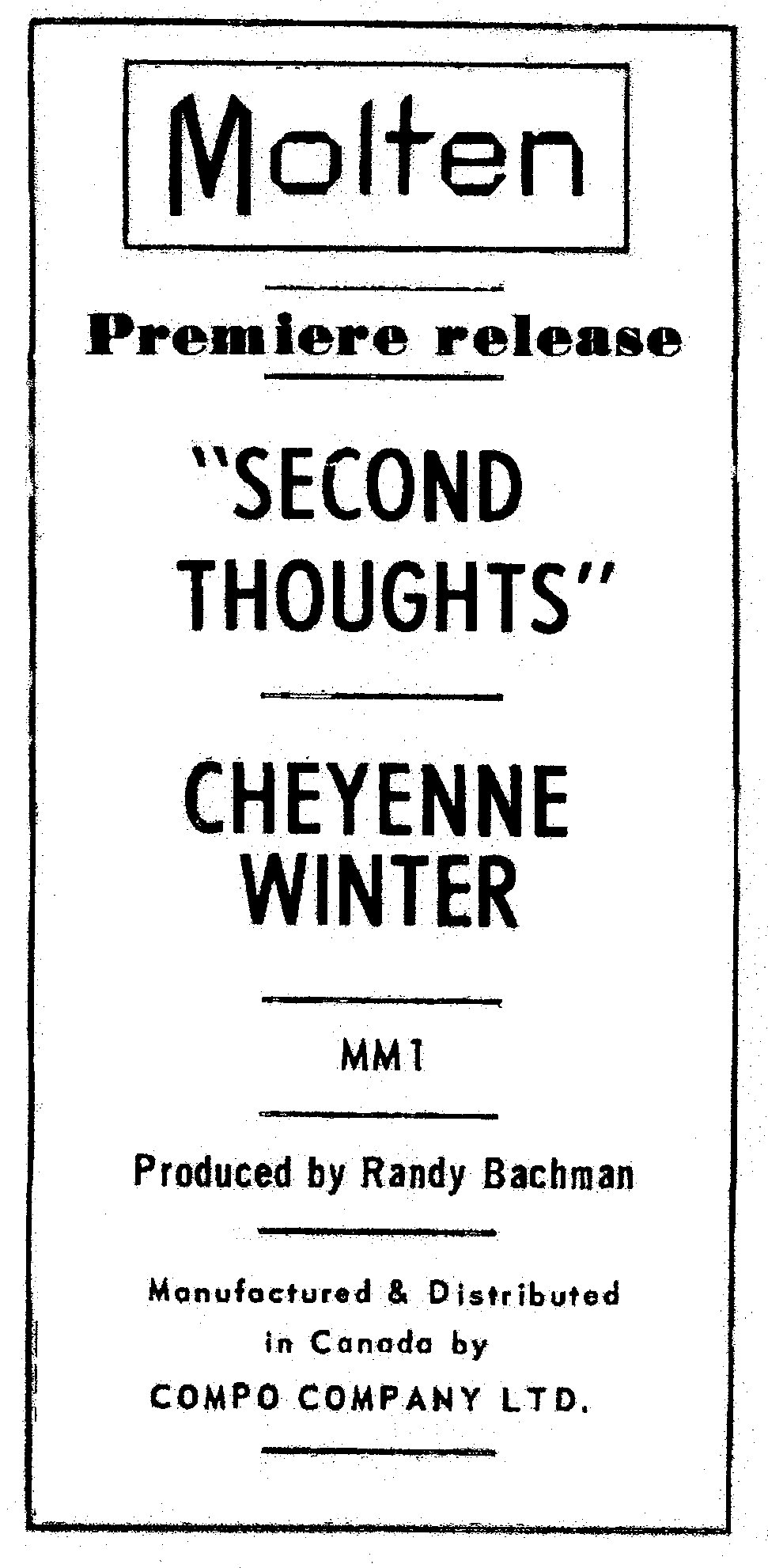
There seems to have been only one more 45 release on the label: “Daybreak” b/w “I Do The Best I Can” by the Calgary-based band Painter, and one album by Barry Allen also entitled Wednesday In Your Garden. Like both Pace and Fountain, the Molten label started with a bang and an abundance of publicity, and then just faded away.
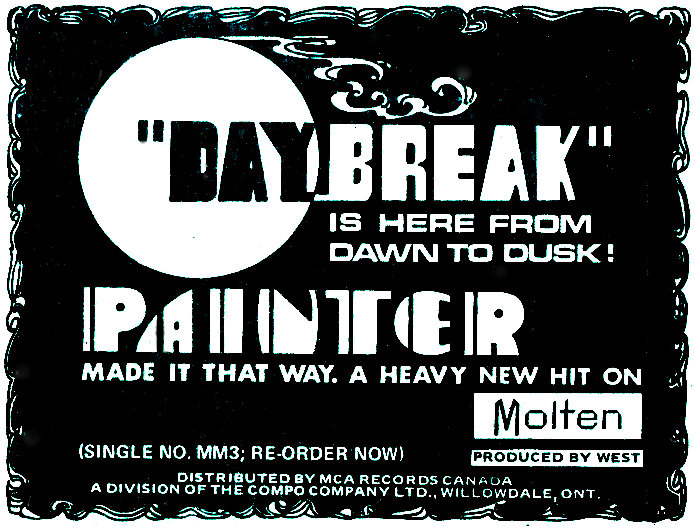
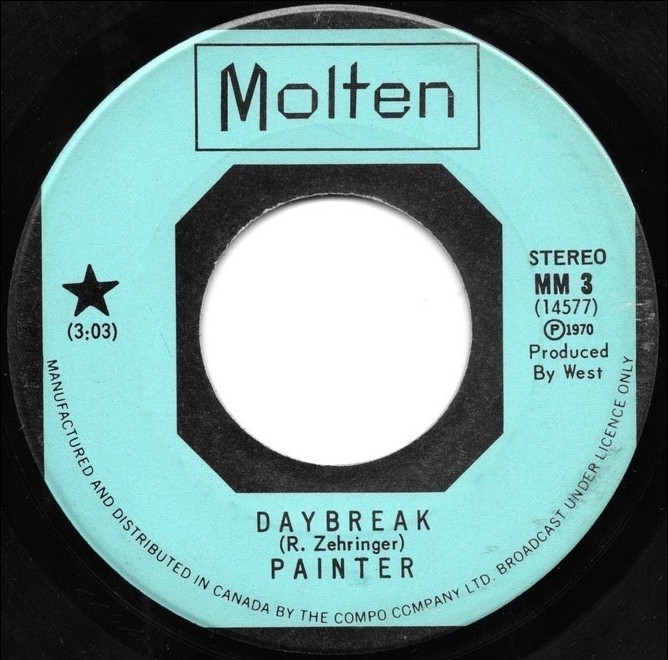
Part 4 – Publishing
From the beginning Short/Schwartz and Johnson thought it would be advantageous to own the publishing on as many songs written by or recorded by their artists as possible. There were several reasons: it meant there was a registered copyright and clear undisputed authorship. There could also be a revenue stream if the compositions were covered by other artists, or were used on a television or film soundtrack. They were aware of both the influence and monetary success of independent producers/writers/label owners Gary Paxton of Bakersfield CA and Norman Petty of Clovis, NM. Each had established a music publishing company- Nor-Va-Jak in 1958 and Garpax in 1960 – to promote and earn royalties from their own compositions and those of a small stable of associated songwriters.
Songwriting had not been treated in a particularly professional manner by the first Edmonton pop/rock musicians. Few had actually written their own material with the exception of select members of The Rebels, The Nomads and Willie & the Walkers. They usually assigned their copyright to whichever publishing company their record company advised them to.
Short/Schwartz fancied himself a songwriter and set up his own publishing company in 1966 – appropriately called Schwartz Publishing (affiliated with BMI) – to handle his compositions. There were not a large number. There were two from the Direct from the Rainbow Ballroom album “Lump City” and “Go Ahead and Make A Fool of Yourself”, as well as his co-writes with Dermond Murray (“Take My Heart”) and with Mavis McCauley (“I Gotta Go Now”, “You Take the Easy Way Out”, and “On A Summer Weekend.”)
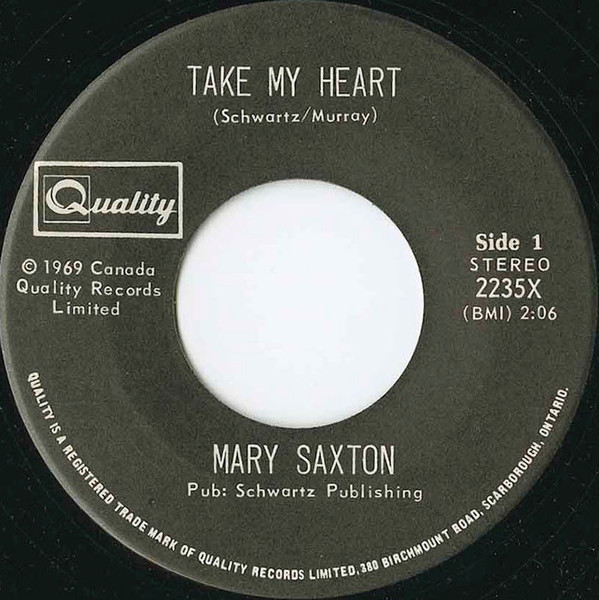
He then brought the numerous solo compositions of the prolific McCauley under the Schwartz umbrella including “Countin’ Cracks in the Sidewalk” (recorded by the Daisy Hill Puppy Farm), “Dream People”, “Experience”, “Girl You Left Behind”, “I’m Coming Later”, “Love’s Standing By”, “Mind Journey”, and “You Better Run”, and a song covered by The Young Ones on the Direct From the Rainbow Ballroom LP “I’ve Been Lonely Too”.
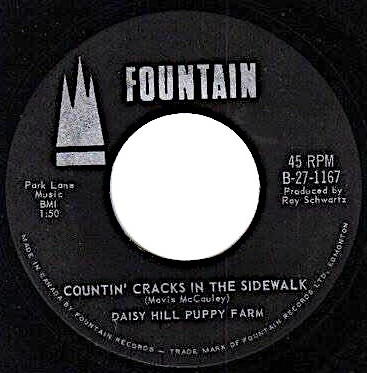
Eight other composers also signed on to Schwartz Publishing: Randy Schwartz with “Everybody Needs Someone” (likely a not-so-clever nom de plume for Schwartz), Mary Saxton with “What’s Happening Baby”, Dermond Murray (of Daisy Hill Puppy Farm) with “Everything’s Wrong”, Jack Hennig who wrote “Born to Lose”, “Has My Little Girl Gone Bad”, “I Made A Wish”, “Janie”, “You Remind Me of a Color” and as John Henning “Lord I Want To Fly”; Peter Guillet with “Shade Your Eyes”, Stephen Spencer with “Why Does She Wear My Ring”, and the team of William Fletcher and Dave Long with “You Shot Me Through the Soul.”
These were all relatives or close friends of Short/Schwartz. However he wanted to build a fuller stable of writers, and came up with a smart idea to bring local songwriters out of their basements. In the second week of February 1968, Rayal and radio station CHED held a songwriting competition in which Schwartz/Short and disc jockey Bob McCord were judges. This was the cause of some excitement, and many aspiring writers submitted songs. Lydia Dotto noted on February 9th:
By the way, he [Ray Short] and BOB McCORD will be picking the winners of the song-writing contest fairly soon. By the end of the week, they will have narrowed the field to six competitors. Each of these people will be given a chance to publish further work under contract, but only one will be chosen this time as a winner, and that song will be recorded by McCord in the studio.
She announced the winners on March 8, 1968
The two winners of the song contest held in connection with CHED were decided this week. One is Doug MacDonald with a composition called PATTERNS, and the other is Butch Thulsen [sic.] with NOTHING BUT A WORD. Bob McCord will be recording both these songs on separate singles in the weeks to come. Mavis McCauley has put the words of both compositions to music.
Actually Theusen and McCauley wrote three songs together: the other two were “Night Time Girl” and “Silent Thoughts”, and all three were published by Schwartz.
It was an encouraging start, and Short/Schwartz decided to establish another publishing entity, this time called Park Lane, also affiliated with BMI.He started recruiting writers as early as April 1968. A note in The Journal of April 5 read: “PARK LANE music is and will be accepting songs written by local people for publication. All enquiries should be directed to Ray Short.”
One person who seems to have shown considerable promise at this early stage (especially for his wordsmithing) was Gordy Walker, then a member of The Family Dog. A note in The Journal in December 1967:
GORDY WALKER, lead guitarist for the FAMILY DOGS may be accepted as a song writer for KAMA SUTRA records (THE LOVIN SPOONFUL’S stomping grounds). His song lyrics have been sent to New York to be set to music which, says he, is ‘something that’s very encouraging.” I should think so.
There were indications in the press of further interest in his songs: on March 29, 1968 “RAY SHORT expects THE YOUNG ONES and THE FAMILY DOGS in the studio this week. Apparently, they might have a chance to sell a song written by GORDY WALKER to GARRY LEWIS, but nothing’s definite on that.”
Then on May 10, 1968:
THE FAMILY DOGS broke up last week. Group members apparently have scattered far and wide. GORDY WALKER remains in town, as a song writer for PARKLANE recording company however. The group have an already pressed record called NO RAIN BETWEEN US coming out under the name THE FUZZIES. Gordy says he is definitely going to form another group and take it on the road to make the most of the record.
While we do not know what came of this, he continued to work on his writing, as can be seen in this mention of May 31, 1968:
Gordy Walker, formerly of THE FAMILY DOGS, has joined THE BROADWAY EXPRESS. Gordy has been working as a song writer for Parklane Music since THE FAMILY DOGS broke up about a month ago. He will continue to write for them even though he will be working with the new group. ….
The winner of the songwriting contest came up again in July 1968:
Bob McCord is going to re-do some of the tracks for his single. He was recording songs submitted in a song-writing contest, but the winner BUTCH THUESEN, has submitted a number of songs that are considered better than his original entry, and some of these may be recorded.
Songs were sometimes published upon completion whether the company had a performer for it or not. More frequently though, the creation and publishing of songs were triggered by a recording project.
Several members of the band Southbound Freeway signed on with Park Lane in December 1972 as they were recording numerous tunes with the expectation of putting out an album. Lead guitarist Dwayne Osepchuk wrote “Comin’ To Ya”, Osepchuk and vocalist Bob Alexander composed “Right Now Good Vibrations”, Osepchuk, Alexander and Wayne Schneider wrote “In Harmony”, “Love Ain’t Real”, while Alexander and Schneider wrote “Don’t Tell Me Your Troubles” and “You Don’t Have To Be”. Two of these tunes were recorded at Wally Heider’s Studio in San Francisco that same year and, co-produced by Wes Dakus and Mavis McCauley – released as a single on London Records.
With their recording activities in 1972, several of The Walkers – notably Will McCalder, Roland Hardie (“All About You”), Will McCalder and Steve Palmer (“Hotels and Wishing Wells”, and Vern Wills (“Living on a Borrowed Dollar”) signed on with Park Lane Publishing, and their compositions were copyrighted in the U.S. in February 1973.
David Peters (formerly known as L’il Davy of Li’l Davey & The Drasktiks) wrote four songs registered to Park Lane “Finally Found My Way Home”, “Melanie”, “Reflection”, and a co-write with Clyde Fisher “If We Don’t Go Together.” All four were copyrighted in the U.S. in February 1973. The latter tune was the B-side of his 1972 London Records single “Today I Started Loving You Again.” Several other writers wanted in as well: Dwayne Scheeler with “Back to the Land”, and Ray Saur of Eddy & Ray and the Drifters “What Did You Have in Yur Mind.”
Dakus’ next corporate entity, Molten Music, was formed in 1968, and concentrated primarily on publishing as is evidenced by the considerably larger number of songs than either of the previous two. Firstly the twenty songs from Schwartz Publishing above became part of the Park Lane purchase, and Dakus merged them into the new publishing company to become joint Schwartz/Molten properties. Then Molten started acquiring more songs.
The first worthy acquisition were the writers in the Edmonton band Graeme & The Waifers (later just The Graeme Waifer). Formed in 1967, they consisted of Geoff Eyre (drums), Pat Coleman (guitar), Bob Verge (bass – replaced by Al Treen), Bruce Nessel (keyboards), and vocalist Graeme Moorhouse. There was always a buzz about them. Part of that was their popularity elsewhere: they toured Ontario in the spring of 1967 and played in Toronto’s Night Owl. They were also popular in Vancouver, and played the Retinal Circus numerous times. They appeared on the CBC-TV program New Faces in May 1968. Their musicianship was superb, and they were arguably the most original and creative of Edmonton’s rock bands. They wrote the first local “concept album”, which was ambitious, musically complex, psychedelic, and very popular. It was performed many times over the spring and summer of 1968. The Journal commented on August 2nd:
THE GRAEME WAIFER have been controversial in past years as this city’s musical heir – apparent to the do-it-yourself crown. The Waifer, you see, most emphatically do their own thing. And a very good thing it is too – for the buffs….Its material is good, but lyrics are often undistinguished. …The group will be featured performers at an environmental show at Torches Theatre Sunday night at 10 p.m. The show is called JENNIFER’S CAREER AND DEATH, after the Waifer’s composition of that name, a kind of latter-day old English ballad.
In anticipation of recording the song cycle, the composers decided to register their tunes. Pat Coleman, guitarist and bassist Bob Verge contributed seven co-writes with “Timeless Tales”, “We’re Back”, “Free and Easy”, “Jennifer’s Career and Death – Part 4”, “Leaving All Behind”, “Oh I Don’t Know”, and “Angie La Vanderhausen.” Coleman gave a solo song: “No One Knows Beyond Me”, and one co-write with one-time fellow Waifer Steve Palmer – the intriguing “What Are You, A Tree.” While several of the songs may have been demoed (the band did take over Park Lane Studio for many days in December 1967), the album as a whole was not, as both Verge and lead singer Graham Moorhouse left the band in the autumn of 1968, and the rest of the members joined with Barry Allen to form The Victory Group.
From the members of Painter came “Cool in the Summer” (by Doran Beattie and Alf Cook), “I Do the Best I Can” (by Beattie, Paul Burton and Dan Lowe – and which became the B-side of their single for Molten Records), and “I Love What We Do Together” (by Beattie and Lowe). There were four tunes by various members of Willie & the Walkers: “My Little Buttercup” (by Steve Palmer – recorded by The Shametrees), “Goin’ Home” (by Ron Rault), and two unreleased tunes by Will McCalder “See It Right” and “You Hurt Me.”
Gord Walker wrote “In The City”, “Painted Memory”, “Someday”, and “There’ll Never Be Someone.” Jordan York came up with “Living the Past”, and “Sherry Wine.” Brad Carlson (of Tyme Five, Time Machine, and Purple Haze fame) contributed two: “You Fooling Nobody” and a co-write with Don Hamilton (a CHED disc jockey) “Miles Between Us”. Jim Lewis (then with Cheyenne Winter) had one “See the World”, while Mike Reveley wrote two songs: “Never Going to Go Away” and “Lizanne.” Oddly, there are even two songs in the BMI database: “Sleep in the Day” and “Can You Give Me Something” attributed to Molten, but with no information on the actual composers.
And lastly Mavis McCauley added three more gems to the Molten roster: “If I Change My Mind”, “If You Look Away” (recorded by Barry Allen), and “Sit Awhile” (recorded by Cheyenne Winter). As previously recounted in 1970 Dakus decided Molten was also going to be a record label, releasing material composed by Molten writers. Only a handful made it to the pressing stage though. And by the second half of 1973, with McCauley publishing with her own company – Sweet Cowboy Music – it appears Dakus was no longer adding to either the Park Lane or Molten catalogues.
In the larger world of international music publishing, the efforts of these three companies might be considered no more than baby steps. As far as can be determined, Schwartz Publishing represented nine writers and twenty-nine songs, Park Lane Music twelve writers and sixteen songs, and finally Molten Music twenty-two writers and fifty-eight songs. Even so, those steps introduced the adult approach to songwriting to Edmonton composers of popular music, and instilled a degree of confidence in their work.
A number of these novice writers went on to long careers and a measure of fame: Gord Walker published with three international companies – Unichappell Music Inc., Acuff-Rose Music and EMI Unart Catalog Inc., Will MacCalder published with Uncut Music, Dundee Music, and Grouse Music; Vern Wills published with EMI Blackwood Music, April Music (Canada), W.D.M., and Goulard Mgmt Ltd.; Dan Lowe published with Painter Music, Wet Paint Music, Canadiana Music, Low Ridin’ Music, Belzam Music Company, and Unichappell Music Inc.; Doran Beattie published with Wet Paint Music, Low Ridin’ Music, Belzam Music Company, Whozoo Music, Lion’s Bay Music, and Danboro Publishing Co.. Finally Mavis McCauley published with the internationals Dundee Music and Unichappell Music Inc., as well as having at least eighty songs under her own Sweet Cowboy Music.
Part 5 – The End of an Era
Edmonton’s music community and infrastructure had grown considerably during the last half of the 1960s and several years into the 1970s. There can be no doubt it was due to Dakus’ untiring efforts, along the path laid down by Johnson and Short/Schwartz. But life had become too busy for one man or one firm. Dakus felt he had to divest himself of some of his activities. Although Spane International was his top money-maker, booking started to become repetitive and always seemed to involve confrontations with venues, artists and occasionally the musicians union. It was the least creative and personally inspiring aspect of all that he wanted to do.
Most of Dakus’ attention from May 1971 on was given over to the formation, signing, recording and promoting of a new band by the name of Brahman. They were one of the first “supergroups” from the West Coast. The two founding members came from the Motown band Bobby Taylor & The Vancouvers – Duris Maxwell on drums and Eddie Patterson, guitarist extraordinaire. In 1970 they added Robbie King on organ, David Lanz on piano, Paul Blaney on bass, Victor Stewart on vocals and mime artist Ian McKay.
The band signed with Chicago-based Mercury Records, and Record World announced it to the industry in July 1971:
Brahman…was acquired following a live audition of the group in their home studio in Vancouver, British Columbia. The group had been formed by Canadian booking agent Wes Dakus who built Brahman from outstanding individual members of the more than 100 groups he books throughout Western Canada.
The debut album was recorded at New York City’s Mercury Studios with Dakus producing. It was released in September with the lead single being “Build a Tower.” Billboard noted:
TORONTO – London’s national promotion director, Michael Doyle, is putting a strong campaign behind the release of the debut album by Mercury group, Brahman. The Edmonton band was recently signed by Mercury Records in the U.S., a label which London distributes in Canada. Brahman is managed by Wes Dakus.
The band clearly had the musical talent, truly original material, received favourable critical reception to their album, and were by all accounts an incredible live act. Yet they never took off – either in Canada or in the U.S.A. – and disbanded in 1972.
While producing and promoting Brahman, Dakus was absent from Edmonton for long stretches of time. Realizing he no longer was challenged by running his booking agency, he sold it to Don McKenzie in April 1972, who had been president of the rival entity called Studio City Music Ltd. since 1970. The new merged agency continued to occupy the office of Spane International on 109th Street, and quickly exerted the monopoly position that Spane had held for the next decade.
Dakus did however hold on to his money-maker – music publishing. In 1972 Dakus finally went international – and in a big way. He entered an agreement with the Robert Stigwood Organization – the management company for Cream, Blind Faith, Eric Clapton, Yvon Elliman, and the Bee Gees. Billboard reported on July 8, 1972:
The Robert Stigwood Organization has signed a five year contract with Park Lane Music Ltd. of Edmonton. RSO will administer Park Lane’s affairs in Canada and will have worldwide publishing and management rights to all artists. The contract was negotiated by Park Lane’s Wes Dakus and Steve Stevenson of RSO. Dakus recently sold out his interest in Spane International Booking Agency to concentrate on local production and publishing.
By 1972 Dakus was spending very little time at the studio, and Park Lane started to welcome independent producers in addition to Allen. In March of that year radio personality Holger Petersen produced nine tracks for a local blues band called Hot Cottage. Consisting of Steve Boddington, Lindsey Umrysh, Bob Derkash, Brian Koehli, and Nancy Nash, they were starting their rise to extreme popularity in the Alberta capital. The initial sessions produced nine tracks, a strong combination of original songs and traditional blues including 9 tracks: “Hot Cottage” (S. Boddington), “The Big Push” (S. Boddington-D. Makarus), “Joy, Purpose and Pain” (S. Boddington-B. Derkash), “Otto’s Song” (S. Boddington), “Early Morning Blues” (B. Koehli), “Natchez Burning” (C. Burnett), “Joe Chicago” (S. Boddington/B. Koehli/B. Derkash/L. Umrysh), “Number Nine” (J.B. Lenoir), “Tom” (S. Boddington), and “When Things Go Wrong” (E. James)
The following month Petersen made the acquaintance of Chicago blues legend – Walter “Shakey” Horton – when he performed with Willie Dixon and the Chicago Blues All-Stars at Edmonton’s Jubilee Auditorium. Peterson interviewed both Dixon and Horton, and – on a whim – asked Horton if he might like to guest at the recording sessions for Hot Cottage. Horton agreed and joined the band in Park Lane to record a new version of “Joe Chicago” and “Shakey’s Edmonton Blues”. The Edmonton representative for London Records immediately showed interest, and it was decided to put out the collaborative effort “Joe Chicago” b/w the band-only “Tom” as a single in July. Jon Faulds of The Journal reported in August on the unexpected attention it was getting:
One of Chicago’s original old bluesmen – harp-player “Shakey” Horton, has cracked the Top 40 charts in Edmonton. In Edmonton several months ago with Willie Dixon’s Chicago All-Stars, Horton sat in on a recording session with Hot Cottage and played on a number called, appropriately enough Joe Chicago. It is the first time that a Chicago bluesman has ever recorded in Canada with Canadians. Soon to be released on a single record by London Records, the song is being played on CHED to the amazement of all concerned.
It was a coup of sorts. Horton’s previous collaborations with white musicians were limited to two albums: Johnny Winter’s first LP, and the original Peter Green-led Fleetwood Mac’s Blues Jam in Chicago.R.P.M. was equally impressed:
Edmonton-based blues group Hot Cottage have released their first record and achieved immediate play on five area radio stations. “Joe Chicago”, recorded with Hot Cottage and guest star Walter (Shakey) Horton, gained playlistings at CHED, CKUA, CFRN, CHFA and CKSR….the recording of “Joe Chicago” is interesting because it represents a breakthrough for the Canadian record industry. For the first time, a Canadian disc is being listed in the discography of Blues Unlimited, one of the most respected blues magazines in the world.
It added; “… production on the session was handled by former Edmonton radio announcer Holger Peterson. Peterson is gaining quite a reputation in this field.”
Billboard published an article on the Western Canadian music scene several months later, discussing Dakus” various activities:
Right now though, Dakus is excited about a blues band called Hot Cottage and a single it cut in 20 minutes with Walter (Shakey) Horton. It’s called “Joe Chicago” and the impromptu session went so well, he decided to stick around Edmonton to make an album with the five man group.
Subsequently Peterson flew Horton back to Edmonton and a full album was recorded at Park Lane Studios in September 1972 with ten tunes including five originals: “Joe Chicago”, “Shakey’s Edmonton’s Blues”, “Big Walter’s Boogie”, “Hard Hearted Woman”, “Worried Worried”, two re-arranged traditional tunes performed only by Horton and his harp – “John Henry” and “Turkey in the Straw”, and three covers: “Hound Dog” (by J. Leiber- M. Stoller), “Looka Here” (by Sonny Boy Williamson), and “Sugar Mama”(by Howlin’ Wolf). Engineering was split between Barry Allen and Will McCalder. It was mixed by Jim Gaines at Wally Heiders Studio in San Francisco, and was also released on London Records. It became a cult favourite in western Canada.
Foulds wrote an even-handed review for The Journal:
It is by no means a milestone blues recording – unless it is as the farthest north blues album ever made. And it doesn’t mark the beginnings of any great new blues talent. Quite simply this is a modest, low-key and extremely enjoyable collection of standard blues numbers, well-played and adequately recorded. Walter Horton doesn’t belong to the screaming school of harp players. He is subtle and soft, never stealing the show yet quite obviously the centre of the action. These attributes are reflected in everyone’s performance throughout the record – only two or three times does anyone cut loose and really wail. For the remainder they show great control.
Peterson was convinced that the LP could possibly have an international appeal. Accordingly he licenced it to First American Records in the U.S.A., and then to X-tra Records in Europe.
As well in June 1972 Petersen produced a session by the American vocalist Aaron McNeil who, again with the backing of members of Hot Cottage cut two tunes he co-wrote “Soul of a Black Man” and “Reap What You Sow.” The Edmonton Journal thought it newsworthy that the recordings were of such quality that they secured a recording contract for McNeil:
Aaron McNeil, 27-year-old variety singer living in Edmonton the past year, has signed a recording contract on the basis of a song he played over the telephone to a man in Los Angeles. Even the best-recorded music doesn’t sound like much when you play it over 3,000 miles of telephone wire and through those tiny little telephone speakers.
But Bill Sheppard of Cutless Records Inc. from Nashville, Tenn., was impressed enough by two songs Aaron played him off a cassette tape recorder to come to Edmonton Thursday to sign him to the newly formed label…..The first single to be released by the company will consist of two songs recorded at Park Lane studios in Edmonton last month….Accompanying Aaron who plays piano and sings, were Edmonton band Hot Cottage, singers Mavis McCauley and Melinda Whittaker, and musicians Rick Hart, Rick Tait and Ross Harvey. The record will be released in about three weeks.
Under the band name Whozit?, the song “Soul” was released as the A side of a 45 rpm on Cutlass Records. The B side was credited to McNeil alone.
In 1972 Will MacCalder – founder, singer and organist with Willie and the Walkers – started to learn the art of audio engineering at Park Lane. Among the more interesting artists he helped put to tape were Hot Cottage, Joe Hall & the Eyeball Wine Co., Brent Titcomb, David Peters, and Lionel & Ron Rault. He spent as many hours in the studio as he could. To hone his skills he needed a band to work with – and who better than his own – The Walkers. They rehearsed endlessly in the studio for their live gigs, and in so doing provided challenging sonic exercises for the neophyte producer. The material was a combination of covers – the Allman Brothers Band “Statesboro Blues”, Neil Young’s “Cinnamon Girl”, Little Richard’s “Miss Ann” – and originals mostly by Vern Wills such as “Living On a Borrowed Dollar” and “Don’t Be Late.” Later that year, two tunes were chosen for a single release. The 45 rpm, produced by Barry Allen for London Records of Canada, had “All About You” as the A-side, and “Hotels and Wishing Wells” on the B-side. Even though both were radio-friendly solid efforts, there was no chart action and poor sales.
Holger Petersen also pulled together a 2 LP compilation set as a non-profit product of Edmonton radio station CKUA in 1972. Entitled Acme Sausage Co.– after the name of his weekly radio program. Amongst the songs were one each by Hot Cottage, Manna, Paul Clarke, The Walkers, and Joe Hall – all recorded in Park Lane.
Also in 1972, the multi-talented Mavis McCauley, writer, singer and keyboard player formerly of the Daisy Hill Puppy Farm and Southbound Freeway slid into the producers seat for a session with the young, not-yet-established roots/country singer Gary Fjellgaard. Their session produced two songs “Sweet Messages to Karin” and “Bitter Wind” – both written by Fjellgaard. They were released as a 45 rpm by London Records Canada. The session musicians included Gaye Delorme,Bob Walker, Gary Koliger, and Stu Mitchell. Both Fjellgaard and McCauley would go on to solid recording careers – the first with Royalty Records, and the latter with Vera Cruz Records.
Billboard published an article on Western Canadian musical activityin its September 30, 1972 issue, and interviewed Wes Dakus. First there was a passing mention of his new record label – Blue Eye Records – which he said numbered thirty-five artists. Strangely there does not appear to have been any releases on this label. Then he talks about his plans for the studio:
Park Lane functions nicely with 4-track, but it will expand to eight soon. But that’s as far as he plans to go. “I’m not a firm believer in 16-tracks” says Dakus. ”There’s too many things being left in the house. There’s more production with 16, but there’s not that much more separation. I want to go back to where rock and country started.”
Even so, it was clear that neither studio-owner Dakus, nor studio manager Barry Allen for that matter considered Park Lane of sufficient quality for their own projects. Both Allen’s solo LP and Dakus’ Brahman LP had been recorded at RCA Studios in Chicago. Thus Park Lane started to decline as the recording studio of choice for most western Canadian rock, pop and blues bands. In January 1973 Tommy Banks opened Century II Studios on the western outskirts of Edmonton with its sixteen-track board. This new studio, designed by Welton Jetton of Nashville, combined with Banks’ talent agency (Banks Associated Music), music publishing (Century II Publishing), and another record label (Century II Records), took a serious bite out of Dakus’ business.
A frequent client of Park Lane during 1971 and spring/summer of 1972 was the Calgary-based band Painter. Led by guitarist Danny Lowe, and including vocalist Dorn Beattie, bassist Wayne Morrice and drummers Terry Bare, and then Bob Ego, they were creating and assembling a series of demo recordings that would eventually get them signed to a major American label. Recalls Dan Lowe:
Painter began recording song demos in April 1971. The studio was located in the alley behind 109 St. NW at 105thAve. Barry Allen was the studio’s engineer who worked with us….We averaged 2-3 sessions per month at Park Lane during 1971 and 1972. We eventually convinced Wes to upgrade the studio speakers to a more professional level monitoring system which produced higher quality demos that helped us obtain a recording contract with Electra Records in 1973.
Two of the tunes: “Country Man” (by D. Beattie & T. Bare) and “Lost the Sun” (by D. Beattie) were released as a 45 rpm by London Records in 1972.
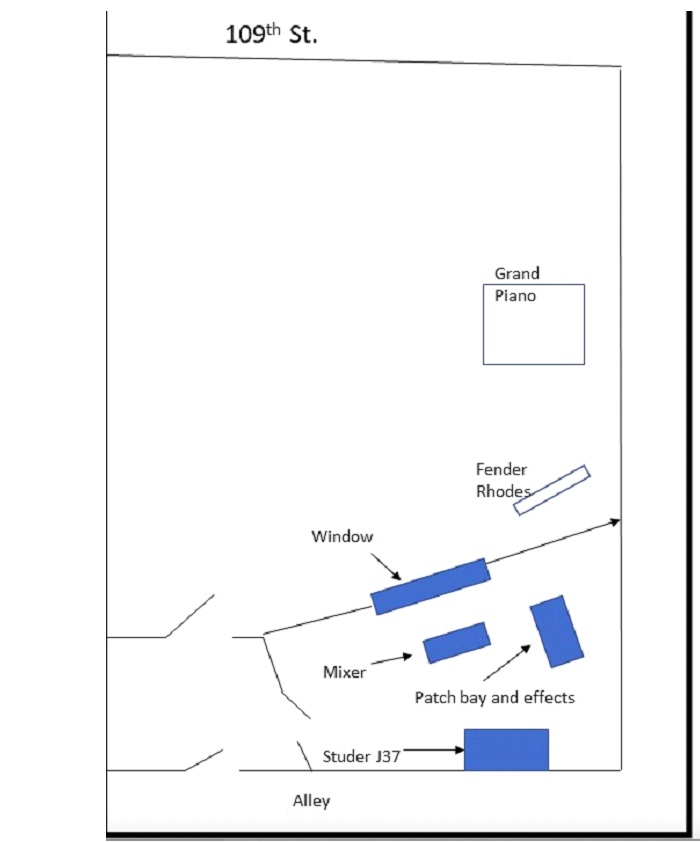
Almost twenty songs were written, recorded and finished in the studio. Included were “Country Man”, “Follow Me”, “Summer Song”, “Lost the Sun”, “Long Nights”, “Back When I Was Young”, “Broken Dreams”, “Tell Me Why”, “Devil Suite”, “50 Thousand Plus”, “For You”, “Get Out of My Life”, “Simple Lady”, “Slave Driver”, “Space Truck”, “Stone Hill”, “Kites and Gliders”, “Going Home to Rock and Roll”, “Going Down the Road”, and “On the Other Hand”.
Lowe adds:
We always had a great and productive time at Park Lane. Barry was great to work with and a good engineer. He achieved terrific results given the limited equipment the studio had. Wes would come in from time to time and cheer us all on which was especially useful at two or three in the morning. The vibe was early rock and roll…. minimal equipment, limited room acoustics but an inspiring vibe much like the early four track studios in Hollywood and Nashville during the late 60’s. I had the privilege of recording the Shades of Blonde (precursor to the 49th Parallel) with Garry Paxton in his garage studio in Hollywood.
Allen became such an integral part of the band’s sound that he was asked to join them in April 1973 as additional guitarist and singer. He jumped at the offer and that helped them secure them their contract with Elektra Records. The band moved to Seattle, quickly recorded their debut LP (which consisted mostly of re-recorded songs demoed at Park Lane), and started a grueling year-long tour of Canada and the U.S. to promote it. Allen decided to bow out of the band in March 1974 for family reasons and returned to Edmonton, taking up his old job of engineering and producing. However, to everyone’s surprise (particularly Dakus), he did not go back to Park Lane. Instead he joined the staff of Century II Studios.
Dakus then went through a brief period of discouragement: Brahman was not the success it should have been, and he had lost his colleague Barry Allen to Century II. The recording equipment in Park Lane had become outdated. Both Century II and Damon Studios were attracting most of the young new bands as well as much of the new commercial work, and as a result Park Lane was intermittently idle.
Near the end of 1974 though, Dakus got his second wind, was re-invigorated and wanted to record Edmonton and Western Canadian musicians at an even more professional level than before. He decided to rebuild the studio and upgrade the equipment to twenty-four track. He would rebrand it as Sundown Recorders. While that institution went on to achieve top reputation in both the rock and country fields, its inauguration signaled the end of Edmonton’s early pop era.
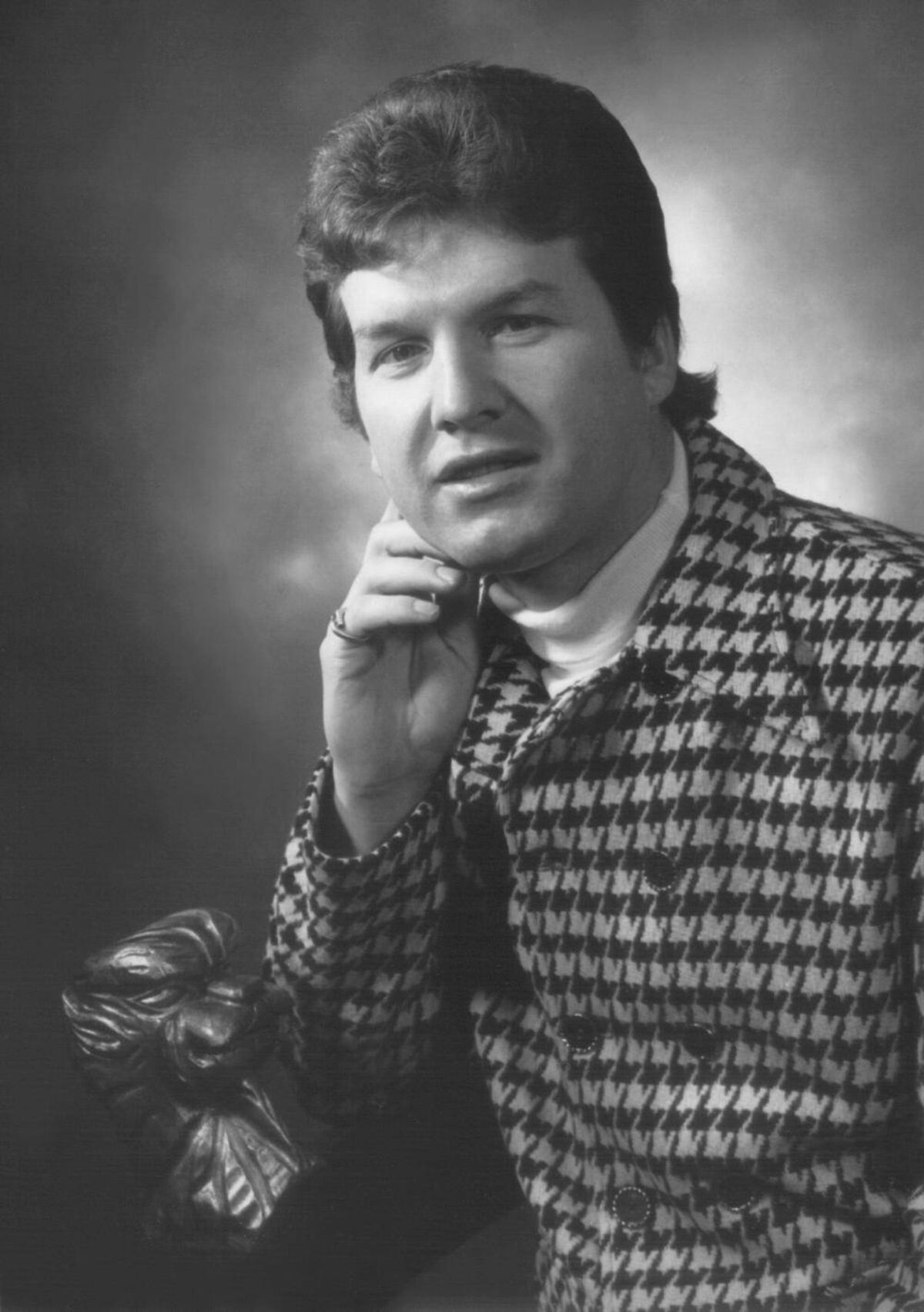
As can be seen then, the Edmonton popular music community for the period 1966 to 1974 was well-served by a booking, management, recording, publishing, and record label infrastructure set up and populated by Ray Short/Schwartz (1945-2007), Al Johnson (1938-1993), The Barabash Family, Wes (1938-2013) and Caryl Dakus, and Barry Allen (1945-2020). While the names Rayal, Park Lane, Pace, Fountain, Molten, and Spane International are now distant memories, they deserve to be celebrated as the initiators of a business model that ensured the establishment and long-term survival of the Edmonton popular music scene.
Discography
1. Pace Records
King Beezz – 45 rpm (27-965)
“She Belongs To Me” (B. Dylan) b/w “Gloria” (V. Morrison)
produced by Bob Stagg
released: November 1965
Mary Saxton – 45 rpm (18-1166)
“Is It Better To Live or Die” (D. Johnson) b/w “Losing Control” (G. Paxton-J. Paxton)
produced by Garry Paxton (uncredited)
released: January 1966
The Lords – 45 rpm (20-1166)
“Rovin’ Heart” (K. Johnson) b/w “There Ain’t No Doubt About It” (D. Hinson-K. Johnson)
producer not credited
released: 1966
Mary Saxton – 45 rpm (31-1166)
“Ask Any Girl” (B. Holland/L. Dozier/E. Holland) b/w “Do the Jerk” (B. Krasnow-G. Page)
produced by Ray Short
released: June 1966
The Lords – 45 rpm (4-367)
“Blue” (K. Johnson) b/w “Dirt Beneath Your Feet” (K. Johnson)
produced by
released: July 1967
The Lords – 45 rpm (16-867)
“Savin’ (Everything For You Girl)” (G. Paxton/K. Johnson/J. Ritchey/B. Hopps) b/w “The Highly Successful Young Rupert White” (K. Johnson/J. Ritchey/B. Hopps)
produced by Gary Paxton
released: 1967
various artists – Direct From the Rainbow Ballroom – LP (RS-101)
produced by Ray Schwartz
released: August 1967
2. Fountain Records
Daisy Hill Puppy Farm – 45 rpm (27-1167)
“Let’s Go To San Francisco” (J. Carter-K. Lewis) b/w “Counting the Cracks in the Sidewalk” (M. McCauley)
produced by Ray Short
released: November 1967
3. Molten Records
Cheyenne Winter – 45 rpm (MM1)
“Second Thoughts” (R. Bachman) b/w “Sit Awhile” (M. McCauley)
produced by Randy Bachman
released: July 1970
Barry Allen – 45 rpm (MM2)
“Wednesday in Your Garden” (R. Bachman) b/w “If You Look Away” (M. McCauley)
produced by Randy Bachman
released: July 1970
Barry Allen – Wednesday In Your Garden – LP (Molten/MCA – 7005)
produced by Randy Bachman
released: July 1970
Painter – 45 rpm (MM3)
“Daybreak” (R. Zehringer) b/w “I Do the Best I Can” (P. Burton/D. Lowe/D. Beatty)
produced by West
released: August 1970
The author wishes to thank Dan Lowe, Bob Walker, Bob Ego, Holger Petersen, and Kim Christie-Milley (City of Edmonton Archives – now retired)
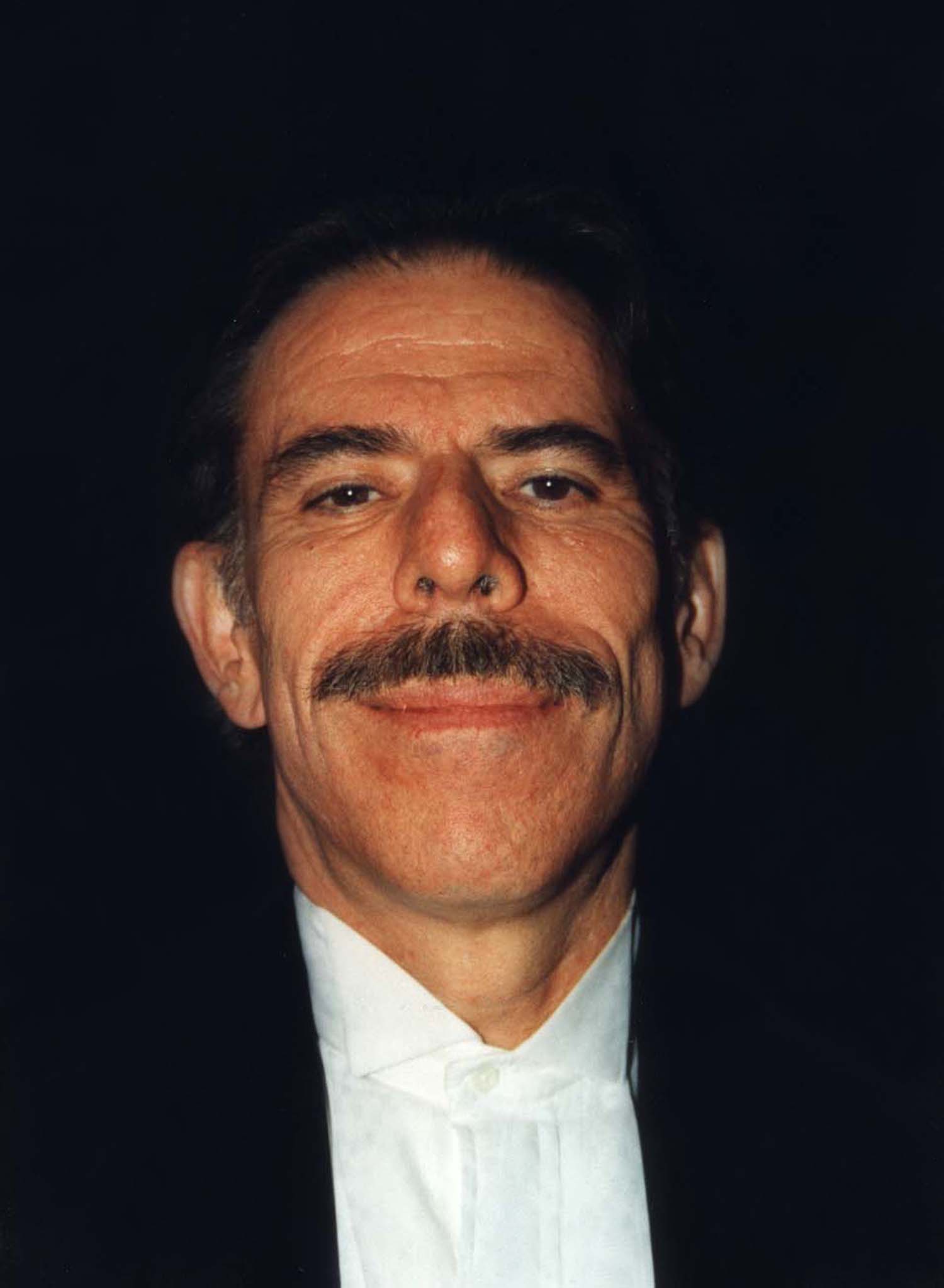


 Norm Rooke
Wow, what a trip down memory lane! I feel like I took ‘the brown acid’ at Woodstock. Ha ha! Excellent article. Could have been a book.