
Magic Castles Interview: Jason Edmonds on ‘Realized’ and the Minneapolis Psych Underground
Magic Castles’ new album ‘Realized’ marks another step in Jason Edmonds’ long-running psychedelic project, now released through Fuzz Club after years of work with A Recordings.
The record was developed across several spaces, including Pachyderm Studios, the Map Room in south Minneapolis, and Neil Weir’s Blue Bell Knoll, where the album was mixed.
For Edmonds, ‘Realized’ continues the direction opened up on ‘Sun Reign’, but with a sharper sense of structure, sound and revision. The sessions began with live band recordings, but the album changed shape over time as songs were reworked, replaced and refined. “I cracked the mix open again and started revising the songs heavily,” he says.
The album keeps the familiar Magic Castles sound of vintage guitars, old amps, analogue warmth and slow-building melody, but Edmonds hears it as a record that also clears space for something new. “Every new album is an opportunity to reset,” he says, adding that ‘Realized’ “continues with my signature style while also resetting the energy for something new.”
Melody remains central to the writing. “I hear the melody first,” Edmonds explains, describing songs that often begin as fragments sung to himself before they are built into full arrangements. That instinct sits alongside a more detailed recording process, shaped by collaboration with Adam Patterson, Izaak Drew, Kristof Marden and Neil Weir.
The interview also looks back at the wider Magic Castles story, from the early Minneapolis scene and ‘Lore of Mysticore’ to Anton Newcombe’s support through A Recordings, the appearance of ‘Lost Dimension’ in ‘Succession’, and the move to Fuzz Club. Seen in that context, ‘Realized’ is not a break from the past, but a careful continuation of it: a psych rock record built from revision, friendship, old equipment and the search for a sound that still feels very much alive.
“Every New Album Is an Opportunity to Reset”
Great to have you here. I want to start right in the middle of things with ‘Realized’. When you listen to it now, removed from the process, what stands out first? Not what you set out to do, but what actually ended up on the record?
Jason Edmonds: Hello! Thanks for having me!
I’m super happy with how it turned out! Overall, it’s sort of cyclical, like, if you flip the B-side to the A-side or back again, the entire album flows in a nice circular way. I think the mix and mastering job was well done. Overall, it felt really good to release this album.
There’s a sense across the album that the songs unfold slowly, almost in waves. Was that something you were consciously shaping while writing, or did it come out of how the material developed over time?
Some songs were definitely written that way. Sometimes, when the songs were recorded with the live band in-studio, those songs developed to become even more dynamic than originally intended. Some of them were molded that way through the mix process.
You’ve talked about clarity on this record, but also holding onto analogue warmth. When you were in the middle of recording, how did you know when something had crossed that line too far in either direction?
We use vintage gear, old guitars and old amps, so the warmth of the tube amps is there. Usually, if I’m doing an overdub, like let’s say a little piano counter melody or something, I end up trying a lot of different types of keyboards, and I keep trying to find the right sound for the part I hear in my head, that also fits with the mix of the particular song, sonically. Process of elimination. I feel my way through these decisions.
Recording at Pachyderm Studios brings its own atmosphere. What did that space do to the sessions? Not just sonically, but in terms of how you worked day to day.
We didn’t complete the album from start to finish there, but we did stay there for two days and got the basic recordings for the entire album. The drums sound amazing in that room. I think one real benefit is having this amazing time there, with the bandmates and our girlfriends, in a secluded retreat type setting. Classic old haunted mansion with lots of crazy rock n roll history. You can hear us having a good time in the cohesive sound of the band in songs like ‘Mary Anne’, ‘Space Manual’ and ‘Realized’.
Then you also had your Map Room setup and the Blue Bell Knoll space with Neil Weir. How did moving between those environments affect the way the album took shape?
I personally do a lot of introverted recording at the collective studio I share with old friends in south Minneapolis, the Map Room.
I recorded ‘Hey Alright’ and ‘Abandoned Mansions’ there, as well as most of the main vocals, piano, keyboards and string arrangements there. My bandmates Izaak and Adam came in and tracked guitar and drums, as well as backing vocals. Also Sarah Pajunen’s beautiful violin, all recorded at the Map Room. I did track some vocals at Neil Weir’s Blue Bell Knoll, but mainly it was mixed out there with Neil.
When it came time to mix with Neil, were you mostly refining details, or were there still bigger decisions being made about the structure of the songs?
Mainly refining details, or me revising the mix constantly. Neil is a very patient guy with me, bless him. I’d recommend him to anyone needing a good sound engineer to mix their album. The structures of the songs, for the most part, were already decided before it got to the mix stage. We try to avoid a fix-it-in-the-mix type mentality if possible, so if a song has major structural or sonic issues, it gets scrapped, which is how some songs recorded at the Map Room ended up on the record. They replaced Pachyderm songs that had some fatal structural flaw I couldn’t get past.
The arrangements feel dense but never closed off. There’s always space inside them. How do you approach building those layers without losing that sense of air?
This might sound dumb, but I kind of think of the mix like a painting of colors, like an array of color dots on a canvas. If all the colors were all grouped together in one part of the canvas, it would sound all fucked up, if that makes sense. I take it as far as my ability allows, and Neil Weir takes it from there. He hits it with his amazing equipment. He’s also good at doing an overall balance after I go in and choose which voices have precedence over others.
Melody seems to carry a lot of weight across ‘Realized’, even when everything else is shifting around it. Has that always been the anchor for you, or has that become more central over time?
I think that is how my brain works. I hear the melody first, and I’ll sing it to myself and remember it, and write a song around that melody. Most of my songs were written this way, with the exception of some songs that write themselves when I’m just messing around on piano or guitar. That happens too. Sometimes they come in like a nearly complete download.
Looking at the current lineup with Adam Patterson, Izaak Drew, and Kristof Marden, how much did their playing change the way these songs ended up sounding compared to earlier records?
Oh, it definitely changes a lot with their involvement, as anyone who has seen this lineup live can attest to. Adam, Izaak and Kristof are all a little punchy, and play with a lot of energy and a lot of musical skill. We also have a keyboard player when we play live, Tim Evenson, but he’s not on this album. When recording, I allow space for them to improvise within my songs, or interpret my songs, to a point. They bring their own ideas to their parts, and come up with some really cool ideas, enhancing my songs. I think our close friendship allows the collaboration to be fluid.
Before this album came together, what state were the songs actually in after the 2023 European tour? Were they already defined, or more like fragments waiting to be shaped?
A lot of them were fully finished! It was actually scheduled for release initially in 2023, but the project was put on hold by the label. While it was on hold, with the future uncertain, I cracked the mix open again and started revising the songs heavily, working closely with Neil Weir. Redoing vocals, adding background vocals, re-recording parts, and doing some heavy remixing. It was pretty risky, and I paid out of pocket for each mix session, but I think it’s a much better album now.
If you go back further, to ‘Sun Reign’, there’s already a shift toward something more open in the sound. Do you hear ‘Realized’ as growing out of that record, or as a separate step entirely?
I feel like it’s advancing what I started with ‘Sun Reign’. It was recorded in a similar manner. The songs ‘Lost Dimension’ and ‘Asuras’ were both recorded at the Map Room in a similar fashion as ‘Hey Alright’ and ‘Abandoned Mansions’, as well as incorporating studio sessions with a full band. ‘Sun Reign’ was mixed by myself and Neil Weir in a similar fashion. I think ‘Realized’ is a positive improvement in execution of both the Map Room recordings, as well as the full band studio sessions.
There’s also that moment where a track from ‘Sun Reign’ appeared in ‘Succession’. Did that experience have any effect on how you thought about the reach of the music, or did it stay disconnected from the creative side?
Yeah, having the song ‘Lost Dimension’ appear on the HBO show ‘Succession’, season 3, episode 7, was definitely a proud moment for me personally and really exciting. It was very much unexpected to land a sync deal like that. I did, however, think that song was special as soon as it was recorded. I play every instrument on that song. I felt proud, and justified, to some extent.
Honestly though, I try not to let that type of thing affect my songwriting. I keep an open mind and an open ear. If I am blessed with a melodic idea, or an enticing song-form, and it comes into my thought-mind, I try to entertain that idea without expectations or judgements. For real. I think it’s important to take musical risks. I intentionally try to have this push-pull musical relationship with the limits of the psychedelic-rock genre, in some way. Like, always be true to yourself but also do something different than just another cover of ‘When the Levee Breaks’ or whatever. That’s where my mind is. If I was more focused on making money, I’d probably be more successful, I don’t know. I should try it out.
Earlier on, with ‘Lore of Mysticore’, the recordings feel more inward, almost self-contained. What did the process look like back then compared to now?
Back in those days, we had a studio in Lowertown, St. Paul. Up on the third-floor loft in an old warehouse. The kind with the freight elevator that has wooden doors that lift up. Of course, it would always break down, and you’d have to load the bass cab up three flights of stairs. It was literally like the meme.
We recorded that album on an old Digi 001 Pro Tools interface on an old G4 tower. I did not spend much time editing anything back then. I barely did any revision at all, actually. I didn’t have the Pro Tools chops I have today. Mostly composed of single takes, probably the quickest album ever recorded. The album definitely has a sound of its own.
That first album led to your connection with Anton Newcombe and the run of releases on A Recordings. How did that relationship actually begin, and what did it open up for you at the time?
I think he came across ‘Lore of Mysticore’ on YouTube, or a friend of his played ‘Ballad of the Golden Bird’ for him. This would have been back in the MySpace era. I just randomly got an email from him one day, and we hit it off OK! Out of the blue.
It was really exciting. My friends and I were already big BJM fans from back in the pre-‘Dig!’ days, when they would play the 400 Bar in Minneapolis what felt like twice a year. I feel indebted to Anton for introducing me to his audience and the rest of the world. Joel, Ricky, and the BJM band(s) have been gracious hosts to us when we’ve supported them on tours. BJM’s audience is great to play for. I don’t know where I would be without Anton’s involvement. When we played Berlin in 2023, Anton came to our show, with two lady friends, one on each arm.
While we are on this topic, I should quickly mention that Stuart Flint, Anton’s manager at A Recordings Ltd for over 16 years, unfortunately passed away recently, before the ‘Realized’ release. Stuart worked behind the scenes as label manager, and he personally helped me navigate a lot over the years. I started the ‘Realized’ project working with Stuart for Anton’s label. Stuart gave no fucks and had himself a notorious reputation. The details around his exit from the label are not known to me. Regardless, I am eternally grateful for everything Anton and Stuart did for my music. I mean, what can I say? Besides rest in peace, Stuart Flint, and keep music evil, Anton Newcombe.
Across those A Recordings albums, there’s a continuity in tone but also small shifts in detail. When you listen back now, do you hear a steady evolution or more distinct phases?
I haven’t listened very closely in a long time, but I think there is most likely a noticeable progression in my attention to detail, appetite for revision, and songwriting complexity, as well as the quality of my recorded voice, not to mention my Pro Tools skills. I think it’s way better than it was, personally. Although there is definitely charm in the early vibe at times. I do have my regrets. For example, I just listened to the song ‘Sky Sounds’ recently, and I admit, I wish I had not recorded the vocals through my Fender Twin with the reverb turned all the way up to eleven. Ruined a perfectly decent song. I would not do things the same way today.
Going even further back, when you first started in Minneapolis in the early 2000s, what did that environment give you? Tell us about that particular scene.
I wanted to do something different that was more psych-folk, but almost instantly, as soon as I put a band together, it became more rock than folk. At that time, the vibrant Minneapolis bands I was into would have been bands like Food Pyramid, Daughters of the Sun, Velvet Davenport, Vampire Hands, Skol Kodiak, First Communion Afterparty, Leisure Birds, and of course the mighty Flavor Crystals were around back then too.
The use of vintage amps, guitars, and transistor organs has always been part of your sound. On this album, did you approach those tools differently, or was it more about refining something already familiar?
I think I’m refining what I’m already doing. Everything was done in a similar process as ‘Sun Reign’, using a lot of the same gear, besides some upgrades to the hardware and equipment, and perhaps more intentional performances.
With the move to Fuzz Club, did anything shift in how the record was finalized or presented, or was that change more about where it would land after it was finished?
Well, I was unsure what to do with it. I had 12 songs finished and was prepared to do a 2LP. Fortunately, Fuzz Club comes in with a perfect new home for the band. I mean, life has to move on, right? It does move on, and sometimes it takes a while for these projects to get sorted out.
In the end, Fuzz Club label manager Jack Palfrey decided, wisely I think, that a single LP would be best at this time. I agreed. I didn’t want the retail prices to be crazy. Also, less is more, as my friend Chris Hontos keeps telling me. So I ended up cutting three songs and paring it down to fit the time constraints of the vinyl format. Like I said earlier, I am happy with the result, and I like the flow of the album as it is now. Fuzz Club has been great to work with.
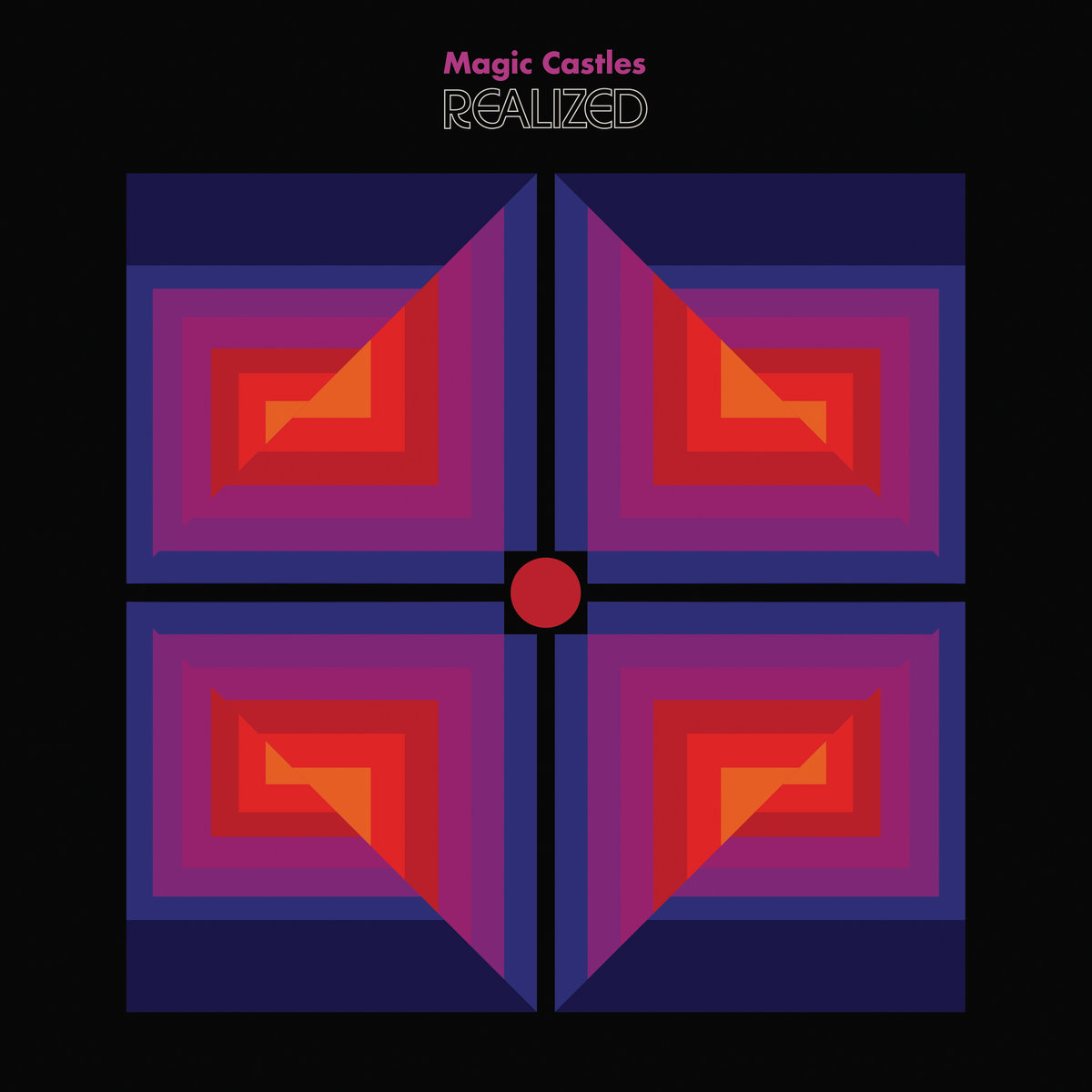
One thing that stands out to me, besides being a great-sounding slab of vinyl, is that the vinyl design looks really sharp. The album art was designed by Jake Luck, the same artist who did the cover art for ‘Sun Reign’.
Jack Palfrey chose two colored vinyl options: a multi-color swirl for club members, and also a neon orange press, and both look amazing with Jake’s album design, so that’s really cool how that ended up looking especially insane. I’m happy with how it all turned out. It is still sinking in that the music is finally out there now.
Also, I had a blast working with Alex Yambrick. He’s an old, old friend of mine who is a videographer. The very first Magic Castles show ever was actually for his birthday party. Anyway, I hired him to make music videos for the singles that rolled out in anticipation of the release. Alex is batshit crazy and a rabid horror movie fan. He chopped up old public domain movies and made the music videos for ‘Hey Alright’ from ‘The Driller Killer’, ‘Mary Anne’ from ‘Bury Me An Angel’ and ‘Abandoned Mansions’ from ‘Messiah of Evil’. I really had a blast seeing what weirdness he’d come up with, and enjoyed watching fans’ reactions.
Looking at the album as a whole, do you feel like ‘Realized’ continues a line that was always there, or does it mark a reset point for Magic Castles?
I think every new album is an opportunity to reset, but actually, I think this album does both. It continues with my signature style while also resetting the energy for something new. Hopefully. New label, and new opportunities. I have enough material already recorded for at least two more albums, nearly complete, as I type this.
And when these songs move into a live setting, do they stay close to the record, or do they open up again and take on a different form once you’re playing them in a room?
We do a great live version of a lot of these songs. I think they grow and change in a live setting depending on our mood and the vibe of the evening. I wish I could tour more. It’s insanely expensive. I hope to get out there.
Okay, I always ask this…if you were to visit me, what kind of records do you think we’d end up playing together?
I think we’d definitely spin Spacemen 3’s ‘Recurring’. It’s been a while since I’ve listened to ‘Dins’ by Psychic Ills, and if we go ’60s era, the first album from the band July is so Psychedelic, Baby.
Thanks for the interview!
Klemen Breznikar
Magic Castles Facebook / Instagram / X / Bandcamp
Fuzz Club Official Website / Facebook / Instagram / X / Bandcamp / YouTube