

The Vanished Singer, The Fading Vision: Adrian Jarvis on Deep Purple and Vile Jelly
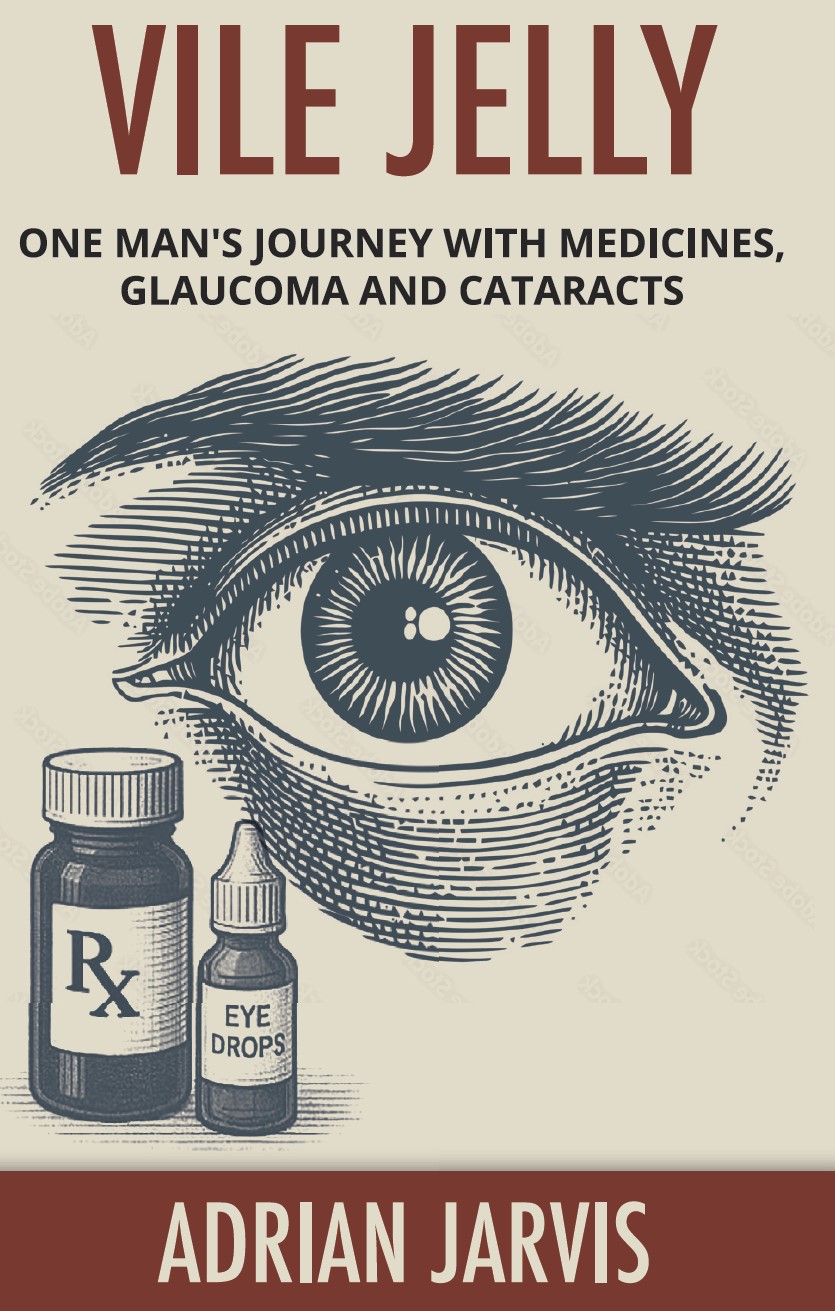
Adrian Jarvis does not write about illness as abstraction or metaphor, though Vile Jelly, published by Stairway Press, contains elements of both. What he offers instead is more direct and more intimate: a record of dependence, of systems quietly failing, and of the ways a life reorganises itself when sight begins to falter.
His account of living with glaucoma and cataracts is not framed as triumph or tragedy, but as a negotiation with the everyday, where even obtaining eye drops depends on “the smooth functioning of a vast system of many parts, any one of which could break down and render the whole thing ineffective.”
There is, early on, a car park scene that lingers for its ordinariness. The fear is not only of blindness, but of being left “high and dry” when supply chains slip and the machinery of care shows its fragility. Jarvis, whose academic work has examined power and leadership, understands what that moment exposes. The individual, in need of something simple, stands at the mercy of systems that rarely announce themselves until they fail.
Yet Vile Jelly avoids despair through its form. Jarvis pares his prose back, leaning into what he calls “economy,” while letting voice carry the weight. “Each character has a distinct way of speaking,” he says, and sound becomes a guide when sight cannot be trusted. There is humour too, dry and persistent, in the rhythms of speech and the small absurdities of medical life.
What remains is a shift in self. Jarvis writes that “seeing is bound up with who we are,” and the book circles that idea without forcing it. Its centre lies not in loss, but in relationships, routines, and the insistence that meaning persists.
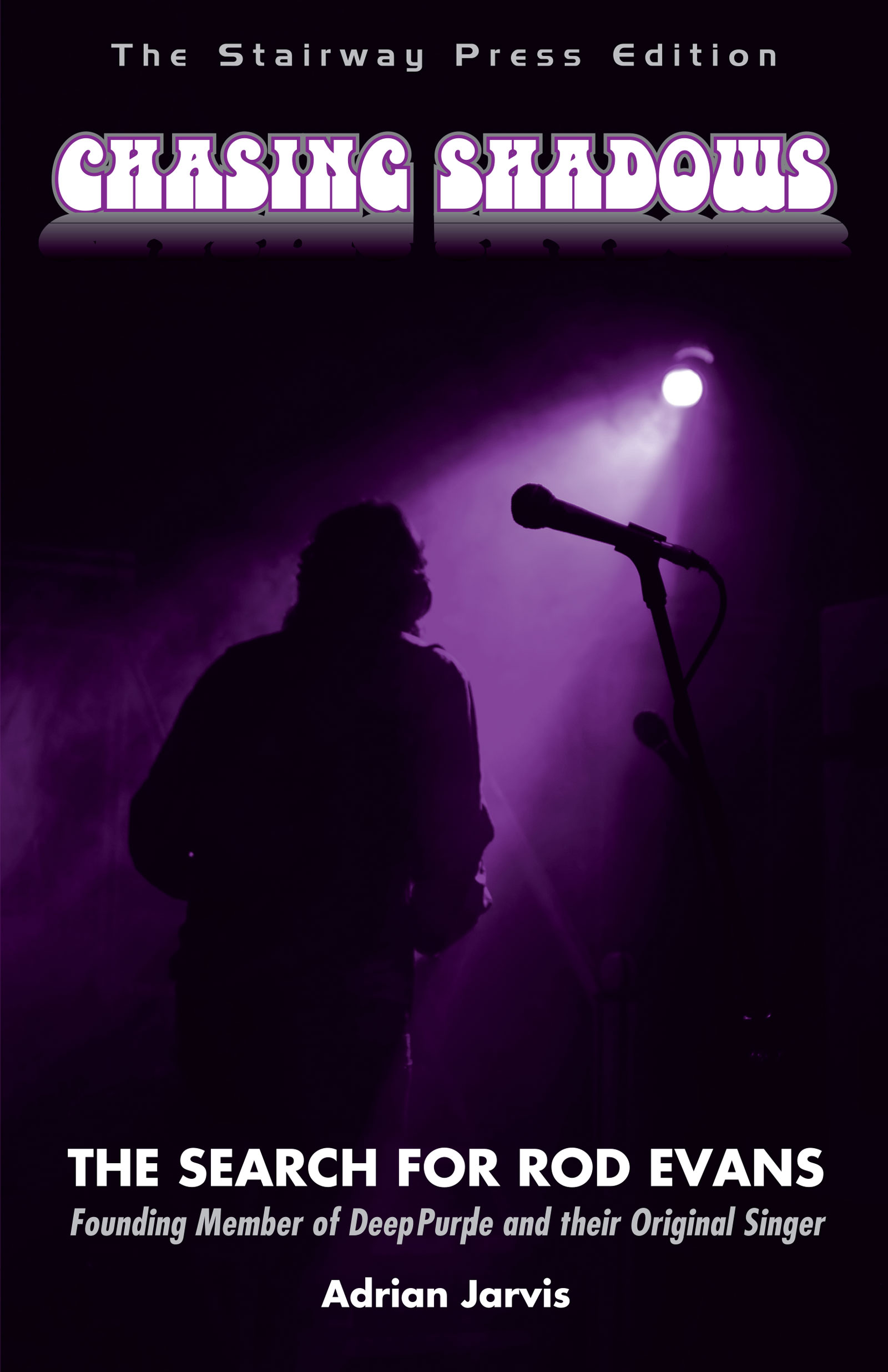
And while this magazine always circles back to music, Jarvis has already taken that route in Chasing Shadows, also from Stairway Press, a book that begins as a search for the vanished Rod Evans of Deep Purple and Captain Beyond and turns into something more personal.
On the surface, it is a detective story. Jarvis sets out to find a singer who disappeared from public life, leaving behind fragments and speculation. But the book does not move in straight lines. It was, he says, “always conceived of as a shaggy dog story,” less about solving a mystery than seeing what the search reveals.
What gives Chasing Shadows its edge is the tension between research and obsession. Jarvis brings persistence, yet meets silence and dead ends, along with the fact that some people do not want to be found. “When someone is that desperate not to be found, you have to respect their wishes,” he reflects, shifting the book away from pursuit.
In the end, Rod Evans becomes secondary. The book is about “a fan looking for something that ultimately proves to be an aspect of himself,” and about how fandom shapes identity. Being a fan, he writes, is one way “we define our individuality.”
Like Vile Jelly, it resists tying things up. Evans is still absent, the answers still partial, but the search leaves a trace, shifting from a missing person to the pull of memory, the habits of fandom, and the kind of questions that linger long after you stop expecting a reply.
“When someone is that desperate not to be found, you have to respect their wishes.”
It’s wonderful to have you here. Let’s start with Vile Jelly, your latest book. You write about the haunting literary echoes of blindness, drawing on figures like Tiresias and Gloucester. Beyond the fear of the physical condition itself, how did facing the possibility of losing your sight change the way you think about metaphor, imagery, and storytelling as a writer?
Adrian Jarvis: That’s a good question! I think that voice is a main element in the book – each character has a distinct way of speaking, so sound became more important than it might otherwise have done. As for imagery, I think that “economy” was the key word: descriptions are brief and quite vivid. They take their cues from the section in the book where I talk about wanting to really “see” the world and imprint impressions of it on my imagination. The images are echoes of those impressions.
The book opens with that terrifying moment in a car park, a reminder of how fragile our dependence on healthcare systems can be. Given your background in studying power and leadership, how do you see an individual’s desperate scramble for life-saving medication as exposing deeper imbalances within so-called functional healthcare systems, especially during a global pandemic?
That scene brought home how powerless people on medication are and how easily they can be left “high and dry” when supply chains break down. I suppose the subtext is that something as simple as me getting my eye drops was actually dependent on the smooth functioning of a vast system of many parts, any one of which could break down and render the whole thing ineffective – as it did at times during and soon after the pandemic.
Vile Jelly has been described as a raw exploration of vulnerability. What was the hardest part of turning such private fear and panic into something public and literary? And how did the act of writing it change your sense of your own strength?
Interesting question! The book is quite honest in the account that it gives, but, ultimately, it is about relationships, in particular that between myself and my visually impaired friend Tosh. That friendship was the source of strength while living with the disease and while writing about it. In that sense, the answer to the question is that telling the story made me realise that my sources of strength include other people, both Tosh and Karen, the other major character.
The book is filled with striking imagery. As your vision was threatened, did your perception of the world sharpen in other sensory ways? How did that shift in awareness shape the style and rhythm of your prose?
See the answer above. I wanted the book to have a sparseness in its prose so that key descriptive moments would stand out, much as certain images do when looking at the world through visually impaired eyes. Otherwise, again, voice was important: evoking character through the rhythms of speech was a main motif, thus foregrounding hearing and sense-making in a different way.
You write about trying to live a normal life while depending on a complex mix of medicines. What does a normal life mean in that situation, and how does the constant fight for prescriptions and medical access change what “ordinary” even looks like?
Yes, that is another good question! In many ways, the central theme of the book is the fight to assimilate medicines into everyday life. As the book shows, that is not easy, especially when hospital appointments are also something of a constant. In the end, it is about treating the medicines and appointments as just another routine, like cleaning your teeth or having a bath. It is a mental shift. Tosh again was a help: he has far worse issues than me – as the book shows – but his habitual response is “it is what it is.”
“Seeing is bound up with who we are.”
There’s something quietly heroic in how you describe taking medicine, turning it into a small, sacred ritual. How did writing about something so routine affect the way you think about the connection between body and identity?
Moving closer to the visually impaired community was a shift in how I saw myself. It was not a planned thing, but just seemed to happen, so, clearly, my sense of self was affected by the reality within which I found myself. Writing the book brought home how much seeing is bound up with who we are and how well we can operate within society. Of all the senses, sight is definitely the one that most conditions effectiveness in the world. Without it, life is difficult, to say the least. That said, some of the blind people I describe are the real heroes, as they manage to maintain busy lives without the help of their eyes.
You use humor, sometimes very dark humor, to move through fear. Was that something you chose consciously as a writer, or did it just become a necessary way to survive?
I find that comic rhythms far more accurately describe the pace of life than those that are more slow-moving and considered. The book, as you will have seen, does include some running jokes (experts always saying “Mmm”, for example, or people forever trying to be reassuring by stating that “they” will probably find a cure at some point): these are shorthand for real-life themes. The humour came naturally out of the situations (and most of it was just how things happened). It must also be said that some of the characters are naturally funny people. Tosh is pre-eminently the case in this regard: he is just a funny guy!
Artists from Borges to Monet have wrestled with partial or threatened blindness. Did you feel connected to that broader creative tradition, to those who have had to reimagine what it means to see?
At the risk of pretension, my chief touchpoint in this respect was Milton. His invocation to light at the start of Paradise Lost, Book 3, was a constant source of inspiration: he calls for poetic insight to replace his now lost physical sight.
As both a music journalist and researcher, I’d love to turn to Chasing Shadows. It’s a detective story, driven by the passion of a devoted fan. How did your academic background in leadership and power shape your search for Rod Evans? And how did you balance the objectivity of research with the very personal pull of fandom?
My background in research was very useful, even though I did not treat the book as a piece of academic inquiry. Nonetheless, my experience did give me the curiosity and tenacity to continue, despite little solid ever really turning up. That said, the book was always conceived of as a shaggy dog story – I viewed it as being about a fan looking for something that ultimately proves to be an aspect of himself. The book is actually quite literary in form (it is deliberately based around Eliot’s ‘The Waste Land’, among other texts) so although everything in it that is not openly presented as fantasy did happen, it is still structured as a classic quest narrative with a quasi-mystical climax.
You’ve said the search for Rod Evans became less about finding a missing person and more about asking why it mattered to you. What did you learn about your own motives in the process? And what does the enduring mystery of a vanished celebrity tell us about connection and collective memory in fan culture?
There is a section of the book (a sort of embedded essay) in which I discuss what being a fan means, the conclusion being that it is a way in which we define our individuality: that was one conclusion to the search for Rod Evans. As for his disappearance, it is quite extraordinary, really! To so completely vanish, despite being of interest to so many people, is some feat. As I say in the book, when someone is that desperate not to be found, you have to respect their wishes; hence, Rod becomes a metaphor in the narrative. In a roundabout way, that answers the question about the role of celebrities: even those that are alive and well and never off my TV are catalysts for the growth of our collective imaginations.
Rod Evans withdrew from the spotlight after an ill-fated comeback. From your perspective as both a rock fan and researcher, what does this kind of disappearance reveal about the pressures and unforgiving nature of fame in the rock world?
It is interesting, because, in a less spectacular way, Rod Evans had already withdrawn from the spotlight and entered “civilian” life. His disappearance was unusually drastic, but celebrity seems to be quite a fragile commodity, hard won but easily lost. I am constantly fascinated by old(ish) film and music magazines that include profiles of “next big thing” artists whom you cannot remember! In that sense, celebrity disappearances happen all the time, but they are not, for the most part, quite as voluntary as that of Rod Evans.
Let’s talk a bit about where you came from. How did your love of music begin? What was your hometown like? Were there any record stores you loved to hang around in? Which local bands made the biggest impression on you back then?
You are basically talking about the story of Chasing Shadows! As it says, I am a small town boy from the Midlands of England who grew up in the 80s – not the most inspiring time or place for music or the presentation of live music. My hometown of Stafford was okay, not especially exciting – although it did have a huge and rather widely celebrated nightclub! My love of rock came courtesy of a few friends who got into it (during the brief “New Wave of British Heavy Metal” period). To be fair, it was either that or synthesiser duos! The main record shop in town was called Lotus Records (now long gone) and it was one of those old style places that you could hang around in and talk about music without being compelled to buy anything. I used to go there a lot after school and listen to stuff and talk to people. It was from there that I acquired my first two Deep Purple albums, ‘Burn’ and ‘The Third Album’. In fact, buying the second of those and seeing the names of the band members was where my fascination with the fate of Rod Evans originated. So, I guess that I owe Lotus Records a lot!
When did your curiosity about Rod Evans first take hold?
See my previous answer. I had only really heard about Ian Gillan as lead singer of Deep Purple and the albums on which he appeared always sounded fresh and contemporary. Then I bought The Third Album and saw that he was not on it. Moreover, the music had that sixties dated feel that seemed to come from a world with a certain glamour that made it different from “my” world. The music transported me not only to a different time, but a subtly different culture. That was fascinating; when I found out about Evans’ fate, the mystery only deepened!
Chasing Shadows blends memoir, history, and detective work. How does your search for Rod Evans and the story of Deep Purple intersect with your identity as an academic, author, and teacher? Is there a connection between chasing a cure for your vision and chasing a lost musical story?
Interestingly, yes! I always thought of Vile Jelly as a sort-of sequel to Chasing Shadows. One deals with sight, the other hearing. Both are about who I am and how I operate in the world, so, in that sense, they are both explorations of my identity. I like the fact that incidents in the two books happen simultaneously, but the fact is not obvious from reading them. That “kaleidoscope” or “jigsaw” approach to memoir or autobiography intrigues me because it is how we form our identities in real life – not in a linear fashion, but through intersecting stories and stop-start advances.
You’ve said the book speaks to anyone who has ever been a fan of something. What universal truths did you discover about devotion, escape, and the ways we build our identities through what we love?
Precisely that: our enthusiasms are one of the main ways in which we build a sense of who we are. The things that we really like – the lifelong loves – are a theme or subtext to our whole lives. They are there, always changing and developing as we do. And they do not need to change in themselves. Sure, Deep Purple have changed many times since I first discovered them, but, say, T. S. Eliot has not. Even so, his work has changed for me as I have grown to appreciate it differently over the course of my life. Context in that respect is important: and we, as fans, provide the context.
During those anxious moments of supply chain chaos in Vile Jelly, did any particular songs or bands help you make sense of what was happening, or bring you comfort?
At around the time of that scene in the car park, I went to a gig that had both Blue Oyster Cult and Deep Purple on the bill – two of my favourite bands. How can you feel miserable when you are experiencing that? These days, I cannot get enough of Larkin Poe: they seem to have been put on the earth for the sole purpose of cheering everyone up. If you have never listened to them, do so immediately. You don’t need to thank me!
Since your work delves so deeply into music, how does it function in your own life? Is it an escape, a source of analysis, or a way to balance the stress of illness and the complexities of the medical world?
I have to say that I am not that deep when I listen to music. I just want to be entertained. The music that I like does that. I have very little patience for music that takes itself too seriously!
Having worked in Malaysia and now living in Nottingham, how have those different settings shaped the way you see healthcare systems and the search for truth in biography? Does the quiet town you grew up in still shape how you see the world?
Once a Midlander, always a Midlander! But I have long had a fairly cosmopolitan view of the world. I love travel and I would recommend spending some time abroad to anyone. As for healthcare systems, ultimately I am most grateful to Britain’s good old National Health Service (NHS). Yes, there is much about it that can be criticised, but, of all the people who have helped me with my eyes, it is NHS workers who have treated me not just as a patient, but someone to actually care for and about.
Vile Jelly is about chasing a lifeline in a moment of fading hope. As a storyteller, how important was it for you not only to document the crisis, but to craft a narrative that still finds light and humanity within it?
It was very important. Visual impairment is too often overlooked as a problem. I wanted to capture some of the experiences of the people (not just myself) who have suffered with it. And, as you have said, that is not merely the tragedy, but the humour and humanity. Quite a bit of the book takes place during that other medical emergency, the pandemic: I certainly thought that there was value in documenting my experiences during that time. It is a little bit of social history from a period that was so strange that it should not be forgotten.
In Chasing Shadows, you explore obsession and the persistence of curiosity. What do you think draws us back, again and again, to the vanished and the forgotten?
Dissatisfaction. An unanswered question is an itch that remains unscratched. We naturally want things to be whole and complete – not least the stories that we tell.

And finally, what is filling your days right now?
I am currently kicking around an early draft of a book about what we call chips, but which Americans refer to as fries – my favourite food item. It takes the same approach as Vile Jelly and Chasing Shadows and features many of the same people. Although this was not planned in advance, I now see it as book three in a “Three Senses” Trilogy, this time dealing with taste. Other than that, I am getting on with my job of teaching and researching.
Klemen Breznikar
Stairway Press Website