
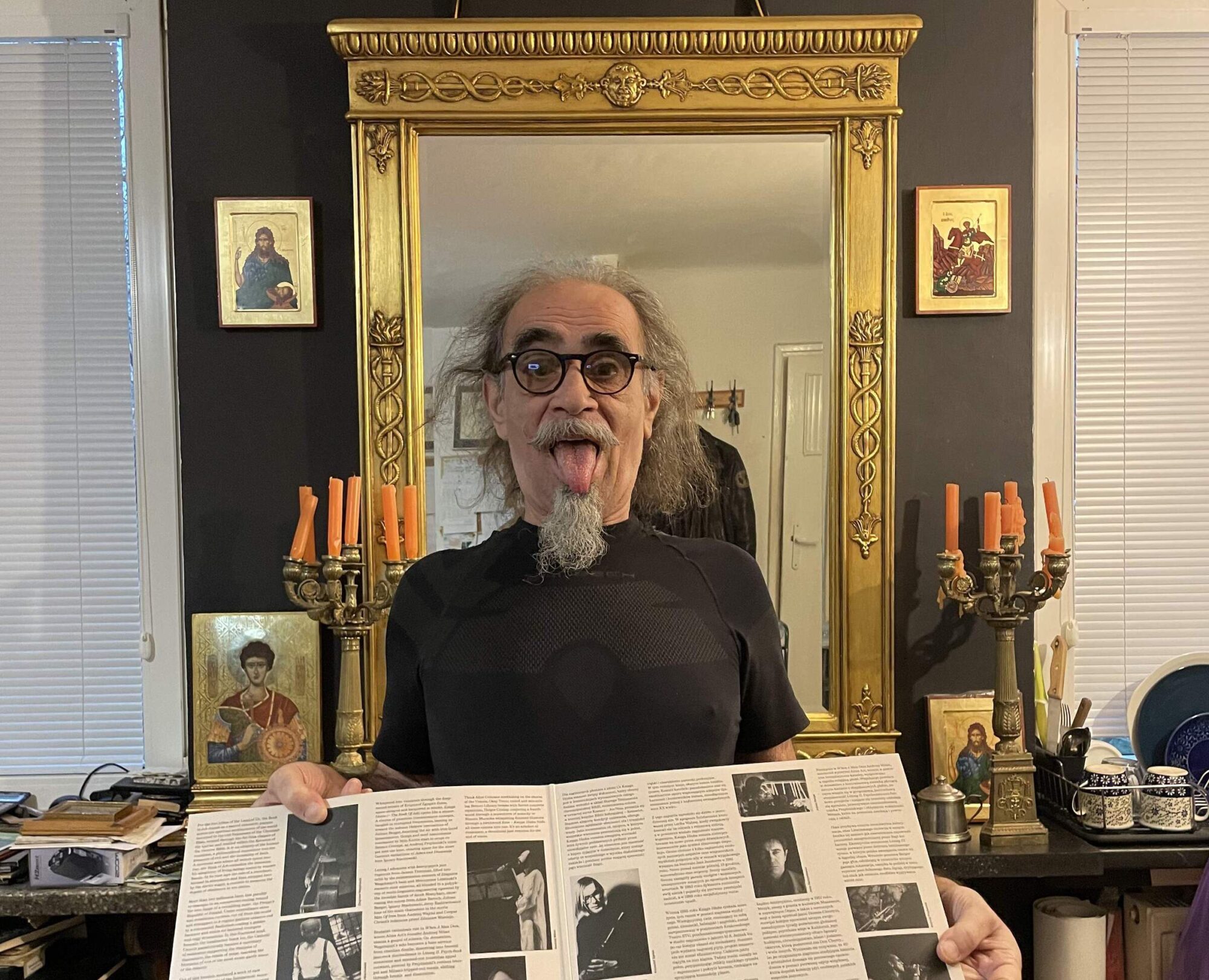

Exploring Poland’s 60s–70s Underground: Milo Kurtis on Jazz, Osjan, and ‘The Book of Job’
Today we speak with one of Poland’s most adventurous musicians, Milo Kurtis, a member of legendary Osjan and a contributor to countless other projects.
Born into a Greek family in Zgorzelec, he spent his childhood in children’s homes, absorbing music wherever he could. Over decades, he has moved from free jazz to folk traditions, performing with influential bands like Osjan and exploring instruments from Greece, India, and the Middle East. “I choose musicians according to what I want to do. I choose the best musicians available in Poland, and they don’t have to be Polish. I have Jews, Syrians, Greeks in the band,” he told us, reflecting on his collaborative ethos.
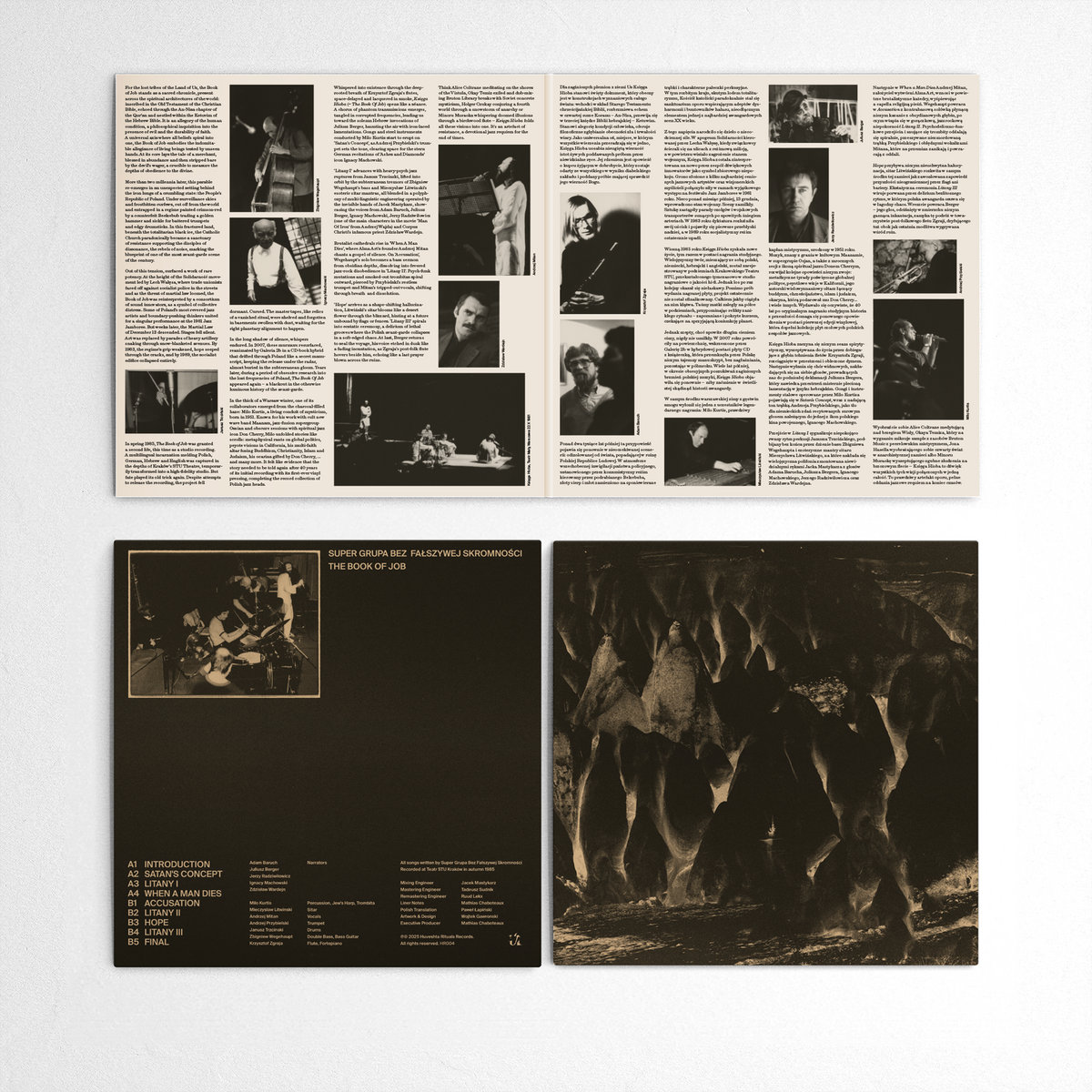
Kurtis’ work on ‘The Book of Job’ by Super Grupa Bez Fałszywej Skromności continues this path. The album transforms the biblical story into a living soundscape, with his clarinet, oud, darabuka, and bassoon weaving through striking improvisations. “For me, music was music. I listened to the melody of the voice, not the words,” he explains. The ensemble behind ‘The Book of Job’ was a daring collective of Poland’s most inventive improvisers, drawn together by a shared drive to stretch sound beyond the expected. Each member brought their own lineage of influences and styles, shaping entirely new sonic landscapes.
This Polish jazz recording was originally composed in 1985 by a consortium of 12 musicians and was recently reissued via Huveshta Rituals (the original release was in 2007 via Icons of Victory). Performed at Jazz Jamboree amidst the Solidarność uprisings and then captured on tape, the project was shelved for decades, whispered about like a forbidden manuscript. Forty years later, the recordings resurface on vinyl, featuring names like Milo Kurtis, Andrzej Mitan, Krzysztof Zgraja, Jerzy Radziwiłowicz, and other visionaries of the Polish avant-garde. The album unfolds as a séance of flutes, sitars, gongs, trumpets, and multilingual invocations.
Milo Kurtis’ decades of experience, from the intuitive ensembles of Grupa w Składzie, the first hippie band in Poland, to the explorations of Osjan, shine through every phrase, giving the album a unique depth. He moves through the music without trying to dominate. “I fit the atmosphere, so I was invited,” he recalls of the sessions. The recording is alive, offering a glimpse into the mind of a musician who has spent a lifetime listening, exploring, and discovering new ways to make sound speak.
You can order your copy of ‘The Book of Job’ here!
“I like discovering.”
Before the drums and flutes, there was rhythm. You were born in Zgorzelec, a small town between Poland and Germany, in a Greek household that fled the Greek civil war. What were the first songs that defined your childhood in Poland? Not music specifically, but how did you lay the groundwork for a life in music afterward?
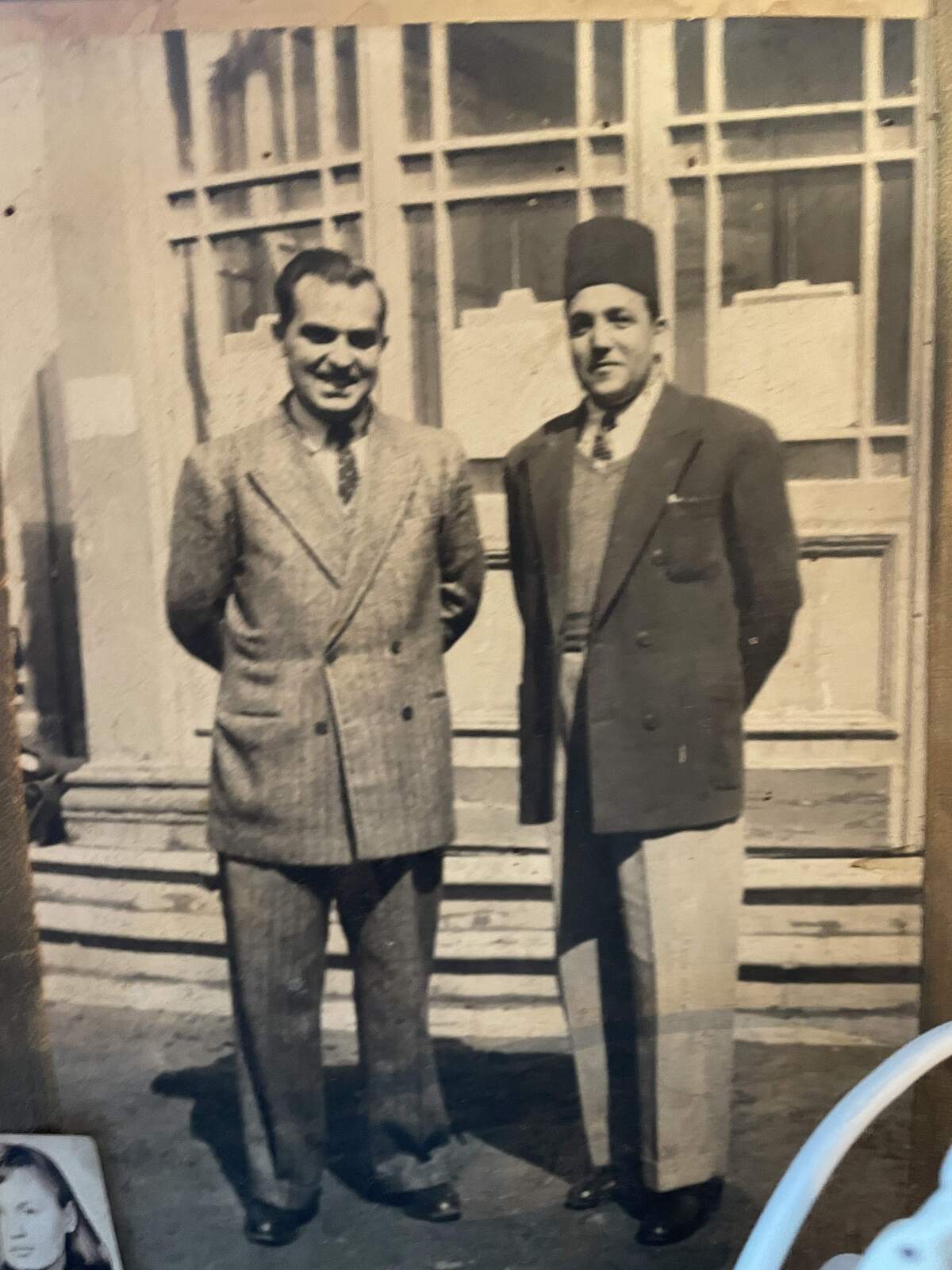
Milo Kurtis: First of all, my parents didn’t flee the civil war in Greece. They traveled from Alexandria, from Egypt, through France to the Soviet Union, because they wanted to live there as communists in the Soviet Union, in the so-called paradise for communists, right? Later it turned out to be a fraud. But on the way, in Zgorzelec, I was born. And so they stayed in Poland, on the one hand. On the other hand, we didn’t really have a family home. I was raised until the age of six in children’s homes, not in a family. Because my parents had to nostrify their university diplomas and had to learn Polish. They had to enroll at the University of Warsaw and so on. They didn’t have time for me. And then, four years later, my sister was born. She’s unfortunately no longer alive. And they still didn’t have time for me. I grew up in children’s homes, which for me was simply wonderful. I had such a beautiful childhood in those homes. When I listen to other artists who had similar experiences, somewhat similar to mine, and hear them complain about children’s homes, about how bad it was, I can’t complain. I’m glad I had such a beautiful childhood.
As for the first sounds. The first sound I remember is the sound of a mandolin. When I was in a children’s home in Police — it used to be German territory before the war, Western Pomerania — my father would come and take me for walks. Once he lost me in winter, because my father was always reading. He was pulling me on a sled. I fell off the sled, but my father didn’t notice. I was light, I was small. And I got lost. I mean, they found me, of course. They brought me back to my father, and there were jokes in the newspapers about my father losing his child.
The first sounds I remember were when we were walking, and I was about four years old then. Three or four. A man was sitting there and playing the mandolin. So not like you say, that everything really started from rhythm, but you know, from a beating heart. The guy played the mandolin beautifully. I thought everyone could play like that. And I said I wanted to play. The man asked me if I could. Of course I said yes. So I took the mandolin, started strumming, and he just took it away from me. “Why are you lying? You can’t play. You don’t know how to play.” That was my first contact with music. One that actually discouraged me or commanded me to either learn seriously or discouraged me entirely. Maybe I should have been an engineer, fly into space, like my father wanted. And the only school I finished was an electronics school, a kind of semi-higher education. And that’s it. So I’m an electronics technician. I’m not an artist, kurwa.
How did this dual heritage, Polish and Greek, shape your sense of identity and artistic vision?
I don’t divide my heritage into Greek and Polish, because I am Greek. I have 100% Greek blood, from my mother and father, from my grandparents and great-grandparents, and great-great-great-grandparents. So I am Greek. But I’m very, very much more attached to Poland than to Greece. Because I’m also a very comfortable person. I want my life to be easy. Maybe that’s why I’ve lived so long. I want my life to be easy, and I don’t need unnecessary problems. But I’m a Polish patriot. And I’m also a Greek patriot. Greek patriotism was instilled in me by my parents. Under communism, Polish patriotism was emphasized. You know, now the word “patriotism” is almost forbidden, right? According to political correctness. But I was never politically correct, so I don’t have a problem with that. In any case, I’m only Greek. I don’t have a single drop of Polish blood. And for us, like for Jews, lineage matters, not place of birth. For Jews, wherever you’re born, you’re Jewish. For Greeks it’s the same — blood matters. It doesn’t matter where you’re born; what matters is that you’re Greek. That’s why there’s this wonderful film I’ve seen dozens of times, and it never bores me, because I always find something new: My Big Fat Greek Wedding. They mock our flaws, and those are real flaws. I have those flaws that I see in that film.
Back to your first encounters with jazz in Poland. Can you describe the feelings and context of those first encounters?
Jazz was very popular in Poland. Until 1956 it was banned by the communists. But later it was allowed, when Gomułka came to power. I started listening to jazz when I was around 13 or 14. I started properly with Dixieland jazz, traditional jazz. And then I started… Within two years I got to free jazz. Quickly. Quite quickly. But I like things I don’t know. I like discovering. Maybe that’s also why I’ve lived so long, because I’m constantly at the beginning of the road. Even now I’m at the beginning of the road, because I have ideas. And you know… I still have a few things to do in my life. I have ideas for them. They need to be done. So jazz — I’m most attached to jazz and to ethnic music.
Who were the key figures in the Polish jazz scene who inspired your first steps?
My very good friend, an influence, Tomasz Stańko, first of all. We recorded two albums together. He was a searching jazzman. I followed him. I learned from him. He was ten years older than me. We were very close friends. For a year and a half of his life he lived in my house. He had a falling-out with his whole family and lived with me. So I probably knew him better than anyone. When I got to know him, it was over fifty years ago. Half a century ago. And he was already doing avant-garde then. It wasn’t a niche in Poland. Free jazz isn’t a niche in Polish jazz. Maybe now it’s starting to be, but no, it’s not. Free jazz was very popular in Poland. I attached myself to that kind of jazz because it’s the hardest type of music. How is that easy to prove? Very easily. Every educated jazz musician can play in a symphony orchestra. But less than one percent of symphonic musicians are able to play jazz. Less than one percent. So jazz music is harder than classical music. At the same time, at home I had an enormous influence of traditional Greek music. In communist times there were basically no Greek records here. Occasionally something appeared. So I bought Bulgarian, Romanian records and so on — folk music from those regions. Because when you listen to Greek music, Bulgarian is identical, Jewish is identical, Turkish, Syrian… it all has identical divisions, identical scales. So I was interested both in traditional music and in the most avant-garde music. I was also attached to music that wasn’t jazz, because at the beginning I didn’t play jazz music. I played intuitive music — that’s how we called the group Grupa w Składzie.
You were using many different instruments, blending rhythms, melodies, and many different things. How did that happen?
It comes from my life philosophy. I lived in many countries for long periods. In the States 11 or 12 years. In Switzerland. In Denmark. Ten years in Germany. In Greece, for obvious reasons, in my family homeland. Every country I live in is my country. I don’t divide the world into national countries, even though it now seems like one should. For me, that doesn’t exist. Wherever I am, I’m at home. The entire globe is my home, not individual countries. That’s where my interest in instruments from different regions comes from. I have an ease in learning new instruments. But I have a problem with practicing. I don’t want to. I’m totally lazy. I don’t feel like practicing too much. When I discover a new instrument, I go into it fully. Then I get bored and move on to another. I don’t like being called a “multi-instrumentalist.” I know people mean it positively, but for me it’s not positive. Because a multi-instrumentalist can’t be a virtuoso on any instrument. So for me it’s not a compliment. But I like discovering new instruments, and I still do.
“Grupa w Składzie was the first hippie band in Poland.”
Can you share your first memories from the earliest sessions with Grupa w Składzie?
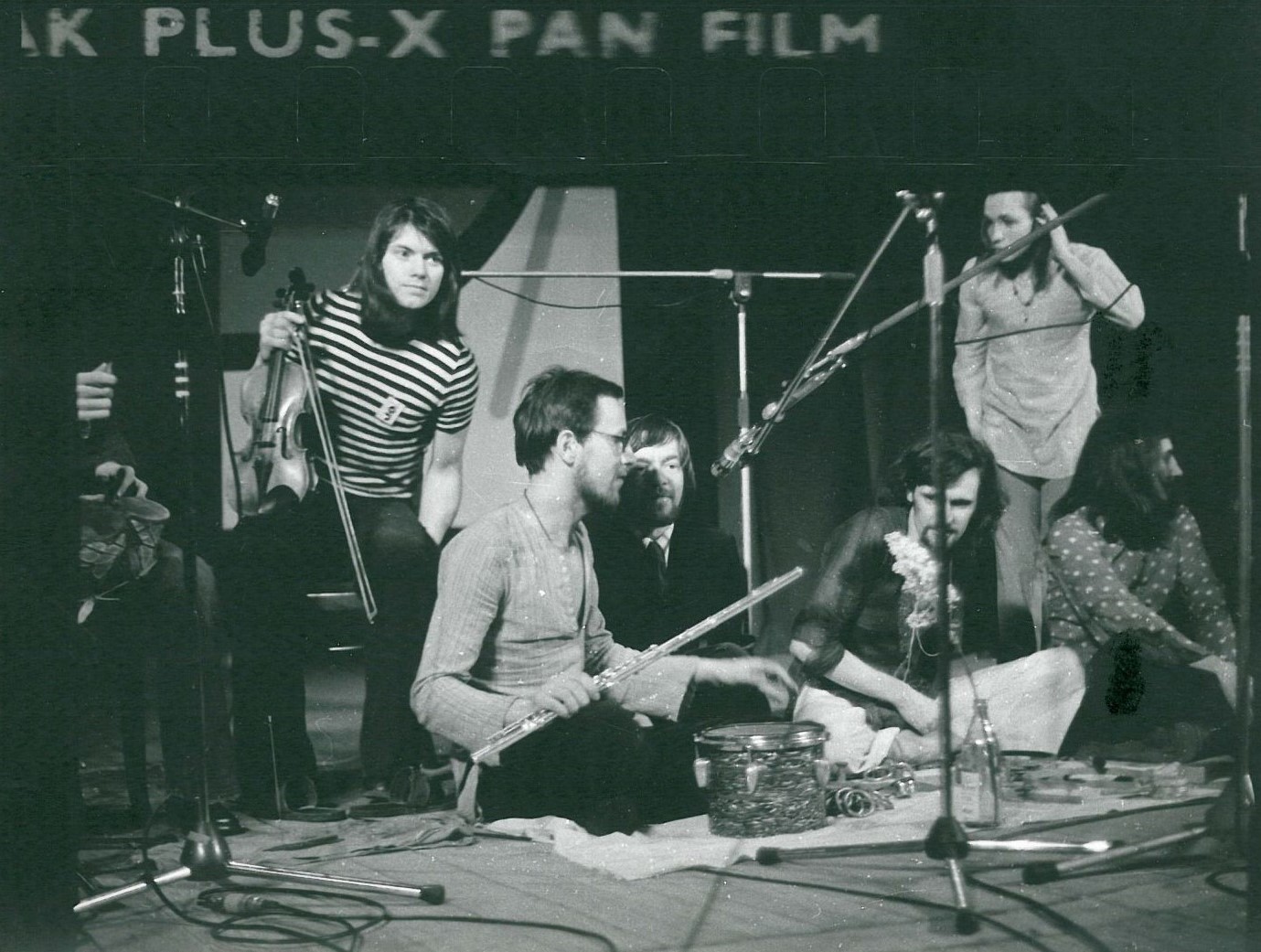
Apart from me, nobody in the band had any musical education or knew how to play instruments. That was the rule of Grupa w Składzie. Only I had music school training and knew how to play. The rest didn’t. And from that we made intuitive music. First you had to listen to someone else before making a sound. We glued sounds together between us. Sometimes concerts lasted four to six hours. People came and went. They were performances, really. Once we went to what I found — an avant-beat festival in Kalisz. Grupa w Składzie was the first hippie band in Poland. On the application form you had to write the band name and members. I said: let’s leave it as Grupa w Składzie. Because each time someone else played. I was the only one who played every concert. It was the peak of the hippie movement in Poland. Hippies organized gatherings several times a year; the citizens’ militia would come, break them up, and so on. I was never at a hippie gathering, even though I was one of the first hippies in Poland, because when Grupa w Składzie played, those gatherings happened at our concerts.
I remember an anecdote. We won a festival. Tomasz Stańko gave us a private prize. At the next festival we won first prize, 5,000 złoty. At that time it was unimaginable money. Some hippie friends came to our dressing room to divide the money. I said: ladies and gentlemen, the band stays, everyone else please leave, we need to discuss the concert. When everyone left, I took the cash and divided it among the musicians. The musicians earned it, not all the hippies. I told the other musicians: you can divide your own money if you want. In the end, everyone followed my example. We collaborated with conceptual artists, did actions together. It’s documented in books. We entered Polish history. To this day, Grupa w Składzie plays one concert a year in the Planetarium.
And how come there were so many bands in this scene at that time?
There were not so many bands then. Hippie bands — there were two hippie bands: 74 Grupa Biednych and Grupa w Składzie.
Why were there so many experimental and jazz bands in Poland under that regime?
It wasn’t the regime. They let us do our stuff. They were fine with it because we didn’t use words, we only used sounds.
You shared the stage with so many different outfits, with very different sound aesthetics like Ossian, Deuter, Izrael, Voo Voo, Don Cherry, Maanam. That’s a lot of very different bands. Why did it happen that you were involved in so many groups?
I don’t know.
You don’t know?
No. That’s just how I was built, you know. Open to all cultures. You see, here I am now. You know, when it comes to the bands I played in. For example, I co-founded the band Maanam, the most popular rock band at the time in Poland. But when it became a rock band — earlier it had been closer to Grupa w Składzie and Ossian — when it started playing rock’n’roll, I left. The same with Voo Voo — when it started playing rock’n’roll / new wave, I left. With Izrael, I got bored playing the same thing over and over again. Always the same, constantly smoking weed. So, uh, I just didn’t feel like it anymore. I also played with punk bands, punk-rock bands, because when punk rock was emerging, it wasn’t important to me that they couldn’t play well. What mattered was the energy they gave, and it was huge. It was a very powerful energy at that time. But eventually I focused on playing music that connects jazz with ethnic music. And at this point, that’s basically all I do. Sometimes I get invitations for other recordings from DJs and so on, like DJ Grzyb, for example. One day I’ll record an album with him, I just don’t know when. You know, to do the kind of things I do, you need to have a clear mind. Yes. And lately I’ve been occupying my mind with completely different things than music — politics…
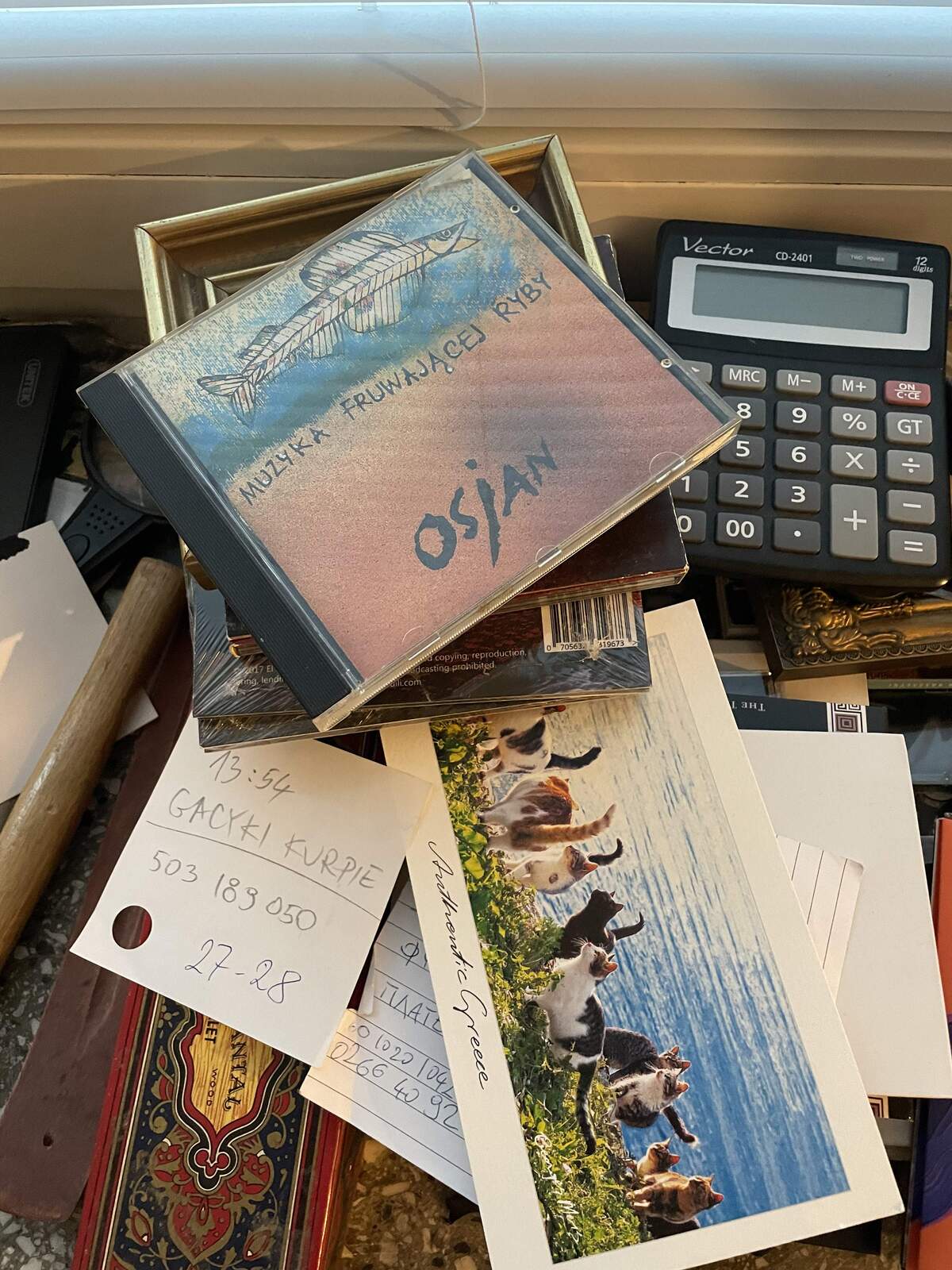
Every band has its own language. What are the unique rituals that define Ossian offstage for you?
You know, I wouldn’t like to say too much about Ossian, because it was wasted time.
In what sense?
In the sense that I didn’t learn anything. You know, only later did I realize that back then I thought I was very closely connected to Ossian. But one of the people in Ossian made me realize what my position in the band really was, and I simply left. I didn’t want to have that kind of role — not just as a performer or just a manager. I also wanted to give something of my own.
Anyway, Ossian. I have the same thing now with my band Milo Ensemble. Milo doesn’t come from my name; it means Musical Instruments Logical Organization Ensemble. I had the same problems, and I still have them now. People came to concerts in large numbers, but organizers don’t want to invite us. For two years now I haven’t received any invitations to any festivals. The only festival I do is with President Trzaskowski. Trzaskowski took over my festival, and now he runs a world music festival. I was also the musical director of around twenty festivals: Festivals of National and Ethnic Minorities of the Republic of Poland, World Music Warsaw, From Bikiniarze to Hipsters, The History of Counterculture in Poland… Also the Festival of Polish Greek Culture.
I organize minority festivals to show Poles that when I organize festivals of national and ethnic minority music, Poles don’t know their own music. Poles are exactly the opposite of Greeks. In Greece, rural origins and attachment to tradition are a source of pride. In Poland, they are a source of shame. People don’t want to admit they come from the countryside, even though 80 or 90 percent of Polish society has rural origins and is ashamed of it. In Greece, they emphasize it. So I have rural origins. Greek.
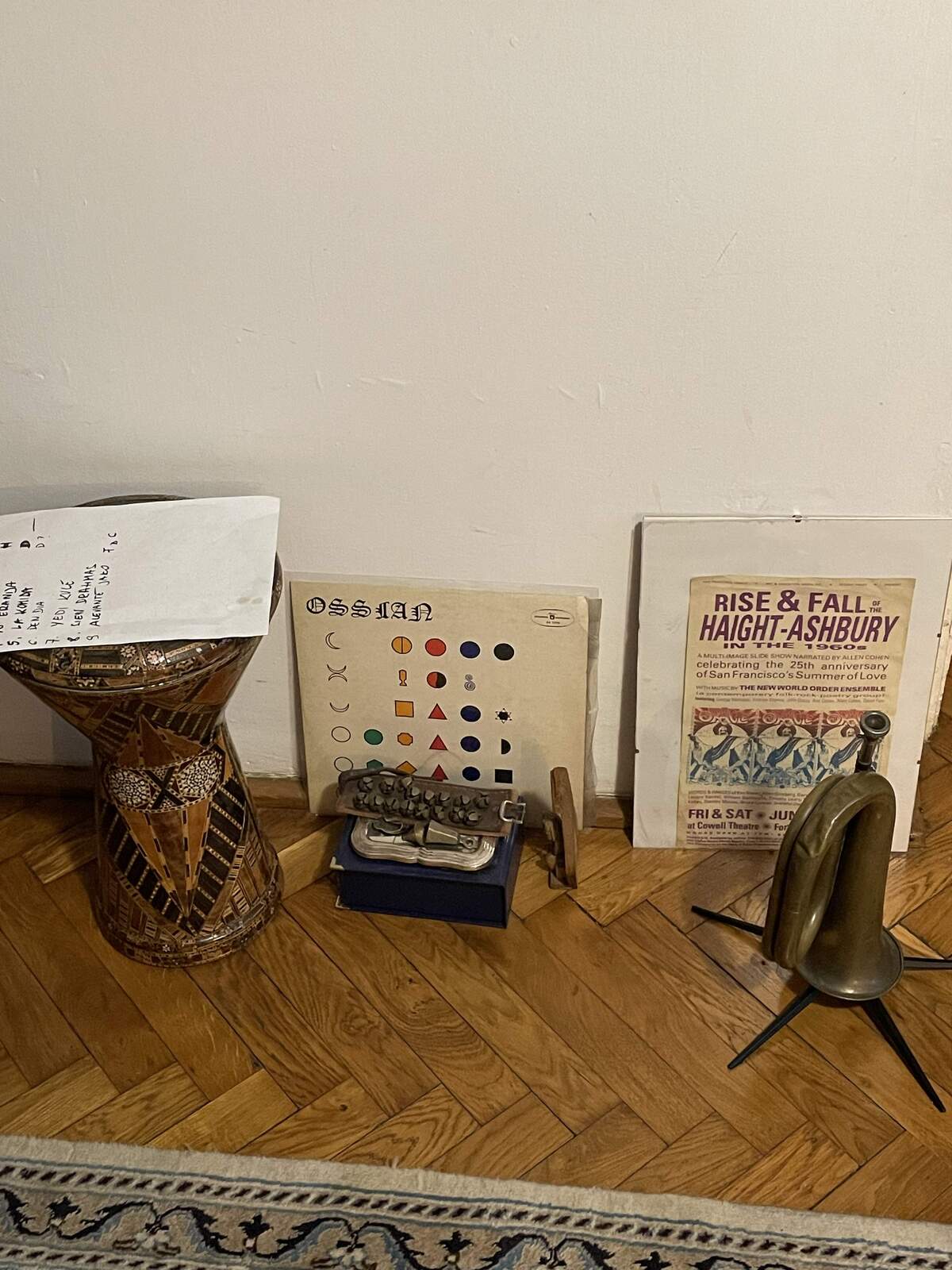
Your approach to performance is quite specific, you like to play with silence, tension, and improvisation. But you’ve also played in large bands. How did you manage to give space to everyone in concerts?
That’s the most important thing in music — to give space to others. If it’s improvised music, you have to listen to others. That’s the foundation of everything: listening. And only then reacting.
Or sending out your own sound and listening to how others react to it. So it’s like tossing sounds back and forth a bit. And in the bands I had, I gave everyone space. There was very strict discipline during rehearsals, but total freedom during concerts.
And you never really knew how long we would play. Another thing is, if someone told me to play for 59 minutes, I played exactly 59 minutes, even though it was improvised music. I could play exactly 59 minutes. Then organizers would come and say, “But Milo, why did you stop?” “Because you said 59 minutes.” “Well, we thought if we said 59 minutes, you’d play an hour and a half.” “No — if someone requires 59 minutes and I sign a contract for 59 minutes, I play 59 minutes.”
If there’s no time limit, I can play two and a half hours without a problem and people don’t leave the concert. As I said before, I had difficulties with Ossian. Why did I break through with Ossian? I was the leader of Ossian, but they didn’t want to acknowledge it. The leader is the one who organizes concerts, right? So I decided to go abroad. And abroad we actually made quite a career with Ossian. We played around a hundred concerts a year in Germany, Switzerland, Belgium, Luxembourg, the Netherlands – in most Western European countries. But we were banned from Eastern Europe. We couldn’t play in Czechoslovakia, the GDR or the Soviet Union. Once we went to the GDR and played in a Protestant church – that was enough for a ban. We played in Czechoslovakia for the Czech opposition, for Havel, the President Havel was at our concert. A private concert for them. We were young, we didn’t know we were being watched everywhere. After that concert, we returned to Poland and couldn’t go back to Czechoslovakia again. That’s how it was in communist times. I don’t complain too much about those times, because I had a beautiful youth. I lived under three or four different systems. I lived under Stalin, I remember a youth congress in 1955; my father carried me on his shoulders. It was the first time I saw Black people and Asians. I thought only white people existed in the world. I lived during Stalinism, during the People’s Republic of Poland, during martial law. I lived in police-puritan America, in Germany. Different systems everywhere. The German, French, European systems were completely different from the American one. There is more freedom in Europe than in America, that’s clear. But I felt okay everywhere, at home everywhere. System changes don’t scare me. Poland changed systems too. I left Poland just after martial law and returned to a supposedly free Poland. Because there are no truly free countries now. But let’s not talk about politics.
Let’s return to ‘The Book of Job’ (‘Księga Hioba’). It’s a story of suffering, loss, and profound questioning. What drew the team of musicians to this narrative as a theme?
After the Solidarity revolution in 1980, people suddenly began admitting their Jewish origins. The Book of Job is a Jewish story, right? Christian too, probably. Muslim as well. So it’s universal. I was invited to participate because I represented what was needed — not only musically, but in my whole life attitude. I used instruments that normally weren’t used in Poland. Even now, listening to the album after 45 years, I don’t remember what I played there at all. I was listening and thinking, “Where am I playing? Where is someone else?” I didn’t know whether I was playing sitar or Litwiński was — he also played sitar. I fit the atmosphere, so I was invited. As for the texts, I never paid attention to lyrics my entire life. For me, music was music. Whether opera, rock’n’roll, jazz, or ethnic singing. I listened to the melody of the voice, not the words. I still don’t listen to lyrics. I don’t know what I’m singing under. I don’t know what’s actually in ‘The Book of Job’. I was involved as a musician, not as a listener. Terrible, right?
If you could give listeners a single word or feeling to hold onto while listening to ‘The Book of Job’ in its entirety, what would it be?
Be open-minded. One word, right? Just an open mind. You have to be open to everything and never be surprised by anything. Don’t be surprised.
You’ve navigated a career spanning decades and continents. From free jazz to ethnic music to your current projects, … what’s the most important lesson you’ve learned about collaboration?
I learned that I know what I want to do. And I choose musicians according to what I want to do. I choose the best musicians available in Poland and they don’t have to be Polish. I have Jews, Syrians, Greeks in the band. I learned to firmly implement my own concept in my bands — whether in Grupa w Składzie or Milo Ensemble — to realize my own vision and explain it to the musicians. They learned a lot in my band. We’ve been playing together for over ten years, although Milo Ensemble first played in 2002 — over twenty years ago. They learned free improvisation. Most of them were classical musicians in their own traditions. I use oud, saz, darabuka, clarinets — many ethnic instruments — but we also play free. And they played free improvisation for the first time in my band.
Once a very famous musician came to a rehearsal. I invited him to play with me. Wojtek from Voo Voo — I had left that band because I drank too much alcohol. I was fired. I never drank vodka, only wine — I’m Greek, after all — but Wojtek fired me, and that made me realize I was on the wrong path. I stopped drinking. After the rehearsal, Wojtek said, “Milo, how did you do that? You run rehearsals brilliantly. You say what you want and they give it to you.” I said, “We’ve been playing together for ten years — they know what I want.”
Andy Sheppard, who played with us at the 50th anniversary of my activity at Jazz Jamboree, said I created a new genre of music — combining ethnic music, jazz, improvisation. No one had done that before me. But still, you know, I sit at home, and he keeps playing his thing. His classical thing, classical, that is, for free jazz.
Musical identity is built on what you listen to and what you create. What would you say you’re listening to nowadays?
I only listen to music when I have to listen to music. So I listen when I’m practicing. I like practicing most with Indian classical music: Anoushka Shankar, Ravi Shankar, Vilayat Khan, Ali Akbar Khan, sarod, Vilayat Khan on sitar. Wait, who else would be good here… Ram Narayan on sarangi, and so on. So I listen to Indian classical music. I was partly raised on that music. It’s quite difficult music, that of classical Indian music. But I like practicing with it.
But I also like — when I listen, you know — I like listening to music I haven’t heard before. There’s very, very little of that left. Basically everything has already happened; I’ve heard it all. When this new wave of jazz appeared in Great Britain, I laughed my head off, because we were playing that music 30 or 40 years earlier. When Grupa w Składzie played its music in 1970, in San Francisco, in the first half of the 1990s people started playing that exact kind of music in clubs — music we had played 20 years earlier. So musical genres were being created here in Poland.
Why do you think that was the case?
Well, nobody thought of it earlier, that’s it. It just took them longer. For me it was natural. What I was doing was a natural development of my life, because my life is connected with music. There’s no other way. It was obvious I would go in that direction. And I did, and I don’t really deviate from it. And living only from music — well, I already told you how that is. It’s not easy. But I don’t complain. I’m happy.
Can you say something about the difficulties of being a musician?
Yes. There is only one answer: no money. No money. That’s the only difficulty.
But the rest is nice. The rest is fantastic.
“You can’t be avant-garde without being conservative.”
If you had to choose one story about one instrument you own, which would it be?
Bassoon — fagot. I studied bassoon at music school. Professor Kazimierz Piwkowski was my teacher. I even visited him at home. He had never seen anyone like me before. Of course, I was learning classical bassoon to play in the philharmonic. But from a very young age I had an ability to improvise. And I preferred improvising to playing sheet music. So I would start by playing what I had prepared from the score for school, and then I’d improvise on that theme. And the professor was crazy about me. In all the other subjects at school I was terrible. I was a hippie, you know. The only one with long hair, a beard, and so on. Of course they wanted to expel me, but they couldn’t, because the professor was such a distinguished figure. Later he went to the music school in Karlsruhe — one of the biggest music schools and one of the biggest contemporary music festivals. He ran that. He left the school, and a few months after his departure, I was expelled. That was because we were playing with Osjan in Christiania — the biggest hippie commune in Europe, in Copenhagen. After the concert, I stayed there for half a year, because we had no other concerts. I lived there, and they welcomed me warmly. But when I came back, I was no longer a student of the music school. The same thing happened when I went to the GDR — East Germany. When I returned, I was no longer a member of Maanam. John Porter took my place. And I was happy about it. As I said, I stayed friends for life with Marek Jackowski and with Kora. You know, we were the creators of Maanam — Marek and I. Milo and Marek, M&M. Later Kora joined after a year. We created Maanam together. They went in a rock direction, and I drifted further away — that’s true. But because I was gone for a long time, well, the absent have no rights. And I stopped playing in Maanam. Which turned out to be good for me. I focused only on Osjan. I wanted to play improvised music, which Osjan gave me at the beginning — later less and less. And I wanted improvisation, not rock’n’roll. So if I had to choose between Maanam and Osjan, I chose Osjan. Even though Maanam was already on the rise — full houses everywhere. The career was going up. But I preferred improvisation. Just like now — I could play with some famous bands. If I had stayed with Maanam, you wouldn’t be sitting on this chair, you’d be sitting on a golden chair already, fuck. But you see — I try to be honest. The most important thing in my life is being honest with myself. That’s the most important thing. Now that I’ve returned to marijuana — which is legal in Poland now, bought in pharmacies with a prescription — after ten years I started smoking again. And suddenly I started wondering whether I’m honest with myself. Because that’s what really matters in life. I think that artistically I’ve been honest with myself. But in everyday life — not really. But I don’t think I’m a saint. Maybe Mahatma Gandhi — no, wait, he was a racist when he was in South Africa. So maybe the Dalai Lama — he’s a man who is honest. But there are very few people who take care of their honesty. At least I haven’t met many. For me, this is the most important thing in life: to be okay, to not harm others, and to create — constantly create new things. That’s how I’ve lived my whole life. You can see it in my apartment. I may be poor, but look how many artworks I have at home. How many instruments. If someone came to my home and we didn’t talk about money, they’d think: fuck, what a rich man. But I’m attached to tradition. And with age, I feel more and more like a conservative. A person who takes peyote or LSD can also be a conservative. Peyote experiences — if you’ve read Castaneda, Don Juan — are rooted in tradition. All psychedelic journeys come from shamanic traditions. So tradition equals conservatism, right? I’m starting to see myself as a conservative, even though I feel like an avant-garde musician. You can’t be avant-garde without being conservative. You have to know tradition to break it. There’s no other way. That’s why I’m so close to traditional music. In my band, all pieces are written — but only the themes and rhythmic structures. About 90% is improvisation, only 10% is written.
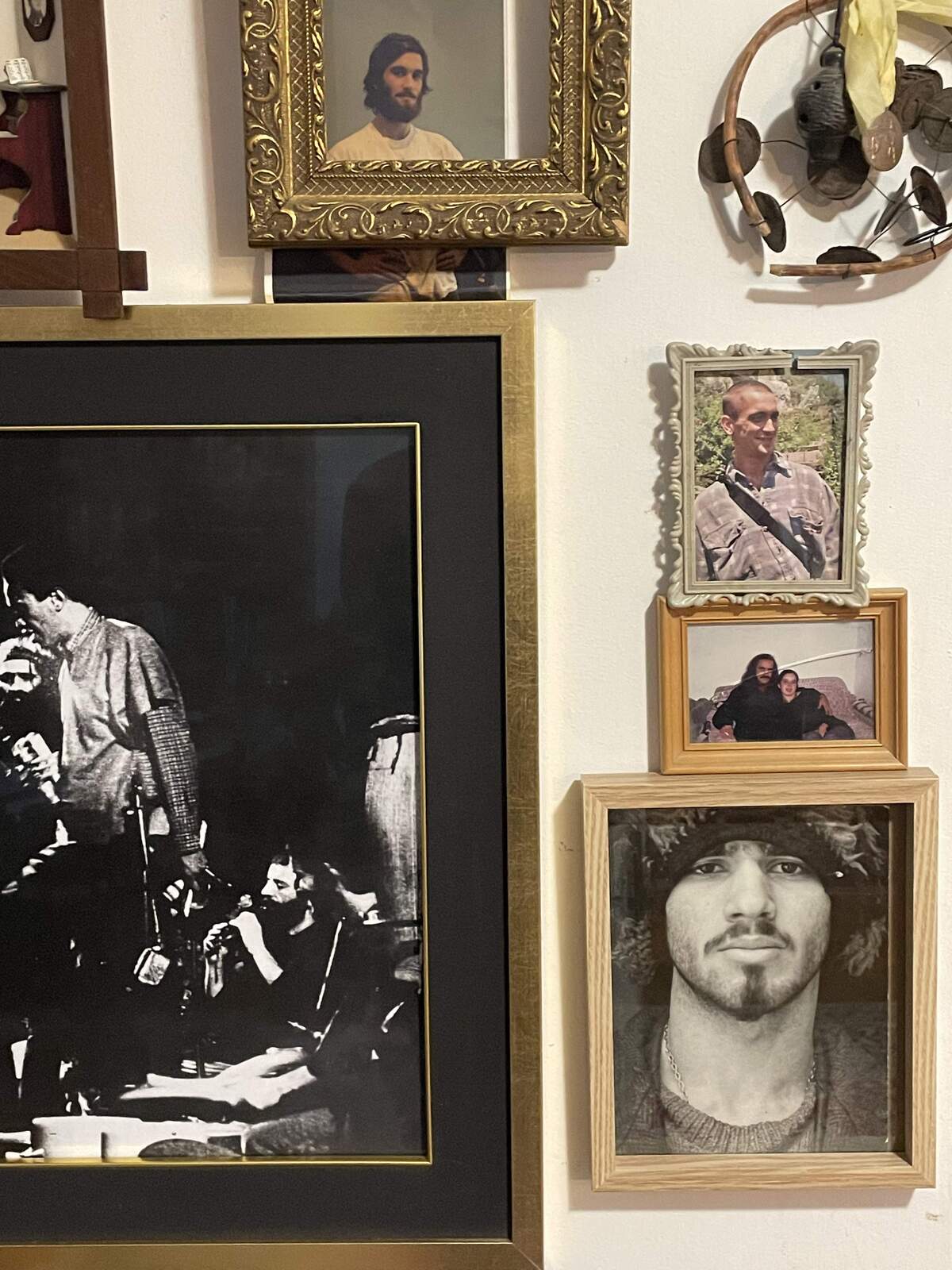
Can you tell us what the psychedelic era in the 1970s and 1980s in Poland was like?
It was fantastic. I took LSD for the first time over 50 years ago. My sister was in America then and sent me blotter acid in a letter. Back then LSD looked completely different. For 24 hours I had intense trips. Beautiful ones. It was recommended to take LSD only once every six months, not more often. That stuck with me. I didn’t take it every six months — more like once every few years. To enter a psychedelic journey, you need a liberated mind. You can’t have guilt or unresolved things. If you take LSD with guilt, it gets worse. Then it’s better not to take it. You need a clean conscience to go on a trip. I also had a peyote journey — much more serious. I sat naked in front of a mirror. The whole ceremony matters — peyote is not just eating a cactus. You have to prepare everything: cleanse the space, remove objects with bad energy, decide which images and instruments can stay. I sat on the floor, everything around me was right. Except one thing — I wasn’t in the mirror. Everyone else was there, but not me. Later I was flying above the Old Town, floating and looking down. Everything was correct — except I wasn’t there. I loved those psychedelic journeys. I first took acid around 1972 or 1973. I liked mushrooms too — especially in California. In Poland there are great psilocybin mushrooms, but in Mexico they were so weak I had to take much more. I invented mushroom shakes — orange juice, bananas. I made smoothies. A girl from East Germany came to visit me once — this was when the GDR still existed. We took the shakes on New Year’s Eve. We planned to have sex, but once we tripped, sex disappeared completely. Psychedelics give a lot — but only if you’re honest. Dishonest people shouldn’t take them. I’ve seen people who wanted to jump out of windows, who wanted to kill themselves. Bad trips. I never had one, but I tried to understand those who did. But if someone says before taking it, “I’m fine, I have no problems,” and then it turns out they do — the truth comes out in nature, and then it’s too late.
Klemen Breznikar
Headline photo: Milo Kurtis (personal archive) (Photo by Mathias Chaboteaux)
Huveshta Rituals Instagram / Bandcamp

Great talk and very intetesting point of view.