
Chevreuil’s ‘Stadium’: Two People, Four Amplifiers and a Strange Force
Chevreuil sounds larger than the simple facts of the band. Two people, guitar and drums, a strict arrangement of amplifiers, a room. From that small set of elements comes music that feels dense, charged, and strangely architectural. The sound seems to depend not only on what is played, but on where it happens.
After twenty years away, ‘Stadium’ feels like a re-entry into a system. Julien and Tony return to a setup they already know, but they do not return as the same people. That is where the record gets much of its force. The structure is familiar, yet the energy inside it has shifted. The history is present, but the music keeps moving.
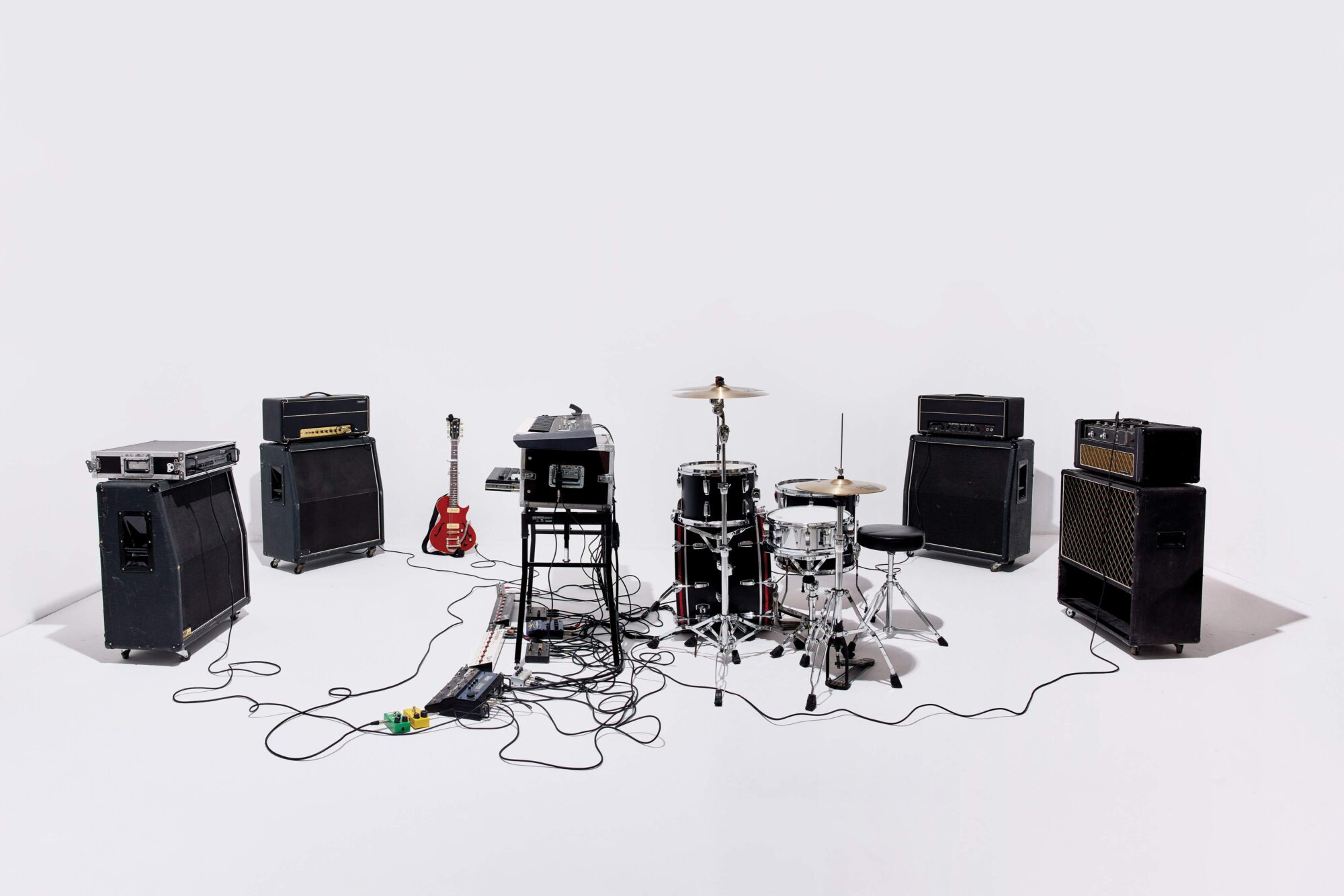
The four amplifiers around the drums remain central to Chevreuil’s identity. The guitar is heard from several places in the room. It surrounds the kit, pushes against it, and changes the way the drums are heard. The drums, in turn, become more than rhythm. They become weight, pressure, response, and movement.
This is why the usual genre names only explain part of the music. Math rock, post-rock, noise rock, experimental rock. Each term points to something, but none of them fully captures the physical quality of Chevreuil. Their music is built from repetition, force, balance, impact, and the constant testing of space.
The ideas around ‘Stadium’, including magnetism, radioactivity, astrometry, barometric movement, and magic, feel closely tied to the sound itself. They describe forces that act without always being seen. That is also how Chevreuil works. Sound moves through the room, bodies respond, pressure builds, and meaning appears through contact.
What makes ‘Stadium’ powerful is the feeling that the old system still has life in it. Chevreuil return to the same shape and find new movement inside it.
“The core logic of Chevreuil stayed intact, but our relationship to it changed.”
Chevreuil has always sounded like more than two people playing guitar and drums. There is the kit, the amplifiers, the room, the electricity, the distance between you. When you came back to it after twenty years, did it feel like returning to a band, or returning to a setup that still had its own logic waiting for you?
Julien: We’ve never really functioned as a band in the traditional sense, for quite a number of reasons. To me, it definitely felt more like returning to a setup I knew I’d feel at home in. Our configuration is so specific that it immediately puts us in an intense creative state where the possibilities feel wide open. The core logic of Chevreuil stayed intact, but our relationship to it changed because we changed as people.
Tony: For me, it’s both. The doctrine of Chevreuil is like an instrument with its own spatial structure — a kind of 3D sound puzzle and kaleidoscopic musical environment. We rehearse and perform within the same architectural setup, maintaining the same distances and angles between the elements and between ourselves. We did not change that aspect at all.
The four-amplifier system puts the guitar around the drums instead of in front of them. That changes the basic idea of where the music comes from. When you write, do you start from notes and rhythm, or do you already hear where the sound will sit in the room?
Julien: I guess it’s both. Composition can take many forms — sometimes carefully constructed, sometimes appearing unexpectedly in the moment. Personally, I love when ideas emerge naturally rather than being forced. Our setup creates the conditions for that kind of instinctive interaction. In the end, we move constantly between control and surrender.
Tony: When we write music, there are many parameters involved. The physical impact of the sound has to be effective, and the geometry created by the four amps around the guitar is also important in order to achieve something compact and symmetrical. At the same time, we shape the music in a narrative way to make it all come together. We tend to favor music in its least obvious form.
Chevreuil often gets placed near math rock, post-rock, noise rock, or experimental rock. Those words help a little, but they do not really describe the way the music seems built out of weight, repetition, angles, and pressure. When a piece is taking shape, what are you listening for: a riff, a pulse, a balance, a physical reaction?
Julien: People often place us in those categories, but I never really identified with them — especially math rock, which tends to suggest something overly technical. What interests us more is tension, density, and spatial movement. We work with repetition, collision, and physical impact as much as with riffs or rhythms. When I play, I’m usually searching for a point where things either lock together completely or begin to destabilize.
Tony: It’s a balance between all of these boundaries. The quadraphonic setup is both an advantage and a constraint. Each time, I try to find ways to use repetition as little as possible. I think we make repetitive music, but repetition itself is not the main focus. Personally, I don’t see Chevreuil’s music as math rock, post-rock, experimental, or any specific category. I just try to feel satisfied with the energy and the power of each composition.
“Sound is invisible, yet it can directly shape reality.”
You use the terms “magnetic guitar” and “magnetic drums.” That is a strange and precise way of naming the instruments. It suggests attraction, resistance, and forces moving between two bodies. What does that word “magnetic” describe in your relationship as players?
Julien: Being in Chevreuil feels a bit like playing ping pong with a friend — the aim is to keep the rally alive for as long as possible. Or like throwing a frisbee back and forth, experimenting with tricks while trying not to let it hit the ground. It’s funny in a way, because we actually play ping pong or frisbee before every show to sharpen our focus and concentration. To me, music works almost like magic. Sound is invisible, yet it can directly shape reality. When we play together, it feels as though we’re casting spells. We enter that space together, and I think that reflects the tension between attraction and resistance that exists in our music.
Tony: The term “magnetic” is a metaphorical way of describing the connections within Chevreuil: between us, technical devices, energy, time, forces, and acoustics.
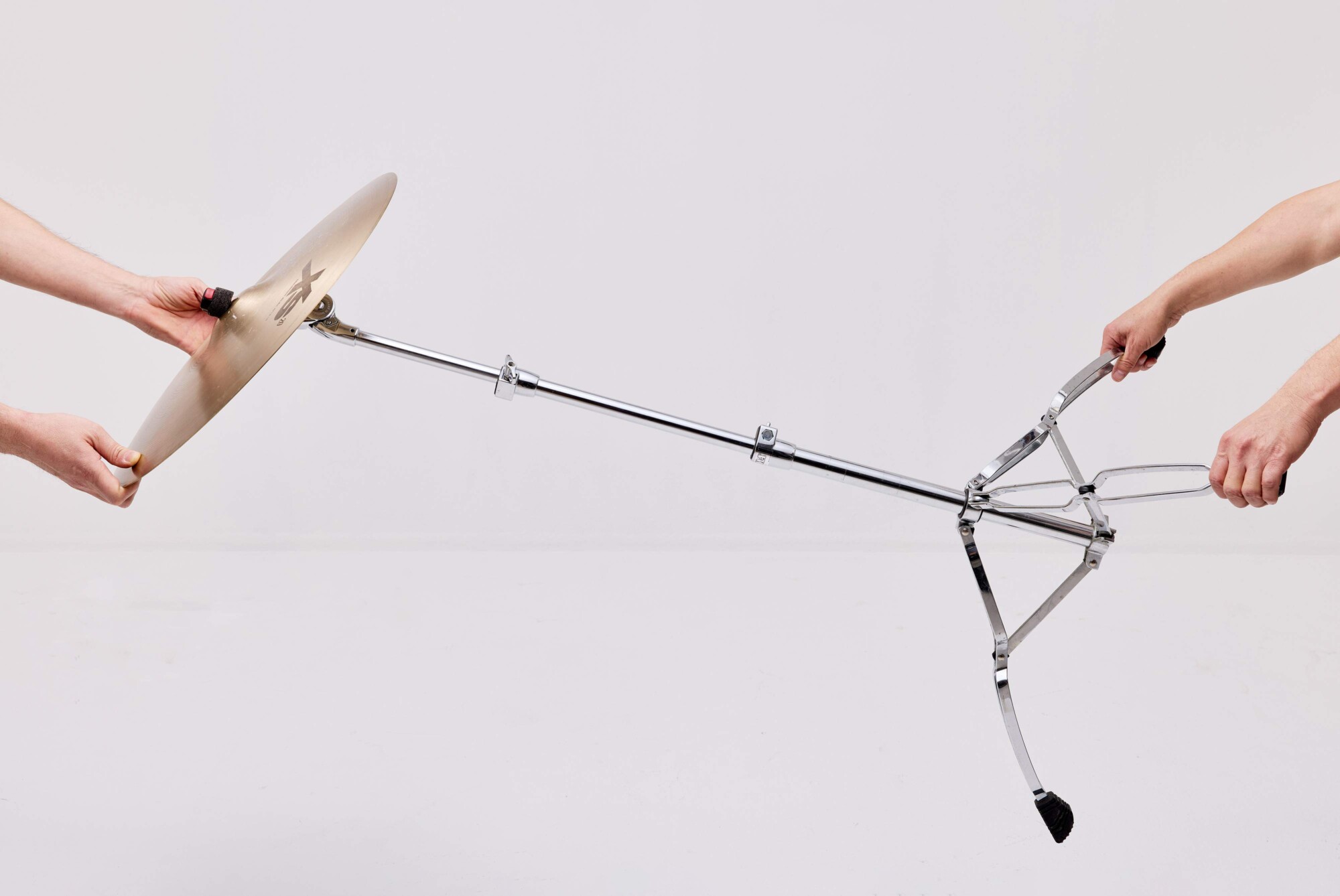
There are only two of you, and the setup is strict, but the music does not feel small. It can feel packed, unstable, even crowded. Does working with so few elements make things clearer, or does it make every choice heavier?
Julien: It definitely makes every decision heavier, especially after so many records. With Stadium, the challenge was finding a way to surprise ourselves again. There would’ve been no reason to come back simply to reproduce an older version of the band. On my side, I completely stopped playing drums for almost fifteen years. In retrospect, that was probably the best thing that could have happened. I had fallen into habits and recurring patterns, and stepping away allowed me to return with a different mindset and a different physical relationship to the instrument.
‘Stadium’ brings in the music of the spheres, magnetism, radioactivity, barometric oscillations, astrometry, and magic. These are all ways of talking about forces that cannot always be seen directly. Did those ideas guide the writing, or did they appear later as a way to understand what the record was already doing?
Julien: I think those ideas were already present during the writing process, even if we only recognized them clearly afterward, once the sequencing and visual aspects of the record started taking shape. The album gradually revealed its own internal logic. From the artwork to the recording process itself, everything became connected through ideas of balance, proportion, and resonance.
Tony: I think these elements have been present in Chevreuil’s music since the very beginning of the project. We’re simply embracing and affirming them more openly now.
The music of the spheres usually brings to mind order, proportion, and distant harmony. Chevreuil is much more physical than that: drums in the room, guitar through amplifiers, vibration, attack, air moving. What drew you to that old cosmic idea for such a direct and bodily record?
Julien: I’m attracted to situations where contradictory ideas coexist. The “music of the spheres” suggests something ordered and celestial, while our music is extremely physical and immediate — air moving, amplifiers vibrating, drums hitting the room. Bringing those extremes together creates friction, and friction usually produces interesting energy.
Tony: The sound of ‘Stadium’ had to feel very organic in order to express its inherent esoteric dimension. The idea was to record the music in the very place where it is performed, reflecting the notion that a work can contain several layers of interpretation.
The return began with a reissue project, then turned into new music. That is a real shift: at first, you are looking back, then suddenly the thing starts moving again. Do you remember the moment when Chevreuil stopped being an old project and became active? On that note, could you walk us through all of the albums and share some details from each? For instance, what runs through your mind when hearing Ghetto Blaster, Chateauvallon, Sport, Capoëira, Science…
Julien: I hadn’t listened to those records in a very long time. Revisiting Sport especially reminded us of the freedom we had when we started — recording everything ourselves, trusting immediacy, staying inside the moment rather than overthinking it. That became an important reference point for Stadium. Most of the albums that followed were made under very different conditions, often shaped by the expectations and pressures surrounding the music industry at the time. Each record carries its own story, but almost all of them were written, recorded, and mixed extremely quickly.
Your records with Steve Albini belong to a period where the recording captured the band as an event in a room. No studio disguise for its own sake… What did that recording method teach you about what Chevreuil needs to sound like itself?
Julien: I learned a lot from those sessions with Steve, especially about tuning drums and staying calm under pressure. At the time, recording was extremely demanding: you had to arrive completely prepared after endless rehearsal, and there was very little room for improvisation or spontaneity. With Stadium, we deliberately removed that pressure. Having more time allowed us to stay relaxed and fully present, and being in control of the entire recording process changed everything for us. Choosing not to work in a traditional studio was also an important decision.
A duo like this depends on memory in the hands as much as memory in the head. Timing, volume, reflexes, the way one sound pushes the other. When you played together again, what came back without effort, and what felt different because time had passed?
Julien: I guess what came back immediately was the feeling that we could still create something new together almost instinctively. We approached ‘Stadium’ a bit like this: a painter uses a palette to create a work — the palette is essential, but not something you consciously think about while painting. Once the painting is finished, most people will look at the final image, but we chose instead to look at the palette and to keep it, throwing away the painting.
Tony: Surprisingly, returning to Chevreuil after twenty years feels like stepping into a time capsule. It’s as though those two decades were simply a parenthesis.
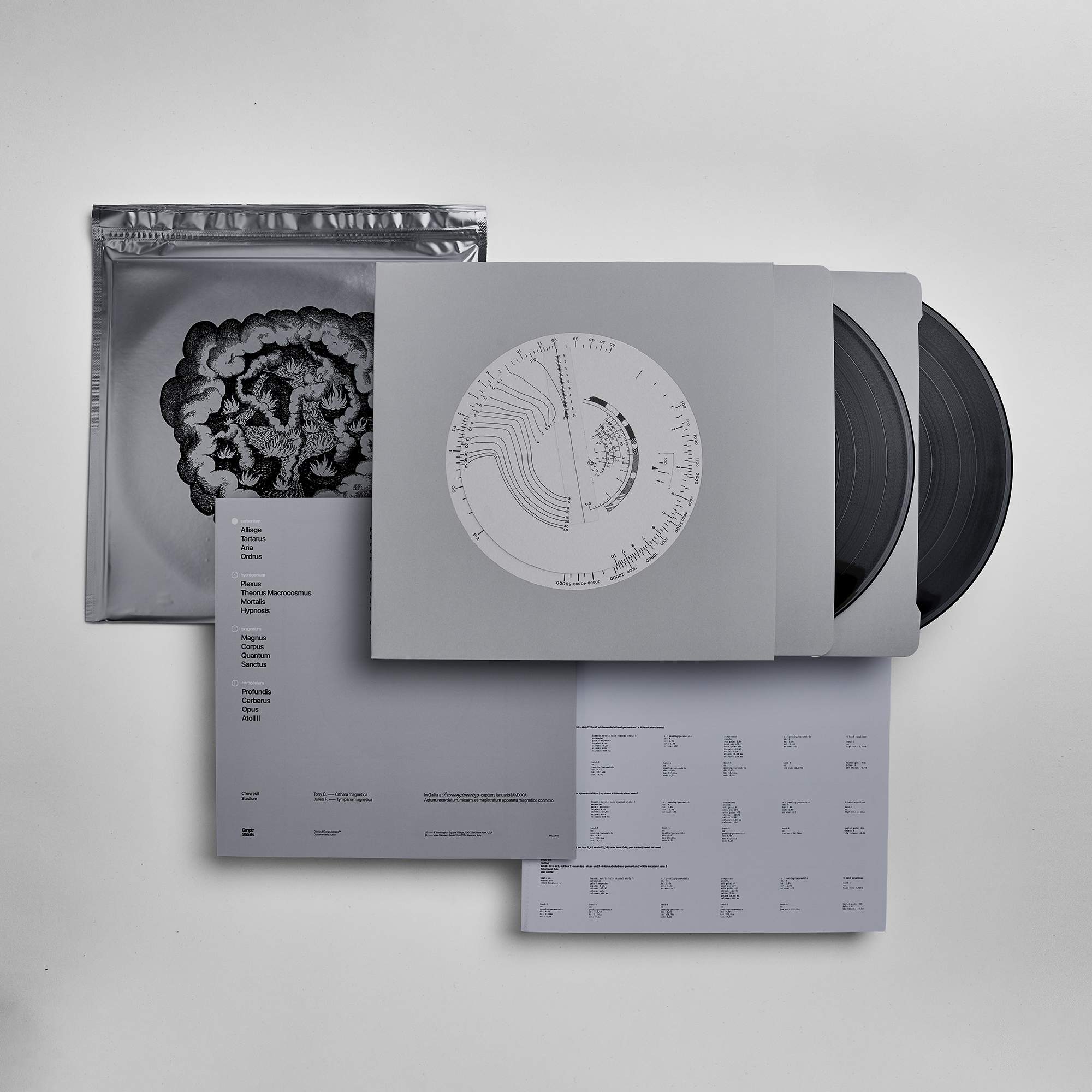
The deluxe edition of ‘Stadium’ includes a codex detailing the recording setup and technical parameters. Could you tell us more about the setup?
Tony: For the recording sessions of ‘Stadium’, we used Pro Tools. The codex is an exact textual transcription of all parameters from the 20-track recording sessions, saved in a .txt format. We kept this same setup across all the songs on ‘Stadium’. This choice reflects the musicians’ interpretation. Ultimately, the booklet reads like a text intended for initiates.
What can Chevreuil do now that it could not do in 2006?
Julien: I didn’t have a driver’s license in 2006, but I do now, so I can drive the van on tour.
Klemen Breznikar
Headline photo: Alessio Federico
Chevreuil Official Website
Computer Students™ Official Website / Instagram