
Rok Zalokar: Opening the Structures — Inside ‘Pieces for Collective Change’
On ‘Pieces for Collective Change,’ pianist and composer Rok Zalokar pushes Zhlehtet toward a denser, more tactile ensemble language, one where composition behaves more like a fluid dialogue.
The octet’s expanded instrumentation allows harmony to circulate. Harp harmonics catch fragments of piano voicings, electronics shadow the rhythm section, and the horns rarely hold the foreground for long. Zalokar describes the album as a reconciliation between written material and spontaneous structure. The studio recordings condense what once existed as a larger suite, yet the sense of scale remains. Repetition functions as a listening tool, sharpening attention rather than smoothing edges. There is a stubborn physicality to the music.
“A lot of times less is more when it comes to composing,” Zalokar said. Blocks of harmony sit long enough for the ensemble to test their edges before the centre shifts and the music opens outward. “I communicate what parameters can be shaped and which are fixed.” The tension lives in that space.
Echoes of spiritual jazz surface in the sustained chords and collective surges, though Zalokar avoids past.
The project continues to function as an expandable laboratory, shifting instrumentation without losing its core chemistry. That openness will shape tonight’s performance, where the octet presents the new material live at Cankarjev dom, Ljubljana. The vinyl edition of ‘Pieces for Collective Change’ was released by Jazz Cerkno Records in November 2025.
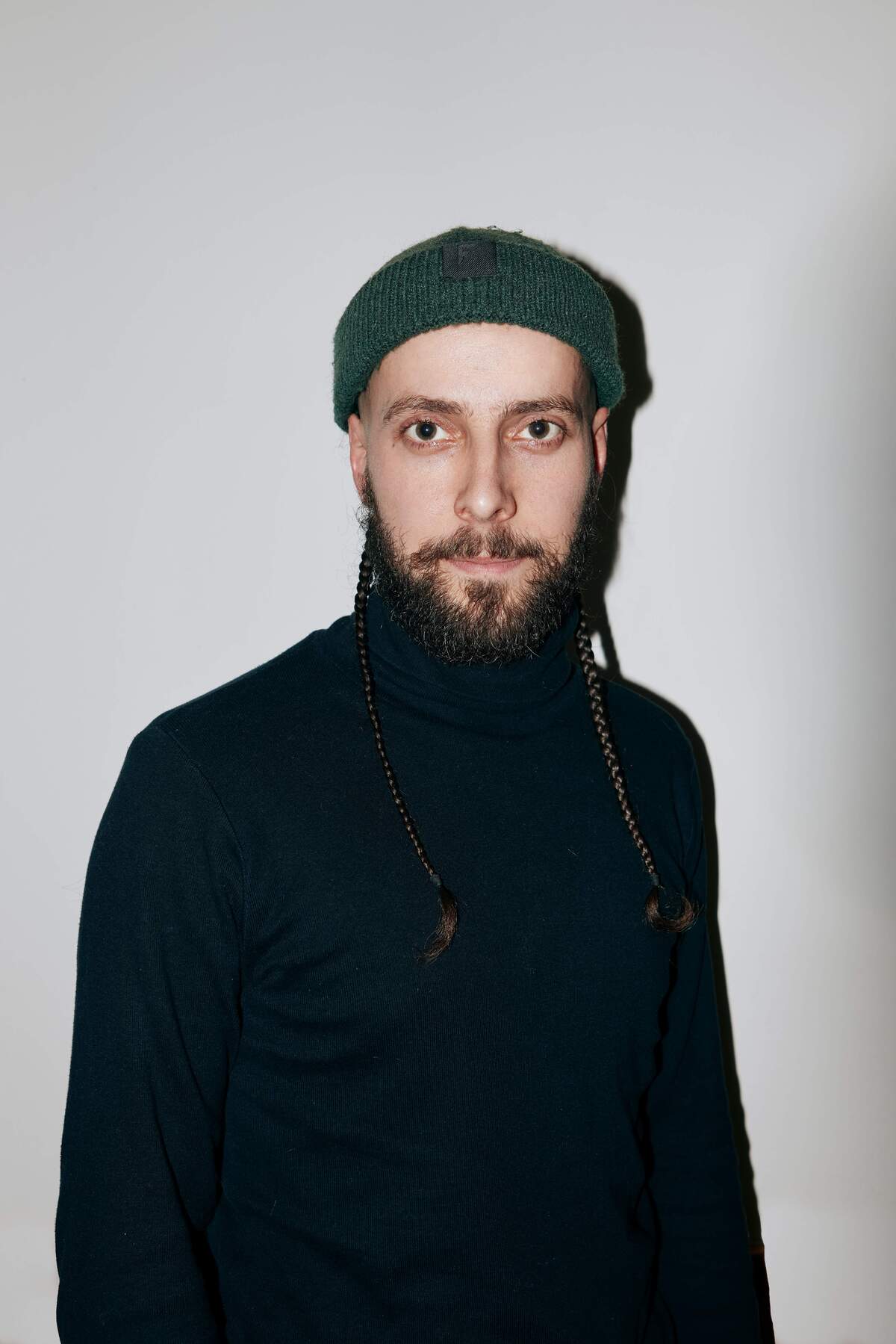
“A lot of times less is more when it comes to composing”
You’re about to present ‘Pieces for Collective Change’ at Cankarjev dom, a venue that carries a particular symbolic gravity within Slovenian cultural life. When you think about bringing Zhlehtet’s octet sound, with its porous structures, its collective improvisation and its spiritual undercurrents, into a hall that has historically framed everything from the classical canon to state ceremonies, what goes through your mind? Does the architecture of the space itself influence how you imagine the music unfolding, the dynamic range, the silences, the ritual dimension that often surfaces in your performances? And perhaps more personally, does presenting this particular album there feel like a culmination of the project’s evolution since 2019, or does it feel more like a threshold moment, where the collective steps into a different scale of visibility?
Rok Zalokar: Actually I feel quite a personal connection to Cankarjev dom, because I heard so much amazing music there and also worked there a lot during the years, even recorded some albums there doing production work, and when just starting college I was having my student job there helping the sound department, I was the one with the cables, hehe.
So this feels like sharing my most personal thing there, but we as a group also adapted to various places and we don’t hold back on our experience.
Looking at your career now, how does it feel when you hear your early pieces from over a decade ago compared to what you’re doing today? You are such an experienced musician now. I’m curious if you are still driven by the same influences or if those have changed, along with the concept behind your music.
Sometimes now I start to feel experienced hehe. Well right now I feel just gratitude when listening to my old stuff, you know, just to be able to do it and being grateful to your old self that you did it also, if that makes sense. Of course I wouldn’t make the same decisions now, but I’m also positively surprised by some stuff, about some aspects that I never noticed back then, and this is a lesson in itself. With influences it’s that some are always changing and some stay. I’m not really a conceptual musician, but I can say that my needs in music have changed a lot during the years.
The new album condenses material that originally existed as a large-scale octet suite into shorter studio forms. What changed musically when you compressed the architecture of the suite into vinyl-length pieces, and did any musical ideas reveal themselves only after you abandoned the suite format?
Songs became more clear, but that was also a need that appeared in the process of development. After some performances I felt the material was calling to be more condensed in an album form, and we also haven’t done that in a while, so I felt we should go in this direction again. So yeah, it was more like finding our sound again in the studio for this condensed approach, and this really outlined some textures we couldn’t work on in other settings.
‘Pieces for Collective Change’ marks the first Zhlehtet release featuring the full octet, an instrumentation that introduces harp, cello, gongs and electronics into a spiritual-jazz lineage traditionally dominated by horns and the rhythm section. When writing for this ensemble, do you still think harmonically at the piano, or do you begin from timbral constellations and spatial thinking?
Actually this is the first Zhlehtet record that I’m coming more from the piano perspective and also wanted to orchestrate piano harmonies, but on top I’m playing really texturally. Also this time everything was composed on piano, compared to our other albums. I think timbral constellations and spatiality developed naturally through the years of playing together, so in my compositions I’m more trying to give the possibility of this happening, to write something that is going to support some specific sound to happen.
Much of the album sits at the intersection between pre-composed frameworks and collective improvisation, with several pieces developing spontaneously in the studio. How do you design compositions that remain structurally recognisable while still allowing the ensemble to fundamentally reshape them in real time?
I communicate to the musicians what parameters can be shaped and which are fixed; this then allows us to stretch the material. A lot of times less is more when it comes to composing, so I try to get close to this. And again, this is something that developed during the years, how we reshape ideas. We played a lot of totally free sets, so that helps. Actually the idea of this album was really to connect the composed and improvised (spontaneously composed) better together. Like in early jazz ensembles when they were improvising collectively over a standard, I miss this approach.
Since the formation of Zhlehtet around 2019, the project has moved fluidly between trio, quintet, and now orchestral-leaning octet configurations. Has the collective evolved into something closer to a compositional laboratory rather than a fixed band identity, and how has that flexibility altered your role as leader?
It has always been a laboratory, but not always compositional. The previous album and ‘Portals Vol. 1’ and ‘Vol. 2’ are the albums that are more compositional. It’s something that has been there since the beginning, but in between we are always recording all the improvised gigs and building new releases based on that, how we sound in the moment live. I also try to vary the composed albums with the improvised ones in our released output. Well, considering my role, I’m really trying to hear where the potential is at a given moment and follow that and curate our playing around that.
You might hear echoes of the Impulse! spiritual jazz era in your recent work, yet the electronic interventions and electroacoustic textures prevent it from becoming just that. When you engage with that historical lineage, are you consciously dialoguing with figures like Alice Coltrane and Pharoah Sanders, or is the connection more intuitive than intentional?
It’s intuitive. Alice Coltrane really opened my ears to a new realm and also Pharoah’s work is so transformative that it always vibrates in the background, but yeah, in the end it’s intuitive for the whole group.
Earlier releases such as ‘Toyomi,’ ‘Celica,’ and ‘Portals’ captured different aspects of the ensemble, from collage-like studio construction to live performance energy. In retrospect, do you see ‘Pieces for Collective Change’ as a culmination of those earlier experiments, or as the beginning of a new compositional phase?
It’s a culmination of our composed side of music making; it has some new compositional approaches that really helped the music, but sonically it connects to our beginning.
Your projects range from solo piano and pipe-organ explorations to improvised hip-hop noise collaborations and electroacoustic works. How do these seemingly distant practices feed into the language of Zhlehtet, particularly in shaping rhythm, pacing, and the sense of sonic ritual that runs through the new album?
I think Zhlehtet connects them. It’s really the first time in my life that I get to combine them so much; it’s really inspiring. I also change my setup for almost every album to keep it fresh, and piano has been underrepresented here. We played with loops a lot a few years ago, so this definitely had a strong impact on how we deal with rhythm. On the other hand, dealing with pacing comes a lot from my pipe organ journey and my electronic explorations. I think also the sense of sonic ritual comes from the two. But yeah, every time the moment all the musicians are in at that time affects the sound tremendously.
The title ‘Pieces for Collective Change’ implies a social dimension that extends beyond purely musical concerns. In your view, what can collective improvisation model for society today that other artistic forms struggle to express?
I think it expresses that in order to be free you have to stand on something; it frees you, and you have to be in the moment sharing with other people, taking care and being helped.
The ensemble often speaks about “channeling the energy of the evening” in live contexts, yet this album is largely a studio recording. What strategies did you use in the studio to preserve the unpredictability and risk that normally comes from performance situations?
Well, just the compositions themselves keep us in pace, but for us the real risk was actually being in a studio hehe, so we definitely got the unpredictability of a studio also; we feel more at home on stage.
Over the last decade, your discography has steadily shifted from small-group jazz formats toward increasingly hybrid electroacoustic environments. Do you feel the piano is still the conceptual centre of your music, or has it become one sound among many within a broader compositional ecosystem?
Actually it is just transitioning back into the conceptual centre, but in recent years it was just one sound to choose. I really wanted to broaden my horizons of sound making with synths and electronics, and Zhlehtet has been at the center of this practice.
The presence of electronics in your music is rarely decorative; it tends to function as an extension of ensemble interaction. When designing electronic layers, are you composing them as fixed elements, or treating them as another improvising voice with its own agency?
I’m really trying to improvise with electronics, so I don’t have fixed presets but try to dial the sound on the spot. I also sample what’s happening in real time and use that as starting points of my patches. I’ve also been using a lot of randomisation elements for a while to get into different sound territories. But yeah, I love the ensemble-electronic interaction.
Having studied and worked internationally before re-embedding yourself deeply in the Slovenian creative scene, how has the local network of improvisers and experimental musicians shaped the sound world of Zhlehtet, and what does this record say about the current moment in Slovenian jazz?
Actually Zhlehtet comes from my re-embedding back to Ljubljana, being immersed and inspired by the improvised scene here. I really wanted to do the sound that is local, but in a different way, with a different rhythm. I don’t know what this record says.
Listening across your catalogue, one hears an increasing interest in long-form spiritual or meditative time, even when the pieces themselves are shorter. Is this something you consciously pursue, perhaps as a counter-gesture to the accelerated listening habits of the streaming era?
I think it just appeared more in the kind of music I need for myself, than to be a gesture, but now that you said it I like what you mean by that.
Speaking of that, as you know I’m an obsessed record collector. Maybe someday we can catch up and have some time to listen to music. What are some of the unusual records you would put on the turntable?
Nice idea, we definitely should! It’s hard to think of unusual hehe, but I have one that I thought of immediately — ‘Rexen Bertel Sandtorv’ by Sleepover, but just because it’s a rare one from a special moment in life. I bought it after the band’s show; one day after they recorded it they already had it on vinyl, but only a few copies, really nice crazy music.
I also listen to a lot of unknown Earl Hines records; there are a lot that never made it to digital and I really wanted to get ones like that. He is such an inspiring piano player with a rich discography.
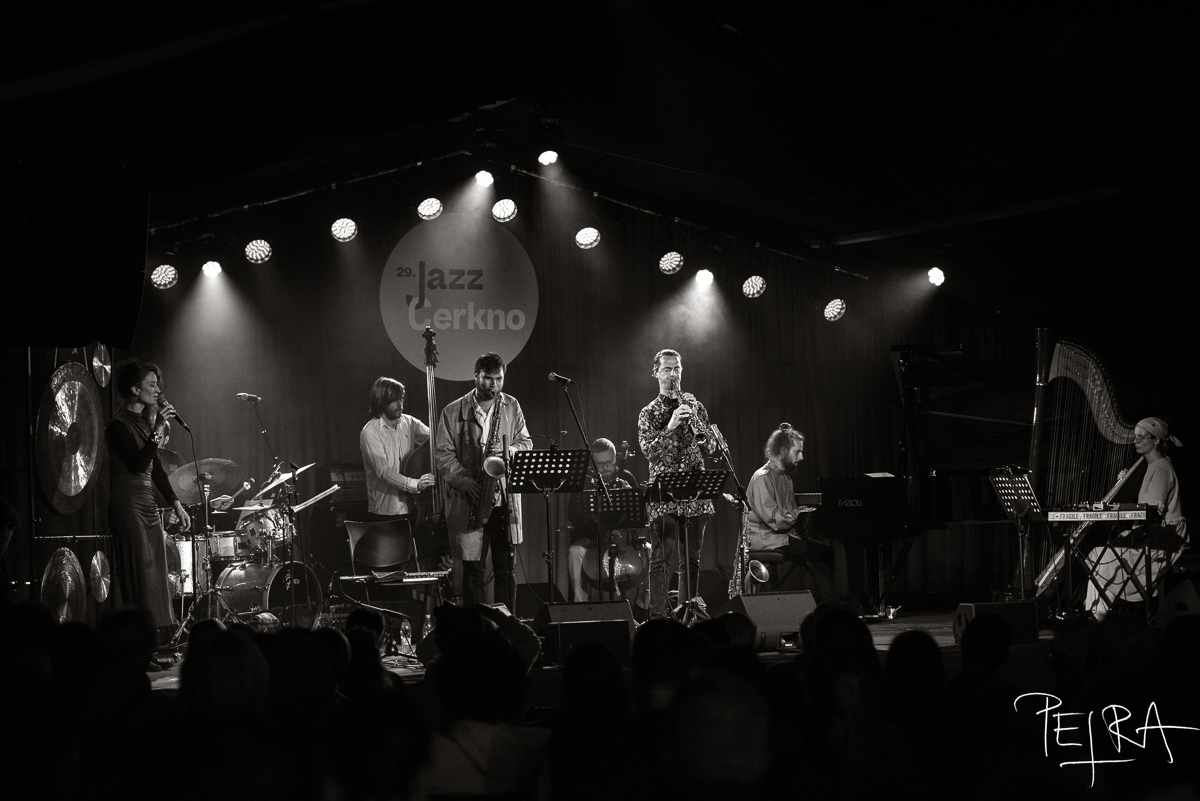
Finally, when you imagine the Zhlehtet project ten years from now, do you see it continuing as an expandable collective with shifting instrumentation, or moving toward even larger compositional forms, perhaps somewhere between improvising ensemble, chamber orchestra, and sound installation?
I really want to expand it to a chamber orchestra form at one point in time for a grand occasion, but mostly I wanna keep it as an expandable collective, because it is so much more rewarding.
Klemen Breznikar
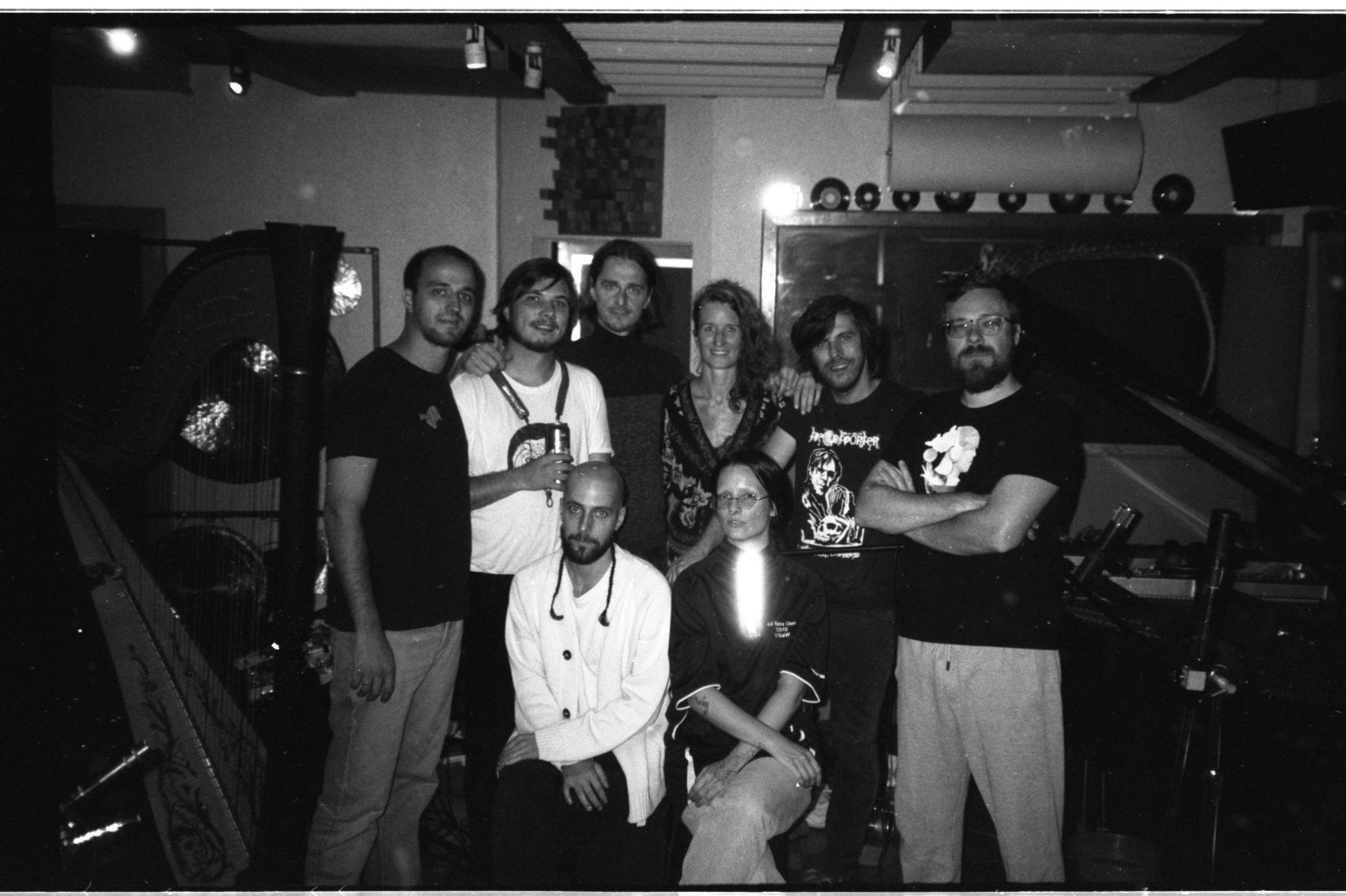
Headline photo: Zhlehtet at Metro Studio
Rok Zalokar Website / Facebook / Instagram / YouTube / Bandcamp